
What a 24000 BTU Ducted Mini Split Can Do
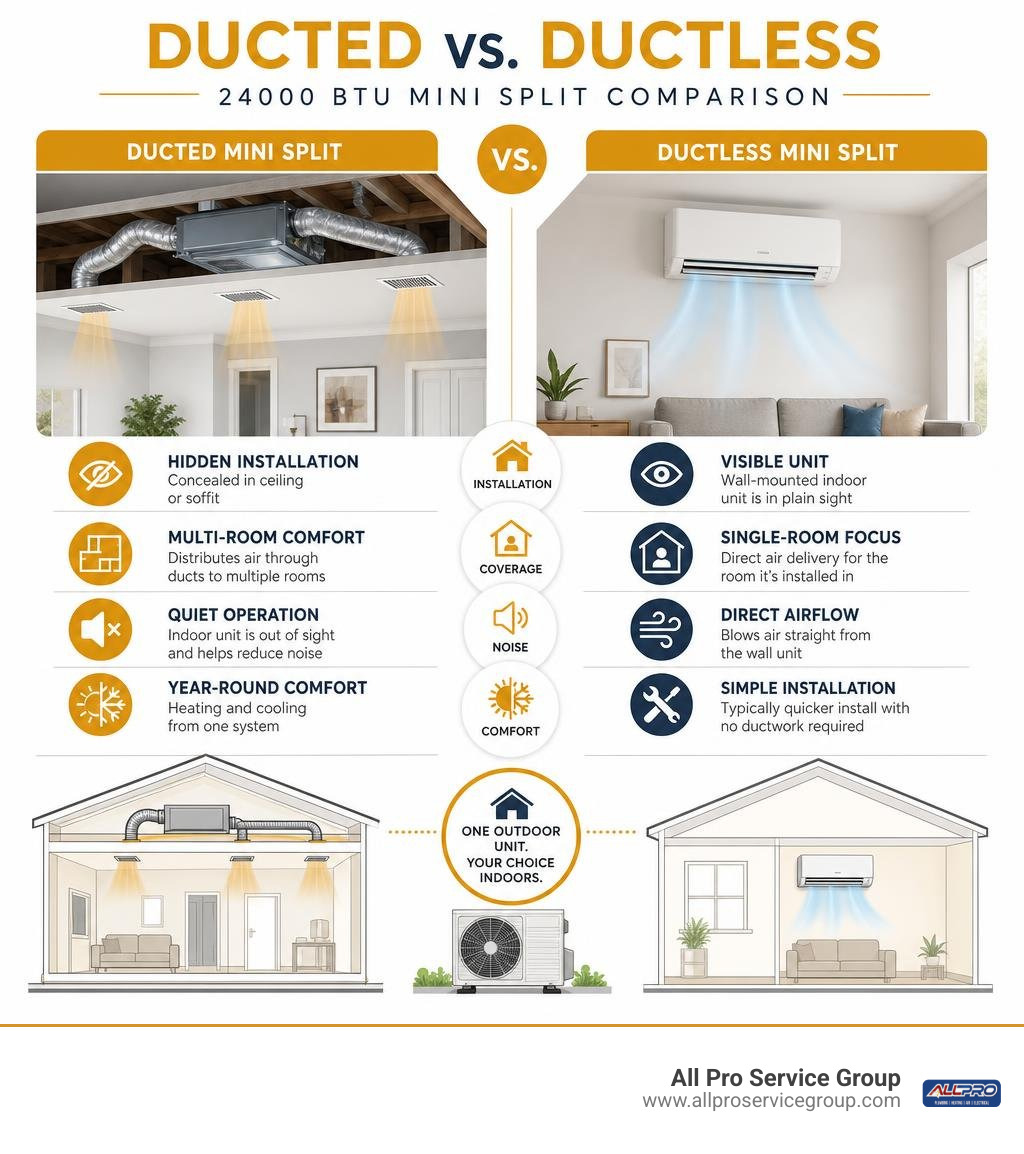
A 24000 BTU ducted mini split is a 2-ton heat pump system with a slim indoor air handler hidden above a ceiling or in a soffit. Short ducts carry heated or cooled air to discreet ceiling or wall registers, unlike a ductless mini split that blows air directly from a visible wall-mounted head.
It is often a strong fit for roughly 800 to 1,200 square feet, or a carefully designed group of nearby rooms. Actual coverage depends on insulation, window exposure, ceiling height, duct layout, and Greater Salt Lake winter heating load.
Choose a concealed duct unit when you want:
- Hidden equipment and cleaner wall space
- Air delivery to more than one room from one indoor unit
- Quiet comfort, with some models operating around 29 to 40 dB indoors
- Heating and cooling from one inverter-driven system
At All Pro Service Group, our team has helped Greater Salt Lake homeowners evaluate heating and cooling replacements where a 24000 BTU ducted mini split may offer the right balance of capacity, comfort, and appearance. The next sections compare concealed ducted and ductless options so you can see which layout fits your home.
Ducted vs. Ductless Mini Splits: Core Differences and Performance
When weighing climate control upgrades for your living space, understanding the hardware footprint is essential. Both systems rely on an outdoor inverter heat pump paired with an indoor distribution unit, but their visual profiles and air delivery methods diverge significantly.
Traditional wall-mounted ductless systems mount directly on an interior drywall surface. They circulate conditioned air directly into the immediate room. A concealed ducted mini split hides the indoor air handler within a ceiling joist bay, crawlspace, drop ceiling, or dedicated mechanical soffit. Instead of blowing air from a single mounted chassis, it connects to a compact network of insulated, flexible, or rigid sheet-metal ducts that terminate at clean, low-profile architectural grilles.
To better understand how these form factors compare in whole-home and targeted zone designs, explore our ductless mini splits complete guide.
| Feature / Specification | 24,000 BTU Ducted Mini Split | 24,000 BTU Ductless Wall Mount |
|---|---|---|
| Indoor Visibility | Fully concealed in ceiling, soffit, or attic | Visible wall-mounted console |
| Air Delivery | Multi-point via short duct runs & grilles | Single-point localized discharge |
| Nominal Capacity | 24,000 BTU/hr (2.0 Tons) | 24,000 BTU/hr (2.0 Tons) |
| Typical Efficiency | 16.5 – 19.5 SEER2 / 9.0 – 11.7 HSPF2 | 17.0 – 22.0 SEER2 / 9.5 – 12.0 HSPF2 |
| Indoor Noise Levels | 29.5 dB(A) to 40.0 dB(A) | 23.0 dB(A) to 50.0 dB(A) |
| Static Pressure Support | Yes (External Static Pressure rated) | No (Direct blow only) |
| Multi-Room Conditioning | 2 to 3 adjacent rooms from 1 air handler | Single large open room per head |
| Average Installed Cost | $4,000 – $6,000+ | $3,000 – $4,800 |
How a 24000 BTU Ducted Mini Split Differs from Ductless Wall Units
The primary functional difference centers on airflow mechanics and static pressure. A standard ductless wall unit relies on an open cross-flow fan that draws air across a localized coil and immediately pushes it into the room. Because there is zero resistance from ductwork, these units achieve slightly higher raw SEER2 efficiency metrics. However, they are restricted to open spaces because they cannot push air through walls or around tight corners.
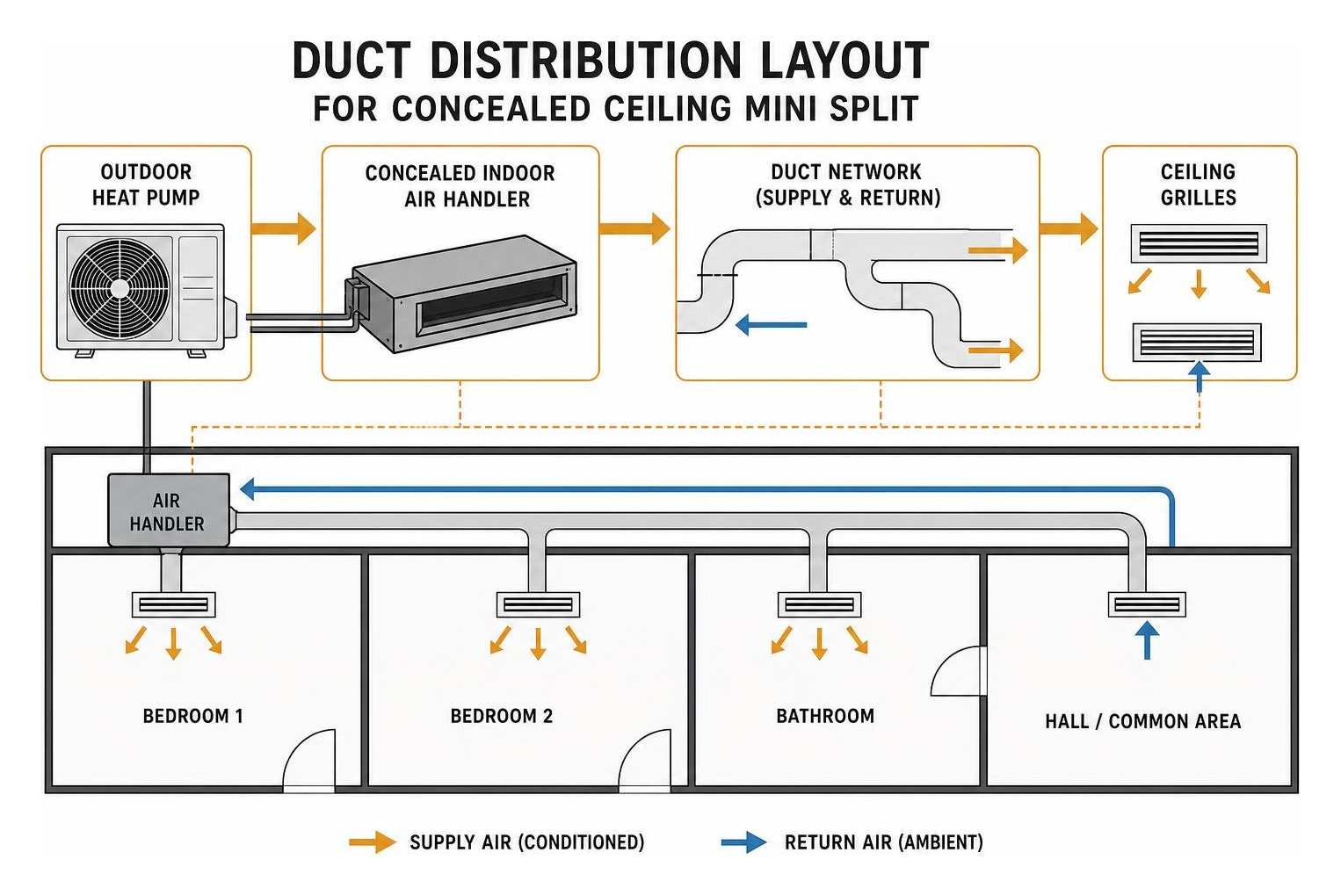
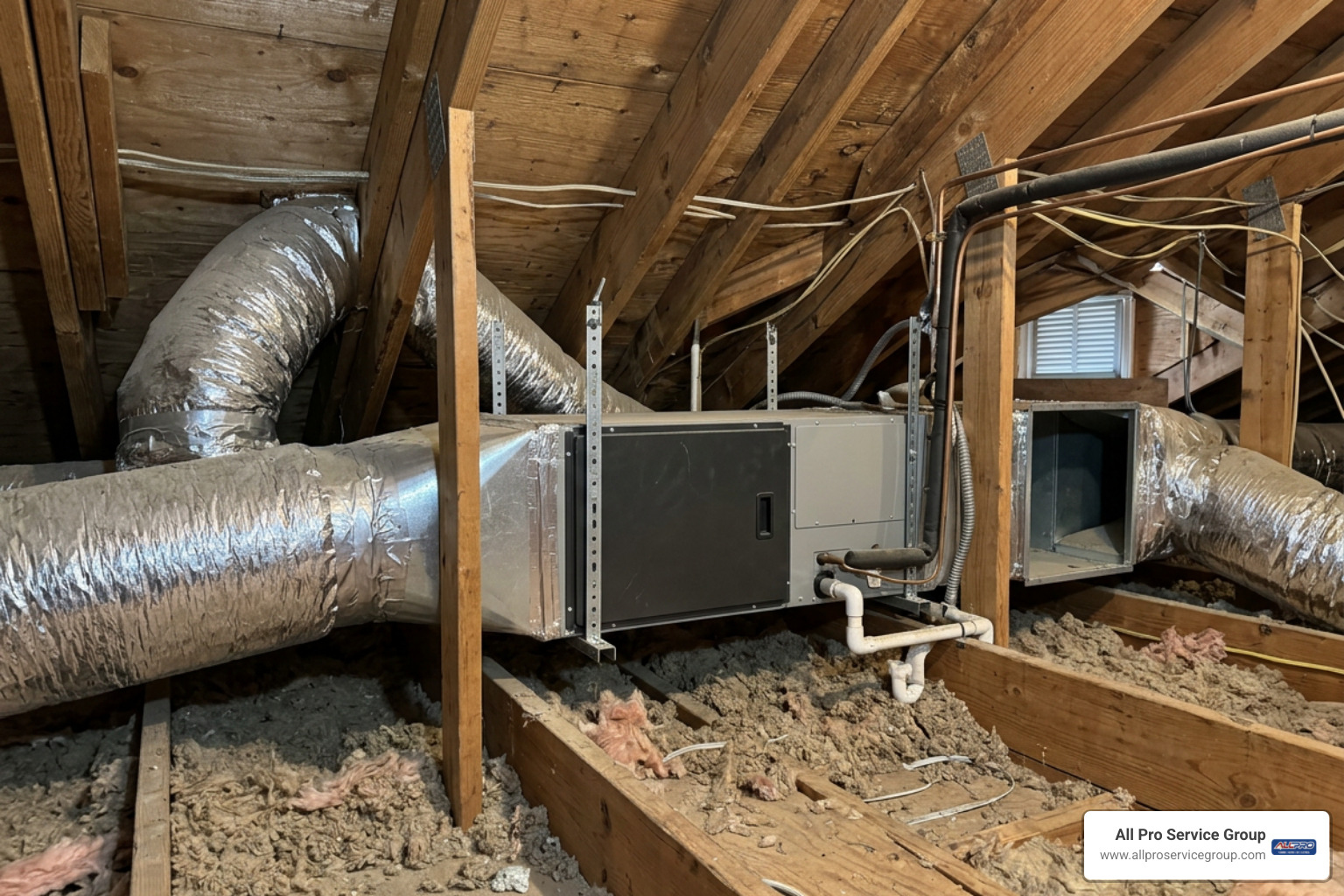
A concealed ducted system utilizes a high-torque centrifugal or backward-curved fan built to overcome external static pressure (ESP). This allows the indoor handler (measuring roughly 39 to 44 inches wide and under 10 inches high) to be tucked between joists above a hallway or closet. Short supply runs feed multiple nearby rooms—such as two adjacent bedrooms and a shared bath—while a dedicated return grille pulls ambient air back into the unit for reconditioning.
Concealed Duct Benefits: Aesthetics, Air Distribution, and Static Pressure
For many property owners across Utah—from historical bungalows in Ogden and Salt Lake City to custom builds in Park City—preserving interior design integrity is a top priority. Concealed duct units deliver comfort without compromising your decor.
- Architectural Cleanliness: Only slim linear slot diffusers or flush-mount registers remain visible on your ceiling or high wall.
- Uniform Thermal Mixing: Multi-point supply registers prevent localized hot or cold pockets by distributing between 500 CFM and 850 CFM of balanced airflow.
- Acoustic Isolation: Because the fan motor and expansion components sit enclosed inside a joist cavity or attic space with insulated duct transitions, mechanical sound is dampened before reaching your living area.
- Design Flexibility: Modern slim-duct handlers accommodate both bottom-return and rear-return configurations, making them versatile for tight attic drops, crawlspaces, or closet ceilings.
Sizing and Capacity: What Spaces Can a 24000 BTU Ducted Mini Split Handle?
In HVAC terminology, 12,000 BTU per hour equals 1 ton of refrigeration capacity. Therefore, a 24,000 BTU system represents a nominal 2-ton heating and cooling setup.
When evaluating smaller spaces, a 12000 BTU mini split guide 2026 or an 18000 BTU mini split guide 2026 may point you toward smaller 1-ton or 1.5-ton units. For spaces requiring medium zoned output, looking into a 23000 BTU mini split provides similar comparisons.
For 2-ton demands divided across independent living levels, a complete guide 24000 BTU dual zone mini split outlines multi-head configurations. For single-room additions or tiny homes, calculating 1 ton mini split square footage or reviewing specialized options like a 110 volt mini split guide 2026, a 12 volt mini split guide, or a 12 BTU mini split guide 2026 will clarify the lower end of the capacity spectrum.
Square Footage Coverage and Multi-Room Airflow
Under typical construction standards, a 2-ton ducted system reliably conditions between 800 and 1,200 square feet, stretching up to 1,500 square feet in modern, high-performance homes with spray-foam insulation and low-E windows.
Square footage alone does not tell the whole story. Manual J load calculations determine true sizing by factoring in:
- Ceiling Height and Volume: Vaulted ceilings significantly increase the cubic feet of air requiring conditioning.
- Solar Heat Gain: South- and west-facing windows across the Salt Lake Valley add heavy thermal loads during midsummer afternoons.
- Duct Run Static Loss: Extended flex duct runs or sharp elbows introduce friction that reduces total CFM output at the supply registers.
When pairing a single 24,000 BTU air handler with two or three small bedrooms, branch balancing dampers ensure that each room receives its designated airflow share (e.g., 200 CFM to bedroom A, 200 CFM to bedroom B, and 300 CFM to a common lounge).
Cold-Climate Heat Pump Capacity and Low Ambient Limits
Heating in Utah requires robust cold-climate engineering. As outdoor temperatures fall, standard heat pumps lose heating capacity because extracting ambient heat from freezing air becomes harder.
Cold-climate mini split heat pumps feature variable-speed inverter compressors, electronic expansion valves (EEVs), and factory-installed outdoor drain pan and crankcase heaters. Advanced systems maintain 100% heating output down to 5°F (-15°C) and continue delivering reliable heat down to -13°F (-25°C) or even -22°F (-30°C) with up to 75% efficiency.
Outdoor units incorporate intelligent defrost cycles that briefly reverse refrigerant flow to clear frost from the outdoor coil without letting indoor temperatures drop.
Efficiency Ratings and Modern Refrigerants in 2026 Systems
Inverter-driven compressors match their operational speed precisely to real-time indoor demand. Rather than cycling on and off at 100% capacity like an older furnace or single-stage air conditioner, the compressor ramps up or down in subtle increments. This eliminates wide temperature swings and lowers continuous electrical draw.
To maintain year-round efficiency and protect your system, keeping up with professional heating and air maintenance ensures coils and electronics stay in top working order.
SEER2, EER2, and HSPF2 Standards Explained
Regional efficiency standards use updated testing protocols that account for higher external static pressure:
- SEER2 (Seasonal Energy Efficiency Ratio 2): Measures cooling efficiency across a standard season. Ducted 24k units generally score between 16.5 and 19.5 SEER2, representing substantial energy savings over older 10–13 SEER equipment.
- EER2 (Energy Efficiency Ratio 2): Tests cooling performance at a sustained 95°F outdoor temperature. High-tier systems reach 10.4 to 12.0 EER2.
- HSPF2 (Heating Seasonal Performance Factor 2): Reflects cold-weather heating efficiency. Look for ratings between 9.0 and 11.7 HSPF2 in northern Utah climates.
By choosing ENERGY STAR certified models, homeowners can cut space conditioning utility costs by up to 30% to 40% annually compared to electric resistance baseboards or legacy central equipment.
Refrigerant Transitions: R32 and R454B Low-GWP Solutions
The HVAC landscape has transitioned toward next-generation A2L low-GWP (Global Warming Potential) refrigerants to comply with updated EPA environmental benchmarks:
- R454B & R32: Modern 24,000 BTU systems use these advanced refrigerants, delivering roughly 10% higher thermodynamic efficiency and an approximate 70% reduction in Global Warming Potential compared to legacy R410A.
- Leak Detection Mitigation: Modern indoor ducted handlers include built-in refrigerant leak detection sensors. In the rare event of a line set fault, the system immediately shuts down compressor operation and triggers an alert code to protect the equipment.
- Pre-Charged Lines: Most factory outdoor units arrive pre-charged with enough refrigerant to support up to 25 feet of line set piping out of the box.
Installation Requirements, Electrical Specs, and Equipment Costs
Installing a concealed ducted mini split involves precise mechanical planning, proper refrigeration techniques, and dedicated electrical runs. Ensuring code compliance requires professional execution.
For complete turnkey replacements or adding zoned climate control to a new addition, trust our team for heating air AC installation replacement.

Electrical Specs and Line Sets for a 24000 BTU Ducted Mini Split
A 2-ton mini split requires a dedicated high-voltage power run from your home's main breaker panel to an outdoor service disconnect switch.
To preserve the factory warranty (often 5 to 10 years on parts and compressors), a licensed technician must pull a deep vacuum down below 500 microns to remove air and moisture before opening the service valves.
Pricing Breakdown, Tax Credits, and Rebate Eligibility
Equipment costs for a standalone 24,000 BTU concealed ducted air handler and matching inverter condenser typically range from $1,800 to $2,800.
When factoring in professional installation, sheet-metal supply/return plenums, insulated flex duct runs, line sets, electrical disconnects, and permitting, total turnkey project pricing ranges between $3,500 and $6,500.
Financial incentives help offset upfront investment:
- Federal Tax Credits: Qualifying high-efficiency mini split heat pumps meeting CEE Tier requirements are eligible for the Energy Efficient Home Improvement Credit (Section 25C), covering 30% of the project cost up to $2,000.
- Utility Rebates: Local power and natural gas utilities across Utah offer cash-back incentives ranging from $400 to $1,200+ when upgrading from low-efficiency heating systems to high-SEER2 heat pumps.
Frequently Asked Questions About 2-Ton Mini Split Heat Pumps
How quiet is a 2-ton concealed duct mini split compared to a wall unit?
Concealed ducted systems are among the quietest HVAC options on the market. While a wall unit places its fan wheel directly inside the room (generating 35 to 50 dB on medium-to-high speeds), a ducted air handler is isolated inside the ceiling or attic framing. Operating sounds at the register register between 29.5 dB and 40 dB, which is comparable to a quiet library or a gentle whisper.
Can a 24000 BTU heat pump handle freezing sub-zero winter temperatures?
Yes, provided you select a cold-climate hyper-inverter model. Modern units equipped with base pan heaters and electronic expansion management operate reliably down to -13°F to -22°F. In areas prone to extreme cold, we verify that heating load calculations account for low-ambient derating factors.
Do ducted mini split systems qualify for federal tax credits and rebates?
Yes. As long as the specific AHRI-matched system satisfies ENERGY STAR Cold Climate or Consortium for Energy Efficiency (CEE) efficiency tiers, it qualifies for the 30% federal tax credit (up to a $2,000 maximum) alongside applicable local utility rebates.
Conclusion
A 24,000 BTU concealed duct mini split offers an ideal blend of unobtrusive aesthetics, balanced multi-room airflow, and variable-speed efficiency. It delivers the sleek, hidden finish of central air alongside the customized zoning and performance of ductless technology.
Whether you are retrofitting a historic property in Salt Lake City, finishing a basement in South Jordan, or remodeling a home in Ogden, Provo, or Park City, accurate load sizing and duct layout are essential for long-term comfort.
Since 2008, All Pro Service Group has provided dependable heating, air conditioning, and electrical services throughout the Greater Salt Lake Valley. As a Gephardt Approved contractor with trained technicians and convenient financing options, we take pride in designing systems tailored to your floor plan.
Connect with our team today to schedule an in-home assessment and explore our specialized heating air ductless mini splits solutions.