Why a 12 Volt Mini Split Makes Off-Grid RV Cooling Possible
A 12 volt mini split is a battery-powered split air conditioner made for RVs, camper vans, trucks, and other mobile spaces. It runs directly on 12V DC power, so you can cool your space without converting battery power to 120V AC through an inverter.
| Quick answer | What it means |
|---|---|
| Best use | Off-grid cooling for RVs, vans, sleeper cabs, and overland rigs |
| Common capacity | About 9,000 to 15,000 BTU |
| Typical power draw | Often dozens of amps at 12V; one heavy-duty 10,000 BTU example draws roughly 38 to 55 amps |
| Main advantage | Less energy is lost because the system uses battery DC power directly |
| Main tradeoff | Higher upfront cost and a serious battery, wiring, and solar plan are usually needed |
Unlike a bulky rooftop AC, a split system places the indoor air handler and outdoor condenser in separate locations. That can reduce cabin noise, preserve roof space for solar panels, and give vehicle builders more choices for mounting equipment.
At All Pro Service Group, since 2008 our team has helped Greater Salt Lake homeowners understand the electrical and HVAC systems that support reliable comfort, and this guide applies that practical systems-first mindset to choosing a 12 volt mini split for mobile cooling.
What Is a Direct DC Air Conditioner for RVs and Off-Grid Spaces?
When you step inside a camper van, semi truck, or overland rig after a day exploring the Utah desert near Salt Lake City or Park City, staying cool is a top priority. Standard air conditioners rely on alternating current (AC) power—the kind flowing from wall outlets in standard residential buildings. But off-grid vehicles run primarily on direct current (DC) supplied by 12V deep-cycle lithium or AGM battery banks.
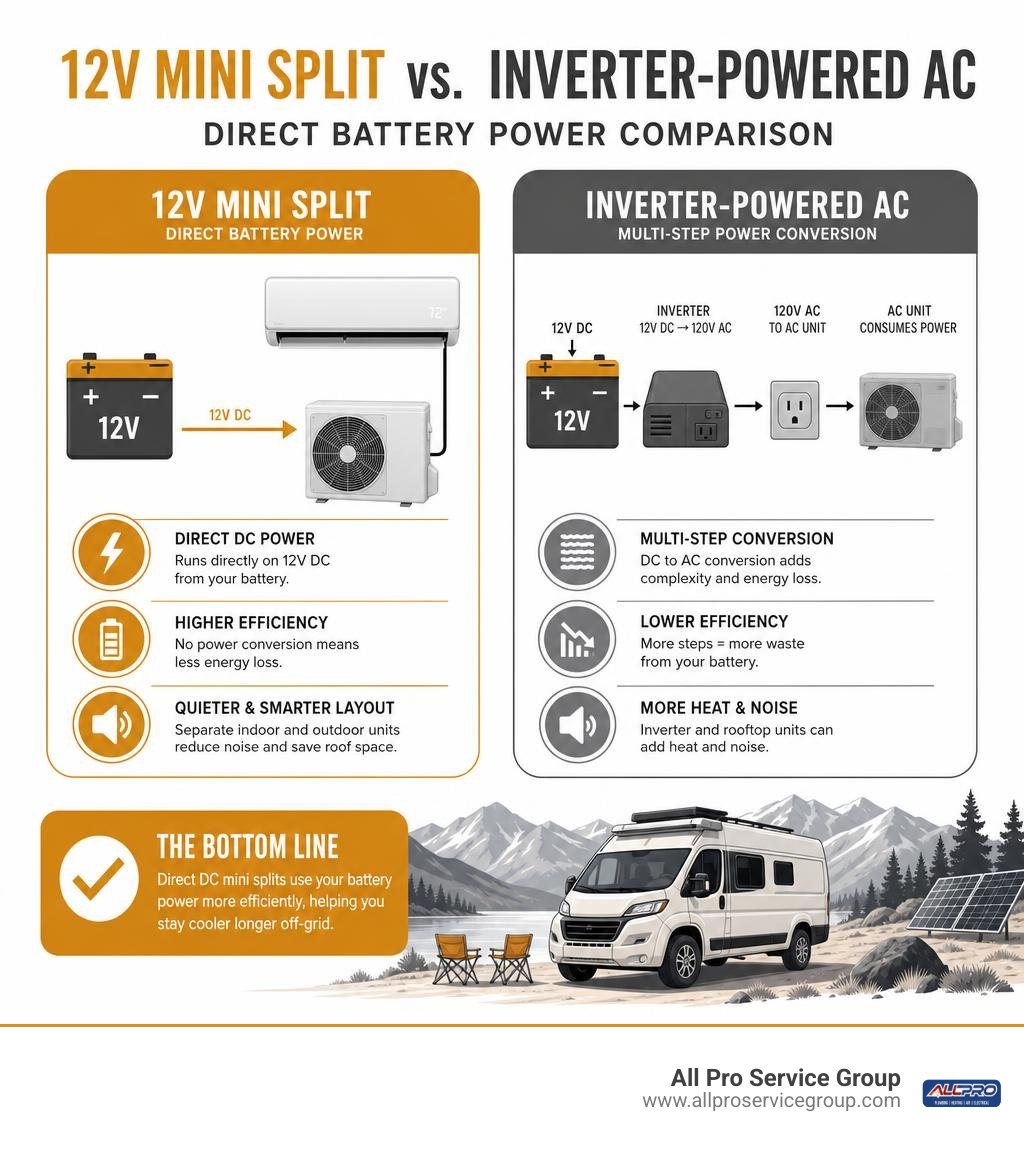
A direct DC air conditioner, specifically a 12 volt mini split, is built from the ground up to operate directly off low-voltage DC electricity. By keeping the entire cooling system inside the DC ecosystem, you remove the middleman that usually wastes precious off-grid energy. To explore the broader world of ductless climate systems, check out our Ductless Mini Splits Complete Guide.
Direct Current vs Standard AC Inverters
When you power a traditional residential mini split or window air conditioner using an off-grid battery setup, electricity must pass through a power inverter to transform 12V DC into 115V or 230V AC.
While modern pure sine wave inverters are relatively efficient, this transformation process naturally loses around 10% to 15% of your total energy as heat. Furthermore, inverters draw a baseline "idle current" just staying turned on, even when the air handler fan is on standby.

A 12 volt mini split connects directly to your busbars or fuse block. Eliminating power transformation losses gives you more actual cooling hours out of every amp-hour stored in your battery bank.
Vehicle Compatibility and Applications
Direct DC mini split units fit seamlessly into a wide variety of mobile applications:
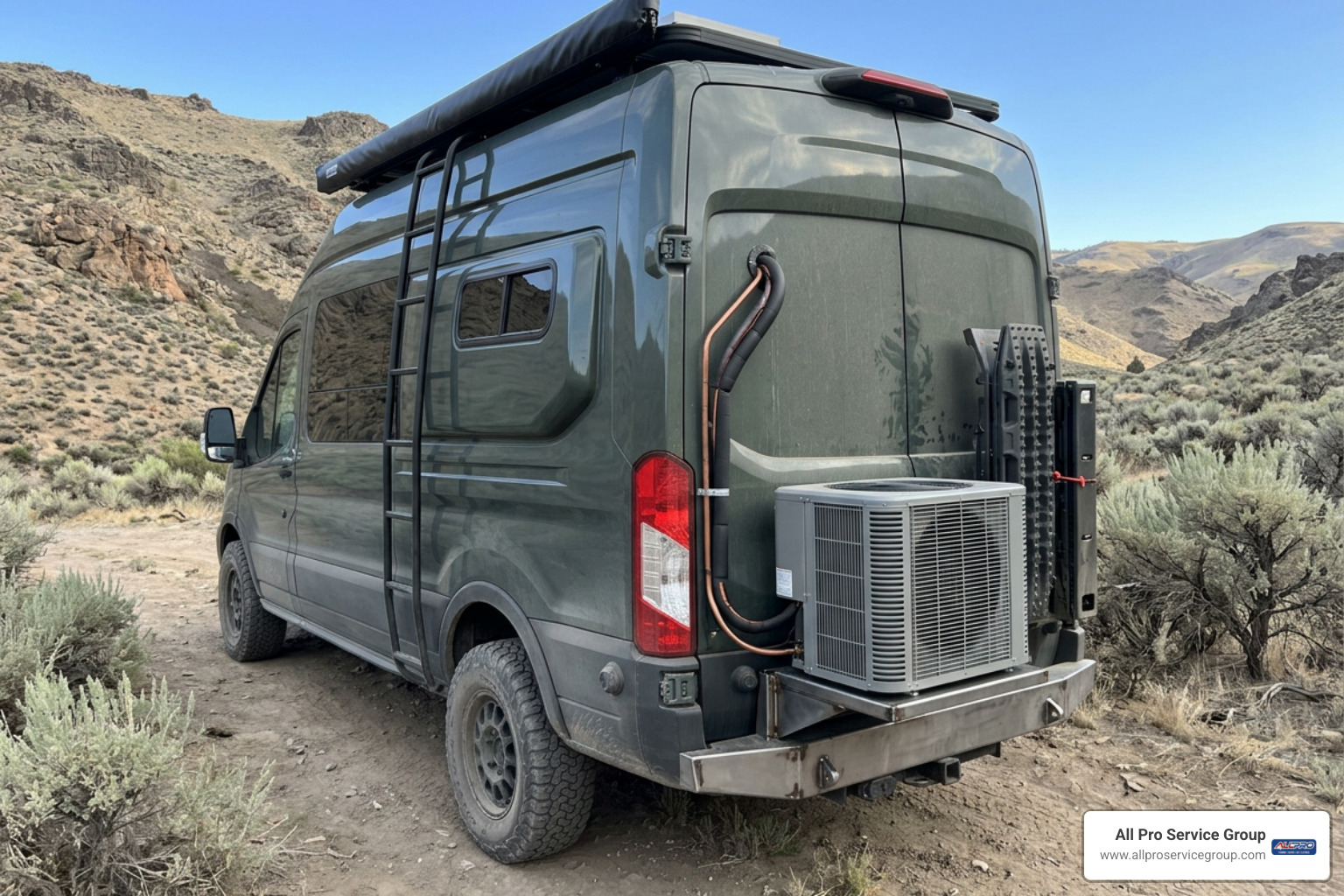
- Camper Vans & Class B RVs: High-roof vans often run out of roof real estate once maxed out with solar panels. A split AC lets you place the condenser underneath the chassis or on a rear rack.
- Semi-Truck Sleeper Cabs: Over-the-road truck drivers use 12V parking cooling units to maintain a comfortable cabin during mandatory rest cycles without idling their heavy diesel engines.
- Overlanding Rigs & Off-Road Campers: Built with ruggedized hardware and vibration resistance, these systems handle bumpy washboard roads in desert backcountry.
- Heavy Machinery & Agricultural Cabs: Cranes, tractors, and excavators use compact 12V DC cooling to keep operators safe in scorching weather without demanding engine-mounted belt-driven compressors.
Understanding How a 12 Volt Mini Split Works Off-Grid
Standard residential air conditioners turn their compressors completely on or completely off, creating heavy electrical spikes called "inrush current" whenever they start up. In contrast, quality 12V mini splits use variable-speed DC compressors (often called intelligent frequency conversion or brushless DC compressors).
These compressors start up smoothly without current spikes and continuously adjust their speed based on the ambient room temperature. Once your rig reaches your desired temperature, the system scales down its power draw to a low-amp maintenance state.
Power Draw and Amperage Requirements for a 12 Volt Mini Split
Calculating continuous power draw is crucial for off-grid system planning. Because standard electrical formulas dictate that Watts = Volts x Amps, operating at a lower voltage (12V) means carrying significantly higher amperage through your wires than high-voltage AC units.
For example, running a 600-Watt load on 120V AC requires only 5 Amps. Running that same 600-Watt load on 12V DC demands 50 Amps!
Here is how power demands typically compare across direct DC system voltages:
| System Voltage | Typical Cooling Capacity | Nominal Current Draw | Recommended Wire Gauge (Short Run) |
|---|---|---|---|
| 12V DC | 9,000 – 12,500 BTU | 38 – 55 Amps | 2 AWG – 1/0 AWG |
| 24V DC | 11,000 – 12,000 BTU | 25 – 33 Amps | 4 AWG – 2 AWG |
| 48V DC | 12,000 – 15,000 BTU | 8 – 16 Amps | 8 AWG – 6 AWG |
To support a 12V system drawing 45 Amps continuously over 8 hours overnight, you need roughly 360 Amp-hours (Ah) of usable battery capacity dedicated strictly to cooling. Pairing your lithium battery bank with 600W to 1,000W of solar panels helps replenish that storage during daylight hours.
Key Installation Steps for Your 12 Volt Mini Split
Installing a direct DC split unit requires careful attention to both mechanical mounting and high-current electrical wiring.
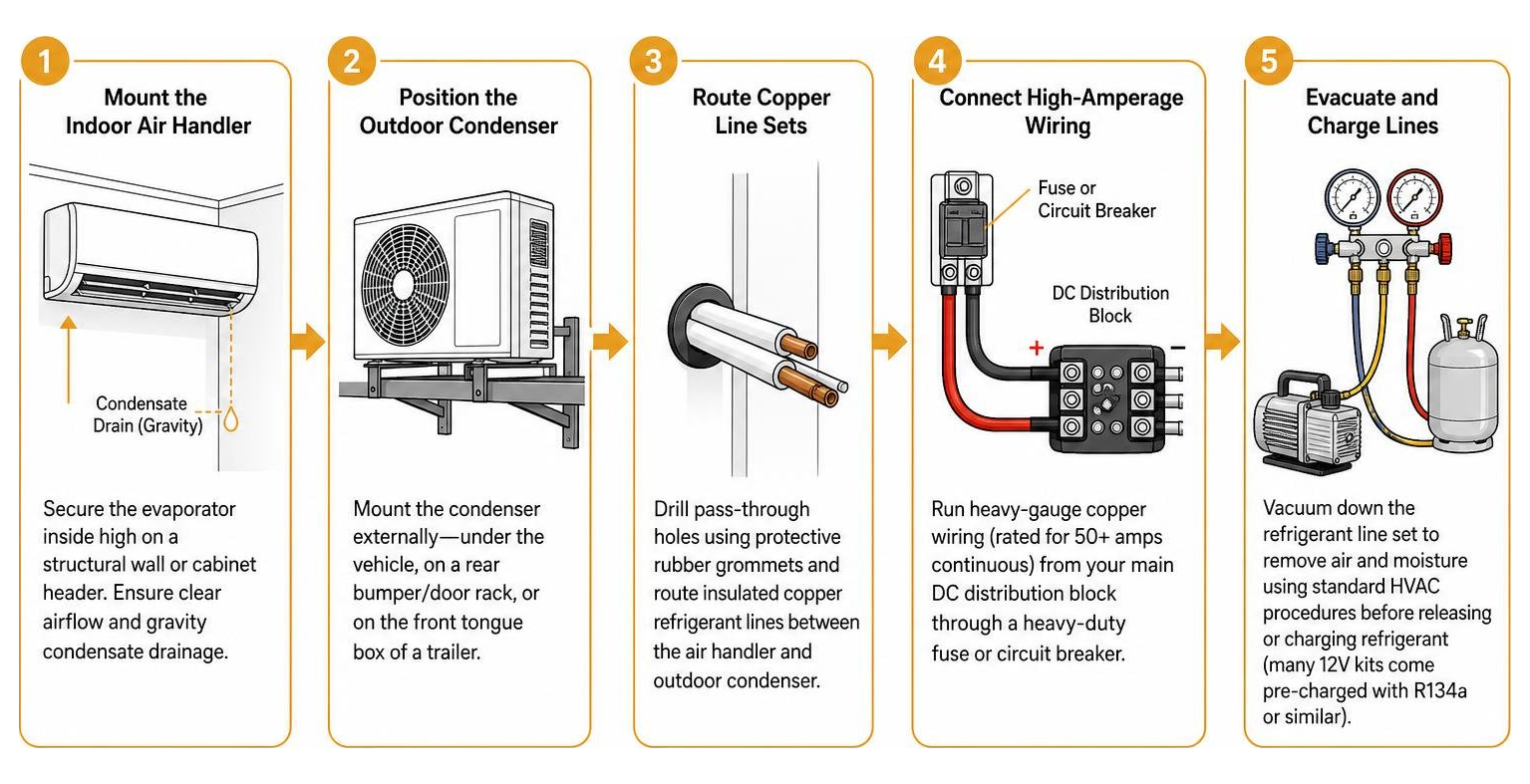
- Mount the Indoor Air Handler: Secure the evaporator air handler inside your vehicle cabin high on a structural wall or cabinet header, leaving space for unimpeded airflow and gravity condensate drainage.
- Position the Outdoor Condenser: Mount the condenser externally—either undermounted under the vehicle floor, mounted on a rear bumper/door rack, or positioned on the front tongue box of a trailer.
- Route Copper Line Sets: Drill pass-through holes using protective rubber grommets and route insulated copper refrigerant lines between the air handler and outdoor condenser.
- Connect High-Amperage Wiring: Run heavy-gauge copper wiring (sized for continuous 50+ amp loads) directly from your main DC distribution block through a heavy-duty fuse or circuit breaker.
- Evacuate and Charge Lines: Vacuum down the refrigerant line set to eliminate air and moisture using standard HVAC procedures before releasing or charging refrigerant (many entry-level 12V kits come pre-charged with R134a or similar refrigerants).
Benefits, BTU Sizing, and Energy Efficiency
Choosing the right cooling capacity ensures you stay comfortable without exhausting your power supply prematurely. Mobile 12V split systems range from 9,000 BTU up to 15,000 BTU.
For quick reference, 12,000 BTU equals 1 Ton of cooling capacity. If you want to understand how tonnage translates into space management, see our breakdown on 1 Ton Mini Split Square Footage.
Selecting the Right Cooling Capacity
Vehicle cabins present unique thermal challenges compared to traditional home structures. Vehicles have thin metal walls, large glass windows, and limited insulation space.
For a comprehensive look at popular sizing options, browse our guide on 12000 Btu Mini Split Guide 2026.
When calculating heat load for an off-grid vehicle, consider these major heat gain factors:
- Insulation Quality: Thicker closed-cell foam or Thinsulate insulation drastically cuts required cooling amps.
- Window Coverage: Uncovered glass windows act like greenhouses in high-altitude environments like Park City or Salt Lake Valley. Reflective window covers are essential.
- Solar Radiation: Parking in direct sunlight significantly increases thermal load compared to shaded parking spots.
Heating Capabilities and Climate Control
Many off-grid adventurers ask if a direct 12 volt mini split can keep them warm during chilly Utah desert nights. Some 12V split units function as heat pumps using a reversing valve, providing both cooling and supplemental heating.
However, heat pump efficiency drops as outdoor temperatures approach freezing. Because electric resistance heating or heat-pumping on 12V power consumes substantial battery power, most off-grid builders rely on a direct DC mini split primarily for cooling, while using a diesel parking heater or propane furnace for sub-freezing winter warmth.
Comparing Direct DC Cooling to Traditional AC Systems
Before purchasing climate equipment for your rig, it pays to weigh direct 12V cooling against standard alternating current options available on the market. You can explore available direct DC products through retailer collections like 12V Mini Split Air Conditioners for RVs, Vans, Trucks ... - OutEquipPro.
| Feature / Metric | Direct 12V DC Mini Split | Standard 115V AC Mini Split | Traditional RV Rooftop AC |
|---|---|---|---|
| Power Source | Direct 12V DC Battery | 115V AC (Requires Inverter) | 115V AC (Inverter or Generator) |
| Energy Efficiency | Ultra High (No Inverter Losses) | High (Losses during DC-to-AC conversion) | Low (Single-speed compressor) |
| Noise Level | Very Quiet (45 dB) | Extremely Quiet (19–30 dB) | Loud (60+ dB overhead vibration) |
| Roof Impact | Minimal (Condenser mounted anywhere) | Minimal (Condenser on bumper/wall) | Blocks 12–15 sq ft of roof solar |
| Typical Equipment Cost | $800 – $3,800+ | $700 – $1,800 | $800 – $1,500 |
If you are exploring traditional shore-power options or running standard household units via an inverter, view our detailed guides on 110V Mini Split and the updated 110 Volt Mini Split Guide 2026.
For high-efficiency residential systems using standard AC voltage, you can check options like the MRCOOL DIY Mini Split Systems USA – MRCOOL DIRECT , retail offerings like the DIY 12,000 BTU 1-Ton 1-Zone 22 SEER Ductless Mini-Split AC and Heat Pump with 12K & 25ft Line, or high-output 230V systems like the VEVOR Mini Split Air Conditioner, 12,000 BTU AC / 12,500 BTU Heat, 230V 19 SEER2 High Efficiency Energy Saving, Quiet Inverter System for 750 Sq.Ft Coverage Area, Easy to Maintain, for Home, Office | VEVOR US.
For additional 5th Gen residential DIY choices, you can review the MRCOOL DIY® 5th Gen E Star 12K BTU Mini-Split | DIY Installation & ENERGY STAR® – MRCOOL DIY Direct or explore budget cooling options on platforms like 12V 12500 BTU Mini Split Air Conditioner Unit, Quiet ....
Maintenance and System Lifespan
Direct 12V DC mini split air conditioners are engineered for long service lives in harsh mobile environments. Standard maintenance routines involve simple steps you can perform yourself:
- Clean Washable Air Filters: Pull out the air handler mesh filters every few weeks during heavy use and wash them under fresh water.
- Inspect Condenser Fins: Spray clean water through external condenser coils to remove road grime, dust, and bugs gathered during highway transit.
- Servicing Ports: Many 12V DC mobile units utilize standard automotive R134a service ports and fittings, making it easy for certified mobile technicians or automotive mechanics to check system pressures over time.
Common Drawbacks and Solutions
While a direct 12 volt mini split offers unmatched battery efficiency, it does come with a few trade-offs:
- Thick Wiring Demands:
Because 12V power requires high current (amps), wiring runs must use heavy copper cable (2 AWG or larger) to avoid excessive voltage drops.
- Solution: Place your battery bank and main fuse panel as close to the mini split connections as reasonably possible.
- Higher Initial Cost:
Purpose-built direct DC split systems cost more upfront than off-the-shelf 115V household units.
- Solution: Offset equipment costs by factoring in the money saved on smaller inverter requirements and lower power loss.
- Installation Effort: Unlike plug-in portable air conditioners, split systems require mounting two separate boxes and running copper line sets through structural walls or floors.
Frequently Asked Questions About Mobile Cooling Systems
How long can a 12V system run on batteries?
Runtime depends directly on your total battery storage capacity, ambient outdoor temperatures, and insulation levels.
For example, a typical 12V system drawing an average of 40 Amps while cycling will consume 320 Amp-hours (Ah) over an 8-hour period. If you have a 400Ah lithium battery bank, you can run the system overnight comfortably with capacity to spare. Adding daytime solar panel input extends that runtime significantly during daylight hours.
Can a direct DC split unit heat as well as cool?
Yes, several direct DC mini split models feature reverse-cycle heat pump functionality that provides heating.
However, heat pump performance diminishes in freezing weather, and heating consumes considerable power. For extreme winter environments across Utah, combining your DC cooling system with an auxiliary fuel heater (such as a diesel or propane furnace) provides the most reliable heat source.
Is direct DC cooling better than a rooftop AC unit?
For off-grid efficiency, direct DC cooling offers clear advantages over standard rooftop RV units:
- Aerodynamics & Clearance: Split systems eliminate bulky roof domes that create highway drag and increase clearance heights.
- Solar Panel Real Estate: Moving the condenser under the vehicle chassis leaves your roof wide open for solar panels.
- Noise Reduction: Separating the heavy compressor from your roof structure eliminates overhead cabin vibrations and rattling noise.
Conclusion
A 12 volt mini split represents a game-changing step forward for off-grid power management, vehicle comfort, and energy independence. By eliminating the conversion losses associated with running power inverters, direct DC cooling allows camper van builders, RV owners, and truck drivers to stay comfortable using stored battery power and solar energy.
Whether you are designing a full off-grid electrical setup or planning your next vehicle build in Ogden, Salt Lake City, or West Valley City, matching your cooling capacity to your battery storage ensures years of dependable performance.
At All Pro Service Group, our team brings decades of combined expertise in electrical, heating, and cooling systems. If you need professional advice, load calculations, or guidance on integrating ductless climate control, explore our full range of solutions at Heating Air/Ductless Mini Splits to keep your spaces comfortable wherever your travels take you!