
What a 12,000 BTU Mini Split Actually Does for Your Home
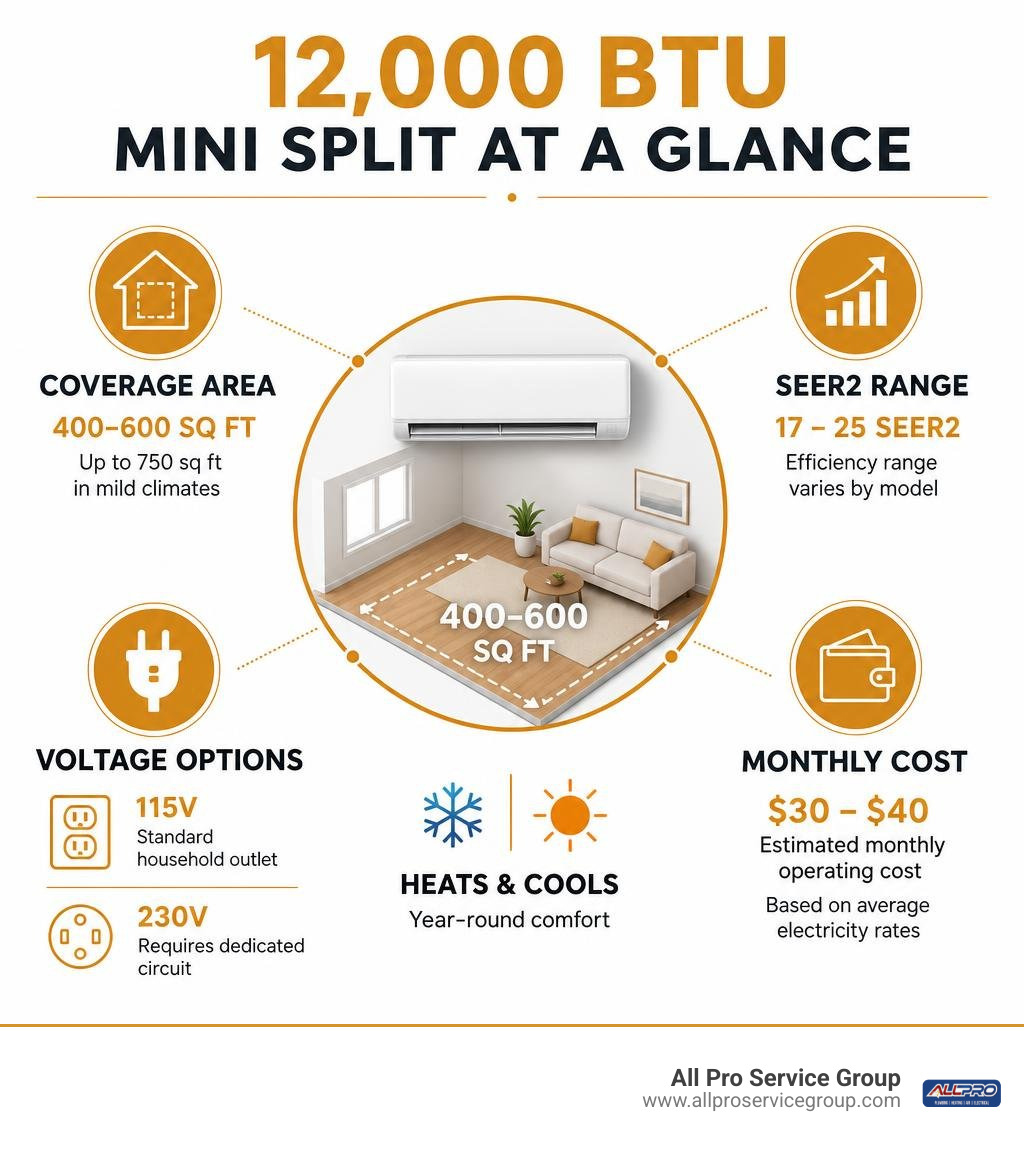
A 12 BTU mini split — more precisely, a 12,000 BTU ductless mini split — is a single-zone heating and cooling system designed to efficiently condition rooms between 400 and 600 square feet. Here's a fast answer if that's all you need:
| Question | Quick Answer |
|---|---|
| How many sq ft does it cover? | 400–600 sq ft (up to 750 in mild climates) |
| What voltage does it need? | 115V or 230V depending on the model |
| How efficient is it? | 17 to 25 SEER2 depending on the unit |
| Can it heat and cool? | Yes — it's a heat pump |
| Can I install it myself? | Some models are DIY; most require a licensed HVAC tech |
| What does it cost to run monthly? | Roughly $30–$40/month at average Utah electricity rates |
This 1-ton system is one of the most popular sizes for homeowners adding comfort to a single room — a home office, a primary bedroom, a garage conversion — without touching existing ductwork.
It's efficient, quiet, and in many cases installable on a standard household circuit. But getting the sizing and setup right makes all the difference between a system that performs for 20 years and one that struggles from day one.
At All Pro Service Group, we've been installing and servicing mini split systems across the Greater Salt Lake Valley since 2008 — including plenty of 12 BTU mini split setups in homes where central HVAC just couldn't reach. Read on and we'll walk you through everything you need to know to choose and size the right system with confidence.
Room Coverage and Sizing Guidelines for a 12 BTU Mini Split
When sizing any HVAC unit, capacity is measured in British Thermal Units (BTUs). One BTU is the amount of heat energy required to raise the temperature of one pound of water by one degree Fahrenheit. In the air conditioning world, 12,000 BTUs equal 1 ton of refrigeration capacity.
Under baseline residential standards, a 12 BTU mini split is designed to heat and cool a space between 400 and 600 square feet. In well-insulated spaces located in moderate weather zones, a high-efficiency 12K unit can stretch to cover up to 750 square feet. However, in Utah's high-desert environment — where hot summer days in Salt Lake City or West Valley City are paired with below-freezing winter nights in Park City — adhering to realistic square footage guidelines is essential to keeping your home comfortable.
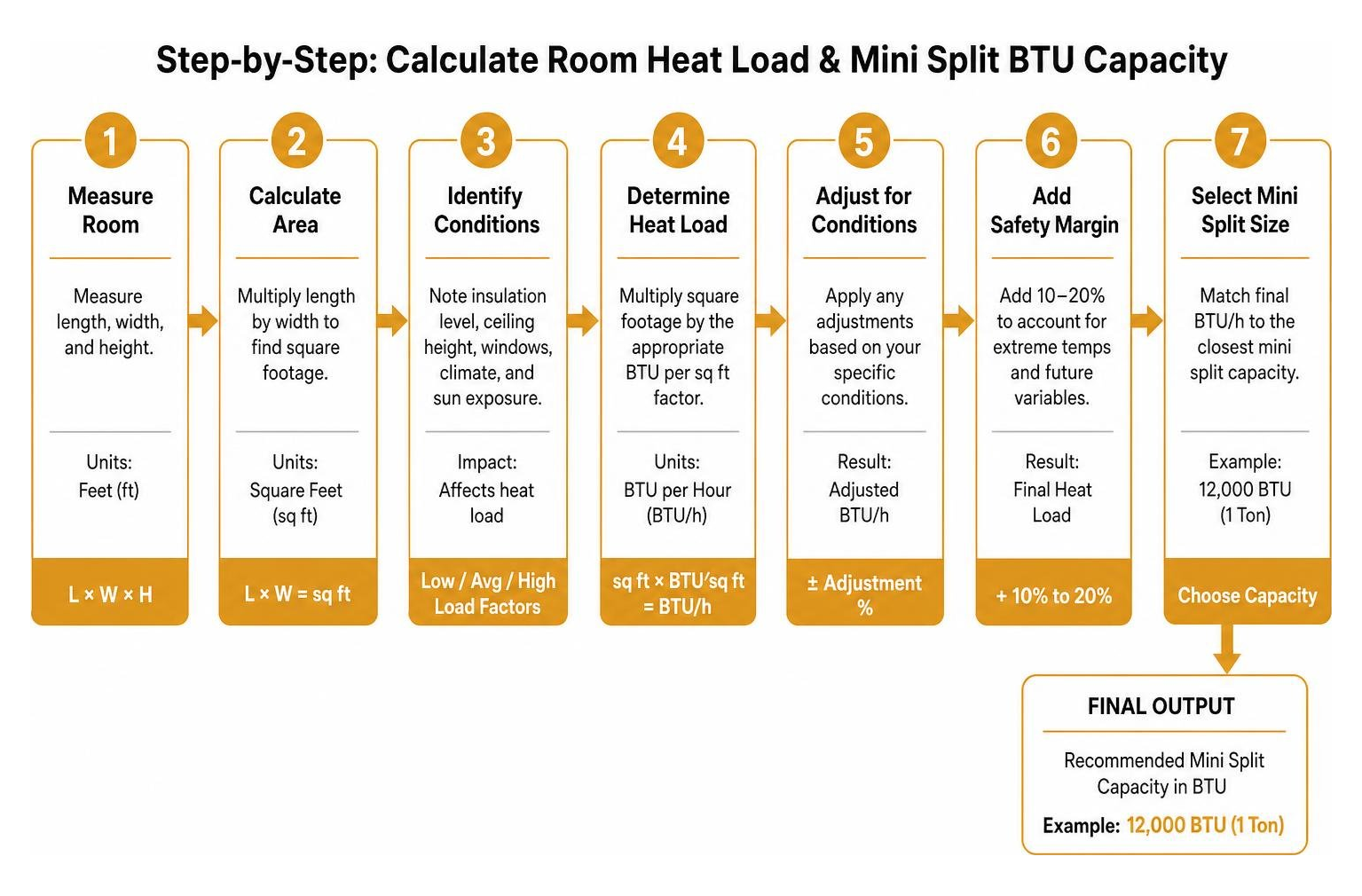
To calculate if a 12,000 BTU unit fits your space, you begin with simple room floor area math (length × width = square footage). For deeper insights on capacity sizing across various floor plans, check out our guide on 1 Ton Mini Split Square Footage.
Choosing a 12 BTU Mini Split for Specific Home Spaces
Because a 1-ton system hits the sweet spot for single-zone climate control, we frequently install a 12 BTU mini split in spaces such as:
- Primary Master Bedroom Suites: Master bedrooms with adjoining sitting areas or walk-in closets frequently span 400 to 500 square feet. A ductless unit allows you to keep your sleeping sanctuary at 68°F at night without blasting the central air for the entire home.
- Home Offices & Studios: With remote work standard in 2026, home offices running warm computers and monitors need targeted cooling. A 12K unit handles this extra heat load quietly.
- Garage Conversions & Workshops: Turning a garage into a home gym, workshop, or living area in South Jordan or Ogden requires dedicated HVAC. Uninsulated concrete floors and garage doors demand a full 12,000 BTUs to maintain year-round comfort.
- ADUs and Casitas: Accessory Dwelling Units (ADUs) ranging from 450 to 600 square feet can often be fully heated and cooled by a single wall-mounted or ceiling cassette 12 BTU mini split.
- Bonus Rooms Above Garages: These spaces notoriously suffer from thermal loss due to unconditioned air below them and roof exposure above. A 1-ton mini split cures hot spots permanently.
Environmental Factors Affecting 12 BTU Mini Split Heating and Cooling
Square footage is only part of the sizing equation. When we perform home heat-load calculations in the Greater Salt Lake Valley, we evaluate five critical environmental factors before selecting a system:
- Ceiling Height: Standard sizing rules assume 8-foot ceilings. If your space features 10-foot or vaulted ceilings, the total cubic volume of air increases significantly, requiring up to 20% more heating and cooling output.
- Solar Exposure: South-facing or west-facing rooms with large picture windows gather immense radiant solar heat during hot summer afternoons.
- Drafts and Insulation: Older historic homes in Salt Lake City or Provo with original single-pane windows or minimal attic insulation lose heat rapidly during cold winters, lowering the effective square footage a 12,000 BTU unit can manage.
- Local Climate Extremes: Extreme summer heat waves or severe winter cold snaps require heat pumps with hyper-heating inverter capabilities to preserve full capacity.
- Occupancy & Electronics: Rooms hosting multiple occupants, large television arrays, or kitchen appliances generate supplemental internal heat loads that must be factored in.
Voltage Comparison: 115V vs. 230V Systems
When shopping for a 12 BTU mini split, one of the first technical forks in the road is selecting between a 115V (110V/120V) and a 230V (208V/230V) system. Both options produce 12,000 BTUs of cooling and heating output. However, their electrical infrastructure needs differ substantially.
A 115V model connects to standard residential voltage setups. For retrofit applications in older homes where adding a new double-pole circuit breaker to an overstuffed electrical panel is difficult or costly, a 115V unit is a convenient solution. Standard 115V 12K units require a dedicated 15-amp single-pole circuit wired with 12-gauge wire. You can learn more about single-voltage configurations in our detailed 110v Mini Split guide as well as our 110 Volt Mini Split Guide 2026.
Conversely, a 230V 12 BTU mini split connects across two power legs on your electrical panel using a double-pole circuit breaker. While 230V units require dedicated wiring during installation, they draw fewer electrical amps while running, which can lower stress on long electrical wire runs. Furthermore, higher-SEER2 performance tiers and extreme cold-climate heating options are more widely available in 230V configurations.
| Specification / Feature | 115V 12,000 BTU Mini Split | 230V 12,000 BTU Mini Split |
|---|---|---|
| Circuit Breaker Type | Single-Pole (15-Amp) | Double-Pole (15-Amp to 20-Amp) |
| Typical Wire Gauge | 12 AWG | 12 AWG or 14 AWG |
| Cooling Output Capacity | 12,000 BTU/h | 12,000 BTU/h |
| Max Heating Capacity Range | 12,000 - 13,000 BTU/h | 12,000 - 15,000+ BTU/h |
| Installation Retrofit Ease | High (utilizes common panel setups) | Moderate (requires 240V double pole breaker) |
| SEER2 Range Availability | 17 to 23 SEER2 | 19 to 25+ SEER2 |
| Best For | Older homes, garageway retrofits, DIY installs | Cold-climate hyper heat, ultra-high efficiency setups |
SEER2 Efficiency Ratings, Inverter Tech, and Monthly Costs
Efficiency standards in 2026 are governed by SEER2 (Seasonal Energy Efficiency Ratio 2), an updated testing framework established by the U.S. Department of Energy that accounts for real-world external static duct pressure and environmental variations. Higher SEER2 ratings mean greater efficiency and lower electricity consumption.
A basic 12 BTU mini split typically carries a rating around 17 to 19 SEER2, whereas premium models reach 22 to 25 SEER2. For complete details on energy metrics and models, review our 12000 Btu Mini Split Guide 2026.
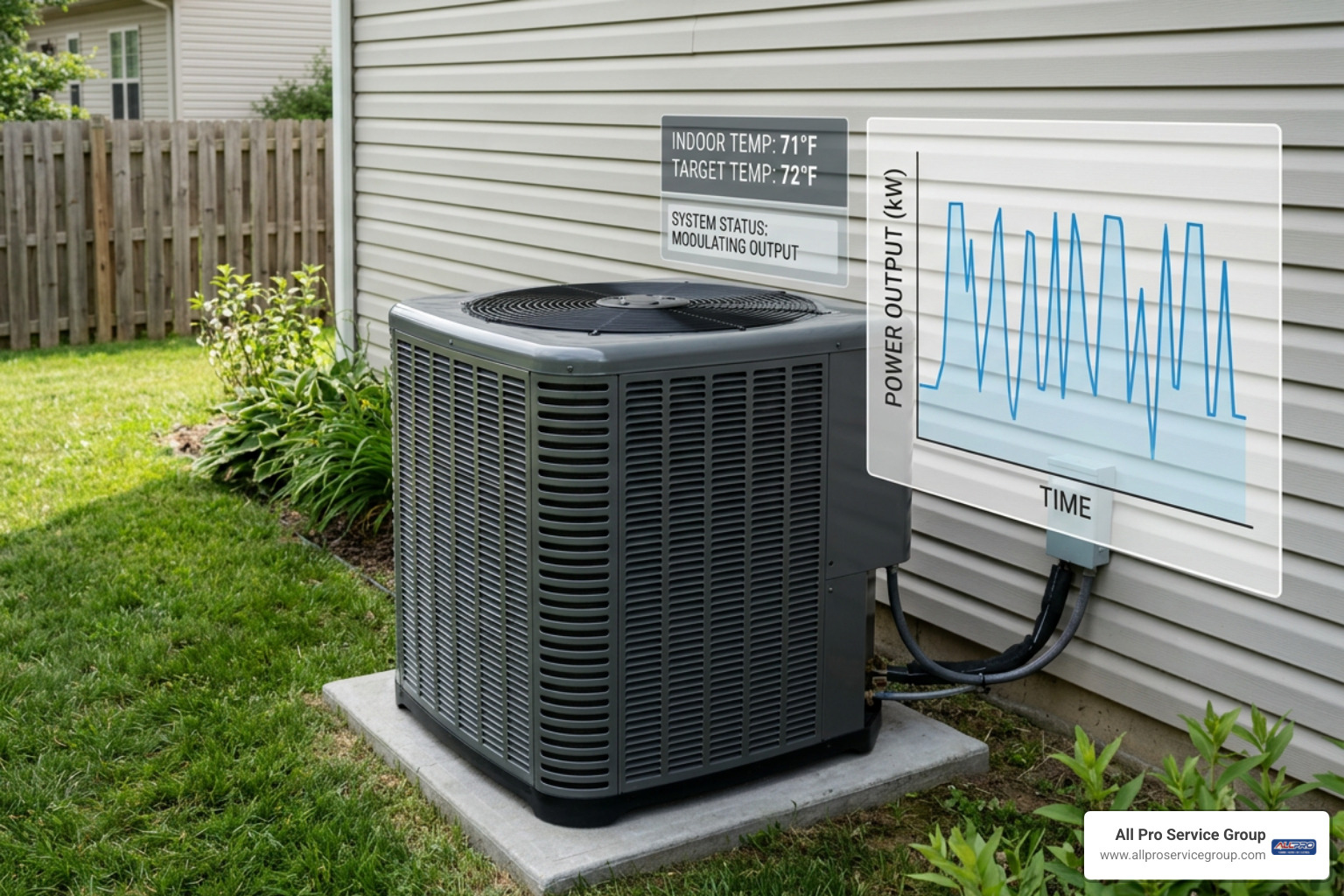
The magic behind these high SEER2 ratings lies in variable-speed DC inverter technology. Traditional single-speed air conditioners operate like a light switch: they blast at 100% power until the thermostat is satisfied, turn completely off, and then turn back on with a heavy surge of electricity when the room warms up.
Inverter compressors act like an accelerator pedal. They constantly adjust their motor speed up or down by small fractions to match the exact cooling or heating loss in the room in real time.
What does this mean for your monthly power bill?
- Operating Hours: Running a 17 to 22 SEER2 unit for 8 hours a day during mid-summer conditions consumes roughly 3 to 5 kilowatt-hours (kWh) daily.
- Monthly Electrical Cost: At average electric utility rates in Utah (around $0.11 to $0.15 per kWh), running a high-efficiency 12 BTU mini split costs between $30 and $40 per month.
- Rebates & Tax Credits: Choosing an Energy Star certified ductless heat pump with high SEER2 and HSPF2 ratings can qualify you for federal tax credits (such as the Inflation Reduction Act Section 25C credit offering up to $2,000 for qualifying heat pumps) as well as local Utah utility rebates.
If you ever decide to expand your home heating and cooling strategy to larger or multi-room configurations later, explore our Complete Guide 24000 Btu Dual Zone Mini Split or consider mid-capacity systems detailed in our guide to the 23000 Btu Mini Split.
Key Features and Cold-Climate Heating Performance
Modern mini splits come packed with advanced features designed to maximize comfort, indoor air quality, and convenience:
- Hyper-Heat Cold-Climate Performance: Standard air-source heat pumps struggle when outdoor temperatures drop below freezing. However, cold-climate hyper-heat systems utilize enhanced vapor injection and specialized compressor controls to maintain up to 85–100% of their rated heating capacity at 5°F, operating reliably down to -13°F. This is a crucial feature for northern Utah winters in places like Park City or West Jordan.
- Ultra-Quiet Whisper Operation: Because the noisy compressor sits outside, the indoor wall unit operates at sound levels as low as 23 to 28 decibels (dB) in Mute or Sleep Mode. To put that in perspective, a whisper is roughly 30 dB, while a traditional window AC unit clatters along at 50 to 70 dB.
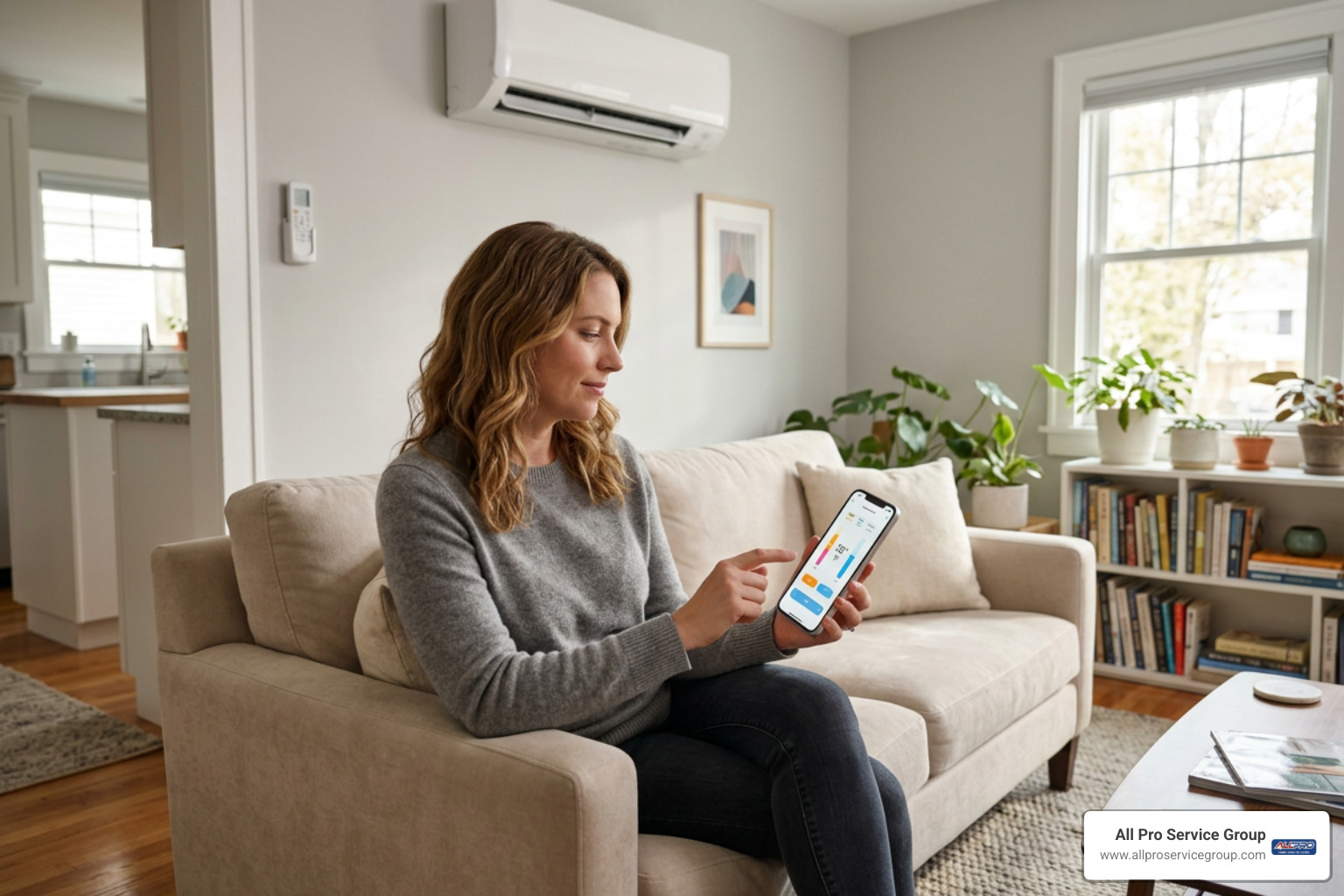
- Wi-Fi Smart Controls: Integrated Wi-Fi modules allow you to monitor and adjust temperatures, set weekly operating schedules, and track power consumption from your smartphone using mobile apps or voice assistants.
- High-Temperature Self-Cleaning: Modern mini splits feature an automated self-cleaning cycle that freezes the evaporator coil, melts away accumulated dust and debris, and then heats internal components to over 130°F to dry the system and prevent mold or bacteria growth.
- I-Feel Remote Sensing: Instead of sensing temperature high up on the wall where the indoor unit is mounted, "I-Feel" technology reads the ambient temperature at the handheld remote control, directing climate control exactly where you are sitting.
Installation Requirements: DIY vs. Professional HVAC Setup
When evaluating a 12 BTU mini split, homeowners encounter two primary installation categories: Do-It-Yourself (DIY) pre-charged kits and traditional mini splits that require professional HVAC installation. Understanding the differences between these options is vital before making a purchase.
DIY Mini Split Systems
DIY systems — such as those offered by popular equipment lines like the MRCOOL DIY Mini Split Systems USA – MRCOOL DIRECT series, 12000 BTU 115V DIY Mini Split — Wall Mount | Zone Air, or DIY 12,000 BTU 1-Ton 1-Zone 22 SEER Ductless Mini-Split AC and Heat Pump with 12K & 25ft Line — use factory pre-charged refrigerant linesets equipped with sealed quick-connect mechanical fittings.
This design allows handy homeowners to pass pre-charged tubing through a 3.5-inch exterior wall penetration, torque the quick-connect fittings together, and release refrigerant into the system without needing an EPA certification, specialized vacuum pumps, or manifold gauges.
Traditional Professional Systems
Traditional ductless systems — including brands like Filterbuy 12,000 BTU Ductless Mini Split AC & Heat Pump | 115V | 17 SEER2, VEVOR Mini Split Air Conditioner, 12,000 BTU AC / 12,500 BTU Heat, 230V 19 SEER2 High Efficiency Energy Saving, Quiet Inverter System for 750 Sq.Ft Coverage Area, Easy to Maintain, for Home, Office | VEVOR US, 12,000 BTU 115-Volt, 19 SEER2, 600 sq. ft. Ductless Mini Split Air Conditioner with Heat Pump, 13 ft. lineset, and catalog offerings from 12000 BTU - Mini Split Systems — feature raw copper lines that must be custom-flared, pressure-tested with nitrogen, evacuated using a micron gauge and vacuum pump, and leak-checked prior to releasing factory refrigerant.
Why do most manufacturers mandate professional installation by a licensed technician?
- Refrigerant Line Evacuation: Trapped air or moisture inside un-vacuumed copper lines reacts with compressor oil to create corrosive acids. Over time, these acids degrade motor insulation and cause premature compressor burnouts.
- EPA Section 608 Compliance: Federal environmental regulations strictly control the handling and release of fluorinated refrigerants (such as R-410A, R-32, or R-454B).
- Warranty Protection: Most standard manufacturers mandate that a licensed HVAC contractor install the equipment to validate their multi-year compressor and parts warranties. Self-installation on non-DIY units often voids warranty coverage entirely.
- Electrical Disconnect Safety: Wiring a high-voltage outdoor disconnect box and surge protector requires trained electrical skills to ensure compliance with local electrical codes across Salt Lake, Utah, and Summit counties.
For a comprehensive breakdown on system design and installation considerations, read our Ductless Mini Splits Complete Guide.
Frequently Asked Questions About 12,000 BTU Ductless Systems
Can a 12,000 BTU mini split cool and heat a multi-room layout?
A single-zone 12 BTU mini split is designed to treat an open-concept space or a single enclosed room (such as a large primary bedroom or open living room up to 600 square feet).
Because air cannot easily flow through doorways, narrow hallways, or solid interior walls on its own, installing a single wall unit in a hallway will not heat or cool adjacent closed bedrooms effectively. If your home layout features multiple distinct rooms, a multi-zone mini split system with separate air handlers in each room is the correct choice.
What size electrical breaker and wire gauge is needed for a 12,000 BTU unit?
Electrical circuit requirements depend on whether you select a 115V or 230V unit:
- 115V Systems: Typically require a 15-amp single-pole circuit breaker paired with 12 AWG copper wiring. The unit should draw between 10 to 14 full-load amps during maximum operation.
- 230V Systems: Generally require a 15-amp double-pole circuit breaker wired with 12 AWG or 14 AWG copper wire, drawing fewer operational amps across two hot legs.
Always consult the electrical data label on the outdoor condenser unit's nameplate and hire a qualified electrician or HVAC technician to ensure your installation meets the National Electrical Code (NEC).
How long does a 12,000 BTU ductless heat pump system typically last?
With proper installation and routine air filter maintenance, a high-quality 12 BTU mini split system lasts between 15 and 20 years.
Inverter compressors experience significantly less mechanical wear and tear than traditional on/off compressors because they ramp up speed gradually rather than slamming on at full power. To maximize system lifespan:
- Clean the reusable air filters every 4 to 6 weeks.
- Keep the outdoor condenser coil free of yard debris, ice accumulation, and fallen leaves.
- Schedule professional annual maintenance inspections to verify refrigerant pressures and clean internal drainage channels.
Conclusion
Sizing your climate control system correctly is the most critical decision you'll make when adding ductless heating and cooling to your home. A 12 BTU mini split delivers exceptional year-round comfort, whisper-quiet sound levels, and remarkable energy efficiency for spaces between 400 and 600 square feet.
Whether you choose a 115V setup for an easy electrical retrofit or a 230V hyper-heat unit to conquer cold Utah winters, getting the heat-load calculation and installation right ensures decades of lower energy bills and cozy living.
If you live in Salt Lake City, South Jordan, West Jordan, Park City, Ogden, Provo, or anywhere in the Greater Salt Lake Valley, our team at All Pro Service Group is here to help. Gephardt Approved and serving Utah homeowners since 2008, we provide expert sizing, electrical prep, and full system installation backed by trained professionals and exceptional service.
Ready to transform your home's comfort? Contact us today to schedule your consultation for Ductless Mini Split Installation & Heating Services!