
Is a 12,000 BTU Mini Split Right for Your Home?
A 12000 BTU mini split is one of the most popular home comfort choices for good reason — it hits the sweet spot between power and efficiency for most rooms in a typical home.
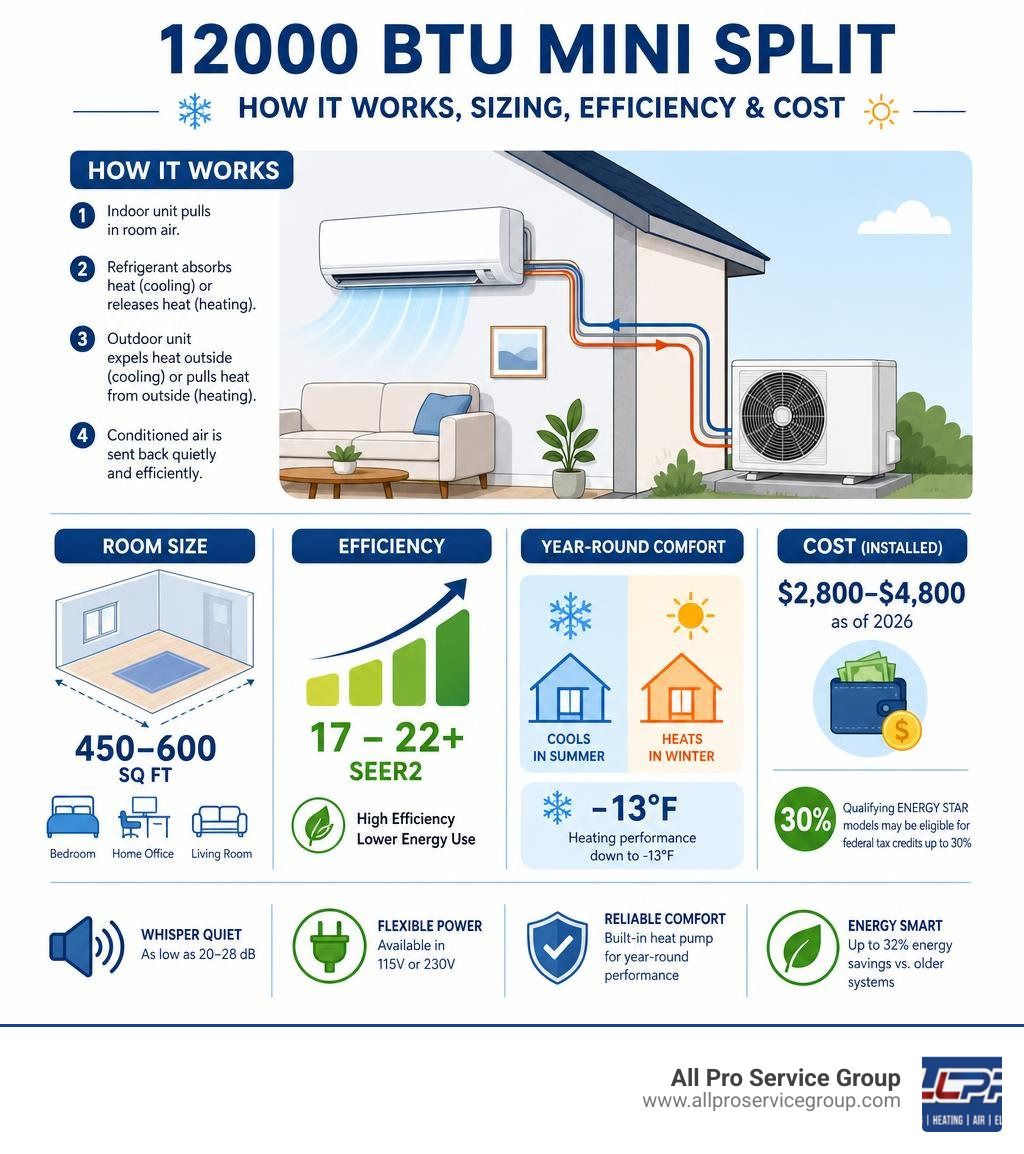
Quick answer: A 12,000 BTU mini split (1 ton) is best for rooms between 450–600 sq ft. It provides both heating and cooling year-round, runs quietly, and can cut energy bills by up to 32% compared to older systems.
Here's what you need to know at a glance:
- Room size: Best for 450–600 sq ft (bedrooms, home offices, living rooms)
- Efficiency: Modern units range from 17 to 22+ SEER2
- Voltage: Available in 115V (standard outlet) or 230V configurations
- Heating: Built-in heat pump works down to -13°F in many models
- Noise: Indoor units run as low as 20–28 dB — quieter than a whisper
- Installed cost: Typically $2,800–$4,800 as of 2026
- Incentives: Qualifying ENERGY STAR models may be eligible for federal tax credits up to 30%
Whether you have a bonus room that never gets comfortable, a home office that's always the wrong temperature, or a bedroom where the central AC just isn't cutting it — a 12,000 BTU unit is often the right-sized fix.
At All Pro Service Group, our team has been installing and servicing ductless mini splits — including 12000 BTU mini split systems — across the Greater Salt Lake Valley since 2008. In this guide, we'll walk you through everything you need to know to choose, install, and maintain the right unit for your home.
Sizing Up the 12000 BTU Mini Split: What Room Size is Ideal?
When sizing a heating and cooling system, accuracy is everything. If a system is too small, it will run constantly, driving up your utility bills while failing to keep you comfortable. If it is too large, it will "short-cycle"—turning on and off rapidly—which leaves the room feeling humid and wears out the compressor prematurely.
A 12,000 BTU system is also known in the HVAC industry as a "1-ton" unit. To understand how this fits into your home, you can read more about 1 ton mini split square footage. Generally, a 12,000 BTU system is engineered to handle spaces ranging from 450 to 600 square feet. This capacity makes it the ideal fit for master bedrooms, medium-sized living rooms, detached home offices, and converted garage workshops.
To help visualize how a 1-ton system compares to other common residential sizes, here is a quick breakdown:
| System Capacity (BTUs) | Capacity in Tons | Typical Coverage Area (Sq. Ft.) | Best Suited For |
|---|---|---|---|
| 9,000 BTU | 0.75 Ton | 250 – 400 sq ft | Small bedrooms, home offices, nursery rooms |
| 12,000 BTU | 1.0 Ton | 450 – 600 sq ft | Master suites, standard living rooms, large offices |
| 18,000 BTU | 1.5 Tons | 650 – 900 sq ft | Open-concept apartments, small basements, double garages |
| 24,000 BTU | 2.0 Tons | 950 – 1,200 sq ft | Large open floor plans, commercial spaces |
Sizing Factors Beyond Square Footage
While floor area is the easiest starting point, professional HVAC sizing involves evaluating several environmental and structural variables. A 12,000 BTU unit that works perfectly in a shaded Salt Lake City bedroom might struggle in a high-ceilinged sunroom in Park City. Here are the key factors we analyze before deciding if a 12,000 BTU unit is truly your "sweet spot":
- Ceiling Height: Standard sizing models assume 8-foot ceilings. If your room features vaulted ceilings or loft spaces, the total volume of air increases. If your ceilings are over 8 feet, you may need to step up to a slightly larger unit.
- Insulation Quality: Older homes in historic areas of Ogden or Salt Lake City often have less efficient insulation and drafty windows. In contrast, newly constructed homes in South Jordan are tightly sealed. Poor insulation means your heat pump has to work harder, which might reduce its effective coverage area closer to 400 square feet.
- Sun Exposure and Windows: Large, south-facing windows act like greenhouses in the summer. If your room is exposed to intense afternoon sun, it will require extra cooling power.
- Local Climate Zones: Here along the Wasatch Front, we experience dramatic temperature swings. Our hot, dry summers and snowy, freezing winters demand a system that can handle both extremes.
Key Features and Benefits of a 1-Ton Ductless System
Ductless mini splits have revolutionized residential climate control. Unlike traditional central HVAC systems that force air through dusty, leaky ductwork, a mini split delivers conditioned air directly to the room. If you want to explore the underlying technology further, check out our ductless mini splits complete guide.
The modern 12000 BTU mini split is packed with features designed to maximize comfort and minimize energy waste:
- Variable-Speed Inverter Technology: Traditional air conditioners are either 100% on or 100% off. They blast cold air, turn off when the thermostat is satisfied, and then turn back on when the room warms up. Inverter compressors work like cruise control. They adjust their speed continuously, running at ultra-low speeds to maintain a perfectly steady temperature. This prevents drafts, reduces wear and tear, and saves up to 35% on energy bills.
- Reversible Heat Pump Functionality: A mini split is not just an air conditioner; it is a highly efficient heater. In the winter, it reverses its refrigerant flow, extracting ambient heat from the outdoor air and pumping it indoors.
- Advanced Eco-Friendly Refrigerants: Modern systems are transitioning to next-generation refrigerants like R32 and R454B. These options offer excellent thermal transfer properties and have a significantly lower Global Warming Potential (GWP) than older refrigerants like R410A.
- Rapid Climate Control: Thanks to smart inverter management, many premium 12,000 BTU units can cool a room in as little as 30 seconds and provide noticeable warmth within 60 seconds of startup.
Understanding the 12000 BTU Mini Split Voltage Options: 115V vs. 230V
When shopping for a 12,000 BTU system, you will quickly notice that units come in two electrical configurations: 115V (often referred to as 110V or 120V) and 230V (often referred to as 220V or 240V).
Choosing a 110v mini split offers high convenience. These systems run on standard household voltage, meaning they can often be wired into your existing electrical panel with minimal disruption. For a great example of this setup, look at the Filterbuy 12,000 BTU Ductless Mini Split AC & Heat Pump | 115V | 17 SEER. It is an excellent choice for additions, home offices, and situations where running a heavy-duty 230V line is structurally difficult or expensive.
A 230V configuration, on the other hand, requires a dedicated double-pole breaker, similar to what you would use for an electric clothes dryer or electric range. While it requires a more involved electrical installation, 230V systems are often slightly more efficient at extreme temperatures and are highly recommended for colder mountain climates like Park City. Both configurations deliver the same 12,000 BTUs of thermal power; the choice comes down to your home's existing electrical capacity and your installation budget.
Decibel Levels and Bedroom Suitability
If you are planning to install a mini split in a bedroom, nursery, or quiet home office, noise level is a major consideration. Traditional window air conditioners are notoriously loud, often registering between 50 and 70 decibels (dBA)—loud enough to disrupt sleep or interrupt a video call.
Because the loud mechanical compressor of a mini split is installed outdoors, the indoor air handler is incredibly quiet. Most high-quality 12,000 BTU indoor units run at noise levels between 20 and 45 dBA. To put that in perspective:
- A normal whisper registers at about 30 dBA.
- A quiet library is around 40 dBA.
- At its lowest "mute" or "sleep" setting, a premium mini split runs at a barely audible 20 to 28 dBA.
This whisper-quiet operation makes a 12,000 BTU system an excellent choice for light sleepers. You get perfect climate control without the disruptive roar of a cycling compressor.
Energy Efficiency, Operating Costs, and Financial Incentives
One of the most compelling reasons to choose a 12000 BTU mini split is the long-term savings on your energy bills. Ductless systems completely avoid the thermal losses associated with ductwork, which can account for more than 30% of a central system's energy consumption.
The efficiency of these systems is measured by their SEER2 (Seasonal Energy Efficiency Ratio 2) rating for cooling and HSPF2 (Heating Seasonal Performance Factor 2) rating for heating. Higher numbers mean greater efficiency. For example, a high-efficiency model like the SUGIFT 12,000 BTU Mini Split Air Conditioner and Heat Pump with 22 SEER2 Inverter System and WiFi Smart Control : Target can reduce cooling energy costs by up to 40% compared to standard, older 14 SEER systems.
On average, running a 17 to 22 SEER2 12,000 BTU mini split for 8 hours a day costs roughly $30 to $40 per month(assuming an electricity rate of $0.15 per kWh). This is a fraction of the cost of running a whole-house central AC system when you only need to cool a single room.
Furthermore, as of June 2026, homeowners can take advantage of significant financial incentives to offset their initial investment. Under the federal Energy Efficient Home Improvement Credit (Section 25C), installing a qualifying ENERGY STAR certified heat pump can make you eligible for a federal tax credit of up to 30% of the total cost, capped at $2,000. Additionally, local Utah utility companies frequently offer rebate programs for homeowners upgrading to high-efficiency ductless systems.
Comparing Popular Brands and Models
When choosing a brand, it is important to weigh features, warranty coverage, and installation requirements:
- MRCOOL: Famous for its DIY-friendly approach. Their systems come pre-charged with refrigerant lines, allowing handy homeowners to perform much of the physical installation. However, they tend to carry a higher equipment price tag to cover the specialized DIY components.
- TOSOT: Known for robust construction and excellent performance in extreme temperatures. TOSOT systems often feature high-end air filtration, smart home integration, and quiet operation down to sub-freezing levels.
- ACiQ: Offers professional-grade performance at an accessible price point. Their Essential Series is highly regarded for reliability and value. For instance, the Buy ACiQ 12000 BTU Mini Split Heat Pump | 20.5 SEER2 | 115V | Essential Series provides an impressive 20.5 SEER2 rating and runs on standard 115V power, making it a highly practical upgrade for existing spaces.
Installation and Maintenance: What to Expect

While some brands market their systems as DIY-friendly, professional installation remains the gold standard for safety, performance, and warranty protection. To understand the overall financial picture of upgrading your cooling system, you can review our ac installation price complete guide.
A standard professional installation involves several precise steps:
- Mounting the indoor air handler securely on a wall.
- Drilling a small 3-inch hole through the exterior wall to run the refrigerant lines, electrical wiring, and condensate drain line.
- Placing and securing the outdoor condenser on a concrete pad or wall bracket.
- Connecting the copper line sets, vacuuming the system with a specialized pump to remove moisture and air, and testing for refrigerant leaks.
- Making final electrical connections inside a weather-proof outdoor disconnect box.
Average Installation Costs for a 12000 BTU Mini Split
The total cost to have a 12,000 BTU mini split professionally installed in the Greater Salt Lake Area typically ranges from $2,800 to $4,800. This price varies based on:
- Difficulty of the installation: Multi-story homes or long runs between the indoor and outdoor units require more labor and materials.
- Electrical upgrades: If your home's electrical panel requires a new dedicated circuit breaker or a subpanel, this adds to the overall cost.
- Permitting and local codes: Professional installations comply with local municipal building and electrical codes, ensuring safety and long-term property value.
Essential Maintenance for Longevity
Ductless mini splits are exceptionally durable, often lasting 15 to 20 years when properly maintained. Fortunately, keeping your system in peak condition is simple:
- Clean the Filters Regularly: The indoor unit contains a washable mesh filter that traps dust and allergens. We recommend sliding this filter out and rinsing it under warm water every 2 to 4 weeks. Always let it dry completely before sliding it back in.
- Keep the Outdoor Condenser Clear: Ensure that leaves, weeds, snow, and debris do not block the airflow around your outdoor unit. Maintain at least two feet of clear space around the condenser.
- Schedule Annual Professional Tune-Ups: Once a year, have a certified technician inspect your system. We will check refrigerant levels, test electrical connections, clean the evaporator and condenser coils, and ensure the condensate drain line is flowing freely.
Frequently Asked Questions about 12,000 BTU Mini Splits
Can I install a 12,000 BTU mini split myself?
While true DIY kits exist, we highly recommend professional installation. Handling refrigerants legally requires EPA certification. Furthermore, vacuuming the lines to remove microscopic moisture is critical; any moisture left in the system can mix with the compressor oil to create an acid that destroys the unit from the inside out. Finally, self-installation almost always voids the manufacturer's multi-year parts and compressor warranty.
How much electricity does a 12,000 BTU mini split use?
At maximum output, a 12,000 BTU system typically draws between 1,000 and 1,500 watts of power. However, because of variable-speed inverter technology, the unit rarely runs at maximum capacity. Once the room reaches your target temperature, the system scales back, often drawing as little as 200 to 400 watts to keep the space comfortable.
Do 12,000 BTU mini splits work in freezing temperatures?
Yes! Modern cold-climate heat pumps are designed specifically to handle subfreezing temperatures. Many high-quality 12,000 BTU units can continue heating efficiently in temperatures as low as -13°F, making them incredibly reliable even during our coldest Utah winters.
Conclusion
A 12000 BTU mini split represents the ultimate sweet spot for home comfort. It offers the ideal balance of heating and cooling power for spaces up to 600 square feet, operates at whisper-quiet decibel levels, and delivers incredible energy savings that pay for themselves over time.
If you are ready to eliminate hot and cold spots in your home, our team at All Pro Service Group is here to help. Since 2008, we have provided trusted, expert HVAC installations, repairs, and inspections across the Greater Salt Lake Valley, including Salt Lake City, West Valley City, Provo, West Jordan, South Jordan, Park City, and Ogden. As a "Gephardt Approved" service provider, we pride ourselves on transparent pricing, exceptional craftsmanship, and 24/7 availability for our customers.
To explore your ductless options or schedule a free installation estimate, visit our heating air ductless mini splits page today. Let us help you find your home's perfect comfort zone!