
How Much Space Can a 1 Ton Mini Split Actually Cover?
1 ton mini split square footage coverage is the first thing most homeowners want to know before buying — so here's the short answer:
| Condition | Estimated Coverage |
|---|---|
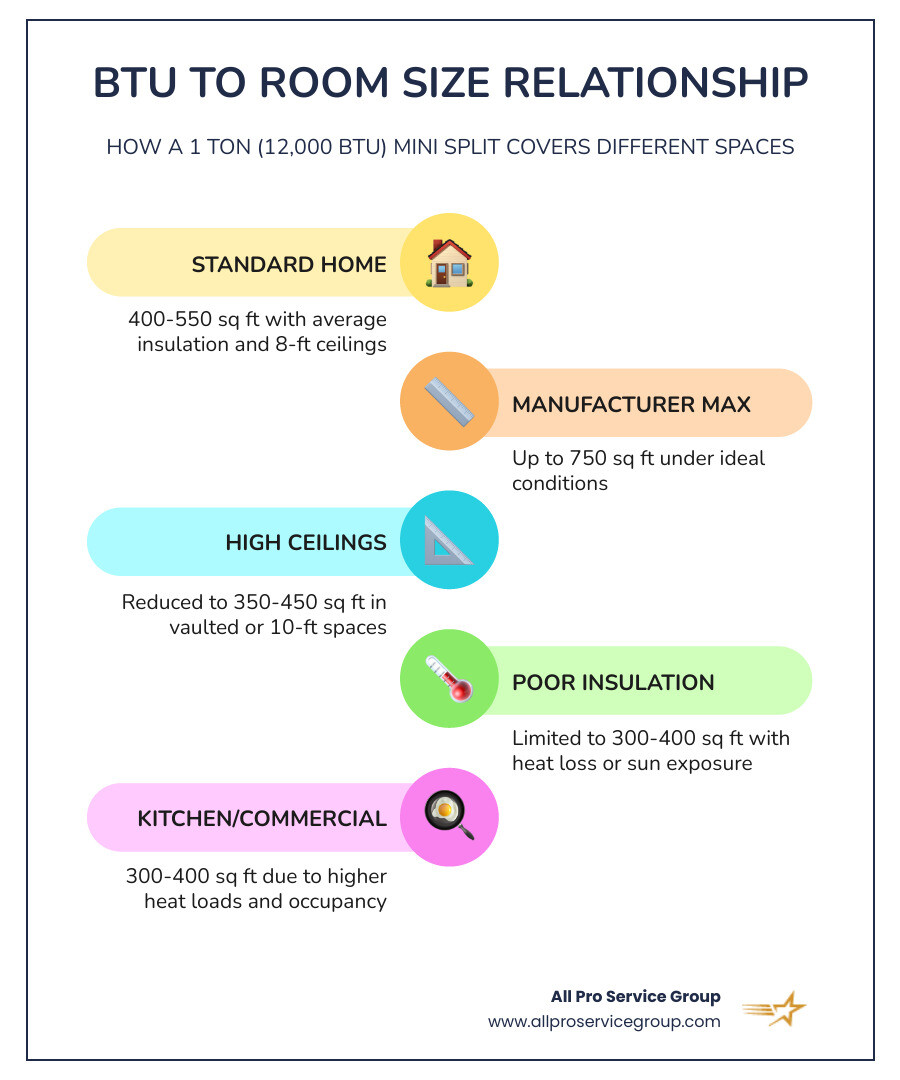
| Baseline (average insulation, 8-ft ceilings, Zone 4) | 400–550 sq ft |
| Manufacturer maximum rating | Up to 750 sq ft |
| Poor insulation or high ceilings | 350–450 sq ft |
| Commercial or kitchen spaces | 300–400 sq ft |
The standard rule: A 1 ton (12,000 BTU) mini split is designed to cover roughly 400 to 550 square feet under normal residential conditions. Some manufacturers rate their units up to 750 sq ft, but real-world performance depends heavily on your space.
Your actual coverage will vary. Ceiling height, insulation quality, sun exposure, and local climate all push that number up or down — sometimes significantly.
In Salt Lake Valley, where summers spike and winters bite, getting the sizing right matters more than most people realize. A unit that's too small runs constantly and wears out fast. A unit that's too big short-cycles, leaves your space feeling clammy, and wastes energy every month.
I'm with All Pro Service Group, and our team has been sizing and installing ductless systems across the Greater Salt Lake area since 2008 — including plenty of 1 ton mini split square footage assessments for bedrooms, home offices, and add-on spaces. In this guide, I'll walk you through everything that affects real-world coverage so you can make a confident decision.
Understanding 1 ton mini split square footage Coverage
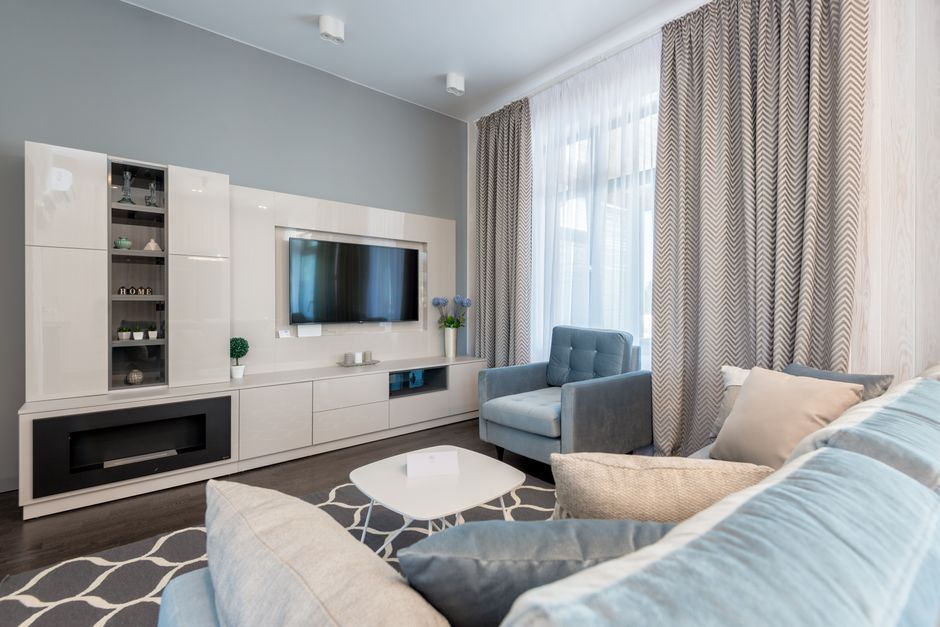
When we talk about a "1 ton" unit, we aren't talking about how much the machine weighs on a scale. In the HVAC world, a "ton" is a measurement of cooling capacity. Specifically, one ton equals 12,000 BTUs (British Thermal Units) per hour. This term actually dates back to the days before electricity, referring to the amount of heat required to melt one literal ton of ice over 24 hours.
For most homeowners in places like South Jordan or West Valley City, a 1 ton mini split square footage range of 400 to 650 square feet is the "sweet spot." While some high-efficiency units are marketed to handle up to 750 sq.ft, we usually recommend staying within the 500-sq.ft range to ensure the system doesn't have to struggle during a record-breaking Utah heatwave.
To get a more technical estimate for your specific home layout, you can use a Mini Split Size Calculator — BTU & Multi-Zone Guide. If you are new to ductless heating and cooling, our ductless mini splits complete guide provides a deep dive into how these systems function without the need for bulky metal ductwork.
Ideal Room Types for 1 ton mini split square footage
A 12,000 BTU unit is the industry standard for medium-to-large single rooms. It is often too powerful for a small guest bedroom but not quite enough for a massive open-concept great room.
Here is how the 1-ton unit stacks up against other common sizes:
| Unit Size | BTU Rating | Typical Square Footage | Best Use Case |
|---|---|---|---|
| 0.75 Ton | 9,000 BTU | 250–400 sq ft | Small bedrooms, nurseries, home offices |
| 1 Ton | 12,000 BTU | 400–650 sq ft | Master suites, large living rooms, ADUs |
| 1.5 Ton | 18,000 BTU | 650–1,000 sq ft | Open floor plans, small apartments, basements |
We frequently install these in master bedrooms where the central AC just can't keep up, or in "Accessory Dwelling Units" (ADUs) and finished basements in Salt Lake City where homeowners want independent temperature control.
Adjusting 1 ton mini split square footage for Climate and Layout
Location matters. Utah is primarily in Climate Zone 4, which means we deal with dry, hot summers and cold, snowy winters. Because mini splits are heat pumps, they have to work harder when the outside temperature drops.
If you have an open floor plan, the air can move more freely, but "air doesn't turn corners on command." If your 500-square-foot space is divided by heavy walls or long hallways, a single 1-ton head might leave the far corners feeling neglected. Furthermore, if you’re placing the unit in a kitchen, you need to account for the heat generated by the oven and stove. Standard practice is to add about 4,000 BTUs to your calculation for kitchen spaces. You can use an AC Tonnage Calculator – Find the Right Air Conditioner Size Fast to see how these variables shift your requirements.
Critical Factors Affecting Real-World Performance
Square footage is just the starting point. If we only looked at the floor area, we’d get the sizing wrong half the time. Here are the "hidden" factors that change the 1 ton mini split square footage effectiveness:
- Ceiling Height: Standard calculations assume 8-foot ceilings. If you have 10-foot ceilings or vaulted spaces common in newer Park City homes, you have more volume of air to cool. We generally recommend increasing your BTU requirement by 12.5% for every foot over 8 feet.
- Sun Exposure: Does the room have massive south-facing windows? Solar heat gain is real. If the room is bathed in direct sunlight for most of the afternoon, you should increase your capacity by about 10–20%.
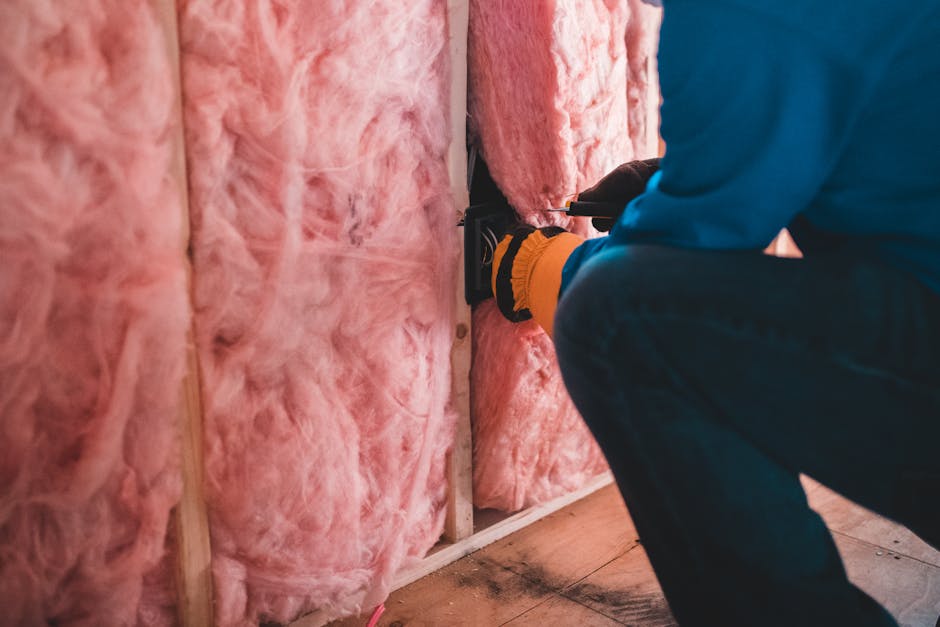
- Insulation Quality: An old bungalow in Liberty Wells with original windows and thin insulation will require much more "oomph" than a spray-foamed new build in South Jordan. Poor insulation can reduce your effective coverage area by 20% or more.
- Occupancy Load: People are essentially 600-BTU space heaters. If the 1-ton unit is for a home gym or a living room where the whole family gathers, you need to account for that extra body heat.
Environmental Limitations and Extreme Temperatures
By May 2026, inverter technology has reached impressive new heights. Modern 1-ton units can often provide effective cooling in outside temperatures as high as 131°F and continue heating down to -13°F. This is vital for our Utah winters.
Many systems now feature auto-defrost and "cold-climate" engineering to ensure the outdoor coil doesn't turn into a block of ice when it's snowing in Ogden. If you're looking for a simpler electrical setup, you might consider a 110v mini split, though most 12,000 BTU units in 2026 still perform best on a dedicated 220v circuit.
Efficiency Ratings and Inverter Technology in 2026
The days of "on-off" air conditioners are fading. In 2026, the gold standard is Inverter Technology.
Traditional ACs work like a light switch—they are either 100% on or 100% off. This leads to those annoying temperature swings and loud "clunks" when the system kicks in. An inverter unit works more like a gas pedal. It slows down or speeds up the compressor to maintain a perfectly steady temperature.
This technology allows for:
- Lower Power Consumption: Because the system doesn't have to "surge" to start up every 10 minutes, it uses significantly less electricity.
- Silent Operation: Many indoor units now operate at 26 dB—that’s quieter than a whisper in a library.
- High SEER2 Ratings: Seasonal Energy Efficiency Ratio (SEER2) ratings for 1-ton units now range from 17 to over 35. A higher SEER rating means more cooling for every dollar spent on your utility bill.
Under the Inflation Reduction Act, many of these high-efficiency heat pumps qualify for federal tax credits of up to 30% of the cost (capped at $2,000 per year), making 2026 a fantastic time to upgrade.
Installation Considerations for Optimal Airflow
You could buy the most expensive 1-ton unit in the world, but if it’s installed poorly, it won't cover the square footage it's supposed to. At All Pro Service Group, we always start with a Manual J load calculation. This is a professional assessment that looks at your windows, walls, and orientation to find the exact BTU needs.
Proper placement is key:
- Indoor Head Placement: The unit should be mounted 6–7 feet off the floor on an exterior wall if possible. This allows for easier drainage and better air distribution.
- Clearance: You need at least 4–6 inches of "breathing room" between the top of the unit and the ceiling.
- Line Set Length: Most 1-ton kits come with 16.4-foot copper lines. While you can extend these, keeping the run short and straight improves efficiency.
- Outdoor Unit: The condenser needs at least 2 feet of clearance on all sides to ensure it can exhaust heat properly.
For a professional look and guaranteed performance, checking out our heating air ductless mini splits service page can help you understand the installation process from start to finish.
Avoiding Common Sizing Mistakes
The biggest mistake we see is "oversizing." Homeowners often think, "If a 1-ton is good, a 1.5-ton must be better!"
Actually, an oversized unit is a nightmare. It will cool the room so fast that it finishes the job in three minutes. This is called short cycling. Because the unit doesn't run long enough, it never has a chance to pull moisture out of the air. You end up with a room that is cold but "clammy" and humid. It also puts massive wear and tear on the compressor, leading to early system failure.
On the flip side, an undersized unit will run 24/7, never reaching the set temperature, and sending your power bill through the roof. This is why a consultation with a professional HVAC technician is non-negotiable.
Frequently Asked Questions about 12,000 BTU Units
Can a 1 ton mini split cool 1,000 square feet?
In 99% of cases, no. While a 1-ton unit is powerful, 1,000 square feet is nearly double its intended capacity. If you tried this in a Salt Lake summer, the unit would run constantly and the room would likely stay in the high 70s or low 80s. For 1,000 square feet, you generally need a 24,000 BTU (2-ton) system.
What is the difference between 110v and 220v 1-ton units?
A 110v unit can sometimes be plugged into a standard household outlet (if it's on a dedicated circuit), which makes installation cheaper. However, 220v units are generally more efficient and are the standard for most high-performance 12,000 BTU systems. In 2026, most "cold climate" models that provide heavy-duty heating require a 220v connection.
How does a 1 ton mini split compare to a portable AC?
There is no contest. A 12,000 BTU portable AC is lucky to effectively cool 300 square feet because they are notoriously inefficient and leak heat back into the room through the exhaust hose. A 12,000 BTU mini split is a permanent, high-efficiency HVAC system that will outperform a portable unit while using about half the electricity and making a fraction of the noise.
Conclusion
Sizing a 1 ton mini split square footage correctly is the difference between a cozy home and a frustrating utility bill. Whether you are in Ogden, Provo, or right here in Salt Lake City, understanding how your home's unique features affect your HVAC needs is the first step toward comfort.
All Pro Service Group has been serving the Greater Salt Lake Valley since 2008. We are proud to be "Gephardt Approved" and our team of trained experts is ready to help you with dependable repair, replacement, and inspections. We offer flexible financing options and 24/7 availability for those times when your AC decides to quit in the middle of a July heatwave.
If you're ready to see if a 12,000 BTU system is the right fit for your space, visit our heating air ductless mini splits page or give us a call today. We'll make sure your "ton" of cooling is exactly what your home needs.