
Choosing the Right 18000 BTU Mini Split
An 18000 btu mini split is a 1.5-ton ductless heat pump designed for heating and cooling a medium-to-large space without adding ductwork. For many homes, it is a strong fit for an open living area, large primary suite, finished basement, or well-insulated garage conversion.
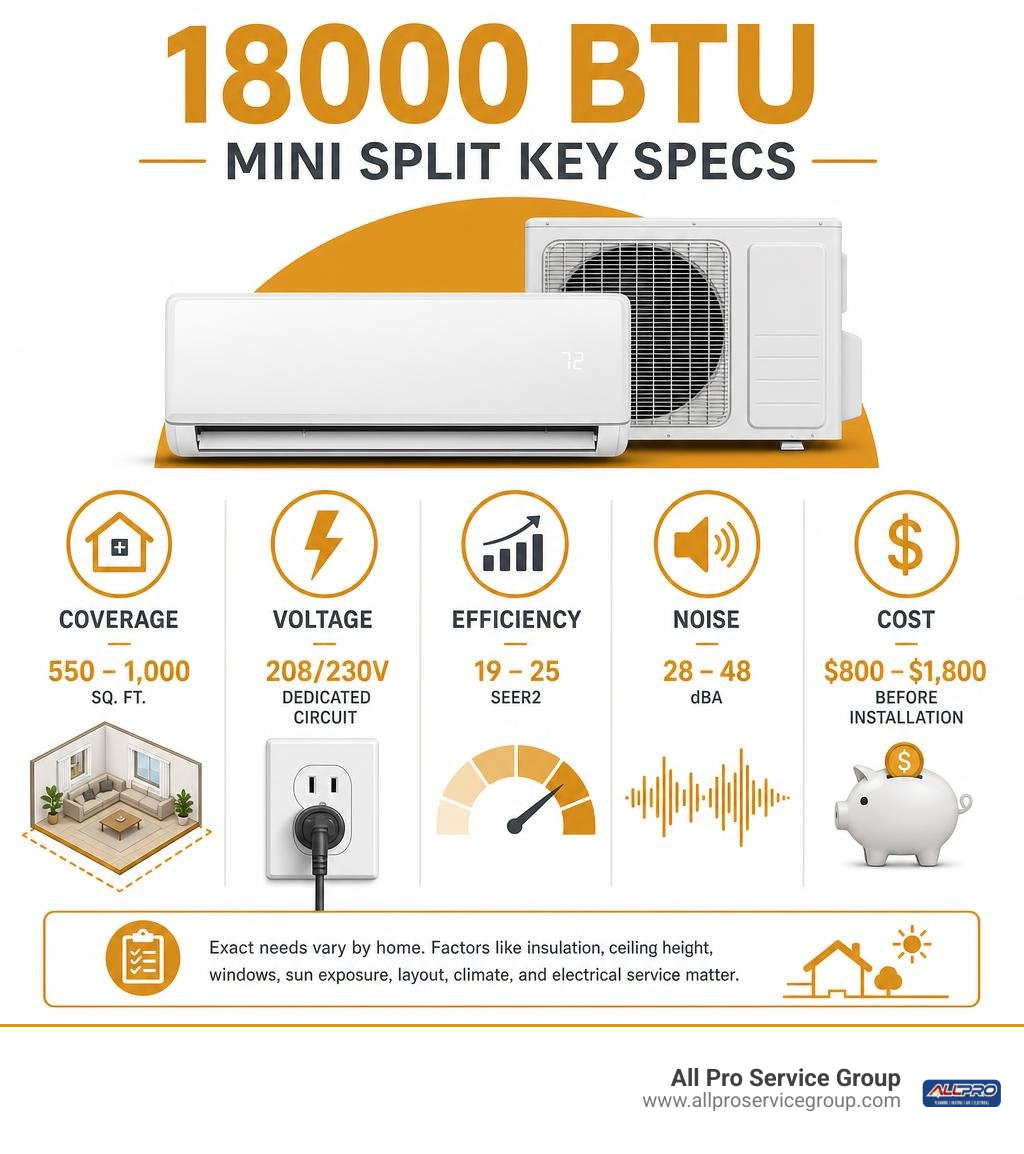
Quick answer: Most 18,000 BTU mini splits serve about 550 to 1,000 square feet under normal conditions. The right choice depends on the home's insulation, ceiling height, window area, sun exposure, layout, winter temperatures, and available electrical service.
| What to compare | Typical 18,000 BTU mini split range |
|---|---|
| Capacity | 18,000 BTU, or 1.5 tons |
| Coverage | About 550-1,000 sq. ft. |
| Electrical supply | Usually a dedicated 208/230V circuit |
| Efficiency | Roughly 19-25 SEER2, depending on model |
| Indoor sound | Often about 28-48 dBA |
| Equipment price | Commonly $800-$1,800 before installation |
The capacity number alone does not guarantee comfort. A sunny room with tall ceilings and weak insulation may need more capacity than a smaller, shaded room with strong insulation. In the Greater Salt Lake area, cold-weather heating performance and proper electrical setup also deserve close attention before you buy.
At All Pro Service Group, since 2008, our team has helped Greater Salt Lake homeowners assess heating, cooling, and electrical needs, including the practical sizing and installation factors behind an 18000 btu mini split.
Sizing and Coverage: What Size Room Can an 18000 BTU Mini Split Handle?
When evaluating an 18000 btu mini split, understanding its coverage capacity is the first step toward getting year-round indoor comfort. In HVAC terms, 12,000 BTUs equal 1 ton of cooling capacity, which means an 18,000 BTU system is rated at exactly 1.5 tons.

Under standard residential conditions, an 18,000 BTU mini split reliably heats and cools areas ranging from 550 to 1,000 square feet. However, coverage isn't just about floor space—it’s also about heat load. If your space has tall ceilings, large south-facing windows, or outdated insulation, the actual heat load increases significantly. If you are comparing different room sizes, you might also want to review our 1 Ton Mini Split Square Footage guide to see how 1-ton (12,000 BTU) models stack up against 1.5-ton systems.
Calculating Square Footage Limits for an 18000 BTU Mini Split
To calculate whether an 18,000 BTU unit fits your space, start with the basic floor dimensions (Length × Width). A standard room of 30 feet by 25 feet gives you 750 square feet, placing it right in the sweet spot for a 1.5-ton system.
Here is how square footage limits break down based on home conditions:
- 350–500 sq. ft.: Highly demanding spaces such as uninsulated 2-car garages, rooms with low-emissivity glass, or spaces with extreme heat-generating equipment.
- 550–750 sq. ft.: Moderate spaces with standard 8-foot ceilings, average window counts, and typical insulation levels.
- 750–1,000 sq. ft.: Well-insulated residential rooms, modern open-concept main levels, or finished basements with minimal direct sun exposure.
- Up to 1,250 sq. ft.: High-efficiency inverter models (such as 22+ SEER2 units) installed in newly constructed energy-efficient spaces with air-tight sealing and low ceilings.
For specialized setups like garage workshops or home gyms, an 18,000 BTU heat pump provides ample heating and cooling capacity, provided the walls and garage doors are insulated. Before committing to a unit size, running a formal HVAC load calculation helps verify that you aren't under-sizing or over-sizing your system.
How Climate and Room Layout Affect Sizing
Geography and interior architecture dictate how hard your air conditioner has to work. In northern Utah—from Salt Lake City to Park City and Provo—winters bring sub-freezing temperatures while summer afternoons frequently climb into the high 90s.
Key structural factors that affect mini split performance include:
- Ceiling Height: Standard sizing assumes 8-foot ceilings. If your living space features 10-foot or 12-foot vaulted ceilings, the total air volume increases by 25% to 50%, requiring additional heating and cooling capacity.
- Sun Exposure and Windows: South- or west-facing rooms with expansive window walls absorb massive amounts of solar heat during peak summer hours.
- Open Floor Plans vs. Partitioned Rooms: Ductless indoor units blow conditioned air directly into the space where they are installed. An open-concept living room and kitchen layout allows air to circulate freely, whereas doorway barriers block airflow to neighboring bedrooms.
If your space is closer to 400 to 500 square feet, exploring our 12000 BTU Mini Split Guide 2026 can help you decide if a smaller unit might be more cost-effective. Alternatively, if your space lies right between sizes, reviewing options like a 23000 BTU Mini Split or checking our 12 BTU Mini Split Guide 2026 will clarify your choices.
Electrical Requirements: 230V vs 115V Power Options
Installing an 18000 btu mini split requires careful electrical planning. Unlike smaller 9,000 or 12,000 BTU units that sometimes plug into standard 115V household outlets, 1.5-ton systems almost universally demand high-voltage power to run their compressor motors efficiently.
Standard 230V Voltage Specifications
The industry standard for an 18,000 BTU mini split is a dedicated 208/230V single-phase electrical circuit. Operating on 230V allows the system to draw fewer amperes while delivering the heavy wattage required for high-capacity cooling and heating.
Standard electrical installation specs for an 18,000 BTU system include:
- Circuit Breaker: A dedicated 15-amp or 20-amp double-pole circuit breaker in your main breaker panel.
- Minimum Circuit Ampacity (MCA): Typically around 13 to 15 amps.
- Running Amperage: Between 6.0 and 10.0 amps during continuous inverter operation.
- Wiring Gauge: 12 AWG or 14 AWG copper wire (2 hots, 1 ground) running from the main panel to an outdoor disconnect switch mounted near the condenser.
- Interconnecting Cable: 14 AWG or 16 AWG 4-conductor shielded wire connecting the outdoor condenser to the indoor wall unit.
Running your equipment on a 230V circuit reduces line resistance, generates less heat along the power line, and extends the lifespan of the compressor motor.
Can You Run a 1.5-Ton System on 115V?
Homeowners often ask if they can install an 18,000 BTU unit on standard 115V household wiring. While standard industry units require 230V power, a handful of specialty manufacturers offer 115V models. However, running a 1.5-ton compressor on 115V comes with notable engineering trade-offs.
At 115 volts, producing 18,000 BTUs of thermal energy requires double the amperage—often pushing current draw to 16–18+ amps continuous. This high current draw requires thicker wire gauges (such as 10 AWG copper), increases line voltage drop over longer distances, and risks tripping standard household breakers if any other appliance shares the circuit.
For an in-depth look at lower-voltage alternatives, check out our 110 Volt Mini Split Guide 2026, our guide on the 110v Mini Split, or our specialized overview of 12 Volt Mini Split Guide technology for off-grid applications. For permanent home installations, hardwiring a dedicated 230V circuit remains the safest and most efficient choice.
Efficiency, Noise Levels, and Winter Heating Performance
Modern inverter-driven mini splits are among the most energy-efficient HVAC options available today. Instead of turning on and off at full power like traditional central AC units, DC inverter compressors automatically ramp their speed up or down to maintain your desired room temperature.
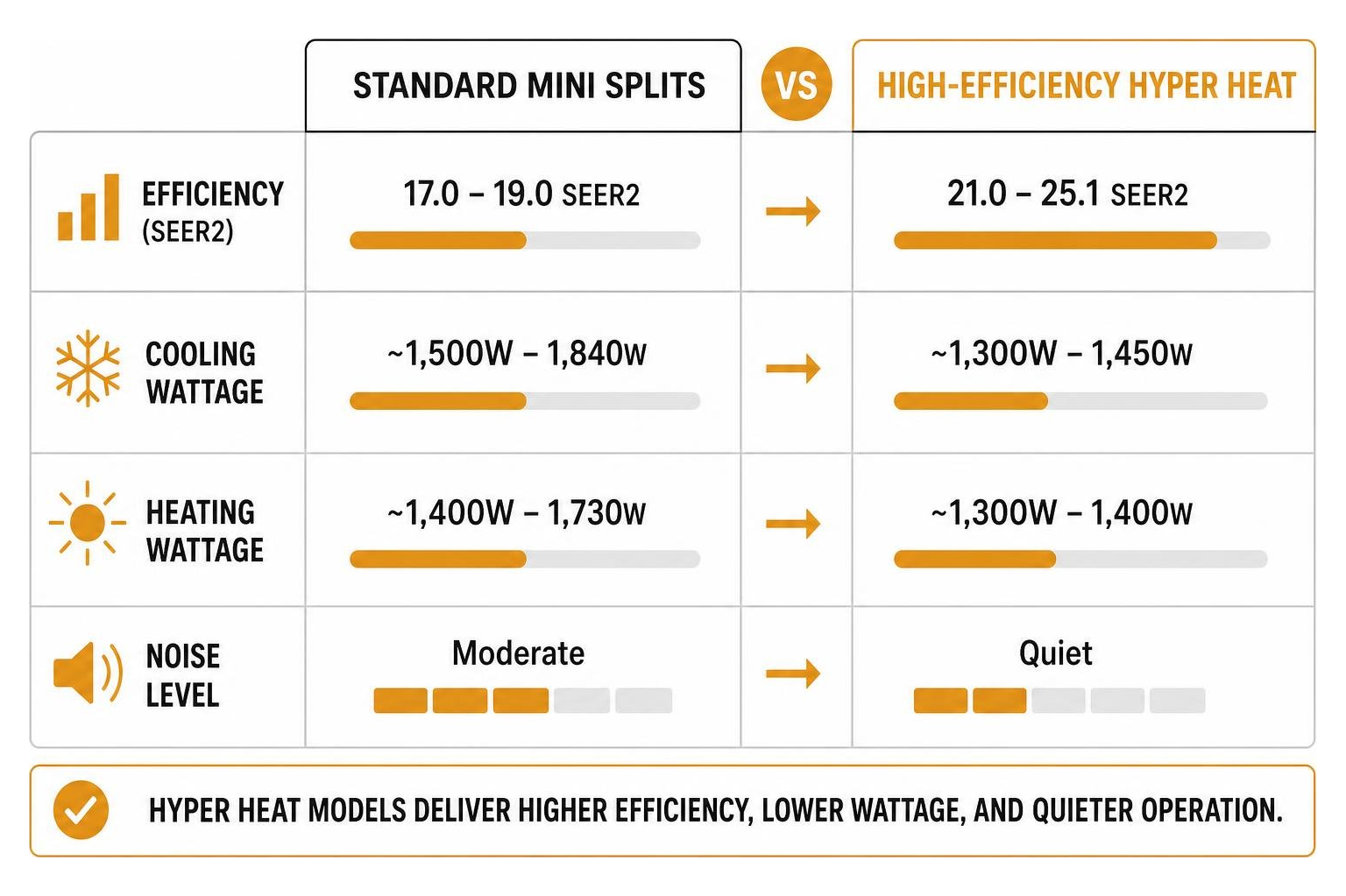
| Feature / Metric | Standard Efficiency Tier | High-Efficiency / Hyper-Heat Tier |
|---|---|---|
| SEER2 Efficiency | 17.0 – 19.0 SEER2 | 21.0 – 25.1 SEER2 |
| Cooling Wattage | ~1,500W – 1,840W | ~1,300W – 1,450W |
| Heating Wattage | ~1,400W – 1,730W | ~1,300W – 1,400W |
| Indoor Sound Level | 32 dBA – 48 dBA | 28 dBA – 40 dBA (28 dBA in Sleep Mode) |
| Outdoor Sound Level | 54 dBA – 56 dBA | 50 dBA – 52 dBA |
| Low-Temp Heating | Down to 5°F or -4°F | Down to -15°F or -22°F |
| Est. Monthly Electricity Cost | $70 – $85 / month | $50 – $65 / month |
Comparing Top Brands and Energy Efficiency for an 18000 BTU Mini Split
Efficiency ratings for mini splits are measured in SEER2(Seasonal Energy Efficiency Ratio 2) for cooling and HSPF2(Heating Seasonal Performance Factor 2) for heating. Modern 18,000 BTU units generally carry SEER2 ratings between 17.0 and 25.1. High-efficiency models feature eco-friendly refrigerants like R32 and R454B, which provide superior heat transfer properties with significantly lower Global Warming Potential (GWP) than older R410A systems.
When browsing models across retailers and HVAC distributors:
- Units rated around 17 to 19 SEER2—such as the Filterbuy 18,000 BTU Ductless Mini Split AC & Heat Pump | 230V | 17 SEER or the 18000BTU 19 SEER2 208/230V Ductless Mini Split Air Conditioner & Heater - Eletriclife —offer accessible entry-level pricing.
- Higher tier models rated at 21 to 22 SEER2—including options like the HOMCOM 18000 BTU Mini Split Air Conditioner and Heat Pump, 22 SEER2 230V WIFI Enabled Energy Efficient Ductless Inverter AC Unit Cools up to 1250 Sq.Ft, Works with Alexa, Installation Kit(also detailed on HOMCOM 18000 BTU Mini Split Air Conditioner, 22 SEER2 230V WIFI Enabled Inverter AC Unit Cools up to 1250 Sq.Ft | Aosom.com)—deliver a strong balance of energy savings and smart Wi-Fi integration.
- Standard systems listed across marketplaces like 18000 BTU Mini Split Air Conditioners or featured on Robot or human? provide reliable residential temperature control.
Equipment costs for an 18,000 BTU mini split typically range between $800 and $1,800, depending on the SEER2 rating, smart capabilities, and cold-climate heating features. On average, operating an 18,000 BTU high-efficiency unit for 8 hours a day costs between $50 and $85 per month, assuming an electricity rate of $0.15 per kWh.
Low Ambient Heating and Quiet Operation
For homeowners living in cold regions like Salt Lake City, Park City, or South Jordan, winter performance is essential. Standard mini split heat pumps lose heating efficiency as outdoor temperatures drop below freezing (32°F). However, specialized Hyper Heat or Ultra Heat models use vapor-injection compressors and pan heaters to deliver 100% heating capacity down to -15°F or even -22°F.
In addition to warming your space in deep winter, indoor noise control is another major advantage of ductless systems. Because the heavy compressor sits outside, the indoor wall unit only houses a balanced cross-flow fan wheel. On standard settings, indoor units produce 31 to 45 dBA—roughly the sound of a quiet library. On "Mute" or "Sleep Mode," sound levels drop as low as 28 dBA, making an 18,000 BTU unit quiet enough for master bedrooms, nurseries, or home offices.
Single-Zone vs Multi-Zone Ductless Configurations
When selecting an 18,000 BTU system, you must decide whether to direct all 1.5 tons of capacity into a single large room or split that power across multiple spaces.
Single-Zone Open Floor Plan Applications
A single-zone 18,000 BTU system consists of one outdoor condenser connected to one indoor air handler mounted on the wall. This setup delivers the full 18,000 BTUs of cooling and heating directly into a single zone.
Single-zone setups are ideal for:
- Large open-concept living rooms, dining spaces, and kitchen areas.
- Insulated 2-car garage workshops or converted bonus rooms.
- Master bedroom suites with attached sitting areas and high vaulted ceilings.
- Detached guest houses, accessory dwelling units (ADUs), or studio lofts.
Multi-Zone 18000 BTU Heat Pump Setups
If you want to heat and cool two or three smaller adjoining rooms, a multi-zone mini split setup allows you to connect multiple indoor handlers to a single 18,000 BTU outdoor compressor.
For instance, an 18,000 BTU outdoor unit can power:
- Two 9,000 BTU indoor units: Perfect for conditioning two separate 350-square-foot bedrooms independently.
- One 12,000 BTU unit + one 6,000 BTU unit: Ideal for an open living room paired with a smaller office.
Each indoor unit features its own thermostat and wireless remote, allowing family members to set custom temperatures in different rooms. If you are exploring multi-zone layouts or considering scaling up total household capacity, our Complete Guide 24000 BTU Dual Zone Mini Split provides valuable insights into how multi-room systems balance capacity.
Professional Installation vs DIY Setup
While direct-to-consumer mini split kits are widely advertised, installing an 18,000 BTU ductless heat pump involves complex electrical wiring, pressurized lines, and EPA refrigerant regulations.

Here is how professional installation compares to a DIY attempt:
- Refrigerant Line Evacuation: Professional installation requires pulling a deep vacuum (down to under 500 microns) using a specialized vacuum pump and micron gauge to eliminate moisture and non-condensable gases. Skipping this step leads to internal acid formation, poor performance, and early compressor failure.
- Flaring and Leak Testing: Professional technicians perform precision nitrogen pressure testing and torque-flaring on copper refrigerant lines to prevent costly refrigerant leaks.
- Electrical Connections: An 18,000 BTU unit requires hardwiring a 208/230V double-pole breaker, mounting a weatherproof outdoor disconnect switch, and routing proper gauge wiring.
- Warranty Preservation: Most major HVAC manufacturers explicitly state in their warranty terms that system coverage is void unless the unit is commissioned by a licensed HVAC contractor.
- Rebate Eligibility: Utility companies throughout Utah offer energy-efficiency rebates for high-SEER2 heat pump installations, but these rebates almost universally require proof of licensed professional installation.
The total cost for an 18,000 BTU mini split system—including the equipment, electrical wiring, mounting hardware, line sets, and professional labor—typically ranges between $3,200 and $6,500. Investing in professional installation ensures your system runs safely, operates at peak efficiency, and lasts for years to come. For a complete breakdown of installation practices, read our comprehensive Ductless Mini Splits Complete Guide.
Frequently Asked Questions
How much does it cost to run a 1.5-ton ductless system per month?
Running a high-efficiency 1.5-ton (18,000 BTU) mini split typically costs between $50 and $85 per month. Actual operating costs depend on your local electric rates, your indoor temperature settings, outdoor weather conditions, and your system's SEER2 efficiency rating. Inverter compressors automatically scale down power draw during steady-state operation, drawing as little as 600 to 800 watts per hour once your room reaches the set temperature.
Can this capacity heat reliably in sub-zero winter temperatures?
Yes, provided you select a model equipped with cold-climate Hyper Heat or Ultra Heat technology. Standard heat pumps struggle when outdoor temperatures drop below freezing, but hyper-heat units feature specialized compressors that maintain reliable heating output down to -15°F or -22°F.
Can I install a 1.5-ton ductless system myself without a professional?
While some pre-charged DIY mini split kits exist, self-installing an 18,000 BTU unit is generally not recommended. Standard systems require precision line flaring, vacuuming with specialized HVAC tools, and high-voltage (230V) electrical wiring. Performing a DIY setup often voids the manufacturer’s warranty and renders the system ineligible for local utility rebates.
Conclusion
An 18000 btu mini split offers an ideal heating and cooling solution for spaces between 550 and 1,000 square feet. Whether you are conditioning an open-concept living area, building out an ADU, or converting a garage into a comfortable workshop, a 1.5-ton ductless heat pump delivers exceptional year-round comfort, whisper-quiet operation, and low monthly energy bills.
To get the most out of your investment, keep these key takeaways in mind:
- Size accurately: Factor in ceiling height, insulation quality, and window exposure alongside simple square footage.
- Verify electrical service: Ensure your main breaker panel can accommodate a dedicated 208/230V double-pole circuit.
- Choose the right features: If you experience freezing winters, select a high-SEER2 unit with low-ambient hyper-heating capabilities.
- Hire certified experts: Professional installation protects your investment, preserves your warranty, and ensures long-term system efficiency.
If you live in Salt Lake City, West Valley City, West Jordan, South Jordan, Sandy, Provo, Ogden, Park City, or anywhere in the Greater Salt Lake area, our team at All Pro Service Group is ready to help you select, size, and install the perfect ductless climate system. Explore our Heating Air Ductless Mini Splits service page today to request an expert consultation and take the first step toward customized year-round home comfort!