What Is a 110 Volt Mini Split — and Is It Right for Your Home?
A 110 volt mini split is a ductless heating and cooling system that runs on standard household voltage — no expensive electrical panel upgrades required. Here's a quick snapshot of what you need to know:
At a glance:
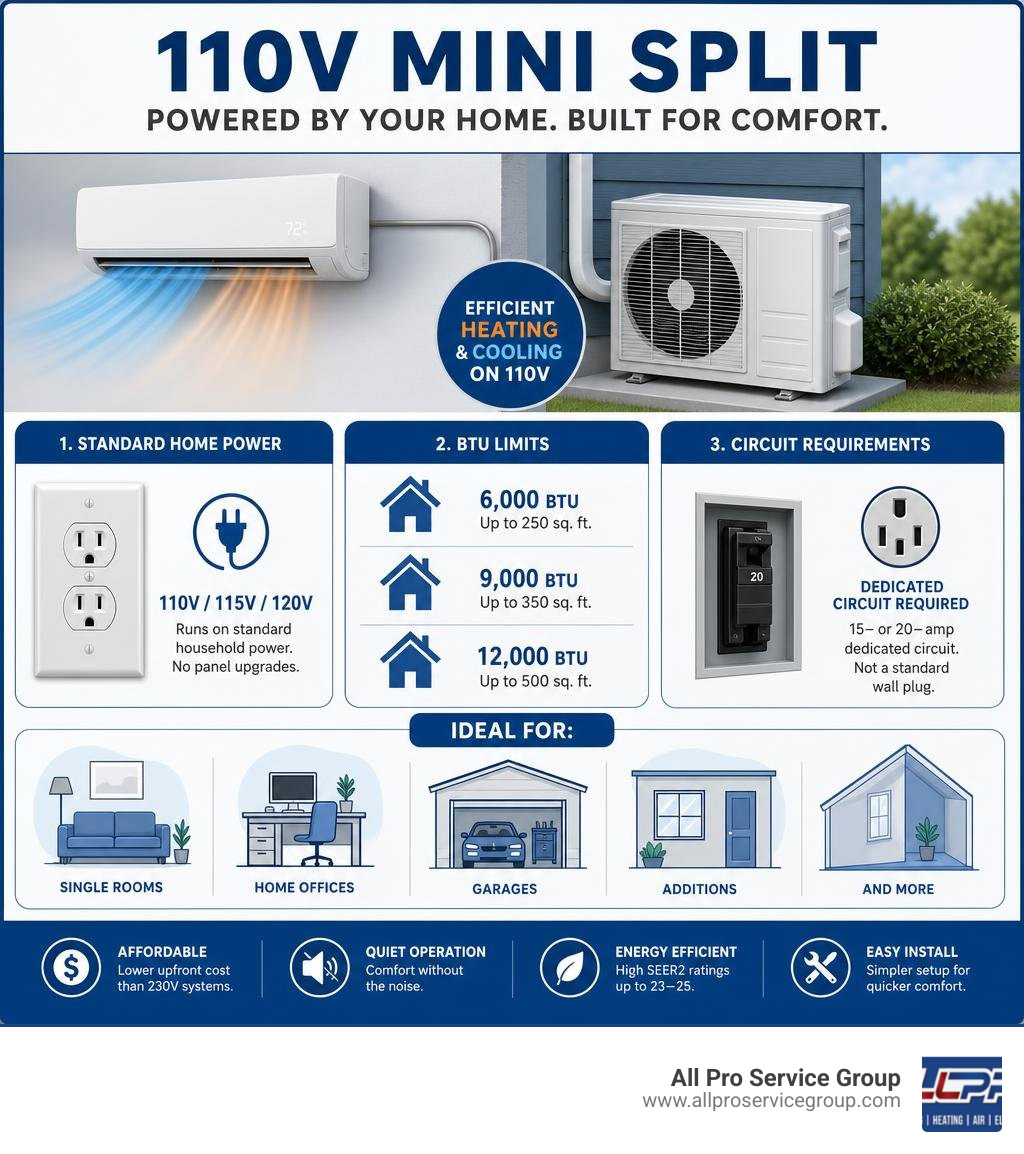
- Voltage: 110V, 115V, and 120V are the same thing in North America — all run on standard household current
- Capacity: Available in 6,000, 9,000, and 12,000 BTU — covering spaces up to 500 sq. ft.
- Heating and cooling: Yes, most models are heat pumps that do both
- Electrical needs: Requires a dedicated 15- or 20-amp circuit — not a standard wall plug
- Efficiency: SEER2 ratings up to 23–25 depending on the model
- Price range: Roughly $650 to $1,165 for the unit; installation costs extra
- Best for: Single rooms, home offices, garages, and additions where running a 230V line isn't practical
Most homeowners assume that upgrading to a ductless system means tearing into their electrical panel for a 230V circuit. That assumption stops a lot of people cold — especially in older Salt Lake area homes where the wiring just isn't set up for it. The good news is that 110V mini splits sidestep that problem entirely, delivering real zoned comfort without the heavy electrical work.
At All Pro Service Group, our team has helped hundreds of Greater Salt Lake Valley homeowners evaluate and install 110 volt mini split systems as part of our full-service HVAC work. In this guide, we'll walk you through everything you need to make a confident decision.
Understanding the 110 Volt Mini Split: How It Works and Key Benefits

To understand why a 110 volt mini split is such a game-changer, it helps to understand how it operates. Like traditional central air conditioning, a mini split consists of two primary parts: an indoor air handler that distributes conditioned air and an outdoor compressor/condenser unit that rejects or absorbs heat.
The magic of modern standard-voltage ductless systems lies in DC Inverter Technology. Instead of turning completely on and off like a traditional furnace or air conditioner, an inverter compressor continuously regulates its speed to match the exact heating or cooling demand of the room. This variable-speed operation allows the system to run on a fraction of the power required by older, single-stage compressors.
For more background on how these standard-voltage systems function, you can find More info about standard 110v mini split systems.
When you choose to Explore standard voltage ductless options, you unlock several key advantages:
- No Panel Upgrades: Standard 230V mini splits require running a heavy-duty double-pole circuit from your main electrical panel. If your panel is already full, this can trigger a panel upgrade costing thousands of dollars. A 110V system avoids this entirely.
- Targeted Comfort (Zoning): Rather than cooling or heating an entire home to keep one room comfortable, mini splits allow you to control individual rooms independently.
- Whisper-Quiet Operation: Because the compressor sits outside, indoor noise levels can be as low as 23 to 27 dB(A)—which is quieter than a library whisper.
- Elimination of Duct Loss: Traditional ductwork can lose over 30% of a home's energy through leaks and poor insulation. Ductless systems deliver conditioned air directly into the space, keeping utility bills low.
Voltage Compatibility: 110V vs. 115V vs. 120V
One of the most common points of confusion for homeowners is the difference between 110V, 115V, and 120V ratings.
In North America, these terms are used interchangeably to describe standard residential electrical current. The nominal voltage supplied by the utility grid is typically 120V, but due to resistance and distance, the voltage at your wall outlet can fluctuate slightly down to 115V or 110V.
Whether a manufacturer labels their ductless system as a 110 volt mini split, a 115V system, or a 120V system, they are all designed to run on the exact same standard household branch circuit. You do not need a special transformer or separate utility hookup; they are fully compatible.
Sizing and Capacity Limits for a 110 Volt Mini Split
Because standard residential circuits have lower amperage limits than 230V circuits, 110V mini splits are strictly limited in their heating and cooling capacities. In almost all cases, standard-voltage mini splits max out at 12,000 BTU(which is equivalent to 1 Ton of cooling capacity).
If you are trying to determine how much space a 1-ton system can handle, you can Learn about 1 ton mini split square footage coverage.
As a general guideline, you can use the following capacity chart to match a unit to your space:
- 6,000 BTU: Best for small bedrooms or home offices up to 250 sq. ft.
- 9,000 BTU: Best for medium bedrooms, small living spaces, or insulated sheds up to 350 sq. ft.
- 12,000 BTU: Best for large master suites, open-concept family rooms, or small garages up to 500 or 550 sq. ft.
To dive deeper into what a 1-ton system can achieve, Read our 12000 BTU mini split guide for 2026. If you are looking for a concrete example of a high-efficiency 12,000 BTU unit that runs on standard household voltage, you can Check out the high-efficiency Rovsun 12000 BTU 115V system, which boasts a stellar 23 SEER2 rating and features built-in Wi-Fi control.
Comparing 110V and 230V Ductless Systems
When deciding between a standard-voltage unit and a higher-voltage system, you are essentially trading off upfront electrical installation costs against maximum heating and cooling capacity.
The comparison below highlights the primary differences:
| Feature / Specification | 110V / 115V Mini Splits | 230V / 240V Mini Splits |
|---|---|---|
| Max Capacity (Single-Zone) | Typically 12,000 BTU (Rarely up to 24,000 BTU) | Up to 36,000 BTU or higher |
| Multi-Zone Support | Almost strictly Single-Zone | Supports 2 to 8 zones on one outdoor unit |
| Electrical Upgrades Required | None (Runs on standard voltage) | Heavy-duty 230V circuit must be run |
| Upfront Electrical Prep Cost | Low ($0 to $300 for a dedicated circuit) | Moderate to High ($500 to $2,000+) |
| Energy Efficiency (SEER2) | High (Up to 23 - 25 SEER2) | Very High (Up to 25 - 30+ SEER2) |
| Best Suited For | Single rooms, retrofits, historical homes | Whole-house zoning, large spaces, multi-zone |
If you want to Compare with the Della Umbra 9100 BTU 230V system, you will find that higher-voltage single-zone units often offer unique aesthetic finishes, such as matte black, alongside stable performance. However, they require that dedicated 230V line. Similarly, you can Compare with the Costway EcoGuard 12000 BTU 230V system, which utilizes advanced eco-friendly refrigerants like R454B but still demands double-pole breaker space.
If your electrical panel is maxed out and you only need to heat and cool a single room under 550 square feet, a 110V unit is almost always the most cost-effective path. For a complete breakdown of all your options across single and multi-zone systems, Read our complete guide to ductless mini splits.
Installation Guidelines and Electrical Requirements
A common misconception about the 110 volt mini split is that you can simply unbox it, mount it to the wall, and plug it into the nearest standard bedroom outlet. This is not true.
While these units operate on standard household voltage, they still draw significant continuous amperage. To comply with local building codes, ensure safety, and prevent your home's breakers from constantly tripping, you must follow specific installation guidelines.
If you are considering handling the physical mounting and assembly yourself, you can Learn about DIY 110V mini split solutions. However, even with DIY-friendly kits, the electrical supply itself must be handled with care.
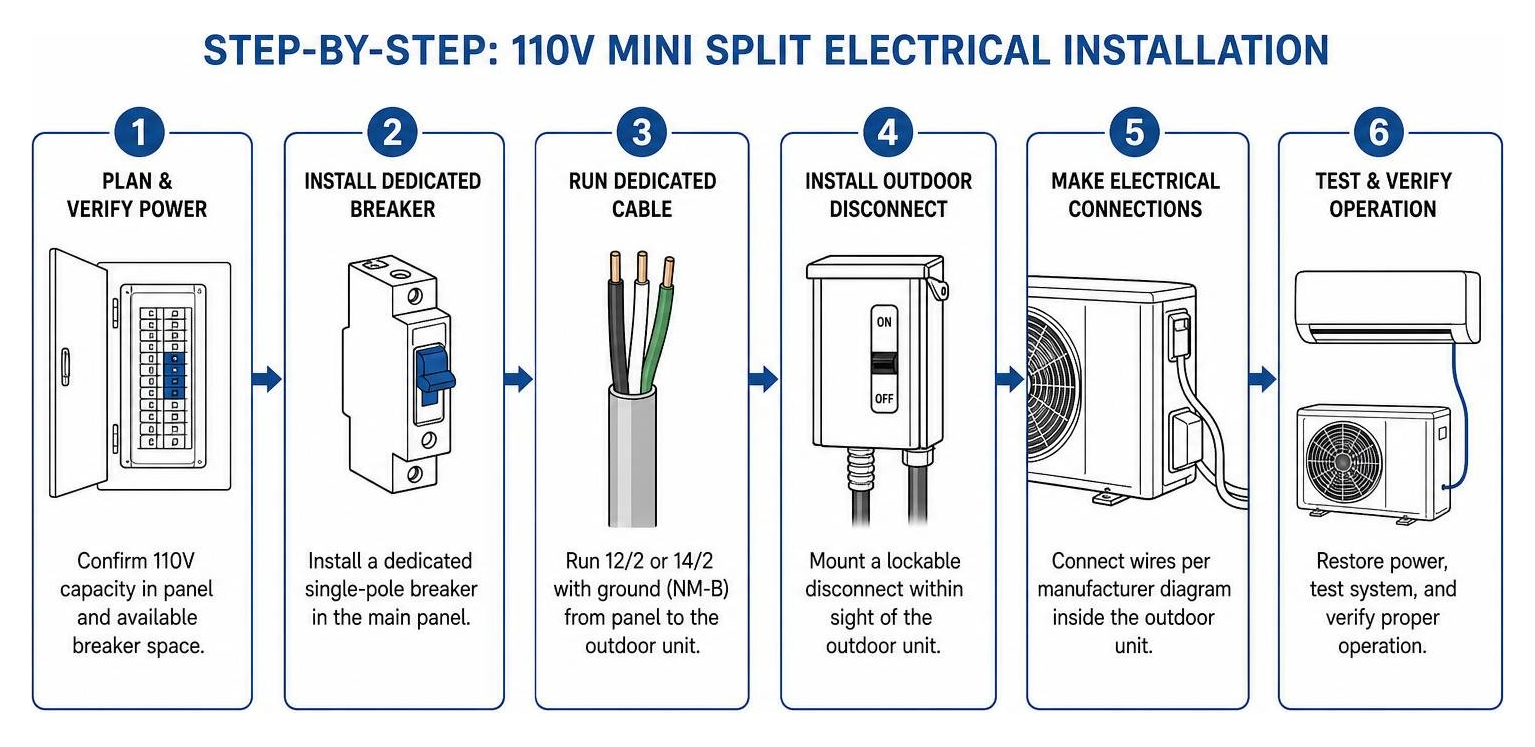
The typical installation sequence for the electrical portion of a mini split looks like this:
Electrical Requirements for a 110 Volt Mini Split Installation
To keep your system running safely and in compliance with the National Electrical Code (NFPA 70), your electrical setup must meet the following criteria:
- Dedicated Circuit Breaker: The mini split must have its own dedicated single-pole circuit breaker in your main panel. It cannot share a circuit with lights, outlets, or other appliances.
- Amperage and Fuse Sizing: A typical 12,000 BTU 115V system requires a Minimum Circuit Ampacity (MCA) of 15 to 17 Amps and a Maximum Fuse Size (MFS) of 20 to 25 Amps. This usually means installing a dedicated 20-amp breaker.
- Wire Gauge: For a 20-amp dedicated circuit, you must use 12 AWG copper wiring (like standard Romex) to prevent overheating.
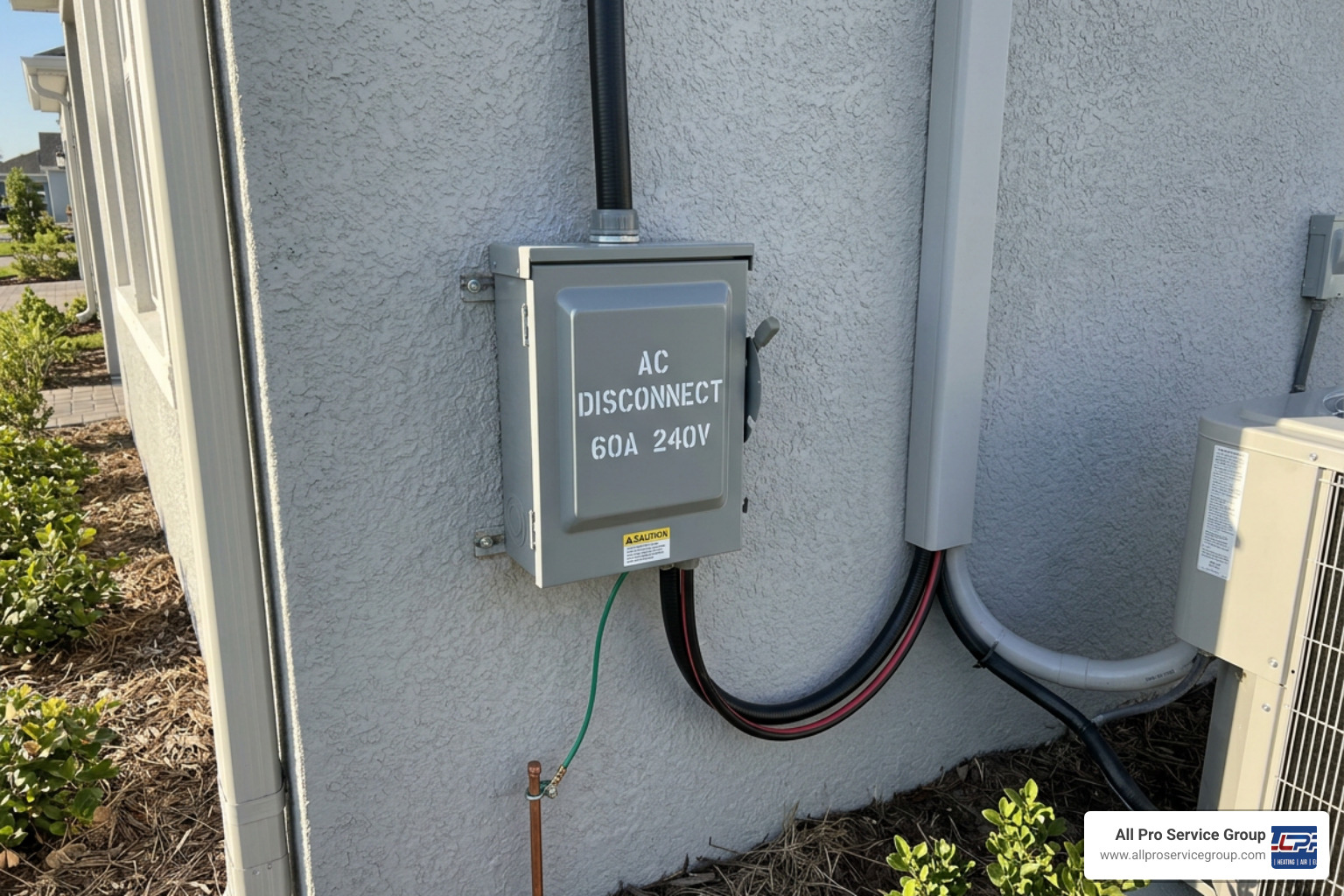
- Outdoor Disconnect Box: Local building codes require a weatherproof outdoor electrical disconnect box installed within sight of the outdoor condenser unit. This allows technicians to safely cut power to the unit during maintenance.
Are 110V Systems Suitable for DIY Installation?
Many standard-voltage mini splits are marketed directly to DIYers. Some brands offer pre-charged line sets, which means the copper refrigerant lines are sealed and pressurized with refrigerant at the factory.
If you choose to Read about the Costway GreyVolt 12000 BTU 115V system, you will see that while these units are packed with smart features like Alexa compatibility and offer high efficiency (22 SEER2), they still require proper installation steps.
For standard (non-DIY specific) line sets, a vacuum pump must be used to evacuate all air and moisture from the lines before releasing the refrigerant. Leaving moisture in the lines can damage the compressor and destroy the system within a few months. Furthermore, most manufacturers will void the equipment warranty if the system is not installed or at least commissioned by a licensed HVAC professional.
Frequently Asked Questions about Standard Voltage Mini Splits
Can a 110V mini split provide both heating and cooling?
Yes! Most modern 110V mini splits are designed as reversible heat pumps. They feature a reversing valve that changes the flow of refrigerant, allowing the system to extract heat from the outdoor air and pump it indoors during the winter.
If you Check out the Manastin 17 SEER2 mini split, you will find a budget-friendly 115V unit that cools in the summer and provides adequate heating down to -4°F. However, keep in mind that in extremely cold climates — like winters in Park City or Ogden — standard heat pumps can lose heating capacity as the temperature drops below freezing. If you live in a high-elevation or exceptionally cold area, you may need a specialized hyper-heating model or a secondary heat source.
What is the typical price range for a 110V ductless system?
For the equipment alone, a quality 110V mini split system typically ranges from $650 to $1,165 depending on the brand, BTU capacity, and SEER2 rating.
While DIY kits can save you upfront labor costs, hiring a professional HVAC technician to handle the mounting, line connections, vacuuming, and electrical hookup typically adds $1,500 to $3,000. However, because you avoid the $500 to $2,000 cost of running a new 230V line from your main electrical panel, the overall project cost is often significantly lower than installing a 230V system.
Do I need a dedicated circuit for a 110V mini split?
Yes, absolutely. Even though a 110 volt mini split uses standard household voltage, it draws a continuous load of 9 to 11 Amps (and up to 15+ Amps during startup). If you attempt to plug it into an existing bedroom or living room circuit that is already powering a computer, TV, or vacuum cleaner, you will instantly overload the circuit and trip the breaker. A dedicated 15-amp or 20-amp single-pole breaker is required for safe, uninterrupted operation.
Conclusion
A 110 volt mini split is one of the smartest, most cost-effective comfort upgrades you can make for your home. By operating on standard household voltage, these units allow you to bypass expensive panel upgrades and complicated wiring projects while still enjoying whisper-quiet, highly efficient zoned heating and cooling.
Whether you are looking to turn a cold basement room in Salt Lake City into a cozy home office, cool down a hot garage workshop in West Valley City, or add supplemental heat to a home addition in Provo, a standard-voltage ductless system is up to the task.
At All Pro Service Group, we have been providing dependable heating, air conditioning, and electrical services to Utah homeowners since 2008. As a "Gephardt Approved" company, we take pride in our exceptional customer service, trained experts, and flexible financing options. We proudly serve homeowners across the Greater Salt Lake Valley, including:
- Salt Lake City & South Salt Lake
- West Valley City & West Jordan
- South Jordan
- Ogden
- Provo
- Park City
If you want to ensure your new system is sized correctly, installed to local electrical codes, and protected by a full manufacturer warranty, we are here to help. Schedule professional ductless mini split services with All Pro Service Group today, and let our team of certified experts bring perfect year-round comfort to your home!