Hydronic heating delivers quiet, draft-free warmth throughout a home. For decades, achieving this level of indoor comfort required a bulky, dedicated space-heating boiler paired with a separate storage tank for domestic hot water. A modern combination boiler changes that dynamic entirely by packing both whole-house hydronic heating and high-efficiency on-demand water heating into a single, wall-hung cabinet.
Instead of burning fuel continuously to keep 50 gallons of standing water hot around the clock, these appliances fire only when a demand is detected. This on-demand approach cuts standby energy losses and can dramatically lower utility expenses. Homeowners who reclaim valuable square footage in their basements or mechanical rooms also gain a streamlined utility footprint with fewer exhaust vents penetrating the exterior walls. Understanding how these appliances balance two distinct thermal jobs within a single chassis is the key to determining if one is right for your property.
How a Tankless Combi Boiler Works and Why Homeowners Choose It
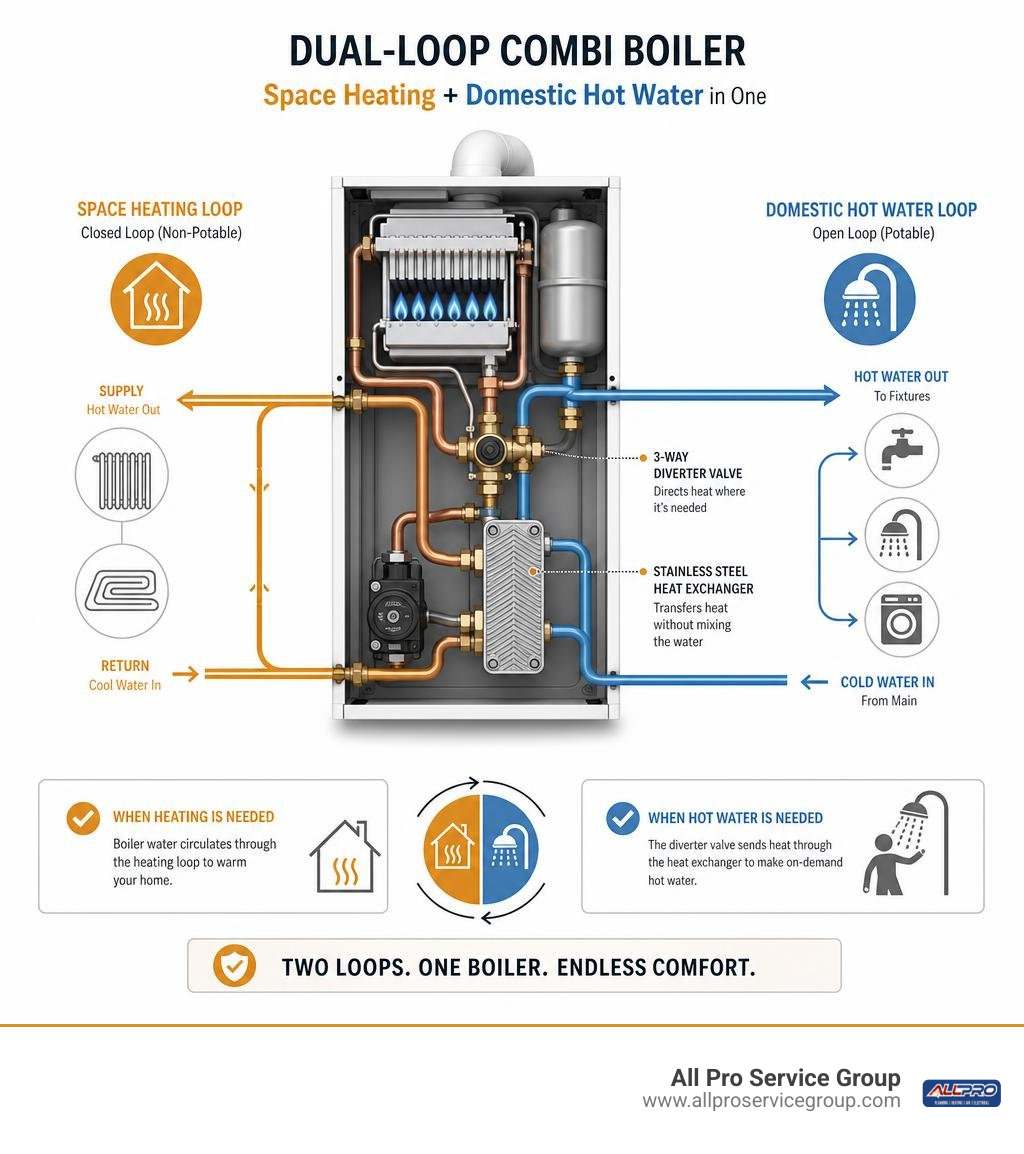
At its core, a combi boiler operates two completely isolated fluid loops within one chassis. The primary closed loop contains the hydronic heating water, which circulates through your baseboards, radiators, or radiant in-floor tubing. This water stays inside the heating distribution circuit and never enters your plumbing fixtures. The secondary loop handles your domestic hot water (DHW)—the potable water that feeds your kitchen faucets, washing machines, and showers.
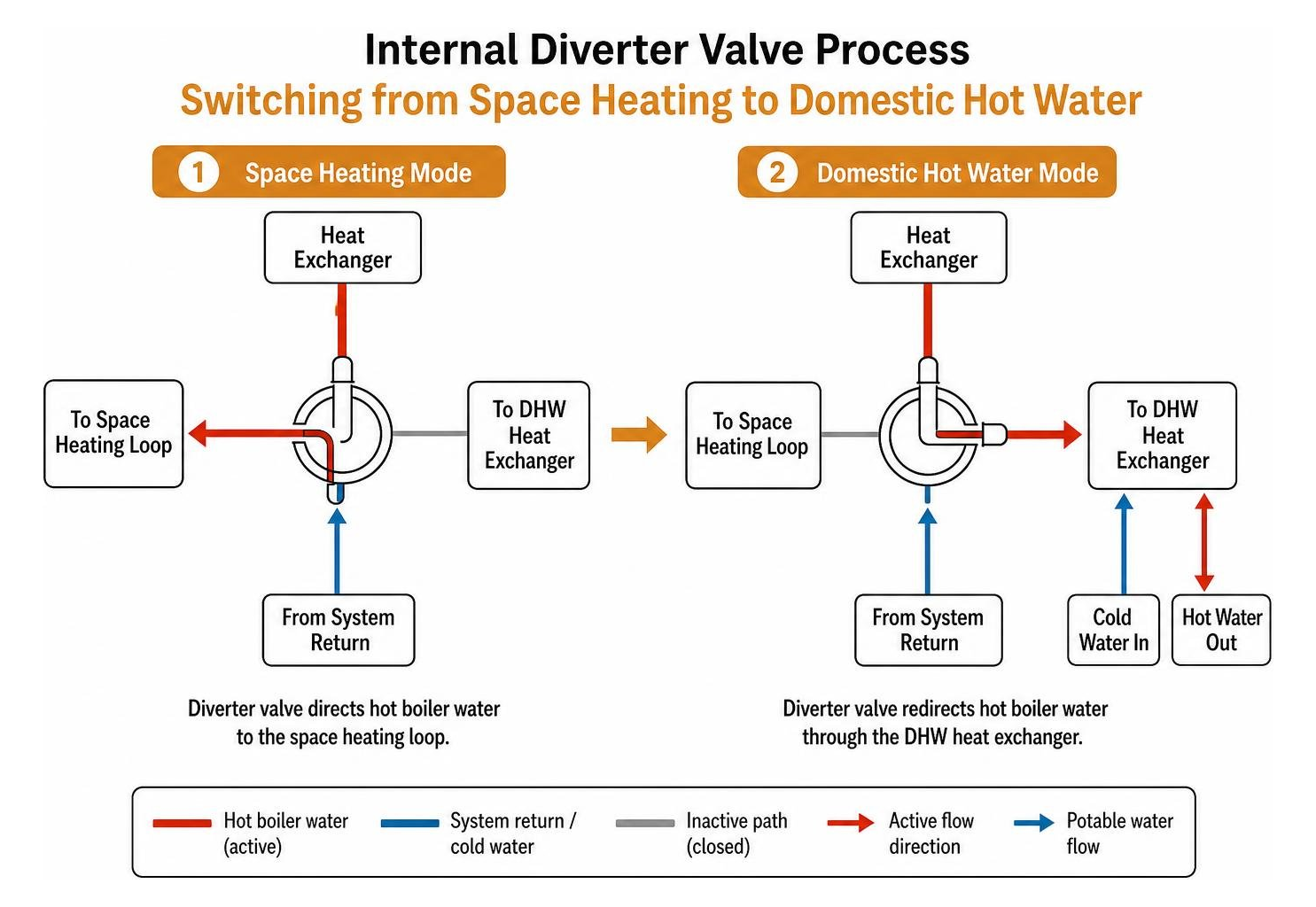
When a thermostat calls for heat, the system fires its burner and an internal ECM circulator directs hot boiler water through your home's heating zones. The moment someone opens a hot water tap, an internal 3-way diverter valve redirects that hot closed-loop boiler water through a secondary brazed stainless steel flat plate heat exchanger. The incoming cold potable water flows across the opposite side of those thin stainless plates, instantly absorbing heat without ever mixing with the heating system fluid.
This dual functionality is why many homeowners upgrade from older setups. High-efficiency condensing units achieve up to a 95% AFUE (Annual Fuel Utilization Efficiency) rating by capturing latent heat from exhaust gases that conventional systems lose up the chimney. With a compact wall-hung profile that frees up roughly 80% of the mechanical room floor space, upgrading provides substantial energy savings and room to breathe. To explore how on-demand water heating functions in different residential configurations, our tankless water heater complete guide breaks down the essential underlying technology.
Sizing a Tankless Combi Boiler for Heating Load and Domestic Hot Water
Properly sizing a combi boiler is fundamentally different from sizing a standard furnace or standalone water heater. Because a combi serves two distinct functions, the unit must be sized to satisfy both your home's peak space heating load and your family's peak domestic hot water flow demand.
In almost every residential scenario, the BTU capacity required to heat incoming tap water on demand is far higher than the BTU capacity needed to keep the house warm. Heating cold groundwater from 45°F up to a comfortable 115°F shower temperature requires a massive, instantaneous burst of thermal energy. A standard rule of thumb is that it takes roughly 50,000 BTU/hr of boiler input to produce 1.0 gallon per minute (GPM) of hot water at a 70°F temperature rise. Consequently, a household needing 4.0 to 5.0 GPM of domestic hot water requires a burner rated between 150,000 and 200,000 BTU/hr.
To prevent an appliance of this size from short-cycling when your home only needs a gentle 15,000 BTU/hr to satisfy a mild heating zone, you must pay close attention to the turndown ratio (TDR). A higher turndown ratio (such as 10:1 or 15:1) allows the boiler to modulate its burner down to a small fraction of its maximum capacity. For example, the NFC-H Fire Tube Combi-Boilers | Navien feature a 15:1 turndown ratio for DHW and up to 11:1 for space heating, allowing units like the NFC-250/200H ultra-high efficiency combi-boiler | Navien to modulate heating output from 199,900 BTU/h all the way down to 13,300 BTU/h without cycling off prematurely.
When evaluating system capacity, a licensed HVAC technician should always perform an ACCA Manual J heating load calculation to verify your building envelope's actual heat loss before matching it with your peak simultaneous fixture demand.
Evaluating the Pros and Cons of a Tankless Combi Boiler System
Like any mechanical equipment, combination boilers offer distinct operational strengths along with physical tradeoffs that should be evaluated before installation:
Advantages:
- Continuous Hot Water: As long as total flow remains within the unit's rated GPM, you will never run out of hot water during back-to-back showers.
- Maximum Space Savings: Wall-mounted units eliminate bulky floor-standing tanks, opening up floor space for storage or finished living areas.
- Lower Operating Costs: Achieving up to 95% AFUE means less wasted gas and reduced monthly energy bills.
- Fewer Wall Penetrations: A single direct-vent intake and exhaust replaces multiple chimney flues or separate vents required by two distinct appliances.
Tradeoffs and Potential Drawbacks:
- Single-Point Failure: Because one appliance provides both hydronic warmth and domestic hot water, a mechanical breakdown takes offline your home heating and your hot water simultaneously.
- Micro-Zone Short-Cycling: If a home has very small heating zones (such as a single 800 sq. ft. radiant loop requiring only 10,000 BTU/hr) and the boiler's minimum firing rate is too high, the burner may rapidly cycle on and off, causing unnecessary wear on components.
- The "Cold Water Sandwich": When someone shuts off a hot water tap and turns it back on moments later, a small pocket of unheated water can pass through the system before the burner reignites, resulting in a momentary cold fluctuation at the showerhead.
- Upfront Investment: High-efficiency condensing equipment involves higher initial equipment and installation costs compared to basic atmospheric tank water heaters.
Learning how a tankless water heater can help your home provides useful perspective on whether on-demand heating aligns with your daily water usage and lifestyle habits.
Key Technical Differences Between Leading Combi Boiler Brands
The combination boiler market offers high-performing models engineered by major hydronic and water heating manufacturers, including Navien, Lochinvar, Weil-McLain, Rheem, Bosch, and Rinnai. While all aim for peak efficiency, their internal components, control algorithms, and flow rates differ in significant ways.
| Feature / Metric | Navien NFC-H Series | Lochinvar Noble Series | Weil-McLain Simplicity | Rheem Combi Boilers |
|---|---|---|---|---|
| Max Space Heating Input | Up to 199,900 BTU/h | Up to 199,000 BTU/h | Up to 199,000 BTU/h | Up to 199,900 BTU/h |
| Max DHW Input | Up to 210,000 BTU/h | Up to 199,000 BTU/h | Up to 199,000 BTU/h | Up to 199,900 BTU/h |
| DHW Flow Rate (70°F Rise) | Up to 5.4 GPM | Up to 4.8 GPM (at 77°F rise) | Up to 5.3 GPM | Up to 4.8 GPM |
| AFUE Efficiency | 95.0% | 95.0% | 95.0% | Up to 95.0% |
| Heating Turndown Ratio | 11:1 (up to 15:1 on DHW) | 10:1 | Up to 10:1 | 10:1 |
| Heat Exchanger Type | Patented Stainless Fire Tube | Stainless Steel Fire Tube | Stainless Steel Fire Tube | Stainless Steel Fire Tube |
| Integrated Zone Control | Up to 3 zone pumps/valves | SMART CONTROL system | Multi-zone compatible | Multi-zone platform |
The NOBLE® Combi Gas Boiler Wall Mount | Model NKC199N | Lochinvar, along with its smaller siblings like the NOBLE® Combi Gas Boiler Wall Mount | Model NKC150N | Lochinvar, NOBLE® Combi Gas Boiler Wall Mount | Model NKC110L | Lochinvar, and the floor-standing NOBLE® Combi Gas Boiler Floor Mount | Model NCF110N | Lochinvar, incorporates patent-pending control technology specifically engineered to eliminate the cold water sandwich effect. These units also include a built-in Air Handler Interlock that disables forced-air blower operation in hydro-air installations during domestic hot water calls, preventing unheated air drafts.
Meanwhile, the Weil-McLain Simplicity line provides added installation versatility, allowing contractors to install the unit purely as a space-heating boiler first, with the ability to connect domestic hot water piping later when an existing water tank reaches the end of its life.
Heat Exchanger Design and Cascading Capabilities
A central distinction among premium combi boilers is the design of the primary heat exchanger. Most leading modern units utilize stainless steel fire tube heat exchangers. In a fire tube setup, hot flue gases pass downward through vertical tubes submerged in a surrounding pool of boiler water. This self-rinsing geometry provides superior resistance to corrosion caused by acidic flue condensates and minimizes hot spots compared to older copper or aluminum designs.
For larger properties or multi-family setups where domestic hot water demand exceeds the capabilities of a single boiler, leading manufacturers offer advanced cascading controls. Navien NFC-H combi units can be cascaded with up to 15 NPE tankless water heaters and common-vented with up to 8 appliances, providing virtually unlimited domestic hot water flow while maintaining zoned central heating.
Installation Considerations and Hydronic System Compatibility
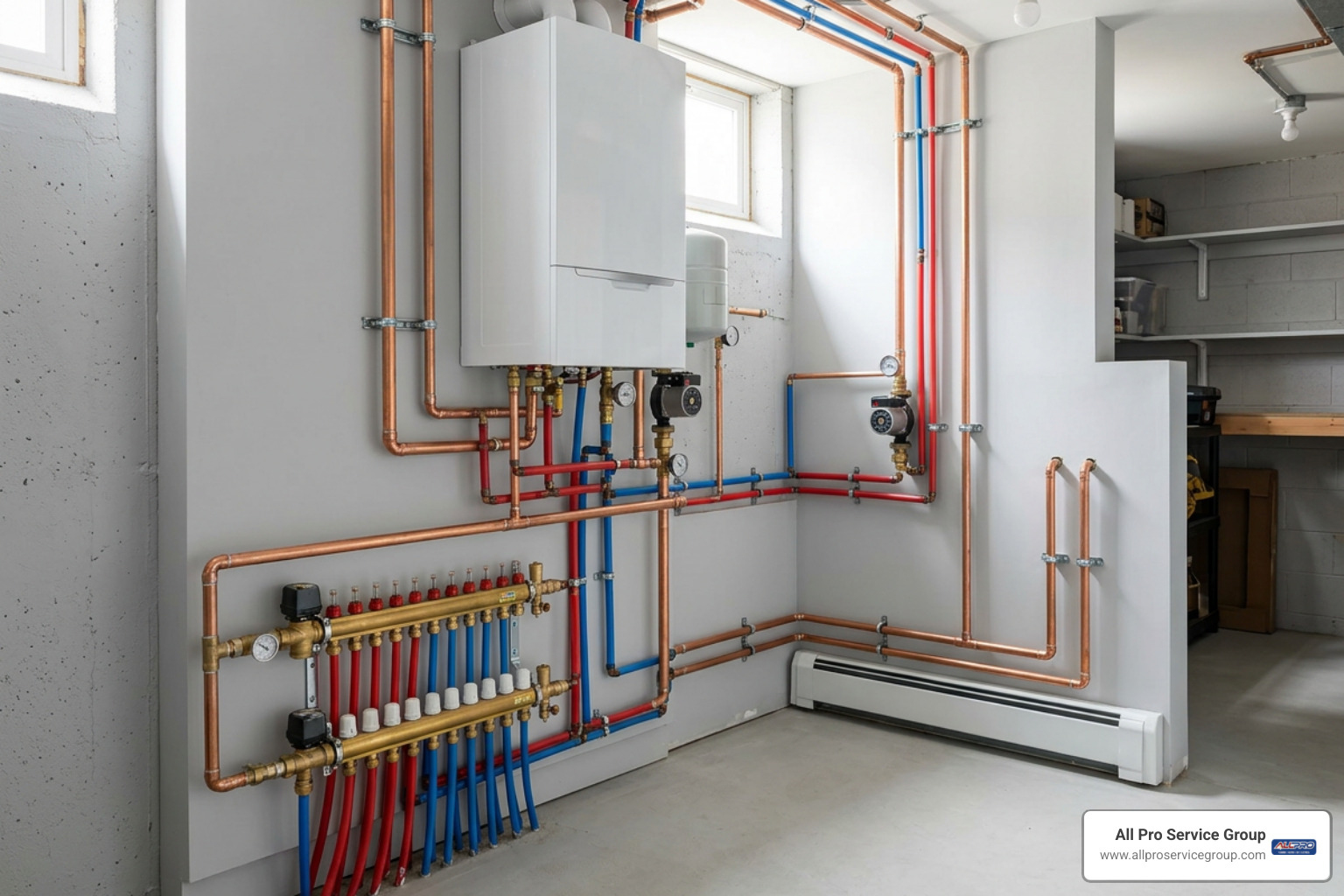
Connecting a combination boiler to an existing home heating network requires evaluating your distribution emitters, gas delivery lines, and venting pathways.
Radiant Floor Heating vs. Baseboard Radiators
Condensing combi boilers reach their maximum 95% AFUE efficiency only when return water temperatures remain at or below 140°F. Low water temperatures cause the moisture in the exhaust gases to condense, releasing extra latent heat into the system.
- Radiant Floor Heating: In-floor hydronic loops naturally operate at low water supply temperatures (typically 90°F to 120°F). This makes radiant flooring the ideal match for condensing technology, ensuring the boiler runs in continuous condensing mode.
- Hydronic Finned-Tube Baseboards: Standard baseboards were historically engineered to operate on 170°F to 180°F supply water, producing roughly 500 BTU/hr per linear foot. If a combi boiler must send 180°F water to heat the home, return water may exceed 140°F during peak winter months, temporarily dropping the appliance out of condensing mode into standard 86–88% efficiency. Installing an outdoor reset sensor helps modulate water supply temperatures downward whenever outside weather moderates.
Gas Supply and Venting
High-BTU tankless burners require adequate gas supply volume. While older atmospheric water heaters operated on 35,000 to 40,000 BTU/hr, a 199,000 BTU combi boiler demands significantly more gas during peak operation. Units equipped with negative-pressure gas valves and dual venturi systems can often utilize existing 1/2-inch gas lines for runs up to 24 feet, significantly simplifying retrofits.
Condensing boilers produce low-temperature acidic exhaust, requiring direct venting through non-metallic piping such as Schedule 40 PVC, CPVC, or polypropylene rather than old metal B-vent chimneys. Direct venting pulls fresh combustion air directly from outdoors, keeping your mechanical room balanced.
Oil-to-Gas Conversions and High-Altitude Adjustments
Converting from an old oil boiler to a natural gas or propane combi boiler removes an aging fuel tank from your basement or yard and eliminates messy fuel deliveries. In high-elevation mountain climates, thin air can cause combustion instability if equipment is not properly adjusted. Units certified for operation up to 10,100 feet (such as Navien's NFC series) use high-altitude gas conversion kits and modulated blowers to maintain clean combustion without derating capacity.
For homes without access to natural gas or propane infrastructure, examining an electric tankless boiler can be a viable alternative for compact hydronic space heating. When you are ready to modernize your equipment, coordinating an experienced team for your water heater installation ensures every gas line, venting slope, and primary-secondary piping loop is executed strictly according to local building and plumbing codes.
Maintenance, Water Hardness, and Longevity Requirements
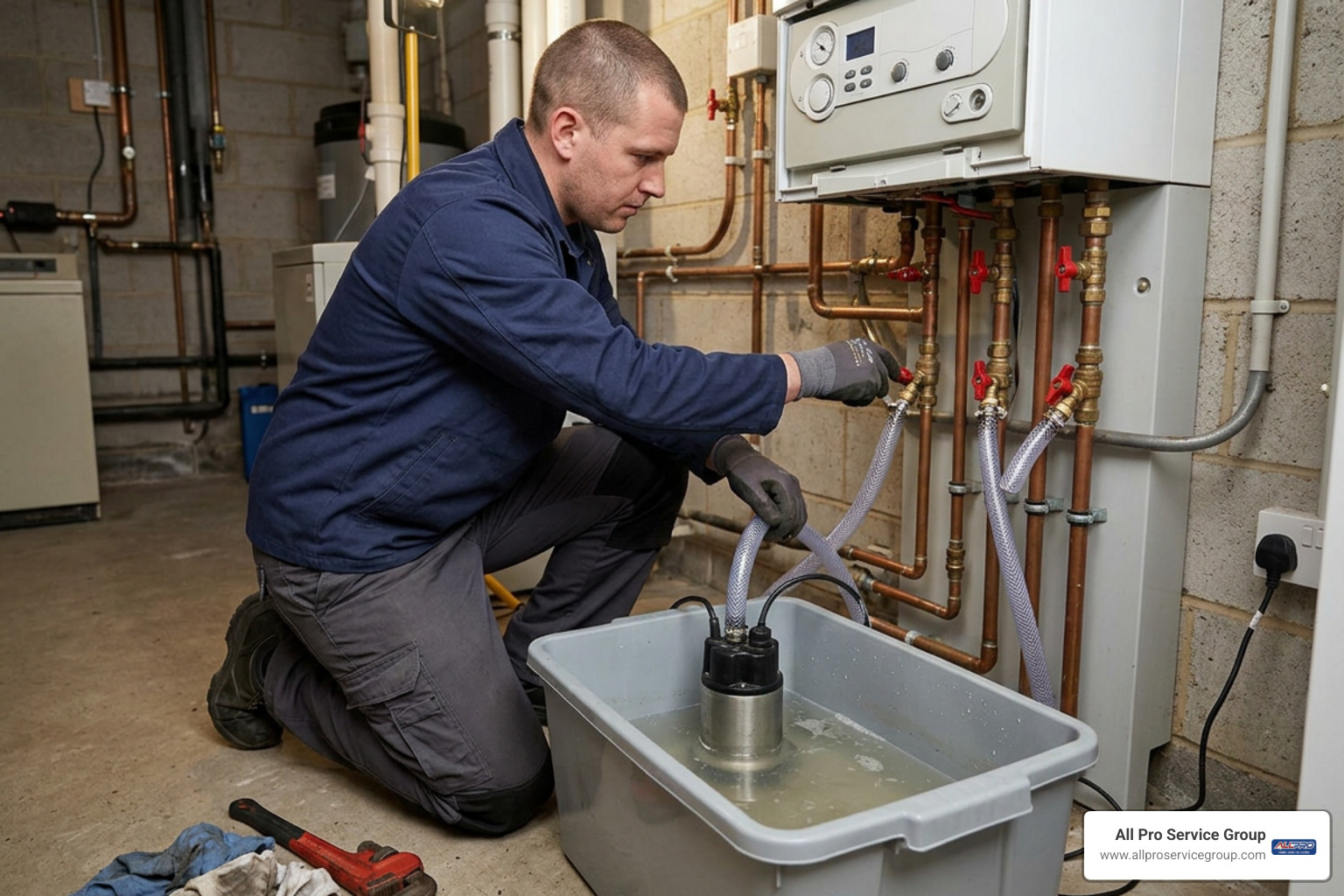
A tankless combination boiler is a precision appliance that requires routine preventative care to deliver its full expected lifespan. While traditional tank water heaters often fail within 8 to 12 years due to sediment accumulation and tank corrosion, a well-maintained combi boiler with stainless steel heat exchangers can operate reliably for 15 to 20 years.
Most leading manufacturers back their residential combi boilers with a 10-year limited warranty on the primary heat exchangers, a 5-year warranty on internal parts, and a 1-year labor warranty. Preserving that warranty coverage and avoiding premature heat exchanger failure requires keeping your system clean of mineral deposits and heating loop debris.
Managing Hard Water and Scaling
Because combi boilers utilize compact brazed plate heat exchangers with narrow internal passages to heat domestic water, they are susceptible to mineral scaling in hard-water regions. When calcium and magnesium precipitate out of hard water at high temperatures, scale sticks to the heat exchanger walls, creating an insulating thermal barrier that restricts water flow and causes hot spots.
To prevent scale damage:
- Install Service Isolation Valves: Webstone-style isolation valves must be installed on the domestic hot water ports to permit routine cleaning without draining household plumbing.
- Annual Descaling: The domestic heat exchanger should be descaled every 12 months by circulating a food-grade virgin white vinegar or citric acid solution through the ports using a small submersible pump. Our step-by-step guide on flushing tankless water heater systems explains the exact process.
- Pre-Treatment Filtration: If water hardness tests reveal levels above 7 to 10 grains per gallon (gpg), installing a whole-home water softener or anti-scale filter upstream of the boiler protects internal components.
Hydronic Loop Protection and Condensate Care
The closed hydronic space heating loop also requires care. Black iron oxide sludge and rust particles circulating from older radiators or baseboards can foul the boiler's variable-speed ECM pump and fire tubes. Installing a magnetic dirt filter (such as a magnetic system filter) on the heating return line captures metallic debris before it enters the boiler.
Technicians should also clean the internal condensate collector trap and inspect the neutralization kit annually to ensure acidic condensate does not corrode drain plumbing. If you ever experience burner lockouts, fluctuating water temperatures, or error codes, scheduling timely water heater repair prevents minor sensor or ignition faults from escalating into major system damage.
Frequently Asked Questions About Combi Boilers
Will my home freeze if someone takes an extra-long shower?
No. Combi boilers operate on Domestic Hot Water (DHW) Priority. When a shower or faucet runs, the boiler's internal diverter valve temporarily suspends space heating to focus 100% of its thermal output on heating domestic water.
Because modern residential structures possess substantial thermal mass in their walls, framing, furniture, and radiant concrete floors, a home loses heat very slowly. Even during a continuous 45-minute family shower rotation, indoor ambient temperatures typically drop by less than 1°F to 2°F. The moment the domestic tap closes, the diverter valve instantly returns flow to your heating zones.
Can a combi boiler support two showers and a dishwasher running at once?
Yes, provided the boiler is appropriately sized for your regional groundwater inlet temperature.
During the winter in colder climates, incoming municipal groundwater can dip to 40°F–45°F. To heat that water to 115°F requires a 70°F to 75°F temperature rise. A 199,000 BTU combi boiler (such as a Navien NFC-250 or Weil-McLain Simplicity 199) produces approximately 5.3 to 5.4 GPM at that 70°F rise. Since modern WaterSense low-flow showerheads consume 1.5 to 2.0 GPM and an energy-efficient dishwasher uses approximately 1.0 to 1.5 GPM, a properly sized 199 MBH combi boiler can comfortably support two concurrent showers and a running appliance.
How long does a combination boiler last compared to a standard water tank?
A conventional atmospheric storage water heater generally lasts between 8 and 12 years before tank corrosion causes an irreparable leak. By contrast, a high-efficiency tankless combination boiler engineered with corrosion-resistant stainless steel fire tubes carries a design lifespan of 15 to 20 years or more when serviced and descaled on an annual schedule.
Conclusion
Choosing the right heating and hot water configuration is one of the most impactful investments you can make in your home's comfort, efficiency, and usable space. A high-efficiency tankless combination boiler represents a modern, consolidated heating strategy—delivering endless on-demand domestic hot water and whisper-quiet hydronic warmth from a single wall-mounted unit.
By carefully evaluating your household's peak domestic flow rates, performing an accurate heating load calculation, accounting for local water hardness, and selecting an equipment platform with a high turndown ratio, you can enjoy dependable comfort and lower utility bills for decades.
At All Pro Service Group, our team provides comprehensive hydronic heating inspections, sizing assessments, and complete system retrofits for homeowners across the Greater Salt Lake Valley, including Salt Lake City, South Jordan, West Jordan, Provo, Ogden, and Park City. If you are considering upgrading an aging heating system, reach out to our team today to schedule your consultation for professional tankless water heater installation.