What Is an Electric Tankless Boiler?
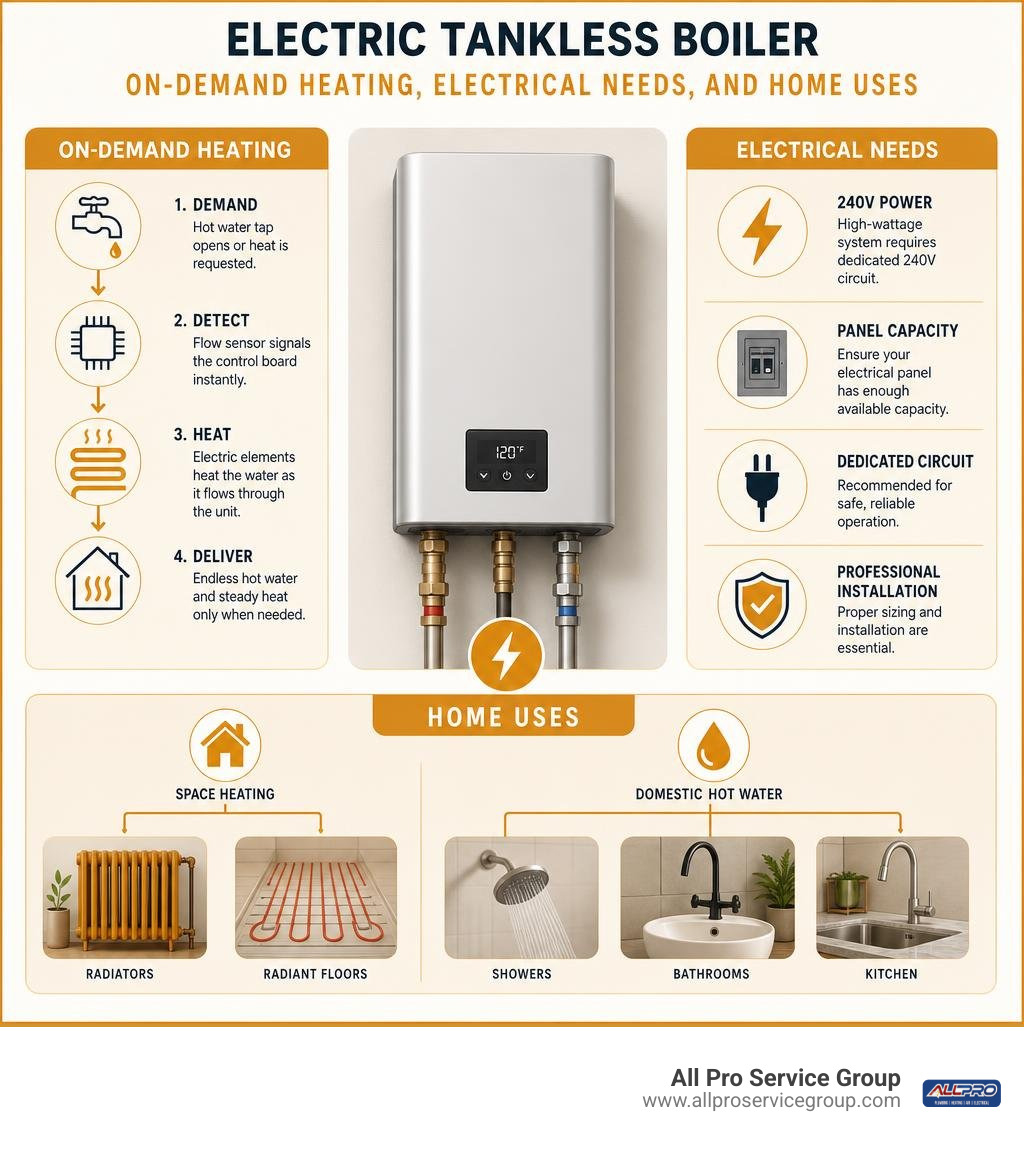
An electric tankless boiler heats water only when your home calls for it. Depending on the model and system design, it can supply hydronic space heating for radiators or radiant floors, domestic hot water, or both.
| Quick answer | What it means |
|---|---|
| How it works | Electric heating elements warm water as it flows through the unit. |
| Main benefit | No stored tank of hot water and no standby heat loss. |
| Best use | Homes with compatible hydronic heating and enough electrical-panel capacity. |
| Key limit | High-output units can require large dedicated 240V circuits and may have lower hot-water flow than gas tankless models. |
Unlike a standard tank water heater, a tankless system is compact and wall-mounted. It can be highly efficient at the unit, but the right choice depends on your home's heat load, hot-water demand, incoming water temperature, and electrical service.
All Pro Service Group has been serving Greater Salt Lake homeowners with plumbing, heating, air conditioning, and electrical work since 2008. In this guide, we’ll help you understand where an electric tankless boiler fits, what it needs, and the tradeoffs to consider before upgrading.
How an Electric Tankless Boiler Works for Space Heating and Domestic Water
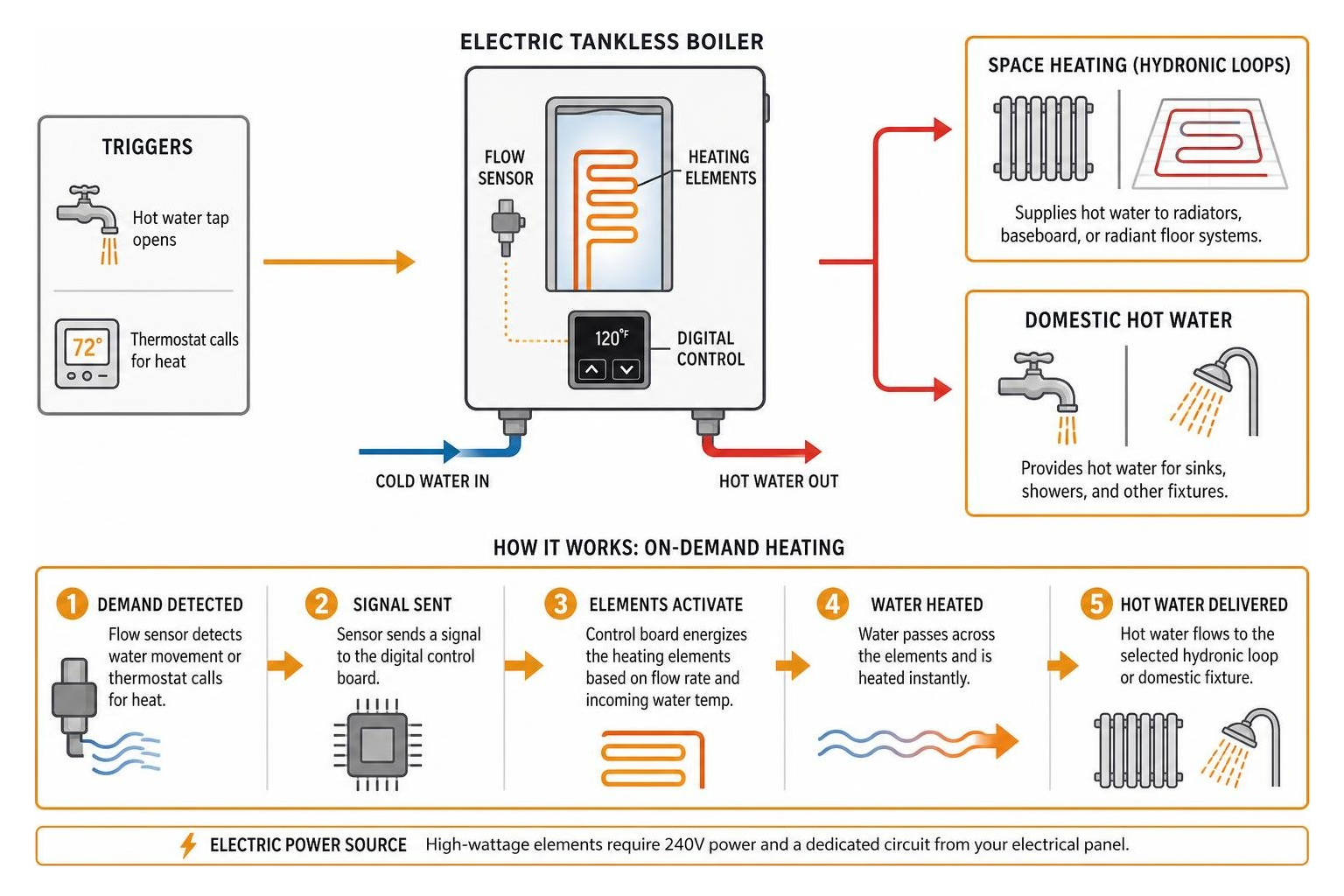
Understanding how an electric tankless boiler operates begins with the principle of instant, on-demand thermal transfer. Traditional heating boilers and storage water heaters continuously burn fuel or energize elements to maintain a reservoir of hot water, regardless of whether anyone is using it. An electric tankless system remains idle until a flow sensor detects that water is moving through the system.
When you open a hot water tap or your wall thermostat signals for space heating, internal flow sensors immediately signal the digital control board. The boiler then energizes high-wattage electric heating elements—frequently housed in heavy-duty cast-aluminum or copper chambers—to heat the incoming water rapidly as it passes across the elements.
To prevent temperature fluctuations, modern units utilize microprocessor-driven modulating power technology. Rather than running at 100% power all the time, the boiler constantly adjusts its wattage output based on real-time flow rate and incoming water temperature. For example, if you are only running a single bathroom sink, a unit rated for 24 kW might modulate down to draw only 4 kW or 6 kW, ensuring optimal electrical efficiency.
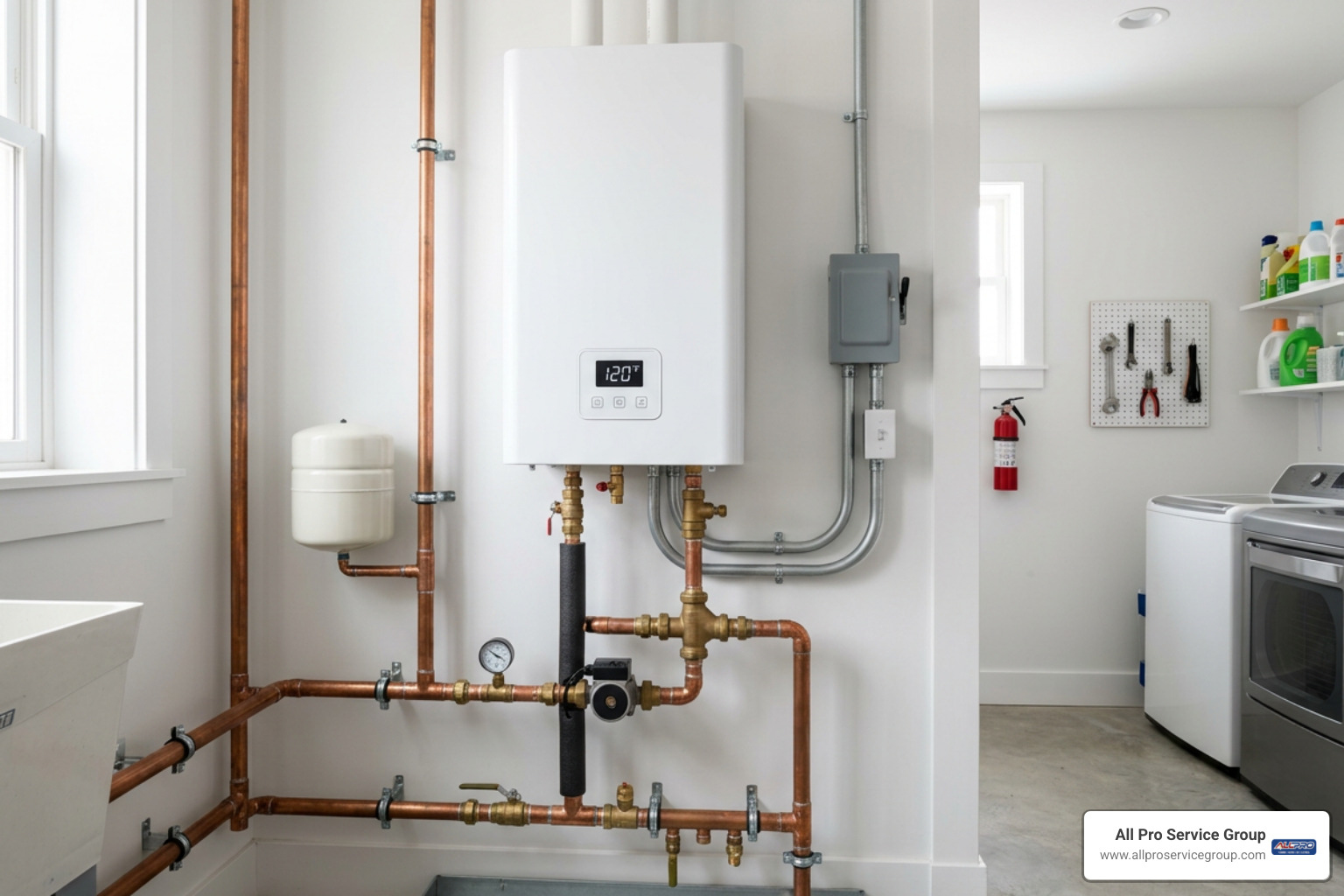
Because an electric tankless boiler operates entirely on electricity, it does not require a chimney, flue, or exterior power-venting pipe. This zero-flue design simplifies installation choices, allowing wall mounting in tight utility closets, basements, or mechanical spaces close to your main electrical panel.
Space Heating and Domestic Water Integration
One common source of confusion for homeowners is distinguishing between a dedicated domestic tankless water heater and an electric tankless boiler designed for space heating.
- Hydronic Space Heating Boilers: These units circulate water through a closed loop connected to radiant underfloor tubing, baseboard hydronic heaters, or wall-mounted radiators. System boilers, such as the JNOD BO Series Electric System Boiler for Underfloor heating & Water Tank - JNOD Electric Heating Boiler, operate at high thermal efficiency (up to 98%) and provide modulating heat output between 5.5 kW and 26 kW. These boilers can also supply domestic hot water when paired with an external indirect buffer tank or storage cylinder.
- Electric Combination (Combi) Boilers: A combi unit handles both space heating and direct domestic hot water within a single wall-hung appliance. For instance, the EASY.BPL 12kW Electric Boiler With inbuilt Cylinder & Smart Control modulates between 2 kW and 12 kW and incorporates a small internal buffer reservoir (such as a 37.5-liter tank) to ensure smooth hot water delivery for showers while simultaneously serving up to 14 radiators or 100 square meters of underfloor heating.
- Dedicated Domestic Tankless Water Heaters: These open-loop appliances focus solely on heating potable tap water on demand for showers, sinks, and appliances.
Comparing an Electric Tankless Boiler with Traditional Storage Tanks
To help evaluate whether upgrading to an electric tankless boiler or tankless water heater fits your home, compare key operational metrics side-by-side:
| Feature / Metric | Traditional Tank Heater | Electric Tankless Boiler / Heater |
|---|---|---|
| Thermal Efficiency | 60% – 85% UEF | 98% – 99.9% UEF |
| Standby Loss | High (continuous reheating) | Zero (heats only on demand) |
| System Lifespan | 10–12 years | 15–20 years |
| Hot Water Supply | Limited to tank volume | Continuous on-demand supply |
| Space Required | Floor space (~10–15 sq ft) | Compact wall-mount (~2–3 sq ft) |
| Venting Required | Gas flues required for gas models | Zero flue or venting required |
| Electrical Demand | Low to moderate (30A for electric tanks) | High instantaneous draw (50A–135A+) |
| Estimated Payback Period | Baseline cost | 12 to 24 months via energy savings |
By eliminating standby energy loss—the heat constantly escaping through the walls of a storage tank—homeowners can lower their water heating energy usage by 30% to 60%. Combined with an expected equipment lifespan of 15 to 20 years, an electric tankless unit offers long-term financial payback alongside space-saving convenience.
Pros and Cons of Upgrading to an Electric Tankless Boiler System
Upgrading your home’s heating infrastructure is a significant investment. Weighing the practical benefits against the technical constraints ensures you choose a solution that aligns with your household's requirements.
Key Benefits
- Exceptional Energy Efficiency: Electric tankless water heating equipment converts 98% to 99.9% of incoming electrical energy directly into thermal heat, virtually eliminating energy waste.
- Continuous On-Demand Hot Water: Because water is heated as it passes through the heat exchanger, you will not run out of hot water halfway through a shower, provided the fixture demand stays within the unit’s flow rate capacity.
- Zero Flue and Emission-Free Operation: Lacking combustion gases, electric boilers do not require gas piping or exterior wall penetrations for flues. This lowers installation labor costs by up to 40% compared to complex gas boiler installations.
- Compact Footprint: Wall-hung designs free up square footage in basements, mechanical closets, or utility rooms.
- Smart Monitoring and Modulation: Modern models incorporate digital touchscreens, Wi-Fi connectivity, and advanced self-modulating logic to match power usage directly to actual flow.
Potential Drawbacks and Limitations
- Substantial Electrical Demands: Instantaneous heating requires high electrical power during operation. While a traditional tank water heater draws around 4.5 kW on a 30-amp circuit, a whole-home electric tankless boiler can draw between 12 kW and 32 kW, consuming 51 to 135+ amps during peak operation.
- Lower Flow Rates in Cold Climates: Electric tankless water heaters deliver lower maximum flow rates (typically 2 to 5 gallons per minute) compared to gas-fired units. In cold climate regions like Utah, where winter incoming groundwater temperatures drop significantly, flow rates are reduced because the unit must work harder to heat the water.
- Electrical Panel Upgrade Costs: If your home has an older 100-amp or 125-amp main electrical service panel, upgrading to an electric tankless system may require a panel upgrade to 200 amps or higher.
How to Choose and Size an Electric Tankless Boiler
Selecting the correct electric tankless boiler requires analyzing two central factors: total required flow rate in gallons per minute (GPM) or heating load in BTUs, and the temperature rise necessary to bring incoming cold water up to your desired temperature setpoint.
To calculate your required domestic hot water GPM, add up the flow rates of all fixtures you plan to operate simultaneously:
- Standard Bathroom Sink: 0.5 – 1.5 GPM
- Low-Flow Showerhead: 1.5 – 2.0 GPM
- Standard Showerhead: 2.5 GPM
- Dishwasher: 1.0 – 2.0 GPM
- Washing Machine: 2.0 GPM
Next, determine your local groundwater temperature rise. In Northern Utah, winter groundwater temperatures can drop to 40°F–45°F. To achieve a comfortable domestic tap temperature of 120°F, your boiler must provide a temperature rise of 75°F to 80°F. Colder inlet water means the system will yield fewer total GPM than its maximum advertised capacity.
For targeted applications or smaller spaces, localized solutions such as a Mini Electric Tankless Water Heater or a dedicated 110V Tankless Hot Water Heater offer convenient point-of-use heating without burdening the main heating system.
Sizing an Electric Tankless Boiler for Peak Household Demand
To meet whole-home demand, units are categorized by kilowatt (kW) capacity and element chamber counts. Higher kilowatt units feature multiple heating chambers (such as 2-chamber configurations for 14–18 kW models or 4-chamber designs for 22–32 kW models) to deliver greater thermal output.

When evaluating models on the market:
- Compact Point-of-Use & Low-Demand Models: The 14kW Touch Control Electric Tankless Water Heater, 240V | ThermoMate delivers up to 3.4 GPM, making it suitable for smaller homes, cabins, or single high-demand fixtures.
- Mid-Range Whole-Home Units: The opti12 plus | 12kW 208V 2.5GPM Wifi Enabled 25-Year Warranty Electric | Optimal Tankless Water Heaters offers smart Wi-Fi controls, 2.5 GPM output, and can also serve as a tank booster to extend existing storage capacity by up to 45%.
- High-Capacity Smart Units: For larger households with simultaneous shower demands, high-output options like the Plus 208/220/240-Volt 27 Kw 4.5 GPM Wi-Fi Enabled Smart Electric Tankless Water Heater provide 4.5 GPM while incorporating advanced digital controls.
When sizing for hydronic radiant in-floor space heating, calculations are based on square footage and structural heat loss. A home built to modern energy codes typically requires around 25 BTU per square foot. For example, a 12.2 kW electric boiler generating approximately 41,600 BTU/hr can support radiant floor heating for up to 3,000 square feet of well-insulated living space.
Electrical Panel and Installation Requirements for an Electric Tankless Boiler
Before purchasing an electric tankless boiler, reviewing your home's electrical panel infrastructure is critical. Because these systems draw significant current, professional electrical and plumbing planning is essential.
Common electrical requirements across unit sizes include:
- 12 kW to 14 kW Units: Typically operate on 240V single-phase power, requiring a single dedicated 60-amp double-pole circuit breaker and 6 AWG copper conductor wiring.
- 18 kW to 24 kW Units: Generally require two separate 40-amp or 50-amp double-pole circuit breakers with multiple 8 AWG or 6 AWG wire runs.
- 27 kW to 32 kW Units: Require significant electrical capacity, often needing three dedicated 40-amp double-pole breakers (drawing up to 135+ total amps) and three separate 8 AWG wire runs.
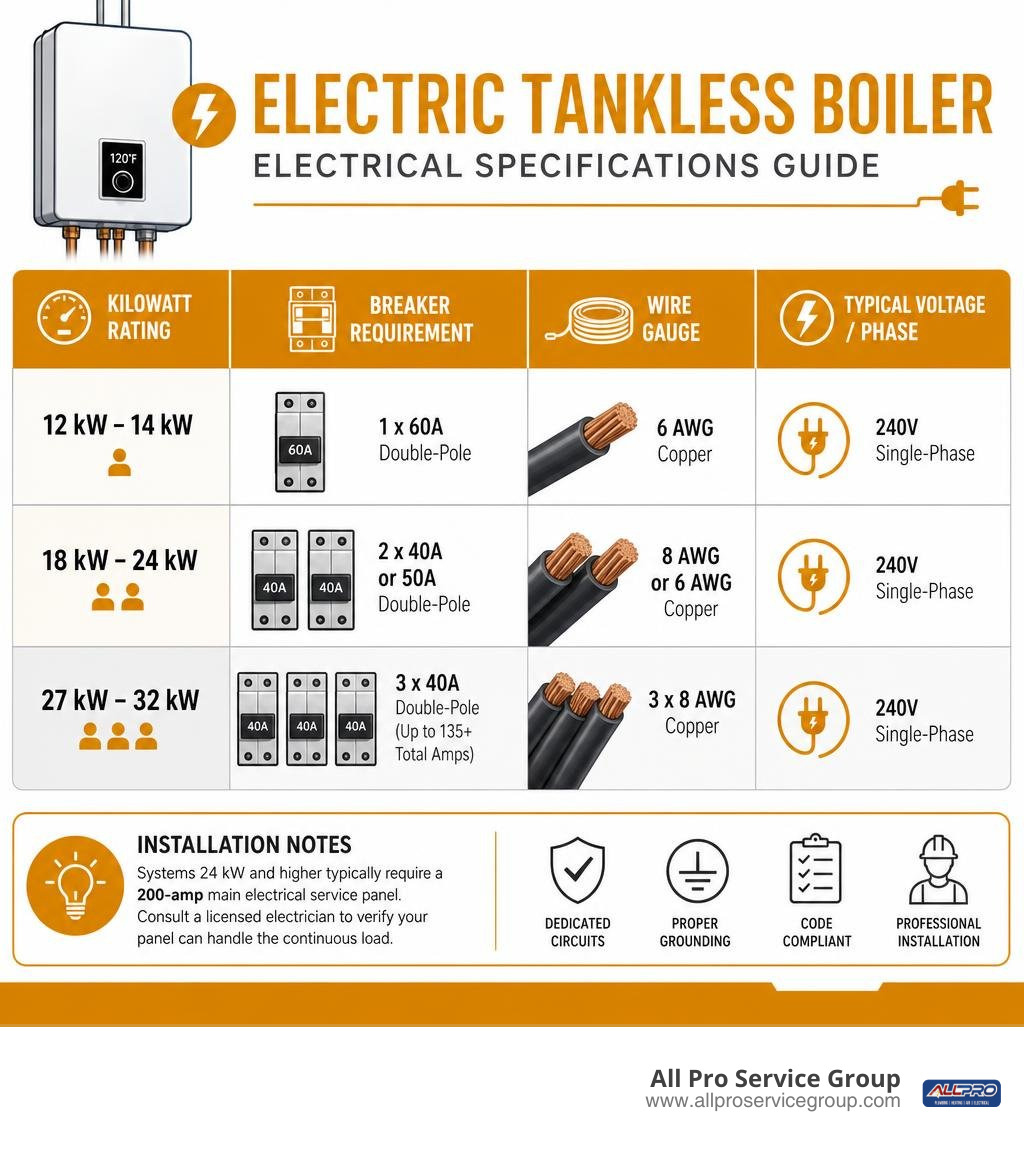
Most installations demanding 24 kW or higher require a 200-amp main electrical service panel. Consulting with an experienced electrician before purchase ensures your main breaker panel can accommodate the continuous load requirements without nuisance tripping. For seamless setup and code compliance, consider professional Tankless Water Heater Installation.
Lifespan, Maintenance, Incentives, and Tax Credits
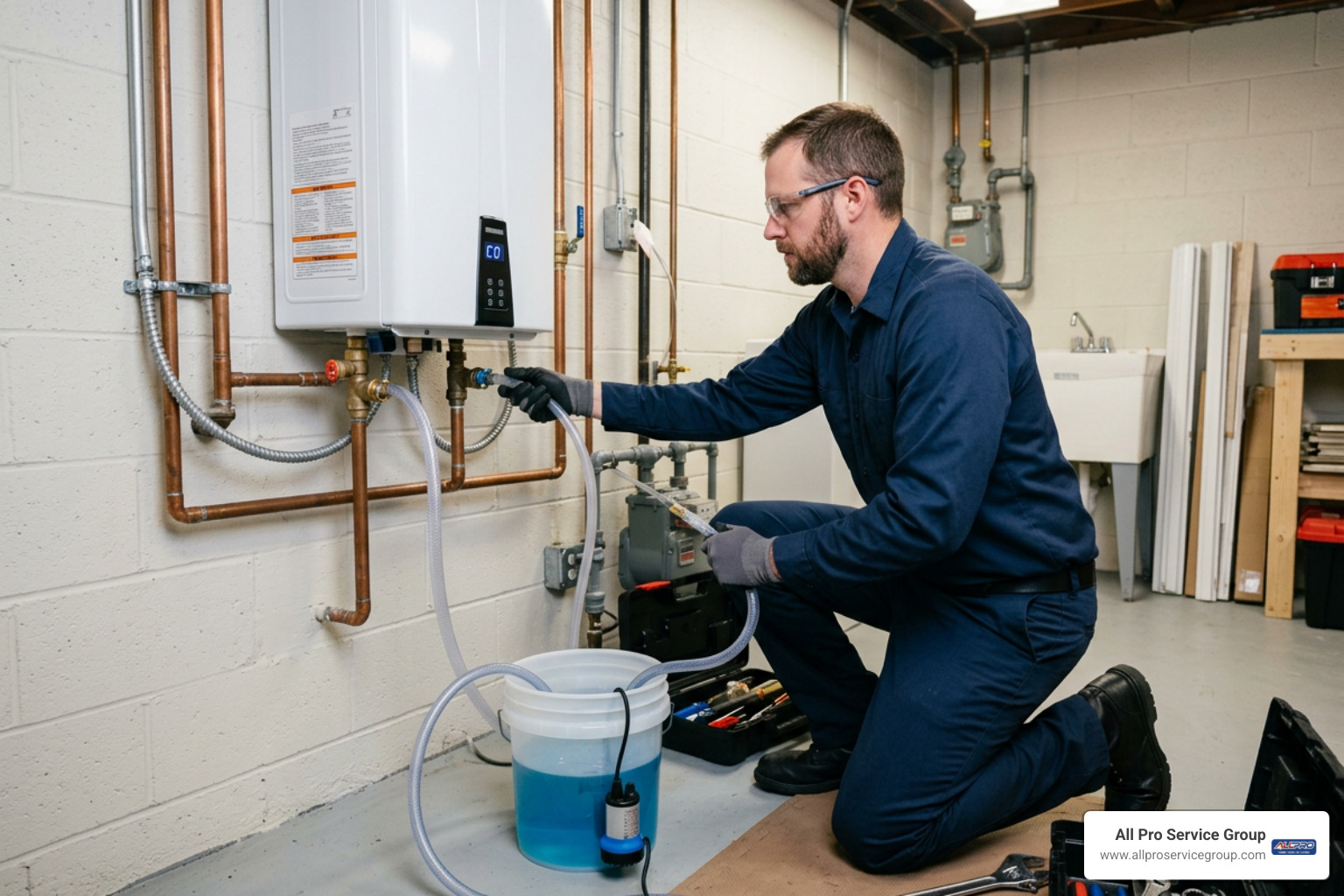
An electric tankless boiler offers an operational lifespan of 15 to 20 years—nearly double that of a standard 10-year storage tank—when properly maintained.
Routine Maintenance and Protection
While electric units have fewer mechanical components than gas models (no gas valves, burners, or blowers), they still require routine upkeep to preserve performance:
- Descaling and Flushing: Mineral deposits (limescale) can accumulate on heating elements in regions with hard water. Flushing the heat exchanger annually with a food-grade descaling solution removes scale build-up and preserves thermal efficiency. Units built with advanced cast-aluminum or water-and-electricity separated heating blocks feature higher scale resistance.
- Hydronic Anti-Freeze Protection: Systems used for space heating in cold regions feature automated anti-freeze programs that energize elements when water temperatures drop below 8°C (46°F) and shut off once temperatures reach 10°C (50°F), protecting hydronic loops from freezing.
- Filter Cleaning: In-line water filters and strainers should be cleaned annually to maintain steady flow rates and prevent pressure drops.
Warranties, Tax Credits, and Rebates
Manufacturers back electric tankless models with strong warranty coverage. Leading units often carry 5-year to 10-year limited warranties on electrical sensors and heat exchangers, with premium models offering extended residential coverage up to 25 years.
Additionally, financial incentives can offset installation costs:
- Federal 25C Tax Credits: High-efficiency heat pump water heaters, such as the GreenTronic 7000 T Hybrid Electric Water Heater | Hybrid Electric Water Heaters | Bosch, qualify for federal tax credits under Section 25C, offering up to $2,000 in energy-efficiency tax credits.
- Local Utility Rebates: Electric utilities across Utah offer energy-efficiency rebates when upgrading from inefficient standard tanks to high-efficiency electric systems or smart heat pump units.
For a comprehensive overview of water heating technologies, maintenance schedules, and efficiency tips, explore our Tankless Water Heater Complete Guide.
Frequently Asked Questions About Electric Tankless Boilers
Can an electric tankless boiler replace a standard 50-gallon water heater?
Yes, an electric tankless boiler or water heater can replace a standard 50-gallon water tank. However, sizing must be based on peak simultaneous fixture demand (GPM) and temperature rise rather than direct volume capacity. Replacing a 50-gallon tank in a typical multi-bathroom home generally requires an electric unit capable of delivering 5 to 8 GPM, which usually translates to a 24 kW to 32 kW system requiring 150 to 200 amps of available electrical panel capacity.
How much electricity does an electric tankless boiler use during operation?
While an electric tankless unit draws high instantaneous power during operation (between 12 kW and 32 kW), it only consumes electricity while water is flowing. Because it completely eliminates the continuous 24/7 standby power loss of storage tanks, overall household energy consumption for water heating is typically reduced by 30% to 60%.
What maintenance does an electric tankless boiler require to prevent limescale?
To prevent limescale accumulation on heating elements, flush the boiler annually using a pump kit and a descaling solution or food-grade white vinegar. Homes in areas with high water hardness benefit from installing a pre-filter sediment system or an inline water softener to extend the unit's operational lifespan.
Conclusion
Upgrading to an electric tankless boiler provides continuous hot water, zero combustion emissions, wall-mounted space savings, and maximum operational efficiency. By selecting a properly sized unit and ensuring your electrical panel meets the amperage requirements, you can enjoy dependable home comfort and lower energy costs for 15 to 20 years.
When you are ready to evaluate your home's heating and electrical readiness, our experienced team at All Pro Service Group is here to help across the Greater Salt Lake Area. Contact us today to schedule your expert consultation and Professional Tankless Water Heater Installation.