
Why Gas Hot Water Heater Maintenance Keeps Your Home Running Smoothly
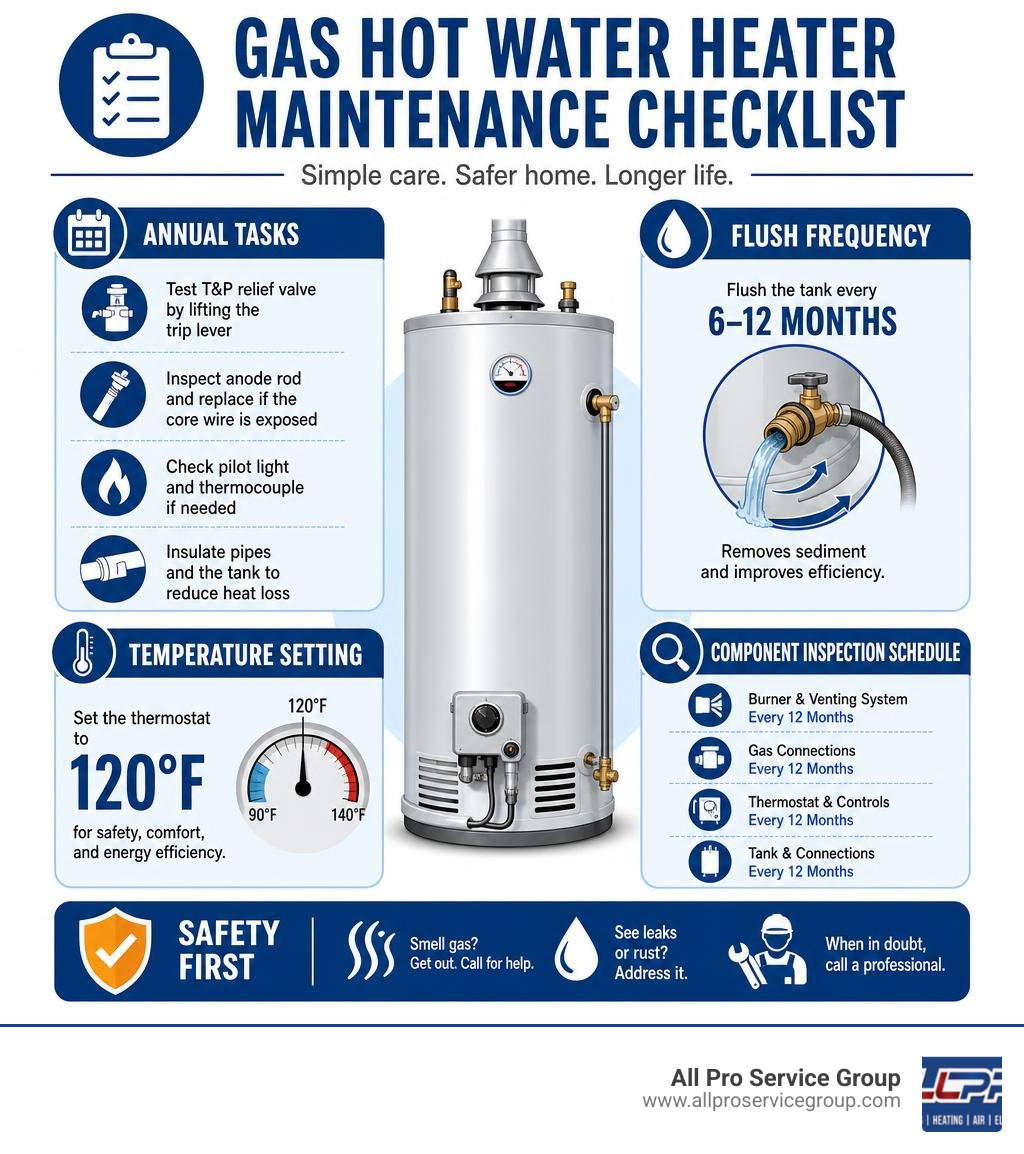
Gas hot water heater maintenance is something most homeowners overlook — until a cold shower forces the issue. Here's a quick overview of the core tasks to keep your unit running safely and efficiently:
- Flush the tank every 6–12 months to remove sediment buildup
- Test the T&P relief valve annually by lifting the trip lever
- Inspect the anode rod yearly and replace it when the core wire is exposed
- Set the thermostat to 120°F to balance safety and energy efficiency
- Check the pilot light and thermocouple if you lose hot water
- Insulate pipes and the tank to reduce heat loss, especially in colder months
- Call a professional if you smell gas, spot leaks, or notice rusty water
A well-maintained gas water heater can last around 10 years — and skipping routine care is one of the fastest ways to cut that lifespan short. Sediment builds up, efficiency drops, parts wear out, and suddenly you're facing a costly replacement instead of a simple fix.
The good news? Most of these tasks are straightforward. This guide walks you through each one, step by step.
At All Pro Service Group, we've been helping Greater Salt Lake Valley homeowners with gas hot water heater maintenance, repair, and replacement since 2008. If anything in this guide looks like more than you want to tackle yourself, our team is ready to help.
Safety First: Essential Precautions for Gas Hot Water Heater Maintenance
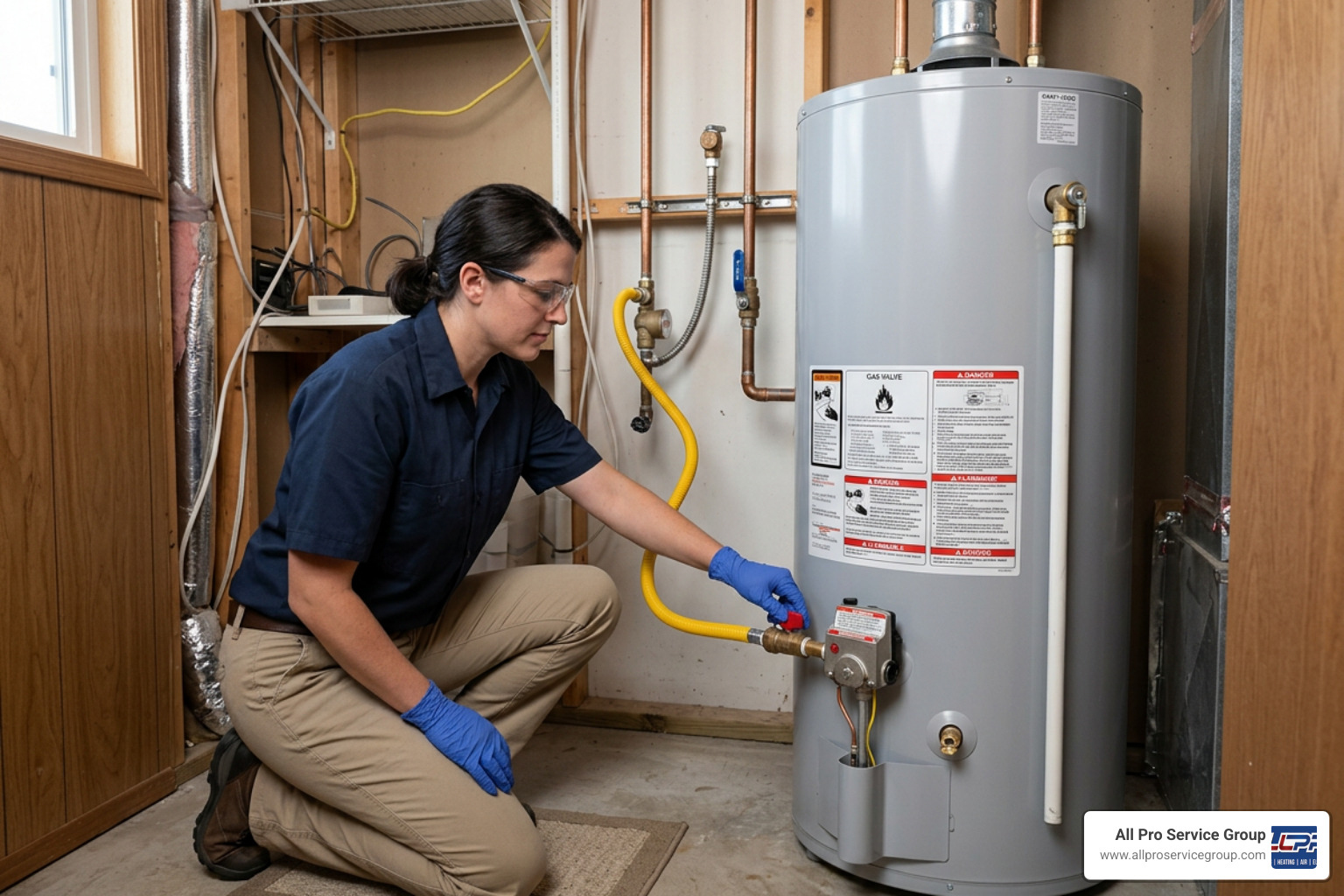
Before you grab your wrench or touch a single valve, we must emphasize that safety is the absolute priority when dealing with gas appliances. Gas water heaters combine water, high pressure, natural gas or liquid propane (LP), and open flames. That combination demands respect and careful preparation.
To keep yourself and your home safe, always adhere to these critical safety rules before beginning any DIY maintenance:
- Shut Off the Gas Supply: Locate the gas control valve on your water heater. Turn the dial to the "OFF" position. For added safety, find the manual shut-off valve on the incoming gas pipe and turn it perpendicular to the pipe to stop the gas flow completely.
- Turn Off the Water Supply: Close the cold water inlet valve at the top of the tank. This stops fresh water from entering while you work on the unit.
- Ensure Proper Ventilation: Gas water heaters rely on proper draft and venting to carry dangerous combustion gases, like carbon monoxide, safely out of your home. Ensure your utility closet or basement has adequate airflow and that the exhaust vent stack is securely attached and free of rust or blockages.
- Watch for Gas Leaks: Natural gas is treated with an odorant that smells like rotten eggs. However, this smell can fade. If you ever suspect a gas leak, do not light matches, flip electrical switches, or use your phone inside the house. Leave the building immediately and call your gas provider or the fire department from a safe distance.
- Wear Protective Gear: Always wear safety goggles, heavy-duty work gloves, and closed-toe shoes. The water inside your heater can easily exceed 130°F, which is hot enough to cause severe burns in seconds.
- Know Your System: Familiarize yourself with your specific model's manual. You can reference official resources like the Manufacturer Safety Guidelines to understand your unit's design. If you need a broader understanding of how these systems integrate with your home's infrastructure, check out our guide on plumbing safety.
Step-by-Step Guide to Flushing Your Gas Water Heater
Flushing your water heater is arguably the most impactful maintenance task you can perform. Over time, the municipal water flowing into your home carries tiny amounts of sand, silt, and dissolved minerals. These particles settle at the bottom of your tank, forming a thick layer of sediment.
Why Regular Gas Hot Water Heater Maintenance Prevents Sediment
In places like Salt Lake City, West Jordan, and Sandy, we have beautiful mountain views, but we also deal with relatively hard water. This mineral-rich water accelerates scale and sediment buildup.
When sediment settles at the bottom of a gas water heater, it sits directly above the gas burner. Instead of heating the water directly, the burner must heat the thick layer of sediment first. This reduces heating efficiency, forces your water heater to run longer, and increases your natural gas bills.
Furthermore, the trapped moisture beneath the sediment can overheat, causing the steel tank to expand, contract, and eventually crack. If you hear knocking, popping, or rumbling noises coming from your utility closet, that is the sound of steam bubbles escaping through a heavy layer of sediment.
To prevent this, we recommend performing a tank flush at least once a year—or every six months if you have hard water. You can learn more about managing these systems on our AO Smith Water Heater Maintenance resource page.
Step-by-Step Flushing Instructions
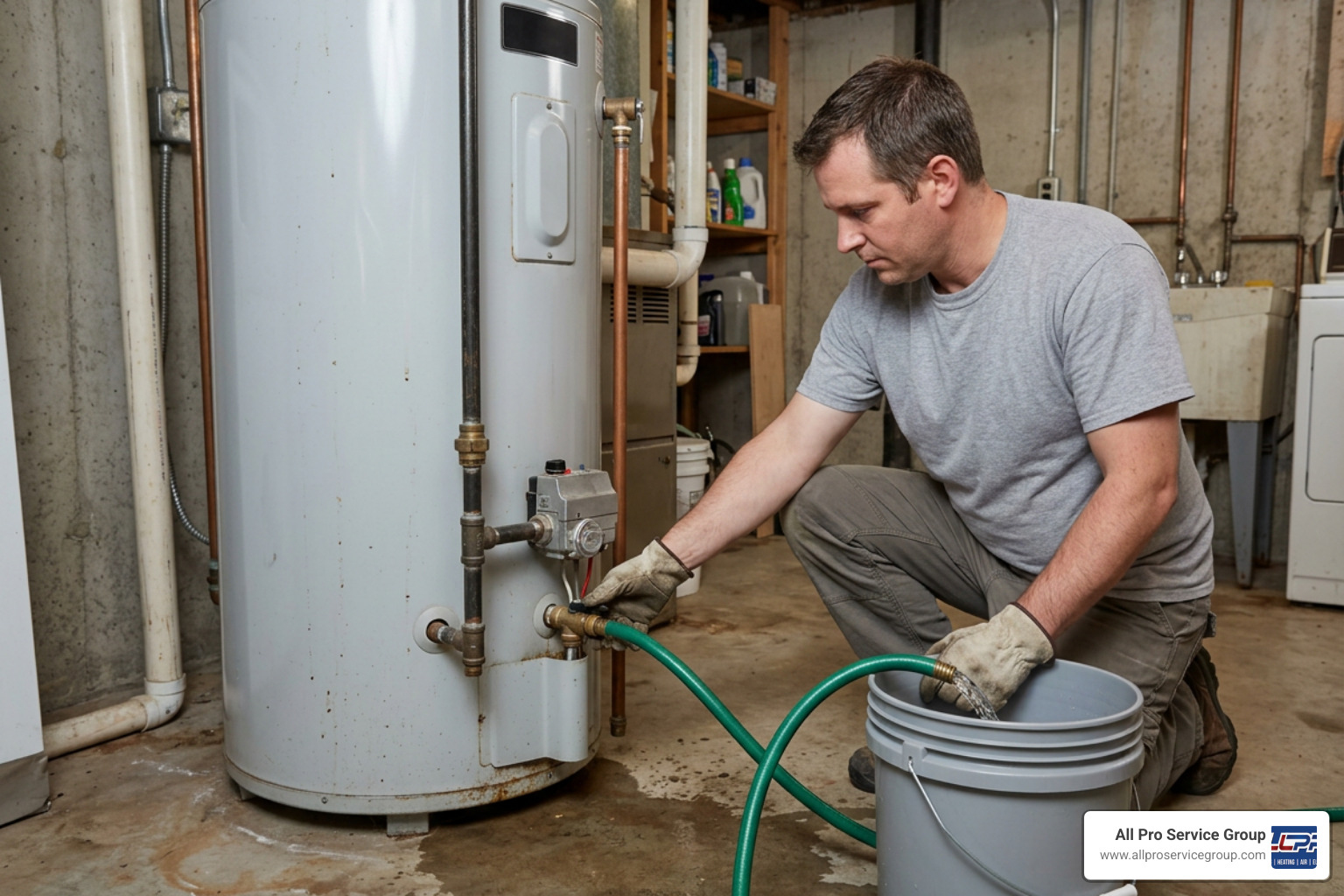
Ready to flush? Grab a standard garden hose, a flathead screwdriver, and follow these steps:
- Cool the Water: Turn the gas control valve to "VACATION" or "PILOT" mode. Let the water sit for a few hours if possible, or perform the flush carefully knowing the water will be extremely hot.
- Shut Off the Cold Water: Turn the cold water supply valve at the top of the tank clockwise until it is fully closed.
- Connect the Hose: Attach a heavy-duty garden hose to the drain valve located near the bottom of the water heater. Route the other end of the hose to a safe drainage spot, such as a floor drain, a utility sink, or outside. Note: Avoid draining hot, mineral-heavy water onto your lawn or delicate plants.
- Open a Hot Water Faucet: Open a hot water faucet upstairs or elsewhere in your home. This breaks the vacuum inside the plumbing system, allowing the water to drain smoothly out of the tank.
- Open the Drain Valve: Use a flathead screwdriver (or turn the handle if your valve has one) to open the drain valve. Water will begin flowing through the hose.
- Perform a Power Flush: Once the tank is empty, keep the drain valve open and quickly turn the cold water supply valve back on for 30 seconds, then shut it off. This blast of cold water helps stir up and wash out stubborn sediment clinging to the bottom of the tank. Repeat this cycle until the water running out of the hose is completely clear.
- Close the Drain Valve and Refill: Close the bottom drain valve tightly and disconnect your garden hose. Turn the cold water supply valve back on to fill the tank.
- Purge Air from the Lines: Keep the hot water faucet inside your house open. You will hear sputtering and air escaping. Once you get a steady, solid stream of water with no air pockets, turn the faucet off. Crucial Tip: Never turn the gas control valve back to "ON" until the tank is completely full of water, or you risk damaging the tank.
- Restart the Heater: Turn your gas control valve back to your desired temperature setting. Check the drain valve over the next hour to ensure it has sealed completely and isn't dripping.
Inspecting and Replacing Key Components (T&P Valve & Anode Rod)
Two critical components stand between your water heater and a catastrophic failure: the Temperature & Pressure (T&P) relief valve and the sacrificial anode rod.
How to Test the Temperature & Pressure (T&P) Relief Valve
The T&P relief valve is a mechanical safety device mounted on the top or side of your water heater. If your thermostat fails and the burner runs continuously, the water inside the tank can boil, creating immense pressure. The T&P valve is designed to open automatically if the temperature reaches 210°F or if the pressure exceeds 150 PSI, venting steam and hot water safely down a discharge pipe.
Without a functioning T&P valve, an over-pressurized water heater can literally turn into a rocket, exploding through floors and ceilings.
To test your T&P valve annually:
- Ensure the discharge pipe is securely connected and routed toward a drain or the floor.
- Gently lift the metal trip lever on the valve. Water should flow freely out of the discharge pipe.
- Release the lever. The valve should snap shut immediately, stopping the flow of water completely.
- If the valve drips, leaks, or fails to open, it must be replaced immediately. You can review the official T&P Valve Testing Standards for detailed technical specifications.
Inspecting and Replacing the Sacrificial Anode Rod
The sacrificial anode rod is a long metal rod—usually made of magnesium or aluminum wrapped around a steel core wire—that hangs inside your water heater tank. Its sole purpose is to rust so your tank doesn't have to.
Through a natural electrochemical process called galvanic corrosion, the corrosive elements in your water attack the anode rod instead of the steel walls of your tank. If the anode rod is completely depleted, those corrosive elements will target the tank itself, causing rust, pinhole leaks, and eventual tank failure.
To inspect or replace the anode rod:
- Turn off the gas and water supply, and drain a few gallons of water from the tank to lower the water level.
- Locate the hex head of the anode rod on top of the water heater (it may be hidden under a plastic cap).
- Use a 1-1/16 inch socket wrench to unscrew the rod. You may need a helper to hold the tank steady.
- Pull the rod straight up. If the rod is rusted down to its thin steel core wire, or if it is covered in thick calcium scale, it is time to replace it.
- Wrap the threads of the new anode rod with Teflon tape, insert it into the tank, and tighten it securely.
Note: If you use a whole-house water softener, the added sodium in the water increases conductivity, which accelerates anode rod decay. If you have a softener, inspect your anode rod every 12 months without fail. For professional assistance with this delicate repair, check out our AO Smith Hot Water Heater Repair options.
Thermostat Settings, Pilot Lights, and Insulation
Optimizing your water heater's settings and environment is the easiest way to cut your monthly utility bills while protecting your family from accidents.
Setting the Optimal Temperature
Many manufacturers ship water heaters with the thermostat set to 140°F. However, water at this temperature can cause third-degree burns in less than five seconds.
We recommend setting your thermostat to 120°F. This temperature is hot enough to prevent the growth of harmful bacteria like Legionella while protecting children and the elderly from accidental scalding. Additionally, keeping the temperature at 120°F reduces standby heat loss and slows down mineral scaling inside the tank.
| Water Temperature | Time to Produce Serious Burn |
|---|---|
| 120°F (49°C) | More than 5 minutes |
| 125°F (52°C) | 1.5 to 2 minutes |
| 130°F (54°C) | About 30 seconds |
| 140°F (60°C) | Less than 5 seconds |
| 150°F (66°C) | About 1.5 seconds |
To adjust your thermostat, locate the dial on the front of your gas control valve. Many valves use markings like "Hot," "A," "B," or "C" instead of exact numbers. "Hot" or the lowest index setting usually corresponds to roughly 120°F. Adjust the dial, wait an hour, and test the water temperature at a nearby faucet using a thermometer. For more tips on setting up your system, refer to our Water Heater Installation Guide 2026.
How to Safely Relight the Pilot Light
If you suddenly lose hot water, your pilot light may have gone out. Modern gas water heaters use a safety device called a thermocouple to monitor the pilot flame. The thermocouple must generate a tiny electrical signal (typically 20 to 30 millivolts) to keep the gas valve open. If the pilot goes out, the thermocouple cools down, shutting off the gas supply automatically to prevent a dangerous gas buildup.
To safely relight your pilot:
- Turn the gas control knob to "OFF" and wait at least five minutes for any lingering gas vapors to clear.
- Remove the outer and inner burner door covers at the base of the water heater.
- Turn the gas control knob to "PILOT."
- Press and hold down the gas control knob (or the dedicated pilot button). While holding it down, press the piezo igniter button repeatedly until you see a blue flame ignite through the viewing window.
- Continue holding the knob down for 60 seconds. This gives the thermocouple enough time to heat up and activate the gas valve safety sensor.
- Slowly release the knob. If the flame stays lit, turn the knob to the "ON" position. Replace the burner covers.
Insulating Your Pipes and Water Heater Unit
In our cold Utah winters—especially in mountain communities like Park City or high-elevation areas of Ogden—your water heater has to work extra hard. You can prevent standby heat loss by insulating the first six feet of both the hot and cold water pipes connected to your unit. Use self-sealing foam pipe insulation sleeves rated for high temperatures.
If you have an older water heater with an R-value of less than R-16, you might also consider installing a fiberglass insulation blanket around the tank. However, be extremely careful when insulating a gas unit: never cover the top cap, draft hood, burner access door, or any air intake vents, as this can cause starvation of combustion air and lead to a house fire or carbon monoxide poisoning.
Tank vs. Tankless Gas Water Heaters
As technology evolves, many homeowners in the Greater Salt Lake Valley are choosing between traditional tank-style systems and modern tankless units. Both systems require maintenance, but the tasks look very different.
Comparing Gas Hot Water Heater Maintenance for Tank and Tankless Systems
Traditional tank heaters hold a large volume of water and require regular flushing to manage heavy sediment.
Tankless systems, on the other hand, heat water on demand by passing it through a compact heat exchanger. Because water is heated rapidly to high temperatures within a tight space, minerals precipitate out of the water quickly, creating scale buildup inside the narrow passages of the heat exchanger.
Instead of a basic flush, tankless systems require an annual descaling process. This involves connecting a small utility pump to service valves on the unit and circulating food-grade white vinegar through the heat exchanger for about an hour to dissolve calcium scale. Additionally, tankless units have an inlet water filter that must be removed and cleaned regularly to maintain proper water pressure.
To learn more about these on-demand systems, explore our Tankless Water Heater Complete Guide.
Lifespan and Efficiency Differences
While tankless units require more specialized maintenance, they offer significant benefits. A high-quality tankless water heater can last up to 20 years with proper care, whereas a standard tank-style heater typically lasts around 10 years. Tankless models are also highly energy-efficient because they eliminate standby energy loss entirely.
If you are weighing your options, you might also want to research alternative systems, such as a Mini Electric Tankless Water Heater for single-use applications, or review our Heat Pump Water Heater Guide 2026 to see how hybrid electric models compare to natural gas options.
Frequently Asked Questions about Gas Water Heaters
How do I know if my gas water heater is failing?
Several warning signs indicate your water heater is nearing the end of its useful life:
- Rusty Water: If your hot water runs brown or rusty, but your cold water is clear, your tank's inner lining is likely corroded.
- Rumbling Noises: Loud popping or banging sounds indicate a heavy layer of hardened sediment that is trapping steam and cracking the glass lining of the tank.
- Slow Recovery Time: If it takes hours for your water to get hot again after a single shower, your burner assembly or thermostat is failing.
- Active Leaks: Any pooling water around the base of the tank is a clear sign that the inner steel shell has fractured.
If you are experiencing these issues, check out our Plumbing Water Heater Installation page to learn about your replacement options.
How often should I perform maintenance on my gas water heater?
For optimal performance and safety, we recommend following this general schedule:
- Every 6 Months: Drain a few gallons of water to check for sediment if you live in a hard water area.
- Annually: Perform a complete tank flush, test the T&P relief valve, and inspect the sacrificial anode rod.
- Every 3–5 Years: Replace the sacrificial anode rod, and have a professional plumber perform a comprehensive safety inspection.
For a deeper dive into manufacturer-recommended service intervals and diagnostic procedures, you can reference the Professional Service Handbook.
When should I call a professional plumber instead of DIY?
While flushing a tank is a great DIY project, some tasks should always be left to licensed professionals. You should call us immediately if you encounter:
- The Smell of Gas: Never attempt to repair gas lines or gas control valves yourself.
- A Leaking Drain Valve: If your plastic drain valve won't close or continues to drip after a flush, we can replace it with a durable brass valve.
- Frequent Pilot Outages: This often points to a failing thermocouple, a faulty gas valve, or improper combustion air venting.
- Electrical or Control Board Issues: Modern power-vented gas heaters feature complex electronic controls that require specialized diagnostic tools.
Conclusion
Taking the time to perform regular gas hot water heater maintenance is the best way to protect your investment, lower your monthly energy bills, and ensure your household always has access to reliable hot water.
At All Pro Service Group, we have been serving families across the Greater Salt Lake Area—including Ogden, Park City, Provo, South Jordan, West Jordan, West Valley City, and Salt Lake City—since 2008. As a "Gephardt Approved" service provider, we pride ourselves on delivering honest, dependable plumbing, heating, and electrical services.
Whether you need a hand with a stubborn anode rod, a comprehensive safety inspection, or a brand-new water heater installation, our trained experts are here to help. Contact us today to schedule your next service, or visit our Plumbing Water Heater Repair page to book an appointment online!