Why Detecting Leaks in Pipes Matters More Than You Think
Detecting leaks in pipes early can save you thousands of dollars — and a lot of headaches.
Here's how to quickly find a water leak in your home:
- Check your water meter — Turn off all water inside and outside. If the meter's leak indicator (a small triangular dial or silver wheel) is still moving, you have a leak.
- Take two meter readings — Record the meter reading, wait 1–2 hours without using any water, then read it again. A change confirms a leak.
- Isolate inside vs. outside — Shut off your main indoor valve and recheck the meter. If it stops moving, the leak is inside. If it keeps moving, it's between the meter and your home.
- Check toilets first — Drop a dye tablet or a few drops of food coloring into the toilet tank. If color appears in the bowl without flushing, your flapper is leaking silently.
- Look for visible signs — Water stains on walls or ceilings, musty odors, warm spots on floors, soft patches in the yard, or a sudden spike in your water bill all point to a hidden leak.
- Call a professional if you can't find the source — plumbers use acoustic sensors, thermal imaging, and video cameras to locate leaks without tearing up your walls.
Even a small, slow leak you can't see or hear can quietly waste thousands of gallons of water. Across the U.S., leaks are a leading driver of unexpectedly high water bills — and in many cases, homeowners don't realize anything is wrong until the damage is already done.
The problem isn't always a burst pipe. Often, it's something quieter: a worn toilet flapper, a slow drip behind a wall, or a hairline crack in a service line underground. These incipient leaks are easy to miss — and expensive to ignore.
At All Pro Service Group, our team has been helping Greater Salt Lake homeowners with detecting leaks in pipes — from simple meter tests to full underground line inspections — since 2008. In this guide, we'll walk you through everything you need to know, step by step.

The Hidden Cost and Common Causes of Plumbing Leaks
Water leaks are more than a minor annoyance; they represent a massive drain on natural resources and household finances. According to the United States Geological Survey (USGS), the average person in the United States uses between 80 and 100 gallons of water per day. When a leak goes unnoticed, that baseline usage can double or triple in a matter of weeks, leading to astronomical utility bills. Fortunately, the average homeowner can save roughly 10% on their water bills simply by finding and repairing common household leaks.
To understand why pipes fail, we have to look at the physical and environmental stressors acting on plumbing systems. Several primary factors lead to compromised pipes in residential and commercial properties:
- Pipe Corrosion: Over time, copper, galvanized iron, and steel pipes react chemically with the water flowing through them. This electrochemical reaction slowly eats away at the pipe walls, leading to pitting and pinhole leaks.
- High Water Pressure: While a high-pressure shower feels great, excessive water pressure puts immense stress on pipe joints, valves, and appliance connections. Any pressure consistently exceeding 80 PSI can significantly shorten the lifespan of your plumbing.
- Temperature Fluctuations: In Utah, we experience hot summers and freezing winters. The rapid expansion and contraction of pipes due to temperature swings weaken joints and can cause fragile materials to crack or burst.
- Boilers and Water Softeners: Appliances that handle heated water or chemical regeneration often experience accelerated wear. If their internal bypass valves or pressure relief lines fail, they can leak water directly into drainage lines without showing any external pooling.
Understanding the difference between an abrupt failure and a gradual leak is critical for prioritizing repairs. Below is a comparison of these two primary leak profiles:
| Leak Feature | Abrupt Bursts | Incipient (Gradual) Leaks |
|---|---|---|
| Onset Speed | Immediate and sudden | Slow, progressive development over weeks or months |
| Typical Cause | Freezing temperatures, physical damage, extreme pressure surges | Corrosion, minor joint weakening, slow seal degradation |
| Primary Symptoms | Gushing water, rapid flooding, complete loss of pressure | Musty smells, water stains, mold, slowly rising utility bills |
| Detection Difficulty | Very low (instantly noticeable) | High (requires systematic testing or advanced tools) |
| Urgency Level | Maximum (requires immediate shutoff) | Moderate to High (requires planned investigation) |
The broader impact of pipeline damage is well-documented. According to Scientific research on pipeline damage statistics, underground infrastructure faces escalating risks annually. In municipal water systems, pipeline failures lead to billions of gallons of treated water escaping into the surrounding soil every single day. By keeping your home's system leak-free, you play a vital role in preserving limited water resources for future generations.
How to Find a Leak: DIY Diagnostic Strategies
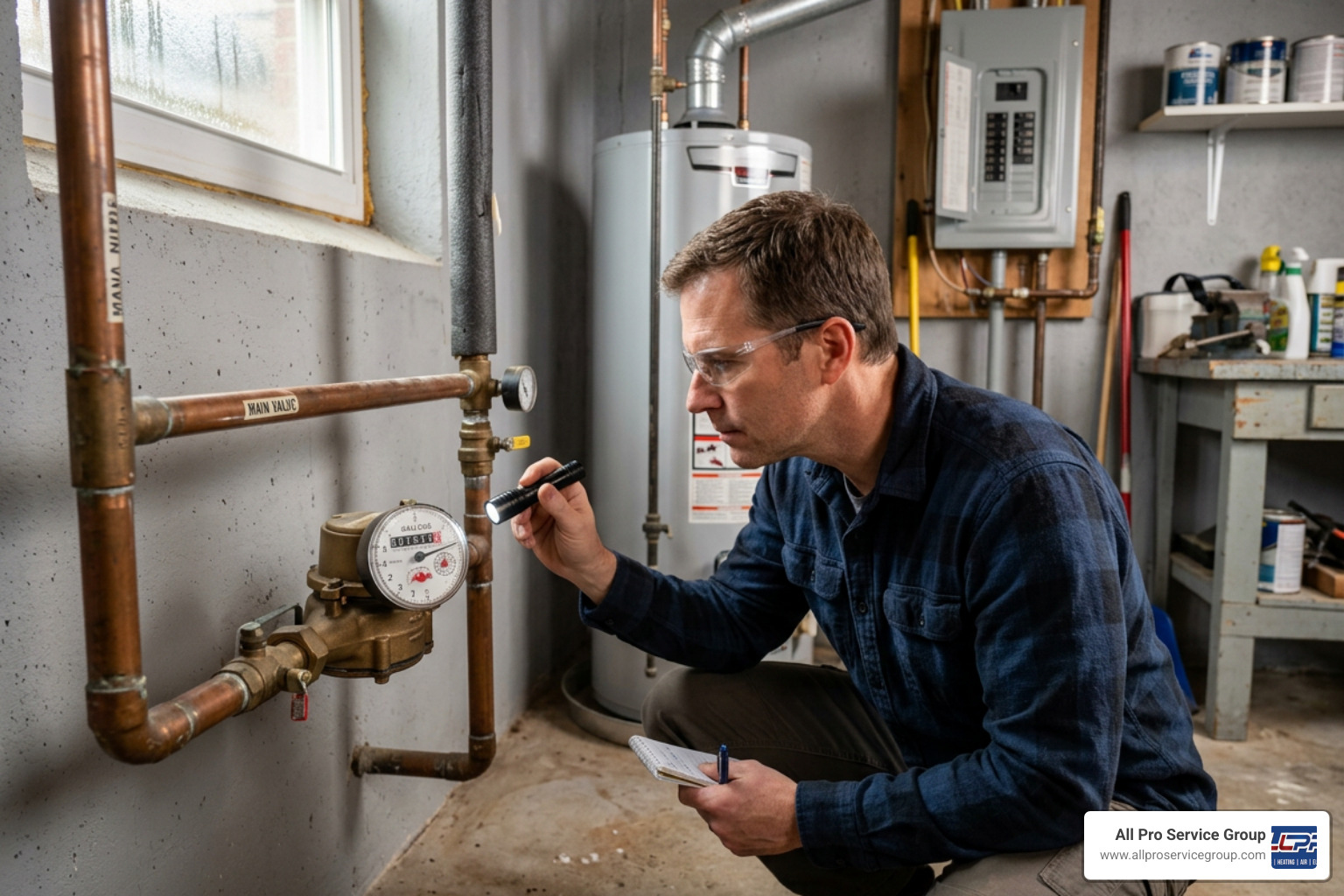
Many homeowners assume that finding a hidden leak requires tearing down drywall or digging up floorboards. In reality, you can diagnose the presence of a leak and narrow down its location using simple, non-invasive DIY strategies.
The first indicator of a hidden leak is almost always a sudden, unexplained spike in your water bill. If your household habits haven’t changed, but your monthly bill has surged, it is time to investigate. For detailed professional guidance on resolving these issues, you can read More info about plumbing leak detection repair.
Before calling a plumber, you can perform a thorough visual and auditory inspection:
- Check under all sinks with a flashlight, looking for damp cabinet floors, peeling laminate, or water rings around the drain pipes.
- Inspect the base of your water heater, water softener, and washing machine for small puddles.
- Walk through your home in the quiet hours of the evening and listen closely. A continuous, faint hissing or rushing sound behind a wall when no water is running is a classic sign of a pipe leak.
DIY Steps for Detecting Leaks in Pipes Using Your Water Meter
Your water meter is the most powerful diagnostic tool at your disposal. It acts as a silent sentry, recording every drop of water that enters your property. By monitoring it systematically, you can confirm whether water is escaping your system. For more information on repairing supply lines once a leak is confirmed, review our guide on More info about water line repair.
To perform a meter test, follow these steps:
- Turn Off All Water: Ensure that no appliances (washing machines, dishwashers), ice makers, or irrigation systems are running. Turn off all indoor and outdoor faucets.
- Locate Your Water Meter: In Utah, water meters are typically located in a metal or plastic box in the ground near the street curb, or inside the basement utility room near the main water shutoff valve.
- Observe the Leak Indicator: Open the meter cover. Most modern meters feature a dedicated leak indicator—often a small, highly sensitive red or silver triangular dial, or a rotating wheel. If this indicator is spinning even slightly while all water is shut off, water is moving through the meter, confirming a leak.
- Perform the Elapsed Time Test: If the leak indicator isn't moving visibly, take a precise reading of the main numerical display. Leave the water off for 1 to 2 hours, then check the reading again. If the numbers have changed, you have a slow, gradual leak.
Isolating Indoor vs. Outdoor Water Leaks
Once you have confirmed that a leak exists, the next step is determining whether the issue lies inside your home's walls or outside in your yard.
To isolate the leak, locate your home’s main indoor shutoff valve. This is typically situated in the basement, crawlspace, or garage where the main water line enters the building.
- Keep all fixtures turned off and close this main indoor shutoff valve tightly. This stops water from entering your home's interior plumbing while leaving the outdoor supply line pressurized.
- Go back outside and check your water meter.
- If the meter's leak indicator stops moving, the leak is located inside the home.
- If the meter continues to record water movement, the leak is located outside, somewhere along the service line running between the water meter pit and your home’s foundation.
Outdoor leaks often manifest as unusually green patches of grass, soft, sunken spots in the lawn, or wet areas on your driveway or sidewalk.
Uncovering Silent Appliance and Toilet Leaks
Toilets are the single most common source of silent indoor water leaks. A single leaking toilet flapper can waste up to 200 gallons of water per day without making a sound.
To test for a silent toilet leak:
- Remove the tank lid and drop a dye tablet or a few drops of dark food coloring into the water.
- Do not flush the toilet.
- Wait 15 to 20 minutes. If colored water begins to seep into the toilet bowl, your flapper valve is worn or misaligned and needs to be replaced.
Beyond toilets, other appliances can hide leaks in plain sight. Water softeners, boilers, and water heaters often have dedicated drain lines connected directly to sewer standpipes or floor drains. If an internal valve fails, water will flow directly down the drain without ever pooling on your floor. To check these, bypass your water softener temporarily or inspect the discharge line of your water heater’s temperature and pressure (T&P) relief valve to ensure it isn't constantly dripping.
Advanced Professional Methods for Detecting Leaks in Pipes
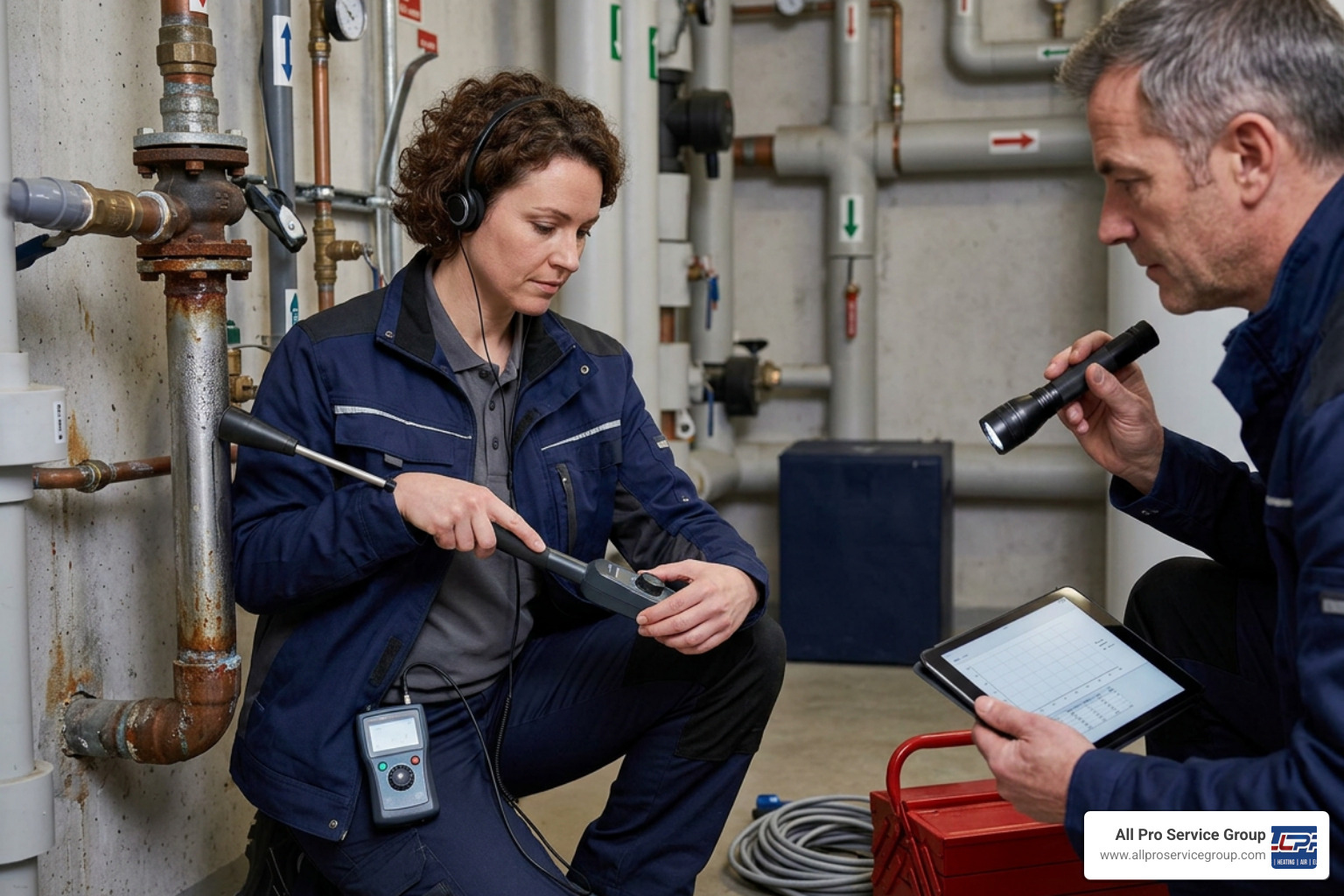
While DIY methods are excellent for confirming a leak, pinpointing its exact location behind concrete slabs or deep underground requires specialized technology. Professional plumbers use non-invasive diagnostic tools to locate the source of a leak within inches, preventing unnecessary damage to your home’s finishes. If you find yourself facing an active leak that requires immediate professional intervention, you can access More info about emergency plumbing.
Some of the most effective professional tools include:
- Acoustic Listening Devices: When water escapes a pressurized pipe, it creates a distinct vibrational frequency. Plumbers use ground microphones and acoustic listening rods to amplify these sounds through the soil or concrete, allowing them to locate the leak by finding the point of maximum sound intensity.
- Thermal Imaging Cameras: Hot water leaks behind drywall or beneath concrete slabs alter the surface temperature of the surrounding material. Thermal cameras allow technicians to "see" these heat signatures, revealing the exact path of the leaking water.
- Tracer Dyes: Specialized fluorescent dyes can be injected into plumbing or drainage lines. When viewed under ultraviolet (UV) light, these dyes illuminate tiny cracks that are completely invisible to the naked eye.
- Hydrogen Tracer Gas: For incredibly small or deep leaks where acoustic methods fail due to ambient noise, technicians use a specialized gas mixture consisting of 95% nitrogen and 5% hydrogen. This non-flammable, non-toxic gas is injected into the isolated pipe under low pressure. Because hydrogen is the lightest and smallest element, it escapes through the tiny pipe fracture and rises rapidly through soil, concrete, or flooring, where it is detected at the surface by highly sensitive electronic sensors. To understand the science behind this advanced diagnostic process, you can read the Scientific research on hydrogen leak detection.
Municipal and Large-Scale Network Leak Detection
On a municipal scale, water loss is an incredibly costly challenge. Across the globe, approximately 20% to 30% of all treated water is lost before it ever reaches a consumer's tap—a phenomenon known as non-revenue water (NRW). In older, poorly maintained municipal water distribution networks (WDNs), these transmission losses can exceed 50%. This translates to roughly 126 billion cubic meters of lost water annually, representing an economic loss of approximately $39 billion.
To combat this, municipal water utilities are moving away from reactive repair models and adopting proactive, continuous monitoring frameworks. By strategically placing pressure, flow, and acoustic sensors throughout the distribution network, engineers can analyze real-time hydraulic data to identify anomalies. To explore the mathematical modeling and algorithms used to manage these complex networks, refer to the Scientific research on AI leak localization.
The Role of Smart Technology in Detecting Leaks in Pipes
The integration of artificial intelligence (AI) and machine learning has revolutionized how we manage large-scale plumbing and distribution systems. Modern detection systems utilize hybrid models that combine real-world physical hydraulics with deep learning algorithms.
These hybrid AI systems use advanced neural architectures to process complex sensor data. By combining Convolutional Neural Networks (CNNs) to analyze frequency-domain acoustic signals with selective state-space models (such as Mamba), these systems can process long-sequence time-domain data to identify the exact signature of a pipe leak amidst heavy background city noise.
These models are incredibly robust, decoupling leak location from leak size, which allows utilities to locate multiple concurrent leaks even in noisy environments. For a deep dive into how these state-space models and neural networks are trained to identify fine-grained pipeline anomalies, see the Scientific research on CNN-Mamba models.
Immediate Action and Preventive Maintenance
Discovering a water leak can be stressful, but taking immediate, decisive action can mean the difference between a simple pipe repair and a multi-thousand-dollar home restoration project. If you find an active leak, follow these steps immediately:
- Shut Off the Water: Immediately close the nearest local shutoff valve or the main water shutoff valve for your entire home.
- Turn Off Electricity: If water is leaking near electrical outlets, appliances, or your main breaker panel, shut off the power to those zones immediately to prevent electrical shock or fire hazards.
- Drain the Lines: Open the lowest faucets in your home to drain any remaining water out of the pipes, directing it away from the leak site.
- Mitigate Damage: Use towels, buckets, or wet vacuums to remove standing water as quickly as possible to prevent mold growth and wood warping. For temporary fixes to contain the water while waiting for a plumber, read More info about the best way to stop a leaking pipe.
To protect your home from future plumbing emergencies, implement these preventive maintenance practices:
- Install a Pressure Regulator: Ensure your home's water pressure is set between 50 and 70 PSI. If your municipal water pressure is too high, a pressure-reducing valve (PRV) can protect your pipes from excessive wear.
- Conduct Routine Visual Inspections: Set a recurring reminder on your calendar to inspect your utility room, under-sink cabinets, and outdoor hose bibs once every six months.
- Monitor Your Water Softener: Regularly check the brine tank and drain lines of your water softener to ensure it is cycling properly and not continuously draining water.
Frequently Asked Questions about Pipe Leaks
How do I know if a water leak is inside or outside my home?
To determine whether a leak is inside or outside, perform the main shutoff valve test. First, turn off all water fixtures. Next, locate and close your home's main indoor water shutoff valve. Go to your water meter and observe the leak dial. If the dial stops moving, the leak is located on the pressurized pipes inside your home. If the dial continues to spin, water is escaping through the underground service line between the water meter pit and your home's foundation.
Can a water softener or boiler cause a hidden leak?
Yes, water softeners and boilers are common culprits behind hidden leaks. Both appliances are connected to dedicated drain lines to discharge excess water or relieve pressure. If an internal bypass valve, flush cycle valve, or pressure relief valve fails, water will flow continuously down the drain line. Because the water goes directly into your sewer system, you won't see a puddle on the floor, but your water meter will show continuous water usage.
What should I do immediately after discovering a pipe leak?
The moment you discover a pipe leak, shut off the main water supply to stop the flow of water. If the leak is near any electrical fixtures, shut off the electricity to that area at your main breaker panel. Clean up as much standing water as possible to minimize structural damage and prevent mold. Once the area is safe, contact a professional plumber to perform a permanent repair. If you need immediate assistance with an urgent leak, you can access More info about emergency plumbing.
Conclusion
Detecting leaks in pipes early is one of the most effective ways to protect your property, lower your utility bills, and support vital water conservation efforts in our beautiful desert state. From simple DIY toilet dye tests to monitoring your water meter, keeping a close eye on your plumbing system pays off.
When a leak is hidden deep beneath a concrete slab, behind drywall, or underground in your yard, DIY methods can only go so far. That is where we come in. At All Pro Service Group, we have been providing dependable plumbing, heating, air, and electrical services to families across the Greater Salt Lake Area—including Salt Lake City, Sandy, South Jordan, West Jordan, West Valley City, Provo, and Ogden—since 2008.
As a "Gephardt Approved" company, we take pride in offering transparent pricing, exceptional customer service, and advanced, non-invasive leak detection technology. Whether you need a routine system inspection or immediate assistance with a broken water line, our trained experts are here to help.
Don't let a mysterious leak damage your home or drain your wallet. Contact our friendly team today to Schedule water line repair services and get your plumbing back in perfect working order.