Is a 110V Tankless Hot Water Heater Right for Your RV, Skoolie, or Tiny Home?
A 110v tankless hot water heater is a compact, on-demand electric unit that heats water only when you need it — no storage tank, no standby heat loss, and no 240V circuit required. If you're living off-grid, outfitting an RV, or squeezing a hot water solution into a tiny space, this is likely the type of heater you're considering.
Here's a quick overview of the most popular 110V tankless models available in June 2026:
| Model | Power | Max Flow Rate | Best For |
|---|---|---|---|
| Camplux 4.5kW | 4.5 kW / 120V | 1.0 GPM (50°F rise) | Single sink, small kitchens |
| Stiebel Eltron DHC 3-1 | 3.0 kW / 120V | 0.82 GPM (80°F inlet) | Bathroom sink, hand-washing |
| Stiebel Eltron Mini 2-1 | 1.8 kW / 120V | 0.32 GPM (60°F+ inlet) | Ultra-compact, low-flow only |
| Titan N10 | 3.2 kW / 110V | 1.0 GPM (24°F rise) | RV, boat, small condo |
The key things to know upfront:
- 110V units are point-of-use heaters — designed for one sink at a time, not whole-house use
- They are not suitable for showers under most conditions
- Flow rates are low (typically 0.32–1.0 GPM)
- They can achieve up to 99%+ energy efficiency by eliminating standby heat loss
- Most require a dedicated 15–40 amp breaker and must be hard-wired
These units shine in specific situations — and fall short in others. This guide breaks down exactly when a 110V tankless unit makes sense, which model fits your needs, and what to watch out for before you buy.
At All Pro Service Group, our team has helped hundreds of Greater Salt Lake Valley homeowners evaluate and install the right water heating solutions — including 110v tankless hot water heater setups for compact living spaces. In the sections below, we'll walk you through everything you need to know to make a confident decision.
What is a 110v Tankless Hot Water Heater?
At its core, a 110v tankless hot water heater is an electric appliance designed to heat water instantly as it flows through the unit. Unlike traditional tank-style heaters that keep 30 to 50 gallons of water hot 24/7, a tankless unit remains completely idle until you turn on a tap.
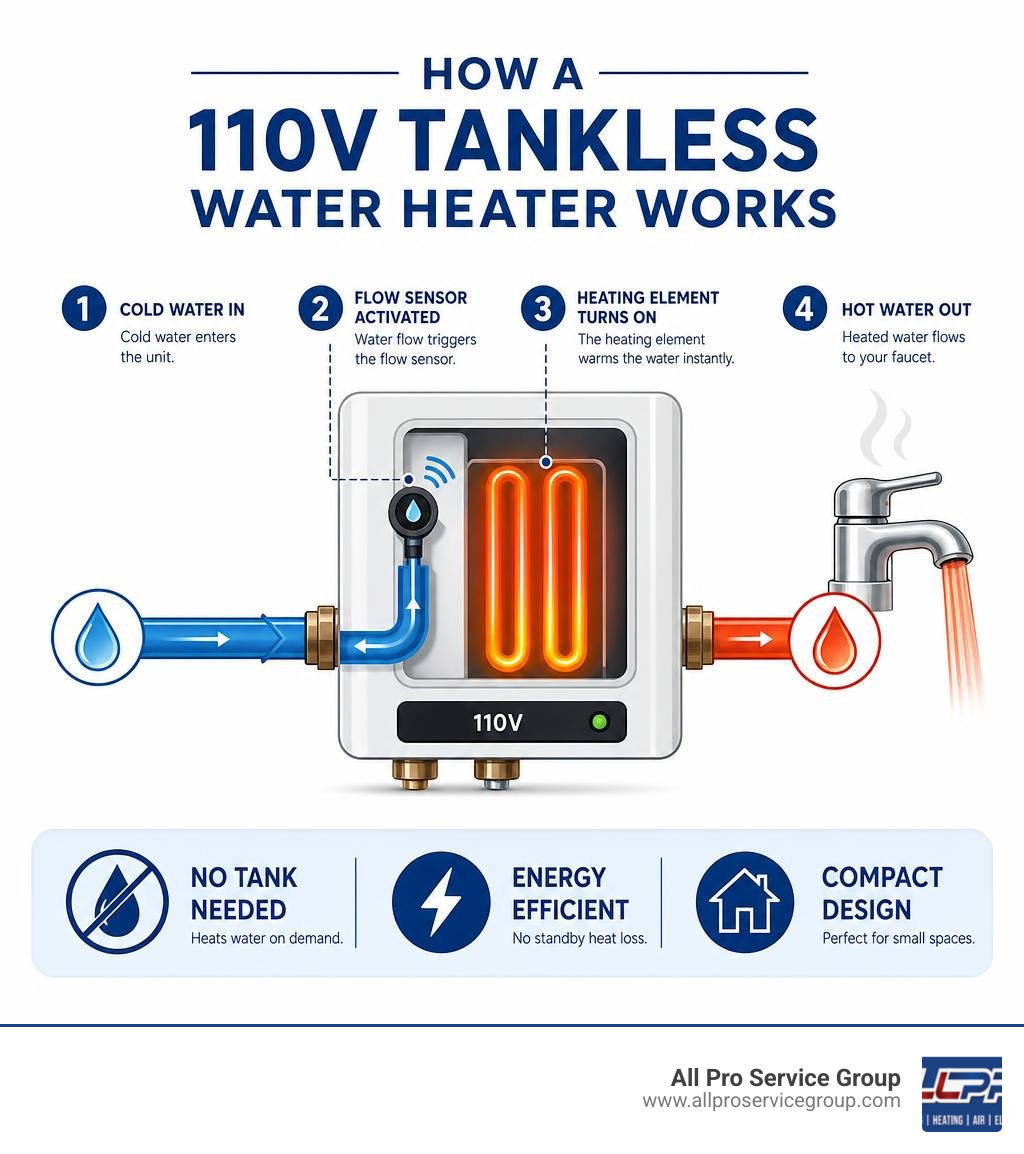
When you open the hot water faucet, a flow sensor detects the movement of water and activates a powerful electric heating element. The water passes over this element, absorbs the heat, and exits the tap at your desired temperature. Because there is no storage tank, you will never "run out" of hot water, provided you stay within the unit's flow rate limitations.
These units are designed strictly for point-of-use applications. This means they are installed right next to or directly under the fixture they serve (like a single kitchen or bathroom sink). Learn more in our tankless water heater complete guide to see how these compact point-of-use systems compare to whole-house setups.
How a 110v tankless hot water heater differs from 240V systems
The most significant difference between a 110V (or 120V) tankless heater and a standard residential 240V tankless unit is heating capacity.
Power in electrical terms is measured in kilowatts (kW), which is directly tied to voltage and amperage (Voltage x Amps = Watts). Because 110V units operate on standard household voltage, their power output is severely restricted compared to their 240V counterparts:
- 110V/120V Units: Typically range from 1.8 kW to 4.5 kW. They draw between 15 and 40 amps and are limited to supplying a single low-flow faucet.
- 240V Units: Often range from 11 kW to 27 kW or more. For example, a heavy-duty single-chamber point-of-use unit like the 240V / 11.00 kW Single-Chamber Point-of-Use Electric Tankless Water Heater UPVA-110E 100 | A.O. Smith or the similar 240V / 11 kW Point-of-Use Tankless Electric Water Heater | Reliance Water Heaters can deliver much higher flow rates. Whole-house 240V systems require multiple 40-amp or 50-amp double-pole breakers and can easily heat water for multiple showers simultaneously.
If you want to check out the sheer variety of electric options, you can Explore electric tankless options on Home Depot to compare physical sizes and power ratings.
Standby energy loss vs on-demand heating
Traditional tank water heaters suffer from what is known as standby thermal loss. They constantly lose heat through the walls of the tank, forcing the heating elements to cycle on and off all day and night—even when you are asleep or away at work.
Electric tankless water heaters, on the other hand, achieve an incredible 99%+ energy efficiency rating. They only draw electrical power when water is actively running through them. By completely eliminating standby energy losses, switching to a point-of-use tankless heater can drastically lower your operating costs. This makes them a favorite for eco-conscious tiny home builders and RVers looking to squeeze every ounce of efficiency out of their solar or shore power setups.
Key Advantages and Best-Use Scenarios for Tiny Spaces
Space is the ultimate currency in an RV, skoolie, or tiny home. A traditional 6-gallon or 10-gallon RV tank heater takes up valuable cabinet space and adds significant weight to your rig. A 110V tankless unit is roughly the size of a thick textbook and weighs less than 5 pounds, freeing up critical square footage for storage.

Beyond saving physical space, these units eliminate the need to run long, complicated hot water lines from a central location. If you are building out a skoolie or a tiny home, placing a compact heater directly under the sink means you get hot water in seconds. Discover how a tankless water heater can help your home by reducing water waste and increasing overall energy efficiency.
Best-use scenarios for a 110v tankless hot water heater
Because of their limited power, 110V units are highly specialized. They are perfect for:
- RVs, Boats, and Campers: Excellent for a single kitchen or bathroom sink when connected to 30-amp or 50-amp shore power.
- Skoolies and Tiny Homes: Perfect for off-grid or semi-off-grid structures where electrical panels are limited and gas lines are not preferred.
- Remote Cabins and Outbuildings: Great for a detached workshop, home office, or guest cottage in places like Park City or Ogden where running a gas line or heavy 240V line is too expensive.
- Commercial Hand-Washing Stations: Ideal for office restrooms, school sinks, and medical clinics.
If you are trying to figure out if an ultra-compact electric unit is right for your specific layout, you can Read our mini electric tankless water heater guide for deep-dive application tips.
Limitations in cold climates
The biggest challenge for any electric tankless heater is groundwater temperature. In the winter months here in Utah—whether you are in Salt Lake City, Provo, or high up in Park City—groundwater temperatures can drop to a frigid 40°F or lower.
To heat water to a comfortable hand-washing temperature of 105°F, your heater has to achieve a 65°F temperature rise. Because a 110V unit has limited wattage, it simply cannot heat water that quickly unless the flow rate is restricted to a absolute trickle (often less than 0.4 GPM). If you are parked in a freezing climate, a 110V unit will struggle to provide warm water, whereas in warmer southern climates (where groundwater is 70°F), the same unit will perform beautifully.
Comparing the Top 110V Tankless Models on the Market
When shopping for a 110v tankless hot water heater, you will find a few reliable models that dominate the market. Let's look at how their real-world performance numbers stack up:
Camplux 4.5kW (110-120V)
This is one of the most powerful 110V units available. Operating at 4.5kW, it requires a hefty 40-amp breaker and 10 AWG wiring. The payoff is that it can deliver a 50°F temperature rise at a 1.0 GPM flow rate. It features a smart self-modulating design that adjusts power input in real-time based on your water flow and temperature settings.
Stiebel Eltron DHC 3-1 Classic
Stiebel Eltron is a gold standard in German engineering. The DHC 3-1 is a 3.0 kW unit drawing 25 amps. It is built with highly durable internal copper piping. In warm climates with 80°F incoming water, it can achieve a maximum flow rate of 0.82 GPM for a 105°F output. However, if your inlet water is a chilly 45°F, its flow rate drops to around 0.34 GPM to maintain that same 105°F output.
Stiebel Eltron Mini 2-1
If you are extremely limited on power, the Mini 2-1 is an ultra-compact 1.8 kW unit that draws only 15 amps. It activates at a very low flow rate of 0.21 GPM. At an 80°F incoming water temperature, it provides a maximum flow rate of 0.32 GPM at 105°F. It is strictly meant for basic, low-flow hand-washing sinks.
Titan N10
The Titan N10 is a 3.2 kW unit drawing 29 amps (requiring a 30-amp breaker and 10 AWG wire). It is incredibly compact and features dual heating chambers. The N10 produces a 24°F temperature rise at 1.0 GPM. This makes it an incredibly popular choice for boats and RVs operating in warmer climates, but it will require a flow-restricting aerator if used in colder northern Utah winters.
Flow rate and incoming water temperature impact
As you can see, flow rate and incoming water temperature are inextricably linked. If you try to run water too fast through a 110V heater, the water won't spend enough time contacting the heating element, resulting in a lukewarm or cold stream.
To help maintain a steady, usable temperature, manufacturers often include or recommend installing a pressure-compensating aerator (usually 0.5 GPM) on your faucet. This limits the physical amount of water coming out of the tap, giving the tiny heating element enough time to do its job.
For those who realize they need a bit more heating power than a 110V unit can provide, you can Check out A.O. Smith electric tankless models to see their line of higher-voltage residential point-of-use systems.
Warranty coverage and manufacturer support
Warranty coverage varies significantly by brand, which is a major indicator of build quality:
- Titan N10: Offers a generous 10-year warranty on water-carrying components (like the heating chambers) and a 1-year warranty on electrical components.
- Stiebel Eltron Mini & DHC: Typically come with a solid 3-year manufacturer warranty.
- Camplux: Generally includes a 2-year limited warranty.
To ensure your warranty is honored, always register your product online immediately after purchase and keep a copy of your professional installation invoice.
Electrical Requirements, Installation, and Maintenance
Do not let the "110V" label fool you—these units are not always "plug-and-play" appliances. While they run on standard household voltage, they draw a massive amount of current (amperage) to heat water instantly.

Before purchasing, you must verify your electrical system can handle the load. See our water heater installation guide 2026 for a complete breakdown of electrical safety and plumbing codes.
Here is a quick reference guide for typical 110V electrical configurations:
| Unit Wattage | Amperage Draw | Required Breaker | Required Wire Gauge | Connection Type |
|---|---|---|---|---|
| 1.8 kW | 15 Amps | 15 Amp | #14 AWG Copper | Plug-in or Hard-wired |
| 3.0 kW | 25 Amps | 30 Amp (Dedicated) | #10 AWG Copper | Hard-wired |
| 3.2 kW | 29 Amps | 30 Amp (Dedicated) | #10 AWG Copper | Hard-wired |
| 4.5 kW | 37.5 Amps | 40 Amp (Dedicated) | #10 AWG Copper (or #8) | Hard-wired |
Note: Always consult the National Electrical Code (NEC) and local building departments in Utah. If your home or RV is wired with 12/2 wire, you can only use it on a 30-amp breaker if the wire is rated as THHN and approved by local codes.
Safety features and certifications to look for
When working with water and high-amperage electricity in close proximity, safety is paramount. Always look for units that carry trusted safety certifications, such as UL (Underwriters Laboratories) approval #499 or ETL certification.
Key safety features to look for include:
- Dry-Fire Protection: Prevents the heating elements from turning on if there is no water in the chamber, which would instantly burn out the element.
- Overheating Protection: Automatically shuts down power if water temperatures spike to dangerous levels.
- Electrical Leakage Protection: Built-in sensors to prevent ground faults.
For an example of commercial-grade safety standards in point-of-use electric units, you can View the State Water Heaters UPVS-110Y 100 specifications to see how high-end models incorporate advanced self-diagnostics and dry-fire protection.
Water hardness and longevity
In the Greater Salt Lake Area, hard water is a common headache. For instance, municipal water in Salt Lake City averages around 117.5 PPM (parts per million) of hardness.
When hard water is heated, dissolved minerals like calcium and magnesium solidify and form scale deposits inside the heating chamber. Over time, this scale coats the heating elements, acting as an insulator. This forces the unit to work harder, reduces efficiency, and can cause premature element failure.
To maximize the life of your heater:
- Install a Scale Inhibitor: A simple inline sediment and scale filter on the inlet line will catch minerals before they enter the heater.
- Perform Annual Flushing: Flush the unit once a year with food-grade white vinegar to dissolve mineral buildup.
If your unit has stopped heating or is making strange noises, you can Learn about water heater repair options to get your hot water back online.
Can a 110V tankless water heater run a shower?
In a word: No.
Standard home showers typically require a flow rate of 1.5 to 2.5 GPM at a comfortable temperature of 105°F. Even if you use a specialized ultra-low-flow RV showerhead (rated at 1.0 GPM), a 110V heater simply does not have the wattage to heat that much water quickly enough, especially in Utah’s colder climate.
If you attempt to run a shower on a 110V tankless unit, you will end up with either a freezing cold shower or a warm shower that is nothing more than a slow drip. For showers in tiny homes or cabins, you will need to upgrade to a 240V electric system, a heat pump water heater, or a gas-powered tankless unit.
For instance, non-condensing gas units like the Ultra-Low NOx Indoor 140,000 BTU Non-Condensing Natural Gas/Liquid Propane Tankless Water Heater | Model LTI-110U | Lochinvar, the TK-110U-I 200 Series - 140,000 BTU Natural Gas/Liquid Propane Indoor Non-Condensing Ultra-Low NOx, or the ProLine® XE Ultra-Low NOx Indoor 140,000 BTU Non-Condensing Natural Gas/Liquid Propane Tankless Water Heater ATI-110U 200 | A.O. Smith can easily deliver 3.5 to 6.6 GPM, making them highly suitable for hot showers.
Does a 110V tankless unit require a dedicated circuit?
Yes, absolutely. Because these units draw between 15 and 40 amps of power, they must be installed on a dedicated circuit running directly to your main electrical panel.
If you try to wire a 110V tankless heater into an existing circuit that shares power with your microwave, lights, or outlets, you will trip your breaker every single time you turn on the hot water tap. For safe operation, always follow the manufacturer's exact specifications for breaker size and wire gauge.
Conclusion
A 110v tankless hot water heater is an excellent, space-saving, and highly efficient solution for point-of-use applications like RV kitchen sinks, tiny home bathrooms, and remote workshops. By heating water only on demand, these compact systems eliminate standby energy waste and provide endless hot water within their flow rate limits.
However, because they require specialized electrical circuits and are highly sensitive to local groundwater temperatures, proper sizing and professional installation are critical to getting the performance you expect.
If you live in Salt Lake City, Sandy, West Valley City, Draper, or anywhere along the Wasatch Front, our team at All Pro Service Group is here to help. We are "Gephardt Approved" and have been providing reliable plumbing, heating, and electrical services since 2008. We can inspect your electrical panel, evaluate your hot water needs, and install the perfect tankless system for your unique space.
Ready to upgrade your compact living setup? Schedule your tankless water heater installation today with the local experts at All Pro Service Group!