
Why AO Smith Water Heater Maintenance Protects Your Home and Your Budget
AO Smith water heater maintenance done right — and done regularly — is one of the simplest ways to avoid a cold shower, a flooded utility room, or a surprise repair bill.
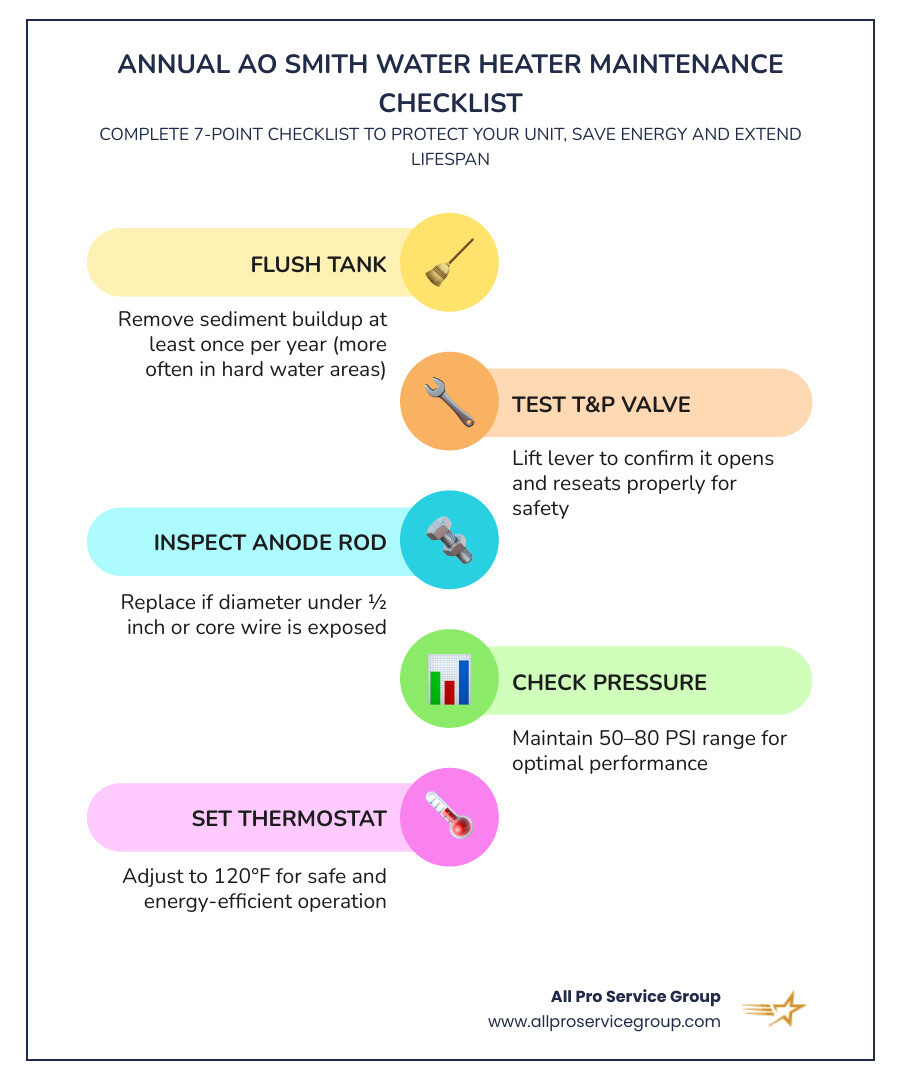
Here's a quick overview of what annual maintenance involves:
- Flush the tank to remove sediment buildup (at least once per year; more often in hard water areas)
- Test the T&P relief valve by lifting the lever to confirm it opens and reseats properly
- Inspect the anode rod and replace it if the diameter is under ½ inch or the core wire is exposed
- Check water pressure — it should stay between 50–80 PSI
- Set the thermostat to 120°F for safe, efficient operation
- Inspect for leaks around the base, connections, and drain valve
- Clean vents and air intake on gas models to ensure proper combustion
Most of these tasks take under an hour and can be done by the average homeowner. Skip them, and you risk reduced efficiency, early failure, and costly repairs.
Water heaters work hard every single day — quietly heating water for showers, dishes, and laundry without much attention. But they don't maintain themselves. Sediment from incoming water settles at the bottom of the tank over time, forcing the heating element to work harder and use more energy. Left unchecked, that buildup can damage internal components, shorten the unit's lifespan, and drive up your monthly utility bills.
I'm the owner of All Pro Service Group, and our team has been servicing water heaters — including ao smith water heater maintenance — across the Greater Salt Lake Valley since 2008. In that time, we've seen how a little routine care can add years to a unit's life and prevent the kind of failures that disrupt your household at the worst possible time.
Benefits of Regular AO Smith Water Heater Maintenance
When you stay on top of your ao smith water heater maintenance, you aren't just checking a chore off your list; you are actively protecting one of the most expensive appliances in your home. As of May 2026, the cost of high-efficiency units continues to rise, making preventative care more valuable than ever.
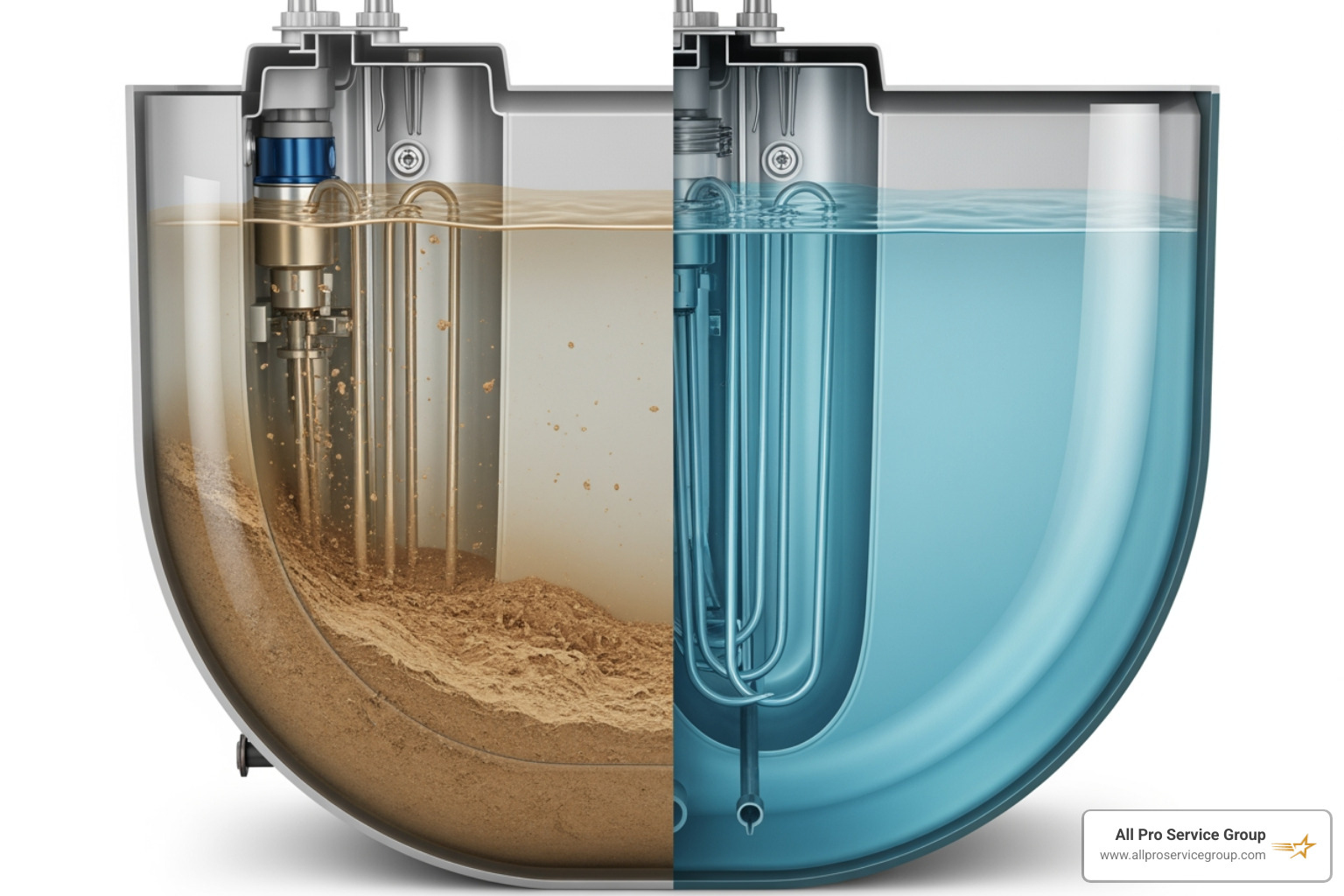
One of the primary enemies of a water heater is sediment. Most water coming into homes in the Greater Salt Lake Area contains trace amounts of dirt, silt, and minerals. Over time, these particles settle at the bottom of the tank. This layer of "gunk" acts as an insulator between the heating element (or gas burner) and the water. According to the Water Heater Maintenance Guide | A. O. Smith, this buildup forces the unit to work significantly harder, which kills your thermal efficiency and sends your utility bills skyrocketing.
Regular maintenance also plays a massive role in warranty preservation. Many manufacturers, including A. O. Smith, expect homeowners to perform basic upkeep. If a tank fails because it was never flushed or the anode rod was ignored for a decade, you might find yourself footing the bill for a Water Heater Repair or full replacement that could have been covered under warranty.
Beyond the money, there is the comfort factor. Proper maintenance ensures consistent water temperatures and reduces "kettling"—that annoying popping or banging sound caused by steam bubbles escaping through layers of sediment. Keeping the tank clean ensures that when you turn on the tap, you get the hot water you expect.
Safety Precautions and Tool Preparation
Before we dive into the "how-to," we need to talk about safety. Working on a water heater involves high temperatures, pressurized water, and either high-voltage electricity or combustible gas. We want you to stay safe!
First, always wear protective gear. This includes work gloves and safety goggles. Water inside the tank can be 120°F to 140°F—hot enough to cause third-degree burns in seconds. Before starting any AO Smith Hot Water Heater Repair or maintenance task, you must disable the energy source:
- For Electric Models: Locate your home’s service panel and turn off the circuit breaker dedicated to the water heater.
- For Gas Models: Turn the gas control knob to the "Pilot" or "Off" position. If you smell gas at any point, leave the area immediately and call for help.
Once the power/gas is off, shut off the cold water supply valve located at the top of the unit. It’s also a good idea to let the water cool for a few hours before draining it, especially if you are directing the water into a plastic bucket or onto your lawn. For specific model details, always consult your A.O. Smith WATER HEATERS Manual.
Tools Needed for AO Smith Water Heater Maintenance
You don't need a professional plumbing van to do basic ao smith water heater maintenance, but having the right tools on hand will make the process much smoother. Here is what we recommend:
- Garden Hose: To drain the water from the tank to a safe location (floor drain or outside).
- Screwdriver (Flathead or Phillips): Often needed to open the access panels or loosen the drain valve.
- Pipe Wrench: Essential for removing the anode rod.
- Teflon Tape (Plumber's Tape): To ensure a watertight seal when reinstalling the anode rod or other fittings.
- Bucket: Useful for catching small amounts of water or testing the T&P valve.
- Multimeter: If you have an electric model, this helps you check the continuity of the heating elements.
- Descaling Pump and Cleaning Solution: Only required if you are maintaining a tankless model.
If you find that you're missing these tools or the job feels a bit too technical, you can always refer to our Water Heater Install Guide for more technical insights or give us a call.
Step-by-Step AO Smith Water Heater Maintenance: Flushing the Tank
Flushing the tank is the "big one." It’s the single most effective thing you can do to extend the life of your water heater. Most manufacturers recommend doing this at least once a year, but in areas with hard water—like many parts of Utah—we often suggest every six months.
- Turn off the power/gas and water: As mentioned above, ensure the unit is not heating and the cold water inlet is closed.
- Connect the hose: Attach a standard garden hose to the drain valve at the bottom of the tank. Run the other end to a floor drain or outside.
- Open a hot water tap: Go to a sink inside the house and turn on the hot water. This breaks the vacuum inside the lines and allows the tank to drain faster.
- Open the drain valve: Use your screwdriver or the handle on the valve to start the flow.
- The "Power Flush": Once the tank is empty, briefly turn the cold water supply valve back on for about 30 seconds. This "stirs up" the sediment at the bottom so it can be pushed out through the hose. Repeat this until the water coming out of the hose runs clear.
- Close up and Refill: Close the drain valve and remove the hose. Turn the cold water supply back on. CRITICAL: Keep the hot water tap inside the house open until water flows steadily without "burping" air. This ensures the tank is completely full.
- Restore Power: Never turn the electricity or gas back on until you are 100% sure the tank is full, or you will burn out the heating elements instantly.
Following this Quick Guide: How to Do Maintenance on an AO Smith Water Heater - ToiletSense ensures your tank stays free of the mineral "rocks" that cause so many problems.
Adjusting the Thermostat for Safety and Efficiency
While you’re performing your ao smith water heater maintenance, take a look at your thermostat settings. Many water heaters come from the factory set at 140°F, but for most households, 120°F is the "sweet spot."
Setting the temperature to 120°F provides several benefits:
- Scald Prevention: It takes only seconds for 140°F water to cause a serious burn, which is a major concern for homes with children or seniors.
- Energy Savings: According to 5 Tips for Water Heater Maintenance | A.O. Smith, you can save a significant amount on your annual energy bill for every 10 degrees you turn the thermostat down.
- Mineral Control: Higher temperatures actually accelerate the rate at which mineral scale forms inside the tank.
On gas models, the thermostat is usually a visible dial on the front of the gas control valve. On electric models, the thermostats are hidden behind access panels (usually two of them). If you are adjusting an electric model, remember to turn off the power first!
Inspecting the Sacrificial Anode Rod and T&P Relief Valve
If the tank is the "body" of your water heater, the anode rod is its "shield." This rod is made of a more "active" metal (usually magnesium or aluminum) than the steel of the tank. Through a process called electrolysis, the corrosive elements in the water attack the rod instead of the tank.
A. O. Smith uses CoreGard technology, which features a stainless steel core in the anode rod to ensure it stays in place even as the sacrificial metal is eaten away. You should inspect this rod every 1–3 years. If you use a water softener, check it annually, as softened water is more conductive and eats anode rods faster.
To check it:
- Turn off the water and power.
- Drain a few gallons of water to lower the level.
- Use a 1-1/16 inch socket wrench to unscrew the hex head on top of the tank.
- Pull the rod out. If you see the thin wire core or if the rod is less than 1/2 inch thick, it’s time for a replacement.
Comparing Anode Rod Types
| Material | Best For... | Pros/Cons |
|---|---|---|
| Magnesium | Most standard water | Best protection; can react with certain bacteria to cause a "rotten egg" smell. |
| Aluminum | Hard water / high pH | Less expensive; good for areas with high mineral content. |
| Zinc | Smelly water | Actually an aluminum rod with a zinc tip; helps neutralize sulfur odors. |
Next, test the Temperature and Pressure (T&P) Relief Valve. This is the safety valve with the little silver lever. Its job is to open if the pressure or temperature inside the tank gets dangerously high. To test it, simply lift the lever briefly. Water should discharge into the drain pipe. When you let go, it should snap shut and stop leaking entirely. If it keeps dripping, the valve is faulty and needs immediate replacement to ensure your Water Heater Installation remains safe.
Managing Water Pressure and Tankless Descaling
High water pressure is a silent killer for water heaters. Plumbing codes generally require home water pressure to be 80 PSI or less. If your pressure is higher, it puts constant stress on the tank's inner lining and the T&P valve. We recommend installing a Pressure Reducing Valve (PRV) if your home's pressure is consistently high.
Additionally, if you have a "closed" plumbing system (common in newer homes with check valves), you likely need a thermal expansion tank. As water heats up, it expands. In a closed system, that extra volume has nowhere to go, causing pressure spikes. An expansion tank provides a "cushion" to absorb that pressure.
Tankless Water Heater Maintenance
If you have an A. O. Smith tankless model, the maintenance is a bit different. Instead of "flushing" sediment, you need to "descale" the heat exchanger.
- The Problem: Mineral scale (calcium and magnesium) coats the narrow passages of the heat exchanger, reducing efficiency and eventually causing the unit to overheat and shut down.
- The Solution: Use a descaling kit consisting of a small submersible pump, two hoses, and a food-grade descaling solution (or white vinegar).
- The Process: You circulate the solution through the unit for about 45–60 minutes. This dissolves the scale. Don't forget to clean the cold water inlet filter, which catches larger debris. For professional help with this, check out our Tankless Water Heater Installation and service page.
When to Call a Professional for AO Smith Water Heater Maintenance
While many of these tasks are DIY-friendly, there are times when it’s smarter (and safer) to call in the pros at All Pro Service Group.
You should call us if:
- You smell gas: This is an emergency. Shut off the gas and call a professional immediately.
- The drain valve is stuck: If the plastic drain valve is brittle and won't open—or won't close—forcing it can lead to a flooded basement.
- Electrical issues: If you see charred wires or your breaker keeps tripping, there is a serious underlying issue.
- The T&P valve won't stop dripping: This could indicate a failed valve or dangerously high pressure.
- You have "Kettling" noises: If your tank sounds like a popcorn machine, the sediment may be too thick for a simple flush to fix.
According to Water Heater Repair: Things to Consider | A.O. Smith, if your unit is over 10 years old and facing a major repair, it might be more cost-effective to replace it with a newer, more efficient model.
Frequently Asked Questions about Water Heater Care
How often should I flush my A. O. Smith water heater?
For most homes, once a year is the standard recommendation. However, if you live in a part of Utah with particularly hard water, we recommend a flush every six months. If you notice your hot water doesn't last as long as it used to, or if you hear rumbling sounds from the tank, that’s a sign that sediment accumulation has become a problem and you should flush it immediately.
Why is my temperature and pressure (T&P) relief valve dripping?
A dripping T&P valve usually means one of three things:
- Thermal Expansion: Your water pressure is spiking when the heater is running because you have a closed plumbing system.
- Excessive Pressure: Your home's overall water pressure is above 80 PSI.
- Valve Failure: Debris or mineral scale is stuck in the valve seat, preventing it from closing. If the valve continues to drip after you've checked your home's pressure, it likely needs to be replaced.
Does a water softener affect my maintenance schedule?
Yes! While a water softener is great for preventing scale buildup (which is a win for your tankless unit or heating elements), it actually makes the water more corrosive to your anode rod. The sodium added during the softening process increases the water's conductivity. If you have a softener, you should inspect your sacrificial anode rod every single year to ensure your tank remains protected.
Conclusion
Taking the time for ao smith water heater maintenance is an investment that pays off in lower bills, fewer headaches, and a much longer lifespan for your appliance. Whether it's a quick annual flush or a more involved anode rod replacement, these small steps keep the hot water flowing for your family.
At All Pro Service Group, we take pride in being the "Gephardt Approved" experts for the Greater Salt Lake Area. Since 2008, we've provided dependable inspections and expert plumbing services to our neighbors in Ogden, Provo, Park City, and throughout the Salt Lake Valley. If you're not comfortable performing these maintenance tasks yourself, or if you've discovered a leak that needs professional attention, we are here to help.