Is a Mini Electric Tankless Water Heater Right for You?
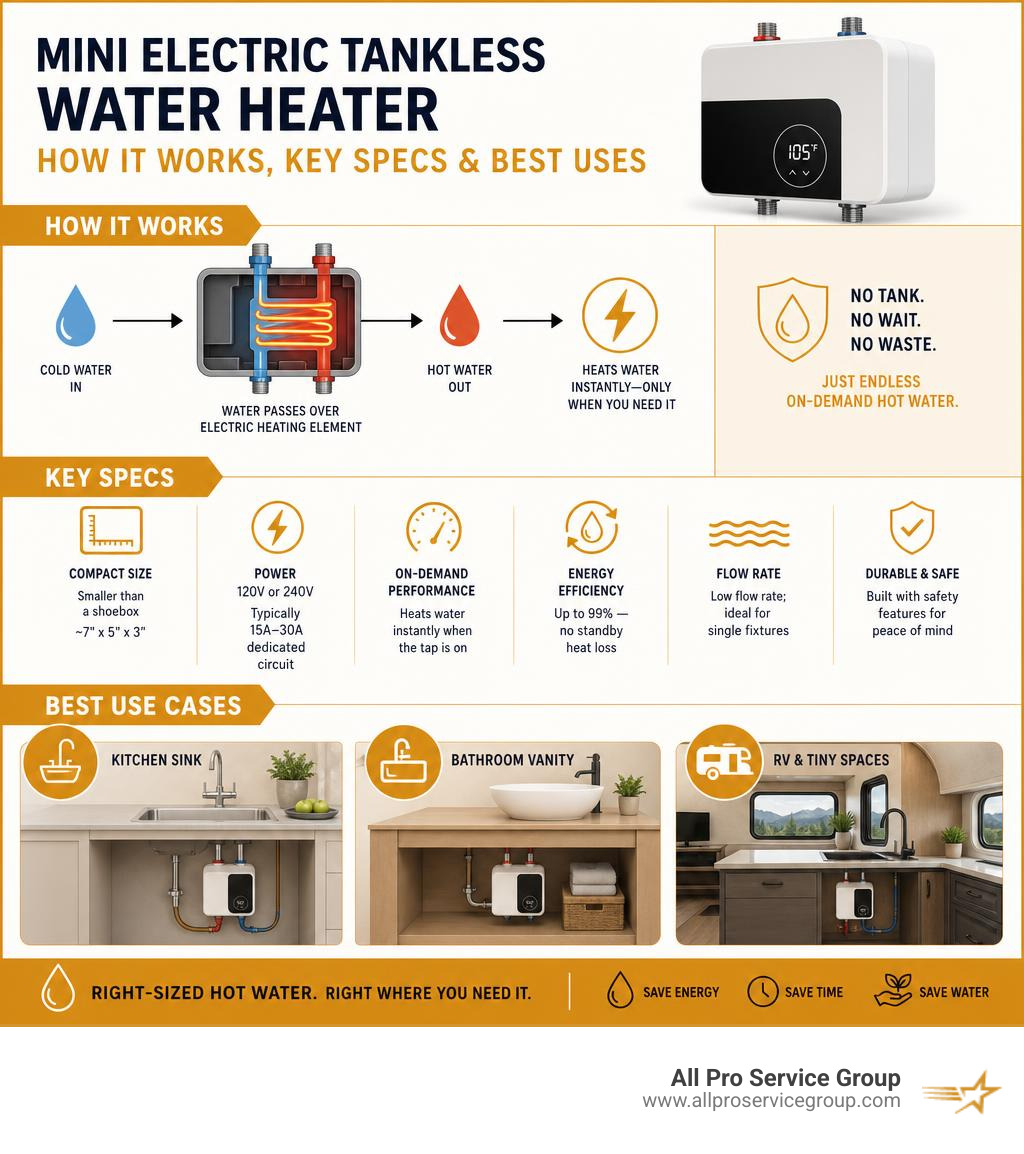
A mini electric tankless water heater is a compact, point-of-use appliance that heats water instantly — only when you turn on the tap — with no storage tank required. Here's a quick summary:
| Feature | Mini Electric Tankless |
|---|---|
| How it works | Heats water on demand using an electric element |
| Typical size | Smaller than a shoebox (e.g., ~7" x 5" x 3") |
| Best use | Single fixture: kitchen sink, bathroom vanity, RV |
| Energy efficiency | Up to 99% — no standby heat loss |
| Power needs | 120V or 240V; typically 15A–30A dedicated circuit |
| Key limitation | Low flow rate; not ideal for whole-home use |
Unlike a traditional 40-gallon tank that constantly reheats stored water, a mini tankless unit fires up only when you need it. That means no standby energy waste — and no waiting for a tank to refill.
These units are especially popular for under-sink installations, tiny homes, RVs, and office restrooms where running hot water to a distant fixture wastes both water and energy.
At All Pro Service Group, our team has helped homeowners across the Greater Salt Lake Valley select and install the right mini electric tankless water heater for everything from basement bar sinks to garage utility rooms. Read on — we'll walk you through everything you need to make a confident choice.
What is a Mini Electric Tankless Water Heater?
To truly appreciate the magic of a mini electric tankless water heater, it helps to understand what it isn't. Traditional water heaters rely on massive tanks (usually 40 to 80 gallons) to store water and keep it hot 24 hours a day, 365 days a year. This means the system constantly cycles on and off to maintain that temperature, even when you are asleep or away on vacation.
A mini tankless system completely rewrites this script. Often smaller than a standard shoebox—with typical dimensions around 7.4" x 5.4" x 3.4" and weighing as little as 3 pounds—these ultra-compact units mount directly under a sink or inside a cabinet. They are designed for "point-of-use" applications, meaning they serve a single fixture or a highly localized cluster of fixtures instead of trying to supply an entire household.
When you turn on the hot water tap, cold water flows into the unit. A flow sensor detects this movement and immediately activates a powerful electric heating element (often a high-efficiency bare wire or alloy heating system). The water is heated instantly as it passes through the small internal heat exchanger and exits the faucet warm and ready.
Many homeowners confuse "mini tankless" units with "mini-tank" units. While both are designed to fit in tight spaces, they use entirely different technologies:
- Mini Electric Tankless: Completely tankless. It heats water on demand, offering an endless supply of hot water at a specific flow rate. It has no standby heat loss and takes up virtually zero space.
- Mini-Tank Storage Heaters: These actually contain a small, glass-lined storage tank (typically 1 to 4 gallons). Products like the Eemax MiniTank™ 4.0 Gallon Storage 120V / 1.4 kW Electric Mini Tank Point of Use Water Heater - Indoor or the Stiebel Eltron SHC 4 Gal. 6-Year Warranty 1300 W Compact Point-of ... keep a small reserve of hot water ready. They provide an instant burst of hot water without any delay but can run out if used continuously, and they still experience minor standby energy losses.
Understanding how these systems differ is key to planning your home's hot water layout. If you want to dive deeper into how this transition can benefit your overall plumbing system, check out our guide on How a Tankless Water Heater Can Help Your Home.
| Feature | Mini Electric Tankless Water Heater | Mini-Tank Water Heater |
|---|---|---|
| Storage Capacity | 0 Gallons (On-Demand) | 1 to 4 Gallons |
| Physical Size | Ultra-compact (approx. 7" x 5" x 3") | Larger cabinet footprint (approx. 18" x 12" x 12") |
| Hot Water Supply | Endless (subject to flow rate limits) | Limited to tank capacity before needing recovery time |
| Standby Heat Loss | None | Minimal, but present |
| Electrical Load | High draw during operation (typically 15A to 30A+) | Lower draw (typically 10A to 12A / 120V) |
Key Benefits and Drawbacks of Compact Water Heaters
As with any home improvement choice, deciding on a mini electric tankless water heater requires weighing the pros and cons. While they are incredibly efficient, they are not a magic bullet for every situation. Let's break down the advantages and limitations so you can make an informed decision. You can also browse various options on the Tankless Electric Water Heaters - The Home Depot page to see how different sizes fit into your budget.
Advantages of a Mini Electric Tankless Water Heater
- Unlimited Hot Water: Because there is no storage tank to deplete, a tankless unit will provide hot water for as long as the tap is running. If you are washing hands or cleaning dishes, you will never run out of warm water midway through.
- Extreme Space Savings: These units free up valuable floor and cabinet space. Instead of a bulky cylinder taking up a closet, a mini tankless unit mounts neatly to the wall or inside a vanity cabinet out of sight.
- Maximum Energy Efficiency: Most mini electric tankless units operate at roughly 99% thermal efficiency. Because they only draw power when water is actively running, they completely eliminate the standby energy losses associated with keeping a large tank hot.
- Rapid Heating Technology: Modern systems utilize advanced bare wire heating elements that transfer heat directly to the water with incredible speed. This reduces the time you spend waiting for the water to reach your desired temperature.
- Simpler Installation: Compared to gas-powered tankless water heaters, electric models do not require complex venting, combustion air supplies, or gas lines. This can significantly simplify the process when you schedule a professional Water Heater Installation.
Potential Limitations to Keep in Mind
- Strict Flow Rate Limits: Mini units are designed for point-of-use applications. This means they are engineered to supply a single handwashing sink or low-flow faucet. They cannot handle running a washing machine, a dishwasher, and a shower simultaneously.
- Heavy Electrical Demand: While they use less total energy over time, tankless units require a large amount of electricity in short bursts to heat water instantly. Even a small 3.5 kW unit requires a dedicated 30-amp breaker and heavy-gauge wiring.
- Performance in Cold Climates: In cold areas like northern Utah, groundwater entering your home in the winter can be extremely cold (often around 40°F). Because the unit has to raise the temperature of the water by 60°F or more to reach a comfortable handwashing temperature, the maximum flow rate it can support will drop significantly compared to warmer southern climates.
Best Applications and Sizing for Point-of-Use Systems

Because of their specific flow and electrical characteristics, mini electric tankless water heaters shine brightest in targeted, point-of-use scenarios. Some of the most common and successful applications we see in the Greater Salt Lake Area include:
- Remote Sinks and Additions: If you have added a wet bar to your basement in South Jordan, a guest bathroom in Park City, or a detached workshop in Ogden, running a hot water line from your main home water heater can be impractical and result in massive water waste as you wait for the hot water to travel down the pipes. A mini tankless unit solves this instantly.
- Tiny Homes, RVs, and Boats: Space is at an absolute premium in mobile and alternative living spaces. A mini tankless unit provides comfortable hot water for handwashing and light cleaning without taking up precious square footage.
- Commercial Restrooms and Kitchenettes: Office buildings, retail shops, and warehouses in Salt Lake City find these units perfect for handwashing sinks, ensuring code compliance for hot water delivery without the need to maintain a commercial-sized boiler system.
For precise temperature control in commercial and high-end residential handwashing sinks, models like the Mini™-E Thermostatic Handwashing Sink Electric Tankless Water Heaters | Stiebel Eltron USA are highly recommended. These thermostatic models feature electronic controls that maintain a steady, accurate outlet temperature even if water pressure fluctuates, preventing accidental scalding.
Choosing the Right Size Mini Electric Tankless Water Heater
Sizing a mini tankless heater is different from sizing a traditional tank. With a tank, you look at gallon capacity. With a tankless system, you must calculate two primary factors: Flow Rate (GPM) and Temperature Rise.
- Determine Your Required Flow Rate: Point-of-use handwashing sinks typically require a flow rate of 0.5 to 1.0 Gallons Per Minute (GPM). To ensure the heater performs correctly, many manufacturers ship their units with specialized pressure-compensating aerators or flow reducers. For example, mechanical units like those detailed in the Mini™ Point-of-Use Tankless Electric Water Heaters Technical Data sheet are designed to activate at flow rates as low as 0.21 GPM and are internally restricted to maintain optimal heating performance.
- Calculate the Temperature Rise:
Temperature rise is the difference between the incoming cold water temperature and your desired outgoing hot water temperature.
- Formula: Desired Temp - Incoming Temp = Required Temperature Rise
- If you want your handwashing water to be 100°F, and your incoming winter groundwater in West Valley City is 40°F, you need a temperature rise of 60°F.
- Consult the Manufacturer's Technical Data: Review the specifications for the model you are considering, such as the Mini & Mini-E Point-of-Use Electric Tankless Hand Washing Water Heaters | Technical Specifications guide. This data will tell you exactly what GPM flow rate a unit can support at your required temperature rise. If a 3.5 kW heater can only provide a 45°F rise at 0.5 GPM, it might not get the water warm enough during a freezing Utah winter, meaning you may need to step up to a 5.7 kW or larger model.
Installation and Maintenance Considerations
Installing a mini electric tankless water heater is a precise task that involves both high-voltage electrical connections and plumbing lines. To ensure a safe, code-compliant setup that operates reliably for years to come, keep the following installation requirements in mind:
- Dedicated Electrical Circuit: You cannot simply plug a tankless heater into a standard shared wall outlet. Even a small 110V/120V unit, like the Electric Tankless Water Heater, 110V 3000W Mini Electric ... - Walmart, draws roughly 29 amps of current. This requires a dedicated 2-pole 30-amp circuit breaker and heavy-duty 12 AWG copper wiring. Higher-output models, such as the Mini 6 5.7 kW Point-of-Use Tankless Electric Water Heater, operate on 240V and require a dedicated 25-amp or 30-amp double-pole breaker.
- Hard-Wired Connection: Most point-of-use tankless heaters must be permanently hard-wired into an electrical junction box rather than using a standard plug-and-outlet connection.
- Physical Mounting: These units are incredibly versatile and can be mounted with the plumbing connections facing either upward or downward, making them easy to tuck into tight cabinet spaces.
- Water Pressure Requirements: Standard units operate within a range of 15 to 150 PSI. If your home's water pressure is exceptionally high, a pressure-reducing valve may be required.
Protecting Your Investment from Hard Water
In many parts of Utah, including Provo and the Greater Salt Lake Valley, hard water is a common challenge. Hard water contains high levels of dissolved calcium and magnesium. When water is heated, these minerals crystallize and form scale buildup on the heating elements.
Over time, scale acts as an insulating blanket over the heating element, forcing the unit to work harder to heat the water. This decreases efficiency, lowers water pressure, and can ultimately cause the heating element to fail prematurely.
To prevent this, we recommend:
- Installing a Water Softener: A whole-home water softener removes these minerals before they ever reach your appliances, protecting your plumbing and extending the lifespan of your water heater.
- Regular Flushing: Depending on your local water hardness, tankless heaters should be flushed periodically with a food-grade descaling solution to clear out mineral deposits.
- Professional Inspections: If you notice your water isn't getting as warm as it used to, or if your water pressure drops, reach out for professional Water Heater Repair to clear the system before permanent damage occurs.
For a seamless, worry-free installation that guarantees your electrical panel and plumbing are perfectly matched to your new system, trust our certified team for professional Tankless Water Heater Installation.
Frequently Asked Questions About Mini Tankless Heaters
We hear many of the same questions from our customers when they are exploring localized hot water options. Here are the answers to some of the most common inquiries.
Can a mini tankless water heater run a shower?
In almost all cases, no. A typical shower requires a flow rate of 1.5 to 2.5 Gallons Per Minute (GPM) and a significant temperature rise. A standard mini electric tankless unit (typically ranging from 1.8 kW to 6 kW) is only designed to output between 0.5 GPM and 1.0 GPM at a comfortable bathing temperature.
Attempting to run a shower off a mini point-of-use heater will result in either a tiny, unusable trickle of warm water or a standard spray of freezing cold water. For showers, you will need a larger, whole-home electric tankless unit (typically 18 kW to 27 kW or larger) or a traditional tank-style water heater.
What electrical requirements do I need for installation?
The exact electrical specifications depend on the kilowatt (kW) rating of the unit you choose:
- Small 3.0 kW to 3.5 kW Units (110V/120V): These require a dedicated 30-amp single-pole breaker and 12 AWG copper wiring.
- Medium 5.7 kW to 6.0 kW Units (208V/240V): These require a dedicated 25-amp or 30-amp double-pole breaker and 10 AWG copper wiring.
Always consult the manufacturer's spec sheet before purchasing to ensure your home's electrical panel has the available capacity to handle the load.
How does hard water affect these compact units?
Hard water is the number-one enemy of tankless water heaters. Mineral scale coats the heating elements, reducing heat transfer and causing the unit to overheat or shut down. If you live in an area with high mineral content, installing a scale-inhibitor filter or a water softener is highly recommended to protect your system. If your water flow begins to drop or the water isn't heating properly, it is a sign that your system needs a professional flush. You can learn more about how we handle these issues on our main Plumbing service page.
Conclusion
A mini electric tankless water heater is an exceptional, energy-efficient solution for bringing instant hot water to single fixtures, remote sinks, guest spaces, and RVs. By eliminating standby heat loss and saving valuable cabinet space, these compact powerhouses offer convenience and utility bill savings when applied in the right scenarios.
However, because these systems demand heavy electrical loads in short bursts and are highly sensitive to incoming water temperatures and hard water scale, proper sizing and expert installation are critical to getting the performance you expect.
At All Pro Service Group, we have been serving the Greater Salt Lake Area—including Salt Lake City, Sandy, West Jordan, Provo, and Park City—since 2008. As a "Gephardt Approved" company, we pride ourselves on providing dependable, honest, and high-quality plumbing and electrical services.
Ready to eliminate the wait for hot water at your sink? Schedule Tankless Water Heater Installation with All Pro Service Group today, and let our trained experts handle the plumbing and electrical work safely and professionally!