
Choose the Right Commercial EV Charging Solution
Commercial EV charging solutions should match how long vehicles park, the power your building can supply, and whether charging is for employees, customers, or a fleet. Level 2 chargers are usually the practical choice for workplaces, apartments, hotels, and long-stay parking, delivering roughly 7.2 to 19.2 kW on 208/240V service. DC fast chargers suit high-turnover retail sites, travel routes, and fleet depots, but they need far more electrical capacity and utility planning.
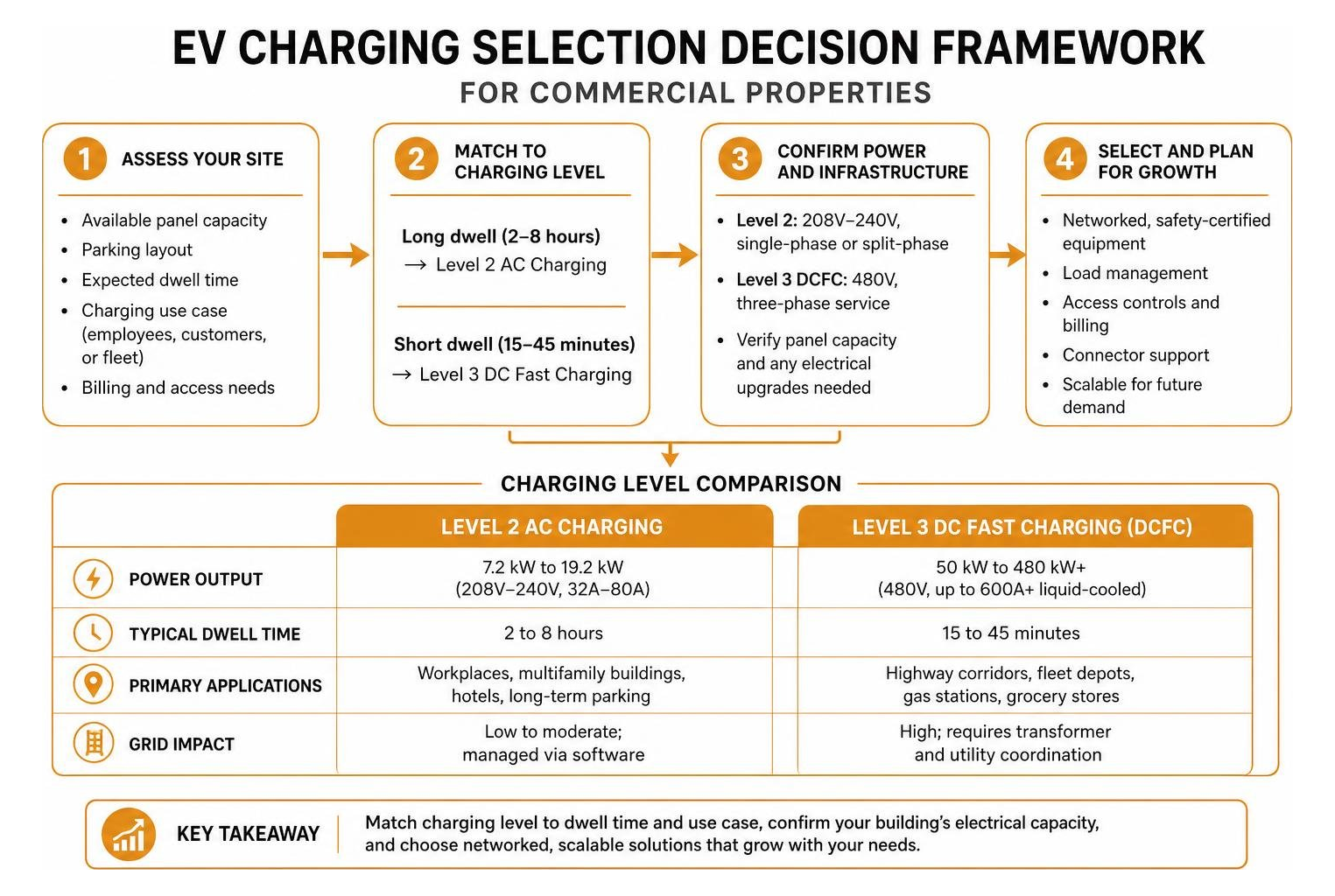
Start by assessing available panel capacity, parking layout, expected dwell time, and billing needs. Then select networked, safety-certified equipment with load management, access controls, and connector support that can grow with demand.
I’m Gary Leany of All Pro Service Group, a Greater Salt Lake Valley service team with electrical experience supporting dependable building systems since 2008. In this guide, I’ll explain how Commercial EV charging solutions can be planned around real electrical capacity, operating needs, and future expansion.
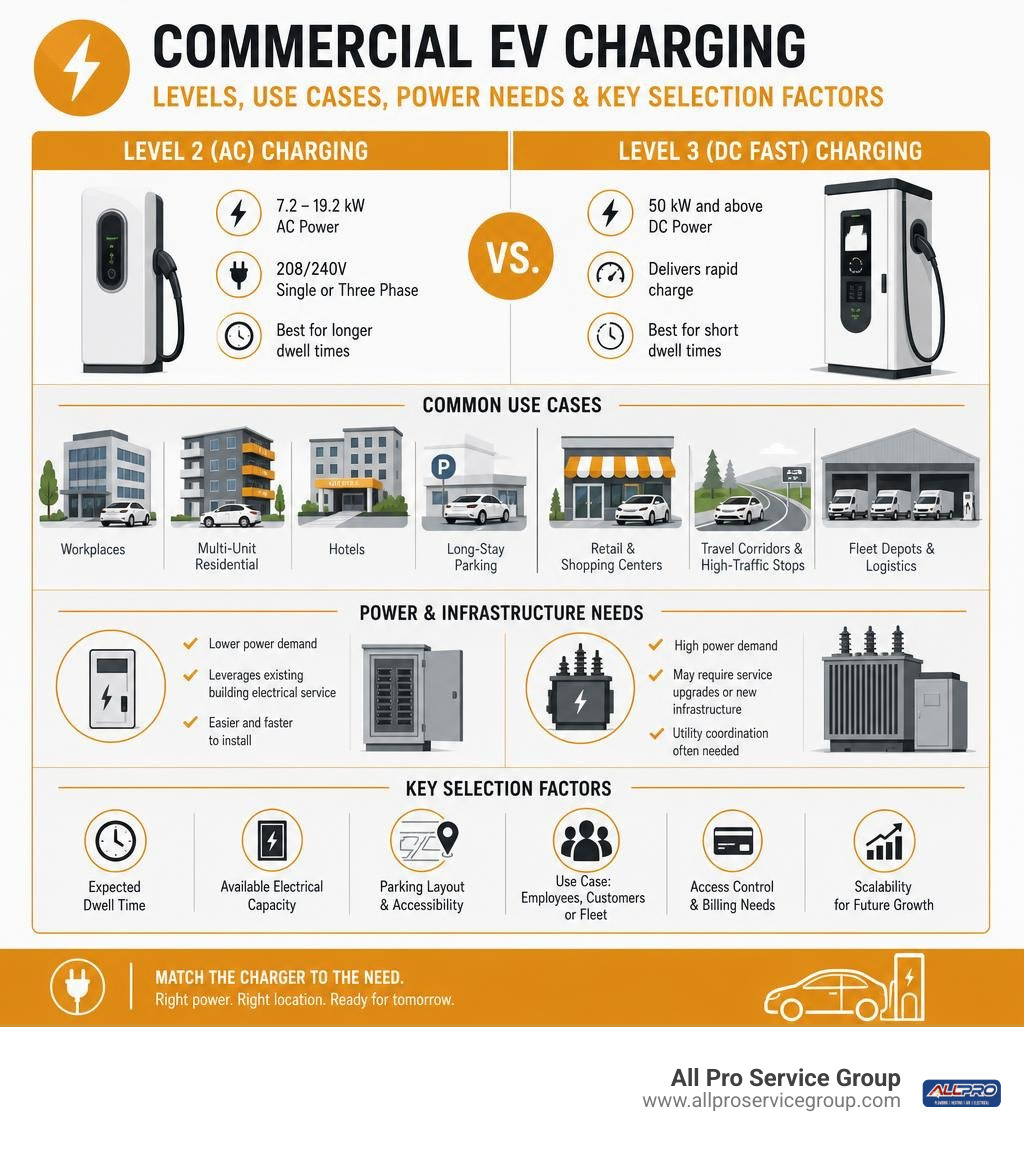
Understanding Commercial EV Charging Solutions: Level 2 vs. Level 3 DC Fast Charging
Selecting the right commercial EV charging hardware starts with understanding dwell time—the duration an electric vehicle remains parked at your facility. Different operational environments require vastly different power levels, electrical infrastructure, and capital investments.
When planning your property's layout, Commercial Electric Car Charging Points Installation requires an evaluation of your existing supply to determine whether alternating current (AC) or direct current (DC) charging makes the most operational sense.
| Feature / Metric | Level 2 AC Charging | Level 3 DC Fast Charging (DCFC) |
|---|---|---|
| Electrical Input | 208V to 240V, Single-Phase or Split-Phase | 480V, 3-Phase Commercial Service |
| Power Output Range | 7.2 kW to 19.2 kW (32A to 80A) | 50 kW to 480 kW+ (up to 600A+ liquid-cooled) |
| Charge Speed Added | 12 to 80 miles of range per hour | 100 to 250+ miles in 15 to 30 minutes |
| Typical Dwell Time | 2 to 8 hours | 15 to 45 minutes |
| Primary Applications | Workplaces, multifamily buildings, hotels, long-term parking | Highway corridors, fleet depots, gas stations, grocery stores |
| Typical Hardware Cost | $500 – $6,700 per port | $30,000 – $250,000+ per unit |
| Grid Impact | Low to moderate; managed via software | High; requires transformer and utility coordination |
Level 2 AC Charging Infrastructure for Workplaces and Multifamily
Level 2 AC charging represents the foundation for commercial charging across corporate campuses, multi-tenant properties, and municipal parking garages. These units operate on standard 208V (common in commercial three-phase supply) or 240V electrical circuits, delivering between 32 amps and 80 amps of continuous power.
Commercial AC chargers deliver outputs ranging from 7.2 kW (around 30–32A) up to 19.2 kW (80A), providing 25 to 65 miles of driving range per hour of connectivity. For property managers looking at baseline requirements, reviewing a Car Charging Port Installation Guide 2026 helps clarify how standard branch circuits support day-to-day employee and tenant vehicle replenishment.
Because employees, residents, and hotel guests naturally leave their vehicles parked for four to eight hours at a stretch, high-voltage DC equipment is unnecessary. Level 2 hardware allows site hosts to deploy dual-port pedestals that serve two adjacent stalls simultaneously, cutting civil construction costs while maximizing stall access.
Level 3 DC Fast Charging for Corridors and Fleet Depots
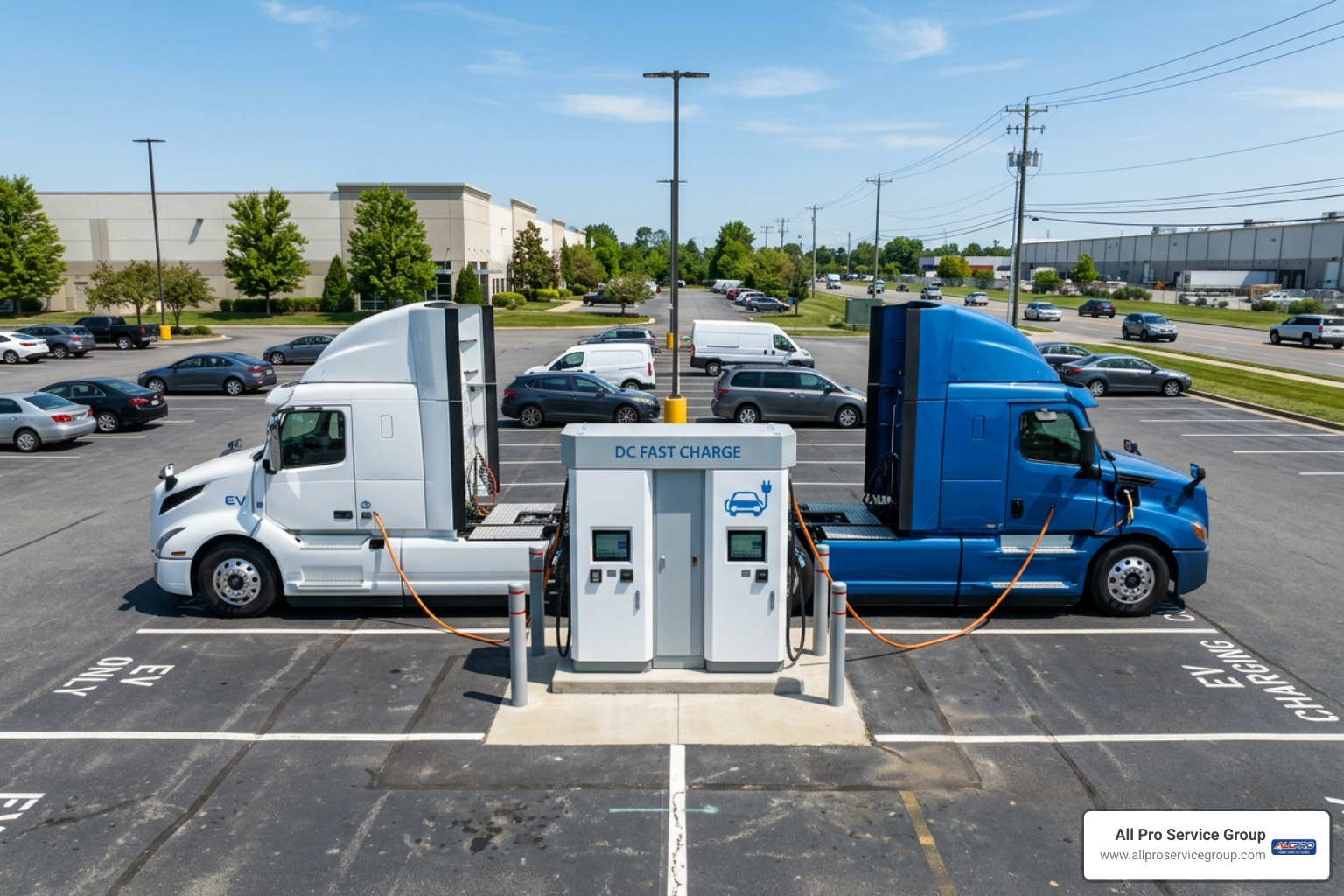
Level 3 DC fast chargers bypass a vehicle's onboard converter to deliver high-voltage direct current straight to the battery pack. Ranging from 50 kW up to 480 kW, these systems operate on 480V three-phase electrical services. Modern high-output systems like the 320-480kW All-In-One Charger – Charge X USA integrate power conversion stacks and dual dispensers into a consolidated footprint, achieving over 96% electrical conversion efficiency.
For commercial delivery fleets, municipal service vans, and retail plazas where customers spend 20 to 45 minutes, DC fast charging delivers up to an 80% charge in roughly 20 to 30 minutes. Advanced systems employ dynamic power distribution, routing full capacity to a single heavy-duty vehicle or sharing power across dual dispensers (such as splitting 240 kW into two simultaneous 120 kW sessions).
Key Hardware and Software Features for Commercial EV Charging Solutions
Modern commercial EV charging stations are intelligent IoT devices that manage grid draw, process payments, and protect local electrical infrastructure.
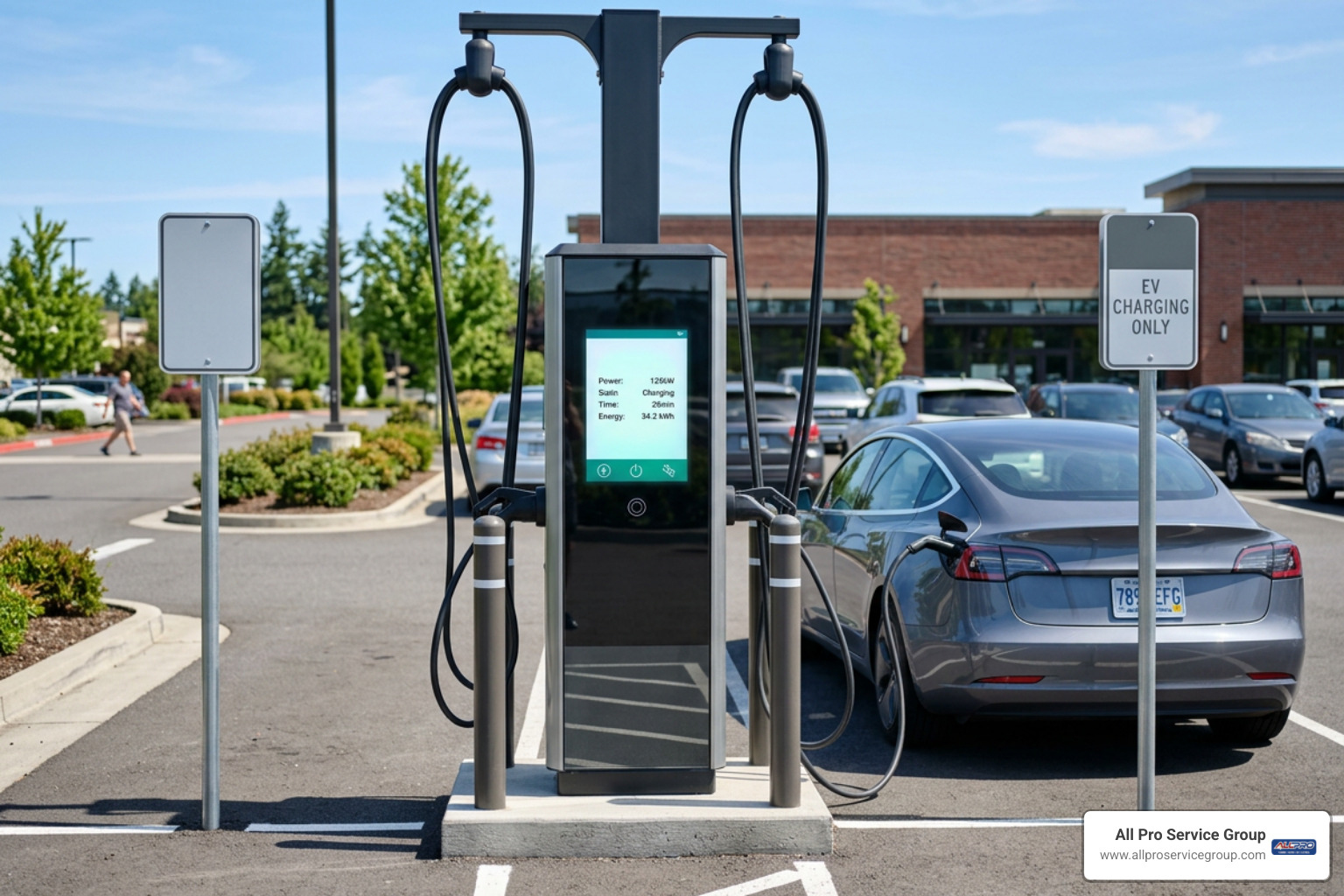
Choosing commercial charging equipment requires evaluating open architecture and durable build standards:
- OCPP 1.6J and 2.0.1 Compliance: Open Charge Point Protocol (OCPP) ensures your physical charging stations are not locked to a single software provider. If you want to change network management platforms, OCPP-certified hardware allows switching backends without replacing physical charging pedestals.
- ISO 15118 (Plug & Charge): This protocol enables encrypted, automated communication between the vehicle and charger. Drivers simply plug the connector into their vehicle; the system identifies the vehicle account, initiates charging, and handles billing automatically without requiring an app or RFID card.
- Enclosure and Impact Ratings: Outdoor commercial hardware must withstand heavy usage and harsh weather. Ensure equipment features NEMA 3R or NEMA 4 weatherproof ratings and IK10 impact ratings to protect internal components against freezing winter conditions, moisture ingress, and physical wear.
- Safety Certifications: All commercial chargers must carry recognized safety listings, including UL 2594 (for AC Level 2), UL 2202 (for DC Fast Charging), and CTEP/NTEP certifications for revenue-grade electrical metering.
Connectivity, Payment Processing, and Access Control
Commercial charging stations rely on stable network connectivity to authenticate users and process credit card transactions.
- Cellular Backhaul (4G/5G LTE): The standard for commercial deployments, cellular communication bypasses local Wi-Fi limitations and firewalls. Reliable commissioning requires maintaining an RSSI signal strength between -96 dBm and -45 dBm at the pedestal location.
- Payment Gateways: Public stations should feature integrated, contactless EMV credit card readers (supporting tap-to-pay, Visa, Mastercard, Apple Pay, and Google Pay) to ensure barrier-free driver access without requiring mandatory mobile app downloads.
- RFID and Access Management: For private employee parking or residential communities, RFID cards and mobile whitelist portals restrict access to authorized personnel while enabling custom rate structures (such as free daytime charging for staff and paid public charging after hours).
Energy Management and Dynamic Load Optimization
Adding multiple high-draw chargers can quickly exceed a commercial facility's main electrical panel limits or trigger massive utility demand charges. Modern energy management platforms resolve this through dynamic load optimization:
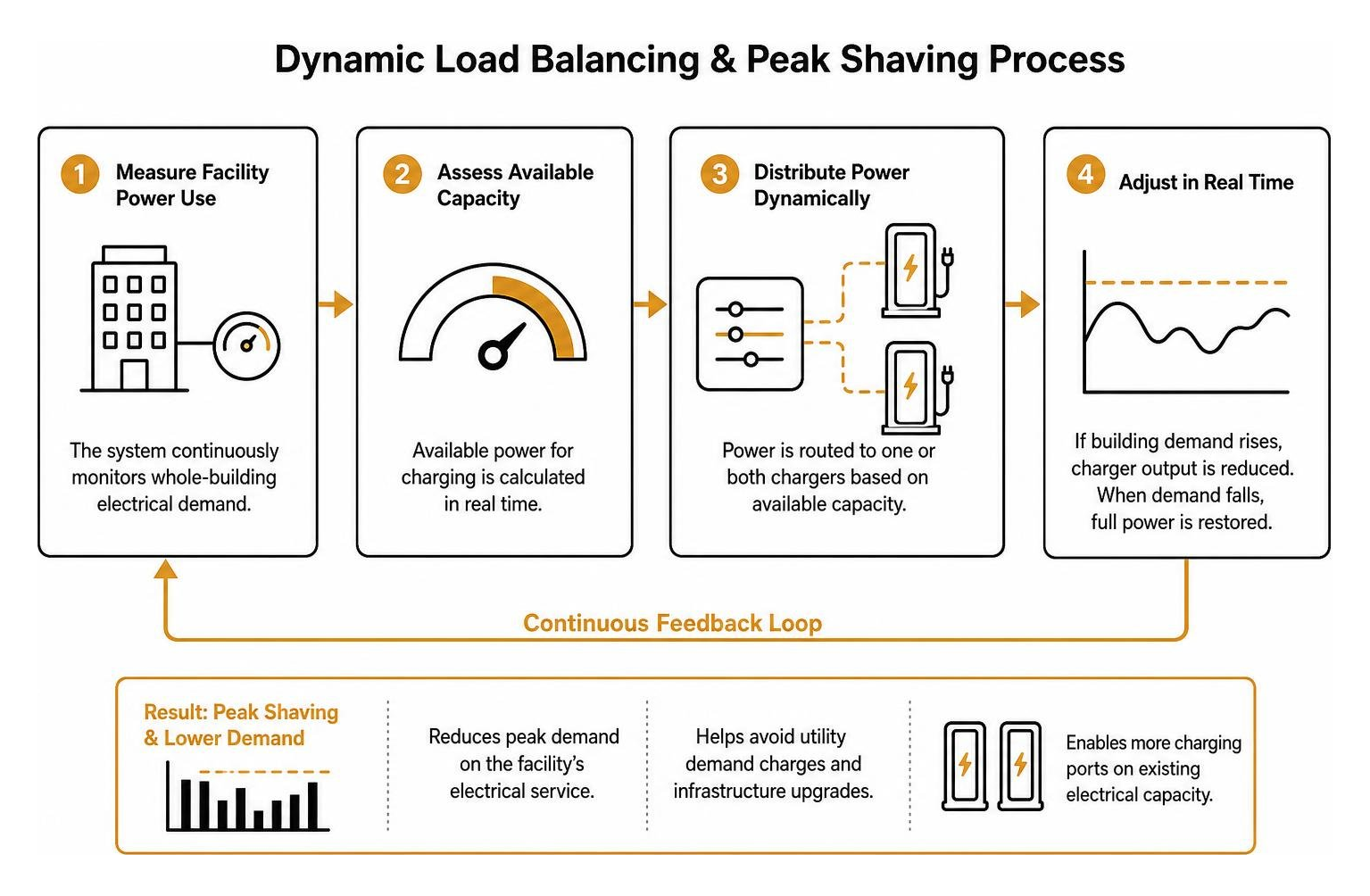
Dynamic load balancing continuously measures whole-building power consumption and adjusts the output of individual charging ports in real time. For instance, when a building's HVAC compressors activate during summer peaks, the charging network throttles down charger output, returning to full power as overall facility demand subsides.
Implementing smart energy management outlined in our Business Ev Charger Installation Guide 2026 enables facilities to install up to three times as many charging ports on existing electrical services without triggering expensive utility service expansions or transformer replacements.
Installation Requirements, Electrical Infrastructure, and Cost Factors
Installing commercial EV charging stations involves utility coordination, electrical engineering, civil site preparation, and software commissioning.
High-power distributed DC systems like the EVPS-360/480 - 480/480 (NA) decouple central power conversion units from dispenser pedestals, requiring precise electrical engineering and dedicated trenching layouts.

A breakdown of general commercial project costs includes:
- Level 2 Turnkey Installations: Typically range from $6,000 to $15,000 per charger, including commercial-grade dual-port hardware, permitting, branch circuit wiring, and concrete pedestal mounting.
- DC Fast Charging Deployments: High-power DCFC installations range from $50,000 for standard 50 kW units to over $150,000 to $250,000+ for 240 kW–480 kW multi-dispenser setups due to new 480V utility transformers, switchgear, and civil excavation.
For an extensive analysis of cost variables, review our breakdown on Commercial Ev Charging Station Cost.
Electrical Panel Sizing and Infrastructure Upgrades
Commercial Level 2 chargers run on 208V/240V dedicated circuits, with breaker sizing calculated at 125% of the charger’s continuous draw in compliance with NEC Article 625. For example, a 48A charger requires a dedicated 60A dual-pole breaker, while an 80A charger requires a 100A circuit.
When existing switchgear lacks available capacity, technicians install dedicated distribution sub-panels. To evaluate circuit prerequisites and load calculations, see our 240 Volt Charger Installation Complete Guide.
For outdoor parking lots, directional boring allows running underground rigid conduit beneath asphalt without tearing up parking bays or disrupting daily business operations.
Commercial Incentives, Tax Credits, and ROI Models
Commercial site hosts can offset upfront installation costs by pairing federal tax credits with local utility make-ready incentives:
- Alternative Fuel Infrastructure Tax Credit (Section 30C): Offers businesses a tax credit of up to 30% of total hardware and installation costs (up to $100,000 per unit for qualifying commercial properties).
- Utility Make-Ready Programs: Regional electric utilities often provide infrastructure rebates covering the cost of electrical panel upgrades, transformer installations, and trenching to support commercial EV readiness.
- Direct Revenue & Dwell Time Lift: Properties can monetize charging by setting custom kilowatt-hour ($/kWh) or hourly parking rates. Retail centers and dining establishments also benefit from increased retail spend while drivers wait for their vehicles to charge.
To calculate payback timelines across various ownership structures, read our Charging Station Cost Complete Guide.
Future-Proofing Commercial EV Charging Solutions for Growing Demand
Commercial EV charging infrastructure is a multi-year investment. As fleet vehicles and passenger cars evolve, commercial systems must accommodate new charging standards without requiring full infrastructure replacements.
- Dual Connector Configurations (CCS1 & NACS): The North American Charging Standard (NACS/SAE J3400) is standard across modern electric vehicles alongside the legacy CCS1 standard. Installing dual-dispenser stations or universal adapter systems ensures seamless compatibility across all vehicle makes.
- Modular Power Stacks: Modern DC fast charging cabinets feature modular 40 kW hot-swappable power modules. This allows businesses to start with a 160 kW or 240 kW footprint and easily scale up to 320 kW or 480 kW by inserting additional power modules as EV traffic grows.
- Over-the-Air (OTA) Firmware Updates: Cloud-connected charging networks receive continuous over-the-air firmware upgrades to maintain cybersecurity, improve driver payment integrations, and enhance remote diagnostic capabilities to target 99%+ operational uptime.
- Heavy-Duty Fleet Management Integration: Enterprise charging platforms link directly with telematics systems to coordinate vehicle departure times, automate battery preconditioning, and balance depot power consumption overnight to minimize electricity costs.
Frequently Asked Questions About Commercial EV Charging
What electrical service is required to install commercial EV charging stations?
Level 2 commercial chargers require a 208V or 240V dedicated circuit with breaker capacities ranging from 40A to 100A per port depending on the charger's output rating. Level 3 DC fast chargers require a 480V three-phase commercial electrical service capable of delivering 50 kW to 480 kW+, which often requires installing dedicated commercial switchgear and coordinating with the local power utility.
Can businesses generate direct revenue from commercial EV chargers?
Yes. Businesses can establish automated pay-per-use billing models using credit card readers, mobile applications, or RFID subscriptions. Property owners can bill drivers based on kilowatt-hours (kWh) consumed, total plug-in duration, or session parking fees, creating recurring income while driving increased foot traffic into nearby commercial facilities.
How does dynamic load balancing reduce commercial installation costs?
Dynamic load balancing monitors real-time building electrical demand and intelligently distributes available power among active charging stations. By automatically throttling charging speeds during peak facility energy usage, businesses can install multiple charging ports without overloading panels or paying for costly commercial utility transformer upgrades.
Conclusion
Deploying commercial EV charging infrastructure enhances customer satisfaction, attracts high-value tenants, and powers electrified commercial fleets. Whether your property requires Level 2 pedestals for long-term parking or high-output DC fast charging systems for rapid vehicle turnaround, a successful deployment depends on accurate load sizing, code-compliant electrical installation, and scalable energy management.
All Pro delivers reliable commercial electrical solutions across the Greater Salt Lake Valley, including Ogden, Park City, Provo, South Jordan, West Jordan, and Salt Lake City. Our licensed commercial electricians manage everything from initial power load calculations and utility coordination to hardware mounting and final system commissioning.
Ready to electrify your commercial property? Explore our complete Electrical/Ev Charger Installation services to plan your commercial charging infrastructure.