
To evaluate a commercial ev charging station cost, property managers must differentiate hardware line items from civil and electrical site work. The table below outlines standard 2026 cost tiers for commercial properties across the Intermountain West:
| Expense Category | Level 2 (Per Connector / Port) | Level 3 DC Fast Charger (Per Unit / Port) |
|---|---|---|
| Hardware & Mounting | $1,500 – $6,000 | $38,000 – $90,000 |
| Basic Installation Labor | $1,500 – $4,000 | $20,000 – $60,000 |
| Site Prep & Upgrades | $0 – $5,000 | $15,000 – $100,000+ |
| Total Estimated Installed Cost | $3,000 – $12,000 | $80,000 – $250,000+ |
Equipment cost scales with output capacity. For a complete deep-dive into standard equipment fees, see our charging station cost complete guide.
Commercial Level 2 Charger Estimates
Level 2 commercial chargers operate on 208V or 240V single-phase electrical service, delivering between 6 kW and 19.2 kW of AC power. This provides roughly 20 to 40 miles of vehicle range per hour.
A single-port Level 2 commercial station typically costs between $3,000 and $12,000 fully installed. Purchasing dual-port pedestals helps lower the overall expense per port ($6,000 to $20,000 total per station). Dual-port hardware shares housing, conduit runs, and power management features across two connectors, making it an efficient option for parking garages and workplace surface lots.
Commercial DC Fast Charger Estimates
Direct Current Fast Chargers (DCFC), or Level 3 stations, operate on 480V three-phase power and output between 50 kW and 350 kW+. These high-power stations bypass an electric vehicle’s onboard AC converter, supplying up to 200 miles of range in 15 to 30 minutes.
Installing a commercial DC fast charger costs between $80,000 and $250,000 per unit, with advanced multi-stall installations exceeding $350,000. Hardware alone ranges from $38,000 to $90,000 per connector, while civil work, utility transformer steps, and high-voltage switchgear comprise the rest of the outlay.
Key Factors That Increase Your Commercial EV Charging Station Cost
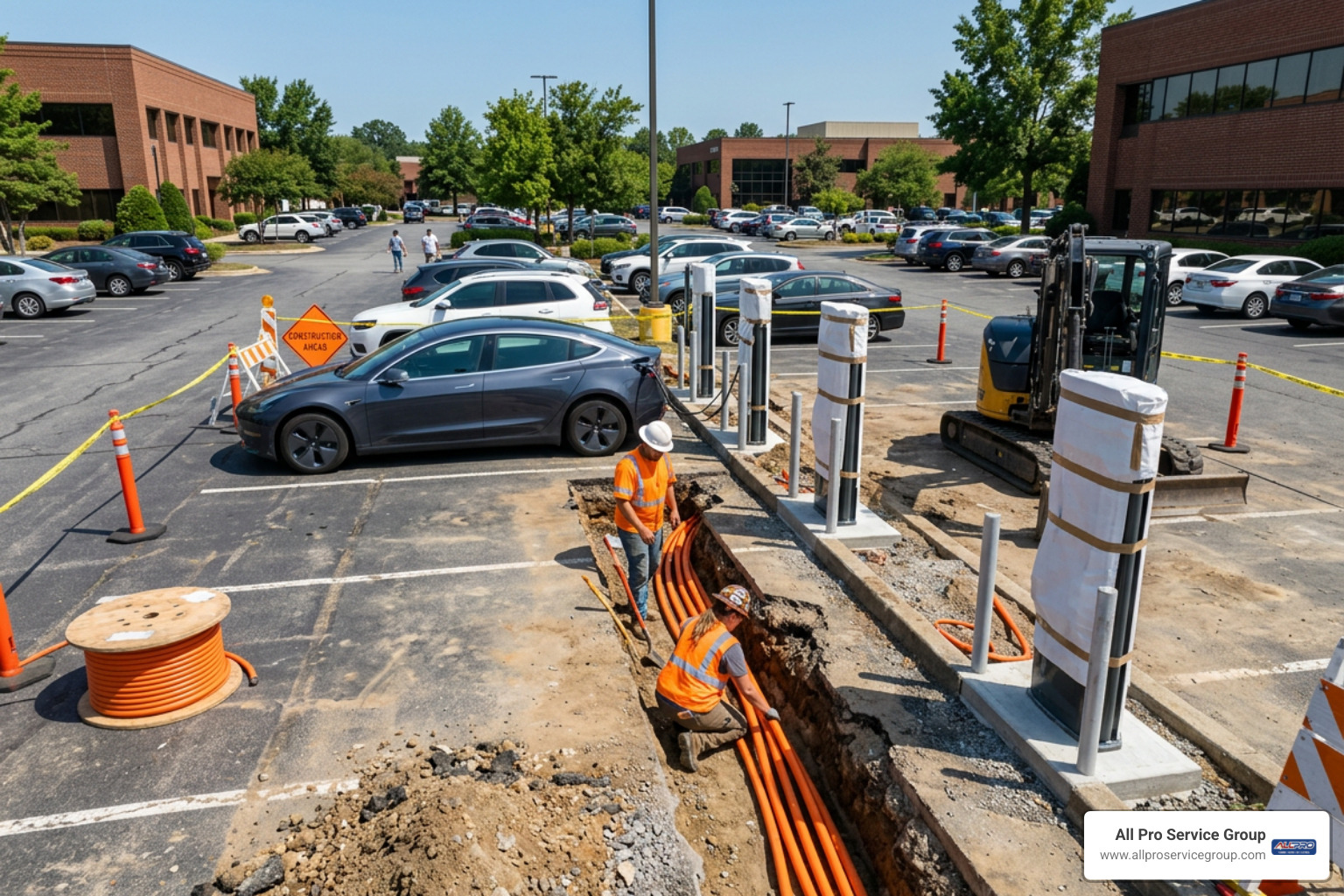
Physical site conditions frequently impact final project budgets far more than equipment selection.
Surface Parking Lot vs. Parking Garage Costs
Installing chargers in an open surface lot versus a multi-level parking structure presents distinct structural demands:
- Surface Parking Lots: Charging locations sited away from electrical panels require asphalt saw-cutting, open trenching, and ground restoration. Commercial trenching averages $75 to $150 per linear foot. A 200-foot run across a parking lot can easily add $15,000 to $30,000 in site prep.
- Parking Garages: Garages generally eliminate external ground trenching, but require concrete drilling, fire-rated wall penetrations, and surface-mounted conduit runs. Structural load assessments and retrofits in legacy garages can add 12% to 22% to base hardware budgets.
Engineering Drawings, Permits, and Accessibility
Commercial charging installations require formal architectural and electrical engineering plan sets submitted to the local Authority Having Jurisdiction (AHJ):
- Stamping and Permitting Fees: Stamped engineering plan sets, load calculations, and municipal permit applications account for 3% to 5% of total project capital.
- ADA Compliance: The U.S. Access Board mandates accessible routing, curb ramps, clear floor space, and operational reach ranges for commercial charging bays. Converting a standard parking stall into an ADA-compliant charging space typically adds $3,000 to $7,000 per space in concrete work, striping, and signage.
Load Management vs. Electrical Service Upgrades
Connecting commercial EV chargers to an existing panel requires sufficient electrical headroom. Under NEC Article 625, EV charging equipment is classified as a continuous load, requiring branch circuits and feeders to be sized to 125% of the system's maximum draw.
If site capacity is tight, property owners face a choice between utility infrastructure upgrades and active load management:
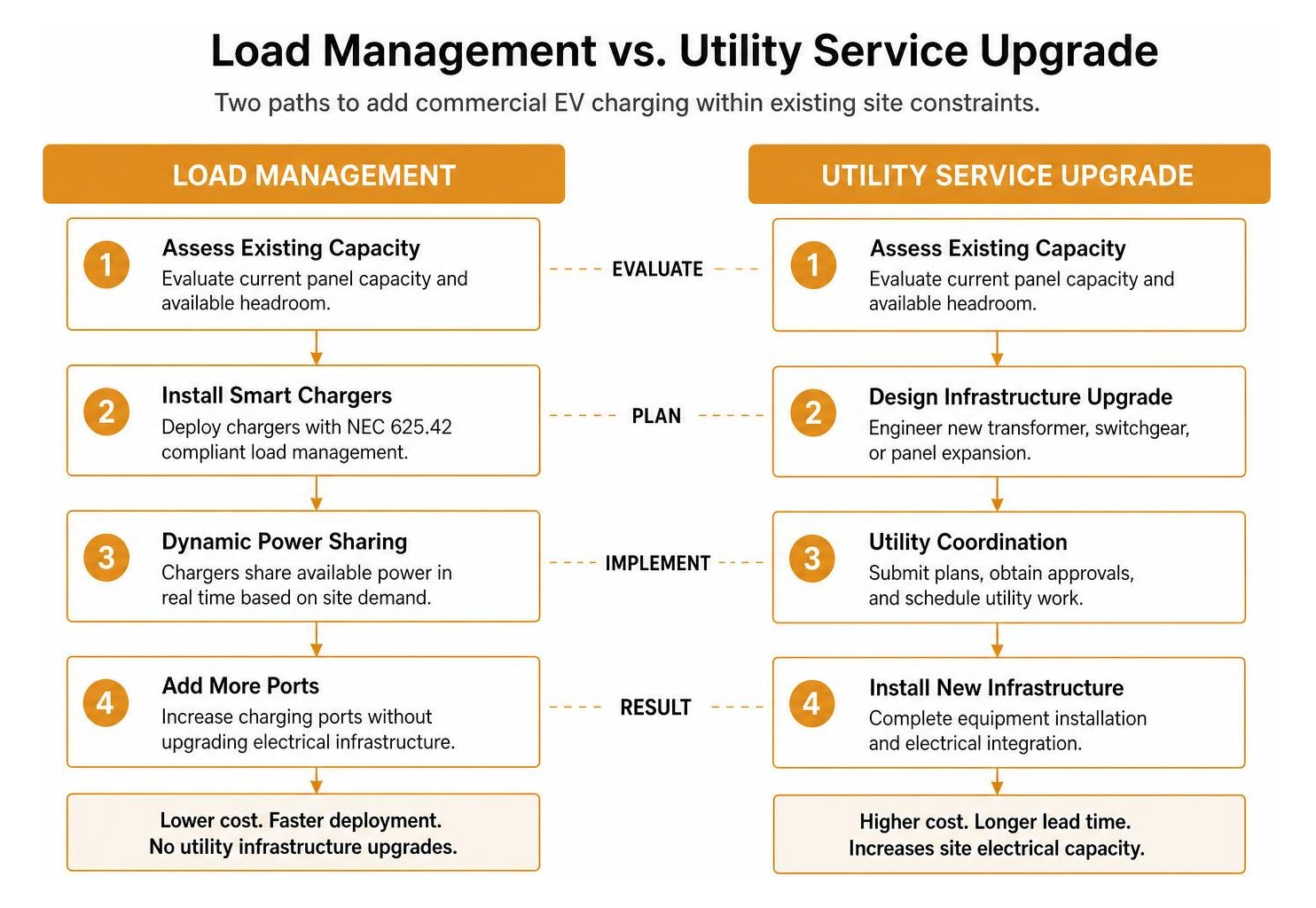
- Utility Upgrades: Installing a new dedicated utility transformer, switchgear, or panel panel expansion costs $20,000 to $100,000+ and can take months to arrange. Property owners considering infrastructure improvements can view our electrical panel upgrade complete guide to evaluate system capacity.
- NEC 625.42 Load Management: Modern smart chargers utilize dynamic power sharing to throttle power based on real-time site draw. This keeps maximum demand below local panel thresholds, allowing properties to deploy additional charging ports without replacing existing electrical infrastructure.
Ongoing Maintenance and Operating Commercial EV Charging Station Cost

Beyond initial equipment and installation, operational line items influence long-term return on investment. Insight into specialized network pricing model trends is detailed in market overviews like How Much Does The Tesla Supercharger Cost A Business?.
Network Software and Routine Maintenance
Commercial chargers require back-end software management for access control, driver billing, and remote diagnostics:
- Cloud Network Fees: Annual commercial software licensing averages $275 to $480 per port, per year.
- Preventative Upkeep: Level 2 charger upkeep costs roughly $300 per unit annually. High-power DC fast chargers—which feature liquid-cooled cables and intricate cooling pumps—require $2,000 to $3,000 per unit in annual preventative maintenance.
Utility Demand Charges and ROI Calculation
Commercial electricity bills consist of energy consumption (kWh) and demand charges ($/kW). Demand charges assess fees based on a property's highest peak power draw during 15-minute billing windows.
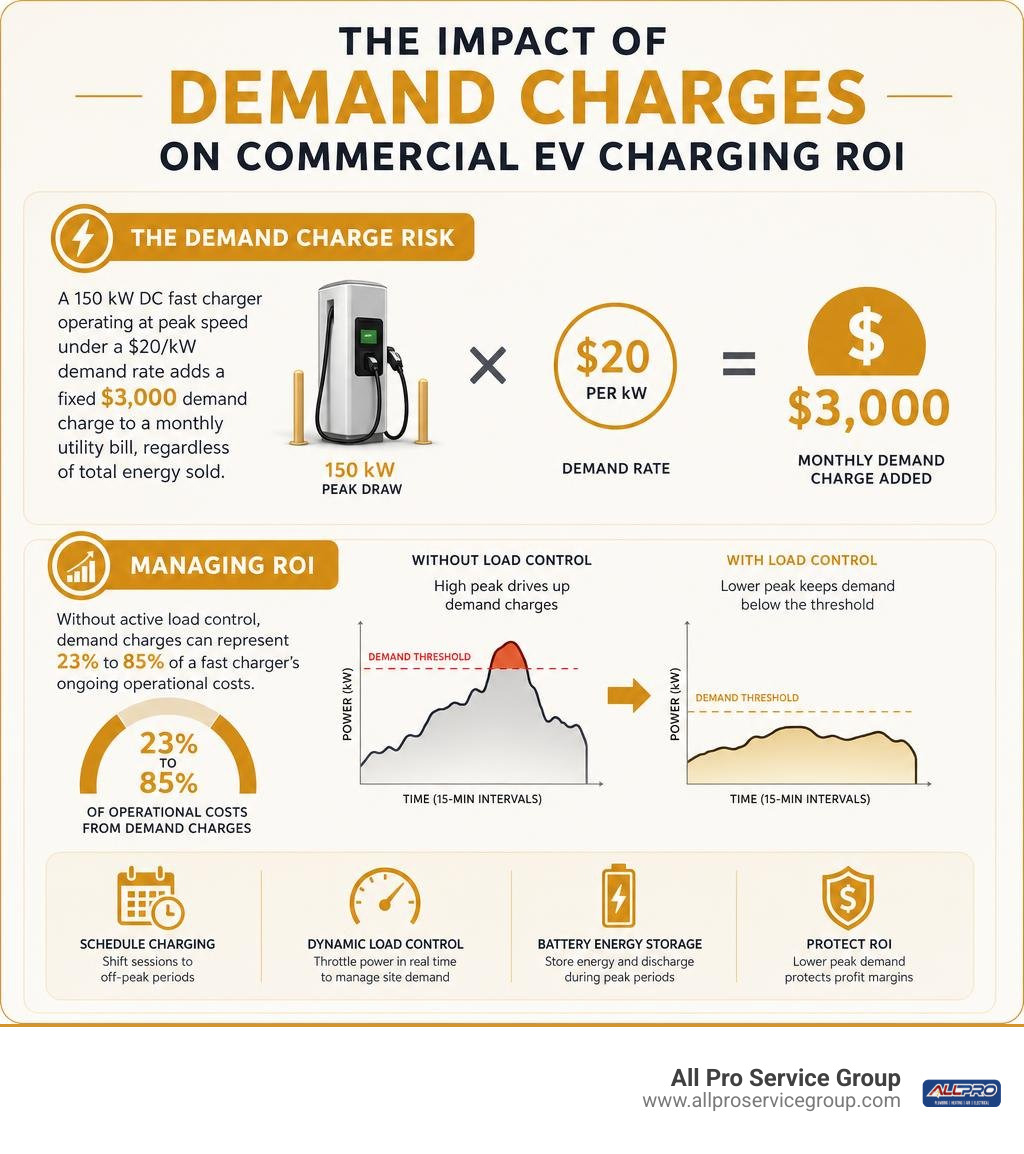
- The Demand Charge Risk: A 150 kW DC fast charger operating at peak speed under a $20/kW demand rate adds a fixed $3,000 demand charge to a monthly utility bill, regardless of total energy sold.
- Managing ROI: Without active load control, demand charges can represent 23% to 85% of a fast charger's ongoing operational costs. Lowering peak draw through scheduled charging or battery energy storage helps protect station profit margins.
In Utah, where average public charging rates hover around $0.344 per kWh, setting pricing structures that balance driver affordability with local commercial electric rates ensures predictable, long-term ROI.
Post-2026 Financial Incentives and Tax Credits
Navigating the post-2026 commercial incentive landscape requires attention to changing policy timelines:
- Federal Section 30C Expiration: The federal Section 30C Alternative Fuel Vehicle Refueling Property Credit expired for property placed in service after June 30, 2026. Projects completed prior to that cutoff qualified for credits up to 30% of eligible costs (capped at $100,000 per unit).
- Utility and Local Rebates: Local electric utilities like Rocky Mountain Power offer make-ready rebates that fund panel connections, conduit runs, and transformer work. Combining utility rebates with smart charger deployment helps lower overall project expenses.
Realistic Timelines for Commercial EV Charging Projects
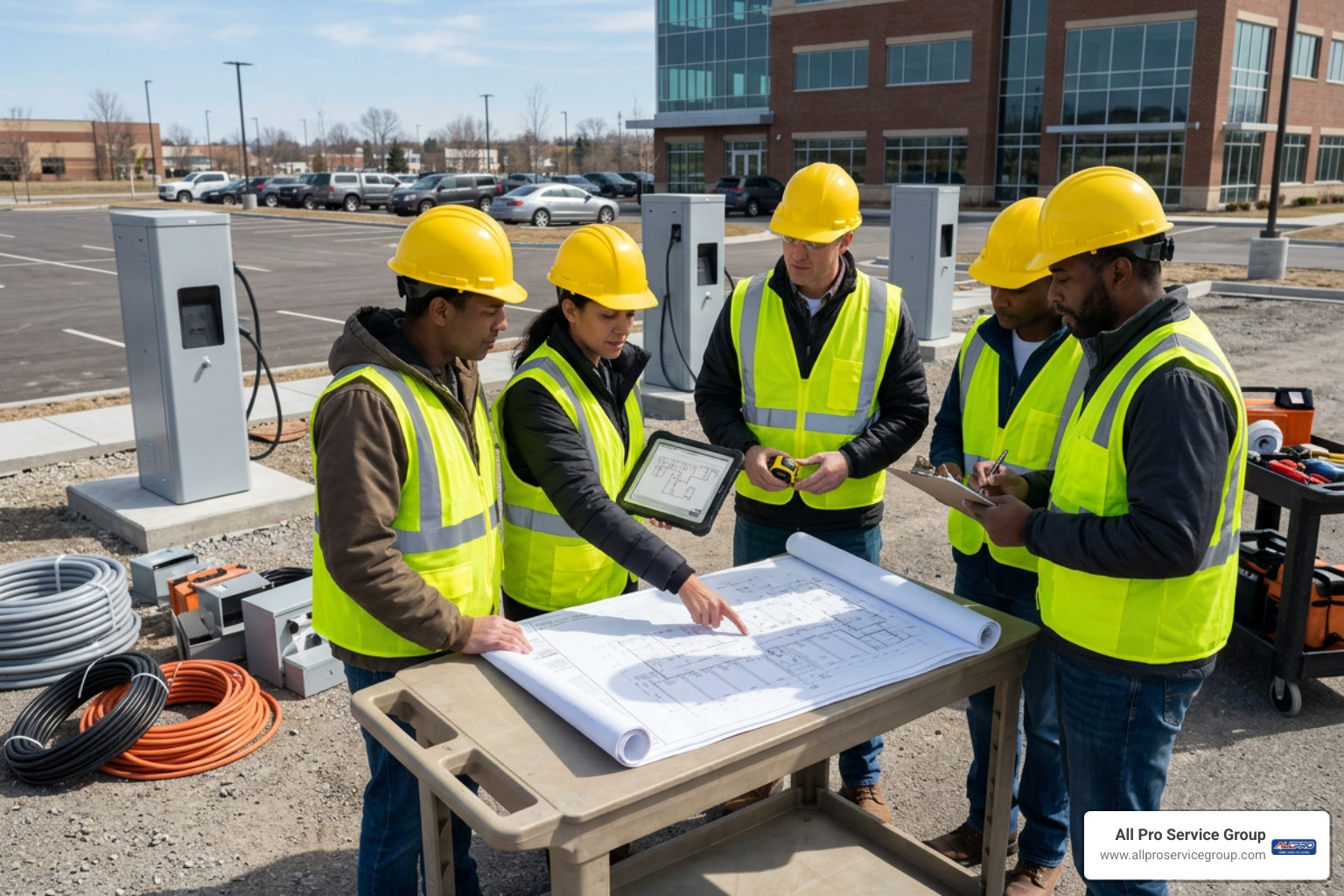
Commercial charging rollouts involve coordinated site engineering, municipal permitting, utility reviews, and physical construction.
Level 2 Installation Timeline
Commercial Level 2 charging projects typically move from contract signing to final commissioning within 4 to 12 weeks:
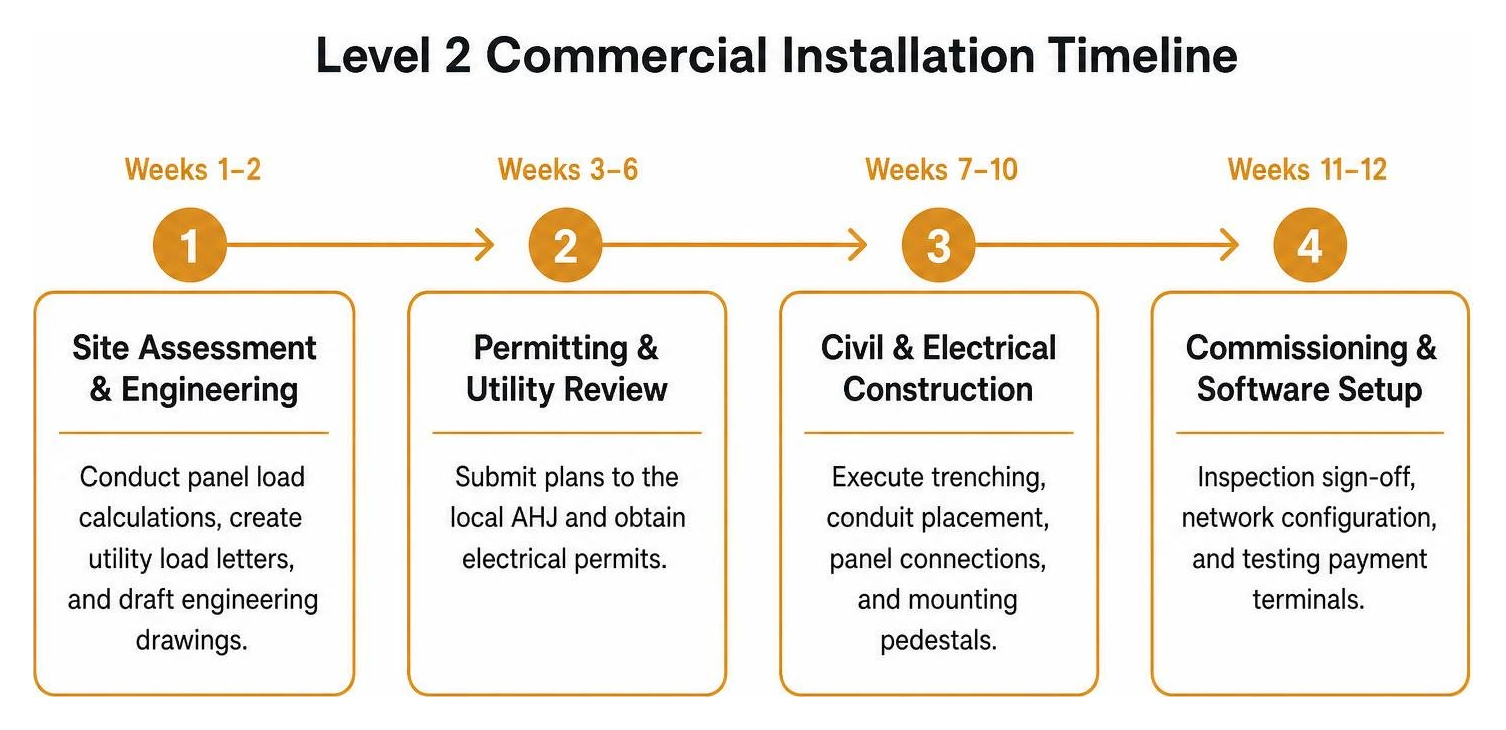
- Site Assessment & Engineering (Weeks 1–2): Conducting panel load calculations, creating utility load letters, and drafting engineering drawings.
- Permitting & Utility Review (Weeks 3–6): Submitting plans to the local AHJ and obtaining electrical permits.
- Civil & Electrical Construction (Weeks 7–10): Executing trenching, conduit placement, panel connections, and mounting pedestals.
- Commissioning & Software Setup (Weeks 11–12): Inspection sign-off, network configuration, and testing payment terminals.
DC Fast Charging Timeline and Utility Queues
Deploying high-power DC fast chargers requires significant grid coordination. Because a multi-charger cluster can draw upwards of 600 kVA, installations typically take 6 to 18 months:
- Utility Interconnection Queues: Grid capacity studies, custom engineering, and transformer procurement frequently require 6 to 12 months before field work begins.
- Site Work & Inspection: High-voltage switchgear placement, directional drilling, and utility transformer drop-ins require multi-phase site inspections before final activation.
Frequently Asked Questions About Commercial EV Charging Station Costs
How much does a commercial EV charging station cost to install per port in 2026?
A commercial Level 2 charging station typically costs $3,000 to $12,000 per port fully installed, including hardware, permitting, and labor. A Level 3 DC fast charger averages $80,000 to $250,000+ per unit installed, driven by 480V three-phase electrical requirements and potential utility transformer upgrades.
Is the federal Section 30C tax credit still available for commercial EV charging?
The federal Section 30C tax credit expired for property placed in service after June 30, 2026. Commercial property owners must now rely primarily on state clean-energy grants, local utility make-ready rebates, and strategic load management to offset installation costs.
How do utility demand charges affect the financial ROI of EV charging?
Demand charges apply fees based on a property's single highest peak power draw (in kW) during a billing cycle. High-output chargers can incur thousands of dollars in monthly demand charges even with low overall energy usage. Utilizing dynamic load management software or co-locating battery storage caps peak draw, protecting ongoing station profitability.
Build Your Commercial EV Charging Strategy with Confidence
Navigating equipment tiers, trenching logistics, local code requirements, and utility capacity demands careful project planning. Sizing your electrical infrastructure correctly upfront prevents cost overruns and ensures long-term system reliability.
Since 2008, All Pro Service Group has provided trusted electrical and facility services throughout Salt Lake City, Park City, Provo, South Jordan, West Jordan, West Valley City, Ogden, and the Greater Salt Lake Valley. Our team handles complete site evaluations, service sizing, panel retrofits, and electrical infrastructure planning tailored to your commercial property.
Contact our team today for a comprehensive commercial site assessment and turn your electric vehicle charging plans into a dependable, well-engineered investment. To explore our commercial installation services, visit our business ev charger installation guide 2026.