
Introduction
Commercial electric car charging points installation typically costs between $3,000 and $12,000 per port for Level 2 stations and $80,000 to $250,000+ per unit for DC fast chargers. Total project costs depend on matching charging speeds to vehicle parking dwell times, electrical service capacity, trenching distance, and smart load management. A standard project involves site assessment, utility load letters, engineering permitting, civil trenching, and electrical commissioning.
As of mid-2026, the United States features more than 250,000 public EV charging ports, with plug-in electric vehicles representing approximately 9% of new passenger vehicle sales nationwide in 2025. Industry analysts project that in just a few short years, half of all auto sales across the country will be electric vehicles. Furthermore, over 70% of Gen Z and Millennial consumers actively prioritize businesses that reduce their environmental impact.
For commercial property owners, corporate campuses, retail plazas, and fleet depots, deploying electric vehicle infrastructure is no longer merely a decorative sustainability perk. It has evolved into an essential customer draw, an employee retention driver, and a direct revenue center.
However, whether you operate an office park or manage a fleet yard, the financial success of your rollout hinges on matching charging speeds to vehicle dwell times, understanding infrastructure requirements, and controlling civil and electrical construction expenses.
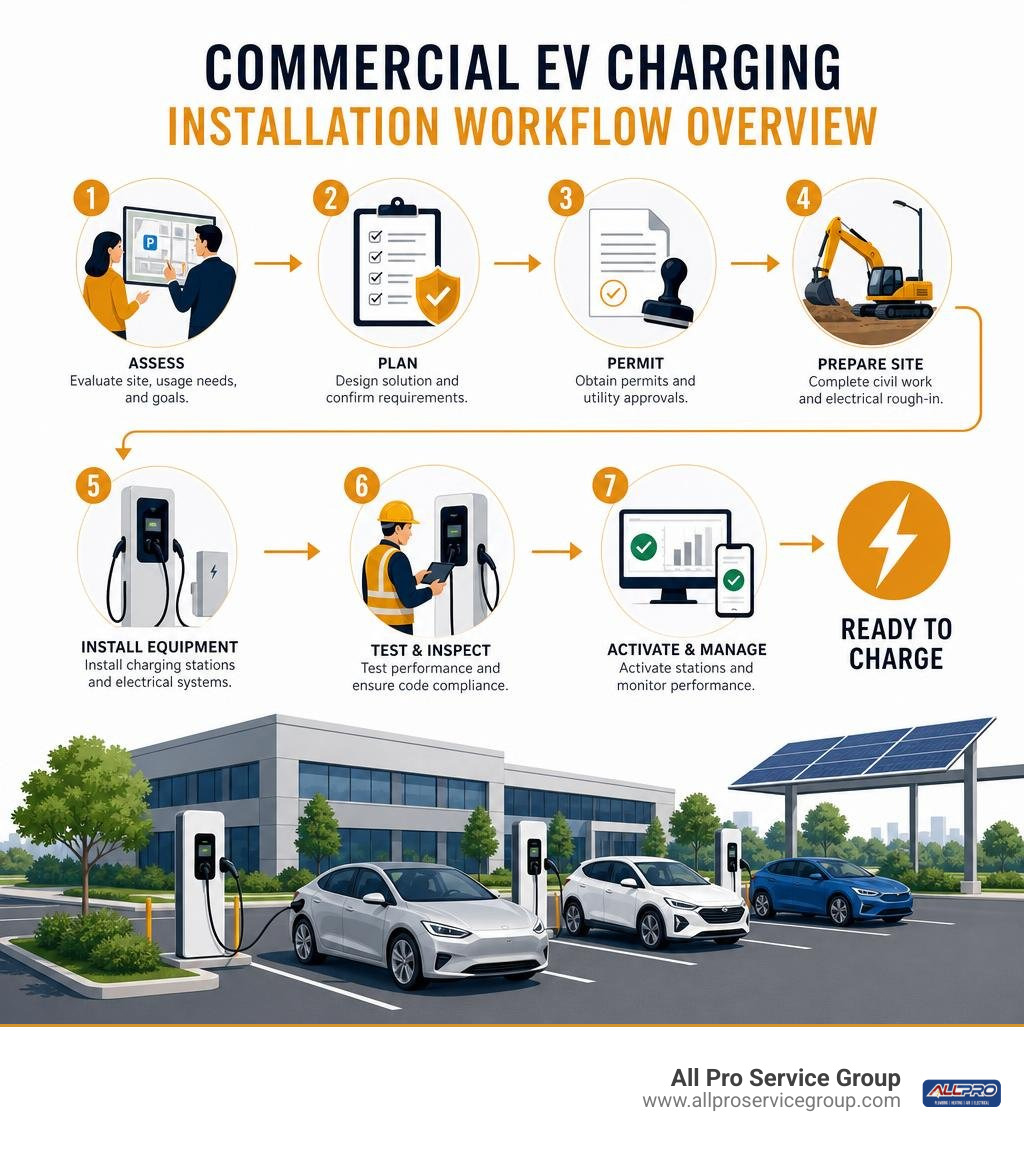
Understanding Hardware Types for Commercial Electric Car Charging Points Installation
Selecting the right charging equipment is fundamentally about matching electrical output to parking dwell times. Installing an ultra-fast DC charger where cars sit parked for eight hours wastes capital, while offering a slow charge at a quick-stop grocery store frustrates drivers who need a meaningful top-off before heading out.
Level 2 vs. DC Fast Chargers for Business Applications
Level 2 commercial charging stations run on 208V or 240V power, drawing between 32 and 80 amps per port to deliver roughly 25 to 45 miles of range per charging hour. Because they operate on electrical infrastructure commonly available in commercial buildings, they represent the absolute sweet spot for:
- Workplace and Corporate Parking: Employees park for 6 to 9 hours, giving ample time to reach a full 100% charge without placing extreme strain on building electrical demand.
- Multifamily Housing & Condominiums: Residents charge overnight while utility electrical demand is at its lowest.
- Hotels and Hospitality: Overnight guests wake up with fully recharged batteries.
- Fleet Depots: Delivery vans and service trucks can recharge steadily overnight using staggered charging schedules.
If your property utilizes existing single-phase or three-phase commercial feeds, reviewing our 240 Volt Charger Installation Complete Guide provides practical context on how dedicated circuits and branch breaker lines are engineered for these loads.
Conversely, Direct Current Fast Chargers (DCFC) bypass a vehicle's onboard converter and supply high-voltage direct current (ranging up to 1,000V) straight to the battery pack. Delivering 50 kW to 350 kW, DC fast chargers can bring an EV battery from 10% to 80% in 20 to 40 minutes. They are best suited for high-turnover retail centers, public charging plazas, highway corridors, and multi-shift commercial fleets requiring fast midday turnarounds.
Smart Charging Hardware, OCPP Protocols, and Payment Gateways
Commercial EV chargers must be smart, connected devices. In public and multi-tenant environments, you need robust communication protocols to track kilowatt-hour (kWh) consumption, bill drivers accurately, and prevent unauthorized usage.
Leading commercial networks like ChargePoint: EVSE | Electric Vehicle (EV) Charging Stations integrate Open Charge Point Protocol (OCPP 1.6J or 2.0.1) compliance. OCPP is the open communication standard that connects physical charging hardware to cloud-based management software.
Choosing OCPP-compliant hardware protects your investment by preventing vendor lock-in. If you ever decide to switch management software or payment billing providers, you can redirect your charging stations to a different platform without tearing out and replacing the physical chargers.
Smart commercial stations also incorporate:
- Integrated Contactless POS Terminals: Allowing drivers to tap a credit card, Apple Pay, or Google Pay directly without mandatory app downloads.
- RFID Access Control: Perfect for workplaces or fleets to restrict charging access to authorized personnel and track departmental electricity consumption.
- 24/7 Automated Diagnostics: Real-time cloud monitoring that alerts facility managers immediately if a cable faults or a station goes offline.
Total Cost Breakdown of Commercial EV Charging Stations
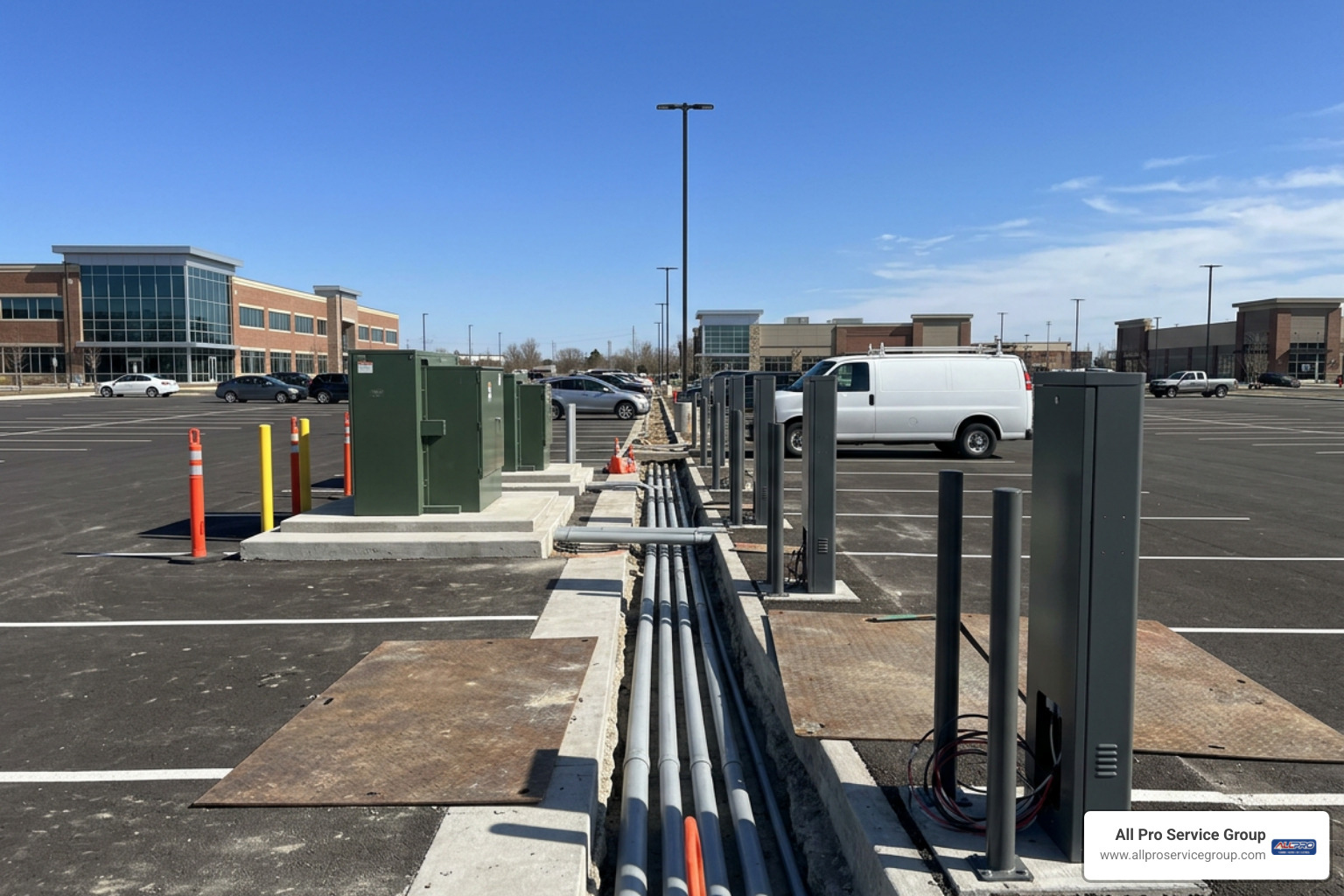
When establishing your project budget, hardware is only one piece of the puzzle. The overall investment includes civil engineering, electrical wiring, switchboard upgrades, permitting fees, and ongoing software subscriptions.
For a comprehensive review of equipment tiers and financial modeling, refer to our detailed breakdown on Commercial EV Charging Station Cost.
Civil Works and Electrical Expenses for Commercial Electric Car Charging Points Installation
The physical distance between your main electrical panel and the planned parking spaces is often the single largest variable determining installation labor costs. Running conduit across a parking lot requires specialized site work:
- Trenching and Surface Reinstatement: Cutting through asphalt or concrete, digging 18-to-24-inch safety trenches for underground conduit, backfilling, and resurfacing costs anywhere from $50 to $150 per linear foot.
- Directional Boring: In established commercial properties where cutting asphalt would disrupt major access lanes or destroy expensive landscaping, horizontal directional boring can route conduit underground with minimal surface disruption.
- Mounting Infrastructure: Free-standing pedestal chargers require poured concrete pads and heavy-duty steel safety bollards to protect sensitive electronics from vehicle impacts.
- ADA Accessibility Compliance: Commercial installations must comply with ADA standards and local building codes. This includes reserving accessible paths of travel, ensuring proper operating mechanism reach ranges (between 15 and 48 inches above ground), and providing wide parking and access aisles.
Our Charging Station Cost Complete Guide explores how these site layout choices influence civil work costs.
Electrical Panel Capacity and Utility Infrastructure Upgrades
Under the National Electrical Code (NEC Article 625), EV charging stations are classified as continuous electrical loads. This means your overcurrent protection devices (circuit breakers) and branch conductors must be sized at a minimum of 125% of the charger’s maximum rated draw. For example, a single 48-amp Level 2 charging station requires a dedicated 60-amp circuit breaker.
If your commercial facility has an older electrical service, adding multiple high-draw chargers can quickly exceed your service panel’s available amperage.
Upgrading your electrical distribution switchgear or replacing a commercial panel often ranges from $6,000 to $25,000. You can explore how service capacity is expanded in our Electrical Panel Upgrade Complete Guide.
When installing high-capacity DC fast charging systems drawing 480V three-phase power, properties often require a dedicated pad-mounted utility transformer. Complex multi-charger projects that demand utility make-ready switchgear and transformer work can easily push total project scopes beyond $100,000.
Step-by-Step Execution for Commercial EV Projects
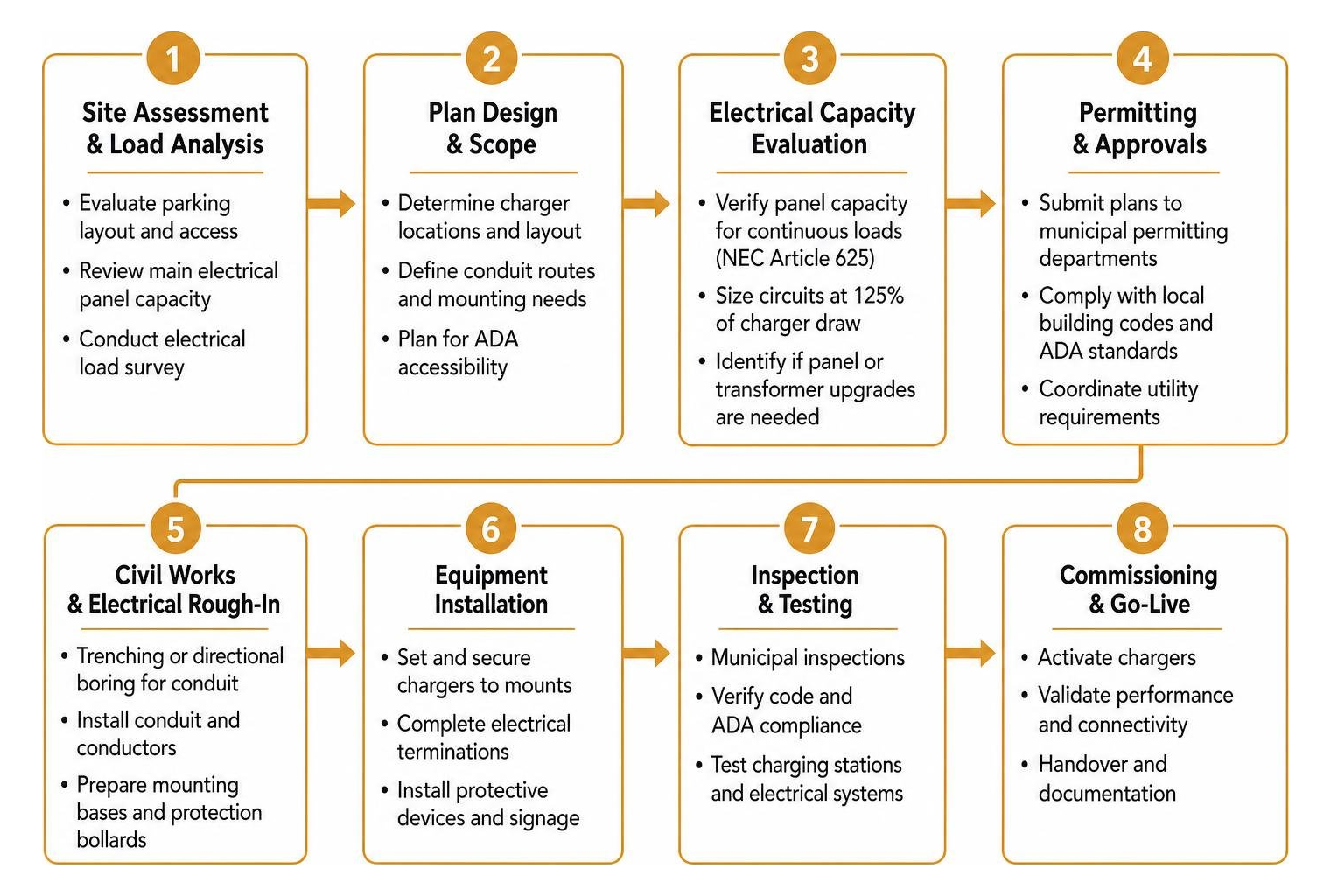
Executing a commercial charging project requires close coordination between business stakeholders, licensed electricians, municipal permitting departments, and the electric utility. For a structured blueprint on managing commercial projects from start to finish, consult our Business EV Charger Installation Guide 2026.
Load Management Strategies to Avoid Costly Service Upgrades
One of the most common pitfalls in commercial EV projects is assuming you must upgrade your main utility transformer to accommodate new chargers.
Under NEC Section 625.42, facilities are permitted to size their electrical service based on Energy Management Systems (EMS) rather than the simple nameplate sum of all connected chargers.
Dynamic Load Management (DLM) controllers continuously monitor the building's overall electrical draw in real time. When primary facility equipment (such as rooftop HVAC systems, industrial chillers, or commercial kitchens) ramps up, the DLM automatically throttles the charging stations. As the building's base electrical demand drops, the system ramps charger speeds back up.
By implementing smart power-sharing, a commercial property can double or triple the number of active charging bays on its existing service board without triggering expensive utility grid upgrade fees, cutting upfront infrastructure costs significantly.
Project Milestones and Timeline for Commercial Electric Car Charging Points Installation
A typical commercial EV charging installation progresses through four key phases:
- Site Assessment and Utility Load Letter (Weeks 1 to 4): A licensed master electrician conducts an on-site audit to measure peak electrical demand, inspect panel capacity, and determine conduit routing. We request a historical 12-month load profile and capacity letter from the electric utility.
- Engineering Design & Municipal Permitting (Weeks 4 to 10): Electrical engineers produce one-line diagrams, site layout drawings, and civil grading plans. These are submitted to the local Authority Having Jurisdiction (AHJ) for electrical and building permits.
- Civil Works & Electrical Construction (Weeks 10 to 14): Technicians perform required directional boring, trenching, conduit placement, concrete pad pouring, wiring runs, panel upgrades, and bollard installations.
- Utility Interconnection, Inspection, and Commissioning (Weeks 14 to 18+): The local building safety inspector approves the installation, the electric utility connects new service or meters where necessary, and technicians test network gateways, configure OCPP software, and commission the charging ports.
For public installations, such as high-traffic hubs like EV charging stations in West Valley City, final commissioning also includes registering the site on public driver navigation apps and mapping directories to maximize station visibility.
Incentives, Monetization, and Maximizing Commercial EV Charging ROI
Commercial EV charging stations can be structured as complimentary customer amenities, cost-neutral employee perks, or profitable standalone revenue streams.
Managing Post-Section 30C Economics and Utility Rebates
While federal Section 30C tax credits historically supported EV infrastructure development, the credit expired for properties placed in service after June 30, 2026. As a result, commercial project economics now rely on state programs, local electric utility make-ready grants, and federal NEVI corridor funding.
Many regional utilities offer commercial make-ready programs that cover a substantial portion of the civil infrastructure, conduit, and panel work required to prepare a commercial lot for charging stations. Combining these utility rebate incentives with smart load management allows many businesses to achieve project payback within 3 to 6 years through direct charging revenues and increased customer spend.
Frequently Asked Questions About Commercial EV Charging
How much does commercial electric car charging points installation typically cost?
For a Level 2 commercial charging station, most business owners can expect to invest $3,000 to $12,000 per port installed, which covers commercial-grade hardware, dedicated electrical circuits, and standard labor. A dual-port pedestal setup typically averages between $6,000 and $15,000.
High-power DC fast charging (DCFC) installations range from $80,000 to $250,000 or more per unit, depending on power capacity (50 kW to 350 kW), 480V three-phase utility requirements, and extensive civil trenching.
How long does a commercial EV charger installation take from start to finish?
The physical electrical work and charger mounting typically take only 2 to 5 days on-site for a bank of Level 2 chargers.
However, the complete project timeline—including initial site feasibility, engineering drawings, municipal permitting, utility load reviews, and final inspection—generally spans 6 to 12 weeks. High-power DC fast charging projects that require new utility transformers or substation upgrades can take 6 to 12 months.
Does installing commercial EV chargers require upgrading the building's electrical service?
Not necessarily. While adding multiple high-power charging stations increases continuous electrical demand, installing a Dynamic Load Management (DLM) system allows chargers to throttle output dynamically during peak building hours.
This prevents your facility from exceeding main panel limits or triggering costly utility transformer upgrades, letting you maximize charger counts on your existing electrical service.
Conclusion
Installing commercial EV charging stations is a proven strategy to future-proof your commercial property, attract eco-conscious customers, retain top talent, and build a recurring revenue stream. However, delivering a reliable and profitable installation requires meticulous load calculations, safe electrical design, and careful navigation of local codes.
At All Pro Service Group, our licensed master commercial electricians handle every stage of your project—from electrical load calculations and utility coordination to trenching, hardware commissioning, and ongoing maintenance throughout the Greater Salt Lake Area. As a Gephardt Approved contractor, we deliver dependable workmanship, clear communication, and safe, compliant commercial power installations.
Ready to evaluate your property’s electrical capacity and design a tailored EV charging strategy? Contact us today to schedule your commercial site assessment for Electrical EV Charger Installation.