
Is a Business EV Charger Installation Worth It? Here's What You Need to Know Fast
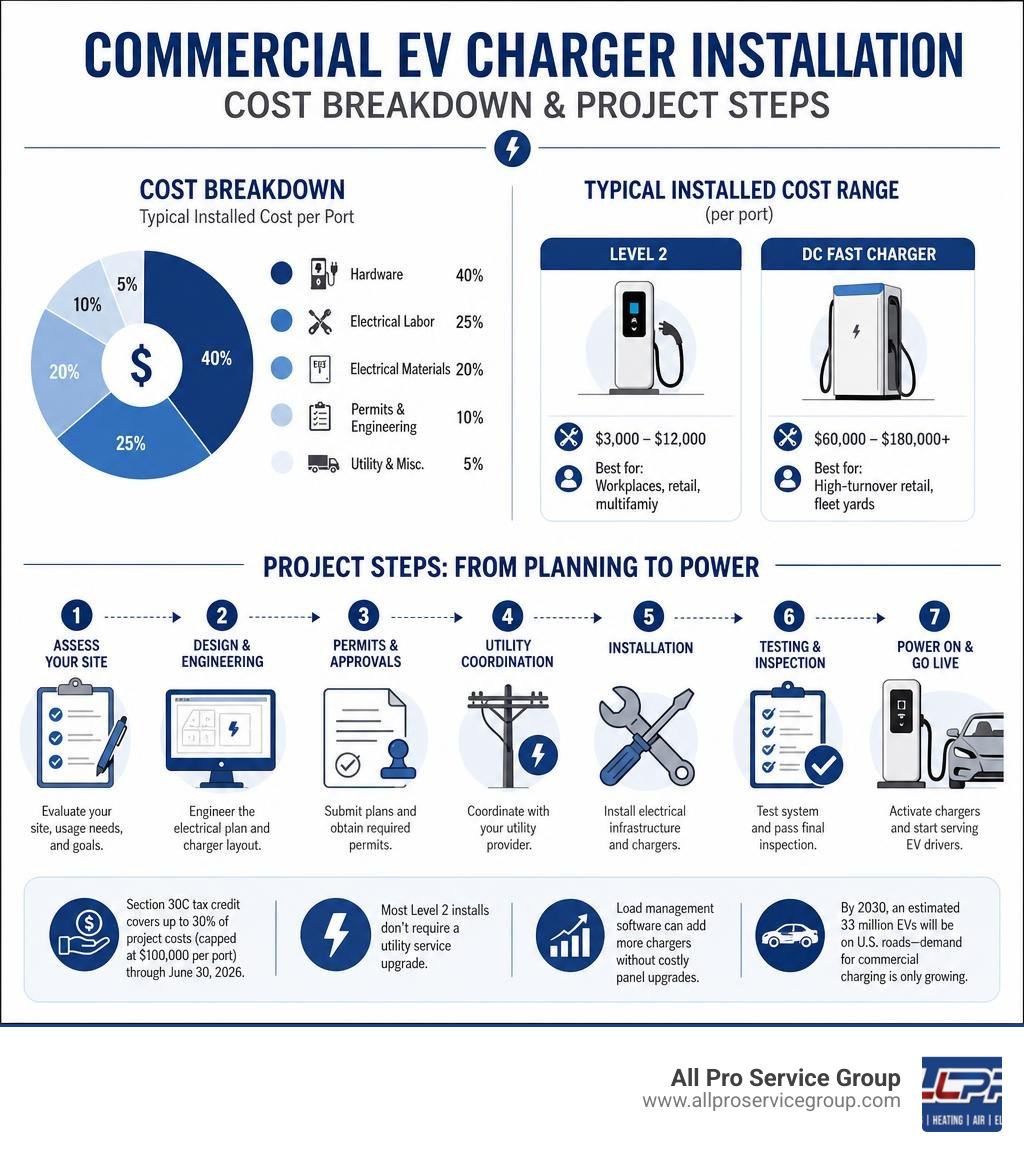
Business EV charger installation costs and complexity vary widely depending on charger type and site conditions. Here's a quick summary:
| Charger Type | Hardware Cost | Total Installed Cost | Best For |
|---|---|---|---|
| Level 2 | $600–$2,500/port | $3,000–$12,000/port | Workplaces, retail, multifamily |
| DC Fast Charger | $20,000–$80,000/port | $60,000–$180,000+/port | High-turnover retail, fleet yards |
Key things to know upfront:
- The federal Section 30C tax credit covers up to 30% of project costs(capped at $100,000 per port), but it sunsets June 30, 2026
- Most Level 2 installs don't require a utility service upgrade — DC fast chargers almost always do
- Load management software can let you add more chargers without expensive panel upgrades
- By 2030, an estimated 33 million EVs will be on U.S. roads — demand for commercial charging is only growing
Electric vehicles are no longer a niche trend. They made up roughly 10% of all new light-duty vehicle sales in the U.S. in 2024, and that number keeps climbing. For business owners, that means one thing: your customers, tenants, and employees are showing up with EVs — and they're noticing whether or not you have a place to plug in.
The good news is that getting commercial EV charging up and running is more straightforward than most people expect. The not-so-good news? Between electrical upgrades, permitting, utility coordination, and incentive applications, there are a lot of moving parts — and getting one wrong can turn a smart investment into a costly headache.
That's exactly why this guide exists.
At All Pro Service Group, our licensed electricians have handled complex commercial and residential electrical projects across the Greater Salt Lake Valley since 2008 — including business EV charger installation at a range of property types. If you want straight answers about what this actually costs and how to do it right, you're in the right place.
Understanding the Types of Commercial EV Chargers

Before we start digging trenches or pulling permits, we need to talk about the hardware. Choosing the right charger isn't just about picking the fastest one on the market; it's about matching the charging speed to how long vehicles naturally stay parked at your property.
If you install a charger that is too slow, your users will leave frustrated. If you install one that is unnecessarily fast, you will spend tens of thousands of dollars on electrical infrastructure that you don't actually need.
Let's break down the three main levels of electric vehicle supply equipment (EVSE) to see how they fit into different business models. If you are still weighing your options, you can learn more about EV charger installation options to see how residential and light commercial setups differ.
Level 2 Chargers for Long-Dwell Business EV Charger Installation
For the vast majority of businesses, Level 2 chargers are the sweet spot. Operating on 208V or 240V alternating current (AC), these units typically deliver between 6 kW and 19 kW of power. This translates to adding roughly 10 to 60 miles of driving range per hour of charging.
Level 2 chargers are highly cost-effective and perfectly suited for "long-dwell" locations where drivers intend to park for several hours. This includes:
- Workplaces: Employees park their cars for 8 to 9 hours a day, making a slow, steady trickle charge ideal. In fact, 80% of employers with an EV charging station report that it has helped them attract and retain top talent.
- Multifamily Properties: Apartment complexes and condominiums in South Jordan, UT, and West Jordan, UT, are seeing massive demand for overnight charging. Tenants expect to wake up to a fully charged battery.
- Hotels and Hospitality: Guests staying overnight in Park City, UT, want the convenience of plugging in while they sleep. Data shows EV drivers book properties with charging at three times the rate of those without.
Because Level 2 systems use standard commercial voltages, they often fit within your building's existing electrical capacity. If you're operating a commercial property in Utah, you can also take advantage of the Rocky Mountain Power Utah EV Incentives to dramatically lower your hardware and setup costs.
DC Fast Chargers for High-Turnover Commercial Sites
Direct Current Fast Chargers (DCFC)—often referred to as Level 3 chargers—are the heavyweights of the EV world. Operating on 480V three-phase power, these behemoths bypass a vehicle's onboard charger to pump DC electricity straight into the battery. Ranging from 50 kW to a massive 350 kW, they can charge an EV to 80% in as little as 20 to 45 minutes.
DC fast chargers are built for speed and high turnover. You will typically find them at:
- Retail and Shopping Centers: Places where customers spend 30 to 60 minutes, such as grocery stores, restaurants, or malls.
- Fleet Yards: Commercial delivery trucks, rental cars, or utility fleets that need to quickly top off between routes.
- Highway Corridors: Rest stops and fuel plazas designed for travelers making long-distance journeys.
To see where these fast-charging hubs are popping up in our local area, check out the Alternative Fuels Data Center Station Locator. For example, you can see how commercial networks build out high-capacity plazas by looking at the layout of the EVgo EV Charging Station in 2572 S 5600 W, West Valley City, UT.
However, DC fast chargers come with a catch: they require a massive amount of power. Installing even one or two DCFC units almost always triggers a major utility service upgrade, including a new transformer and heavy-duty switchgear.
The Real Cost of Business EV Charger Installation
Let’s talk numbers. When planning a business ev charger installation, looking only at the price of the charger itself is a recipe for budget-busting surprises. The actual hardware is often the smallest line item on the final invoice.
The total cost of your project is determined by a combination of hardware selection, software licensing, local permitting fees, and the physical labor required to connect the hardware to the power grid. To get an idea of the base electrical requirements, you can read our 240 volt outlet cost guide or dive deeper with our 240 Volt Charger Installation Complete Guide.
Here is a realistic look at how those costs break down in practice.
Hardware and Software Licensing Fees
Commercial chargers are built to survive public abuse, extreme weather, and constant use. This commercial-grade engineering means they cost more than the simple charger you might mount in a home garage.
- Level 2 Hardware: Expect to pay between $1,000 and $4,000 per port for commercial-grade Level 2 chargers. Wall-mounted units are generally cheaper to purchase and install than freestanding pedestals.
- DC Fast Charger Hardware: High-output DCFC units start around $20,000 and can easily climb past $80,000 per port for ultra-fast 350 kW systems.
In addition to the physical equipment, commercial chargers usually require network management software. This software connects the charger to the internet (typically via a cellular connection) so you can:
- Process credit card payments and manage driver fees.
- Monitor energy usage and track carbon offset data.
- Restrict access to employees, tenants, or specific customers.
- Run automatic diagnostics to ensure the charger is online and functioning.
These networking fees typically run about $300 per year per charging port, though some manufacturers bundle them into multi-year service contracts.
Electrical Infrastructure and Installation Labor
The physical work of installing a charger is where project costs can vary wildly. If your electrical panel is right next to a parking space with plenty of spare capacity, your installation will be incredibly cost-effective. But if you have to run conduit across a massive asphalt parking lot, the price tag will rise.
Key factors that drive installation costs include:
- Trenching and Concrete Work: Cutting through asphalt, digging a trench for conduit, pouring concrete pads for pedestals, and repairing the pavement afterward. Site work like this can easily account for 40% or more of your total installation budget.
- Electrical Panel Upgrades: If your building's current electrical panel is fully loaded, you will need to invest in electrical panel upgrades to safely handle the new load. If you run into unexpected electrical issues during the process, you may also need to budget for commercial electrical repair to bring your existing systems up to modern standards.
- Utility Upgrades: For larger installations, especially DC fast chargers, Rocky Mountain Power may need to bring a new, high-capacity power line to your property and install a dedicated transformer.
Because of these variables, we always recommend starting with a professional Electrical EV Charger Installation assessment. This ensures your existing infrastructure is evaluated by an expert before you purchase any equipment.
Maximizing Incentives, Rebates, and the Section 30C Tax Credit

Now for some great news: you do not have to shoulder these installation costs alone. There is a massive pool of federal, state, and utility funding designed to offset the cost of commercial EV infrastructure. By stacking these incentives, many businesses in Salt Lake City, Provo, and Ogden are able to cover 50% to 100% of their total project costs.
Navigating the Section 30C Federal Tax Credit Before the Sunset
The single most powerful incentive available to businesses is the federal Alternative Fuel Vehicle Refueling Property Credit (Section 30C).
Under Section 30C, businesses can claim a tax credit of 30% of the total cost of the EV charging project, up to a maximum of $100,000 per charging port. This applies to both the hardware and the physical installation costs.
However, there are a few critical rules you must follow to qualify:
- Location Requirements: The charging station must be installed in an eligible census tract, which generally covers low-income or non-urban areas.
- Labor Standards: To get the full 30% credit, you must meet strict federal prevailing wage and apprenticeship requirements during construction. If you do not meet these standards, the credit drops to 6%.
- The Sunset Date: This credit is currently scheduled to sunset on June 30, 2026. To secure this massive tax break, your commercial EV charging system must be fully installed and placed in service before this deadline.
State and Utility Rebates for Commercial Properties
On top of federal tax credits, local utility companies offer direct rebates that can be applied right to your bottom line.
In Utah, Rocky Mountain Power provides substantial "Make-Ready" incentives. These programs are designed to cover the costly grid-side infrastructure—such as trenching, conduit, and panel upgrades—leaving the business owner responsible only for purchasing the actual chargers.
For a complete look at how these federal and state programs work together to support business owners, consult the Department of Energy Commercial EV Charging Guide.
Site Design, Load Management, and Project Timelines
A successful commercial EV project is built on careful planning. You cannot simply mount a charger to an exterior wall and hope for the best. You must design a site that is safe, accessible, and engineered to scale as more drivers make the switch to electric.
Assessing Electrical Capacity and Load Management Software
Before you choose a location for your chargers, our team will perform a detailed load calculation on your building's electrical system. We need to determine if your current panel can handle the continuous draw of multiple EV chargers.
If your panel is near capacity, you don't necessarily have to pay for an expensive service upgrade. Instead, you can use smart load management software(also known as automatic load balancing).
Under National Electrical Code (NEC) Section 625.42, businesses can use smart software to dynamically share a set amount of electrical capacity across multiple charging ports. For example, if you have a 40-amp circuit but install four chargers, the software will automatically distribute the power. If only one car is plugged in, it gets the full 40 amps. If four cars plug in, they each get 10 amps. This simple trick can cut your upfront installation costs in half by avoiding expensive panel and utility upgrades.
If your building's electrical system is older or lacks proper grounding, we can resolve those issues ahead of time through our professional electrical wiring and rewiring services. You can also read our Electrical Panel Upgrade Complete Guide to understand how we prepare commercial buildings for high-draw appliances.
Step-by-Step Timeline for a Business EV Charger Installation
Installing a commercial EV charging station is a multi-step process that requires coordination between our electricians, local permitting offices, and the utility company. Here is what a realistic timeline looks like:
- Site Assessment & Engineering (Weeks 1–2): We analyze your electrical panel, measure distances to parking stalls, and design the conduit runs.
- Utility Coordination (Weeks 2–4): We submit a load study to Rocky Mountain Power to confirm grid capacity.
- Permitting (Weeks 4–8): We secure electrical and building permits from your local municipality (such as Salt Lake City, South Jordan, or West Valley City).
- Civil & Electrical Work (Weeks 8–10): We trench, lay conduit, pour concrete pads, upgrade panels, and mount the chargers.
- Inspection & Commissioning (Weeks 10–12): The local building inspector signs off on the work, the utility energizes the system, and we configure the network software.
To learn more about the national standards guiding this process, review the official Alternative Fuels Data Center Infrastructure Guide.
Ongoing Operational Costs and Revenue Recovery
Once your chargers are installed, they become a permanent part of your business operations. Just like any other commercial asset, you must plan for ongoing operational costs and decide how you want to recover those expenses.
Managing Demand Charges and Maintenance Fees
Running a commercial charging station involves a few recurring costs:
- Electricity Usage: You will pay for the kilowatt-hours (kWh) consumed by the chargers.
- Demand Charges: Many commercial utility rates include "demand charges" based on your peak electricity usage during the month. If multiple EVs plug in simultaneously and draw a massive amount of power, it can spike your utility bill. Smart load management software helps prevent this by capping peak draw.
- Network Subscriptions: Ongoing fees for cellular connectivity and payment processing software (typically around $300/year per port).
- Maintenance: Budgeting roughly $400 per year per charger for physical inspections, cable replacements, and software updates.
Monetization and Flexible Ownership Models
How you choose to pay for these operational costs depends entirely on your business goals. There are three common business models:
- Free Amenity (Loss Leader): You provide charging for free to attract high-value customers, increase customer dwell time, or retain employees.
- Cost Recovery: You charge drivers a fee that is set slightly above your utility rate. This covers your electricity costs, network fees, and maintenance expenses without making a profit.
- Profit Center: You set higher charging rates to generate a new revenue stream. Drivers pay via credit card, mobile app, or tap-to-pay terminals directly at the charger.
If you do not want to manage the hardware yourself, you can also explore flexible ownership options like Charging-as-a-Service (CaaS). Under this model, a third-party provider owns, operates, and maintains the equipment, while you pay a predictable monthly fee. To explore these options further, check out the Alternative Fuels Data Center EV Charging Business Models overview.
Frequently Asked Questions About Commercial EV Charging
How many EV chargers should a business install?
As a general rule of thumb, we recommend making 10% of your parking spaces "EV-capable"(meaning conduit is run to the spaces) and installing active chargers in 2% to 5% of your spaces to start. For apartment buildings, a good starting point is one Level 2 charger for every 20 units. This gives you room to scale as demand grows without overinvesting upfront.
Do commercial EV chargers require a utility service upgrade?
For a few Level 2 chargers, usually no. Most commercial buildings have enough spare capacity to handle 4 to 8 Level 2 ports, especially if you use load management software. However, if you are installing a DC fast charger, you will almost certainly need a utility service upgrade. You can read our 200 amp power panel guide to see how panel capacity limits electrical expansion.
Can businesses generate revenue from EV charging stations?
Absolutely. By using networked chargers, you can set custom pricing structures. You can charge by the kilowatt-hour, by the hour, or implement parking fees for vehicles that remain plugged in after their battery is fully charged.
Conclusion
Setting up a commercial EV charging station doesn't have to be overwhelming. By choosing the right charger level, utilizing smart load management, and taking advantage of the federal Section 30C tax credit before it sunsets on June 30, 2026, you can future-proof your business while keeping your installation costs highly manageable.
At All Pro Service Group, we pride ourselves on delivering dependable, high-quality commercial electrical services across the Greater Salt Lake Valley. As a "Gephardt Approved" business, our licensed electricians handle every step of your project—from initial load calculations and utility coordination to final installation and inspection.
Ready to bring reliable EV charging to your Utah business? Schedule your commercial EV charger installation with All Pro Service Group today, and let's build the infrastructure your customers and employees deserve.