
Charging Station Installation Cost: A Quick Homeowner Guide
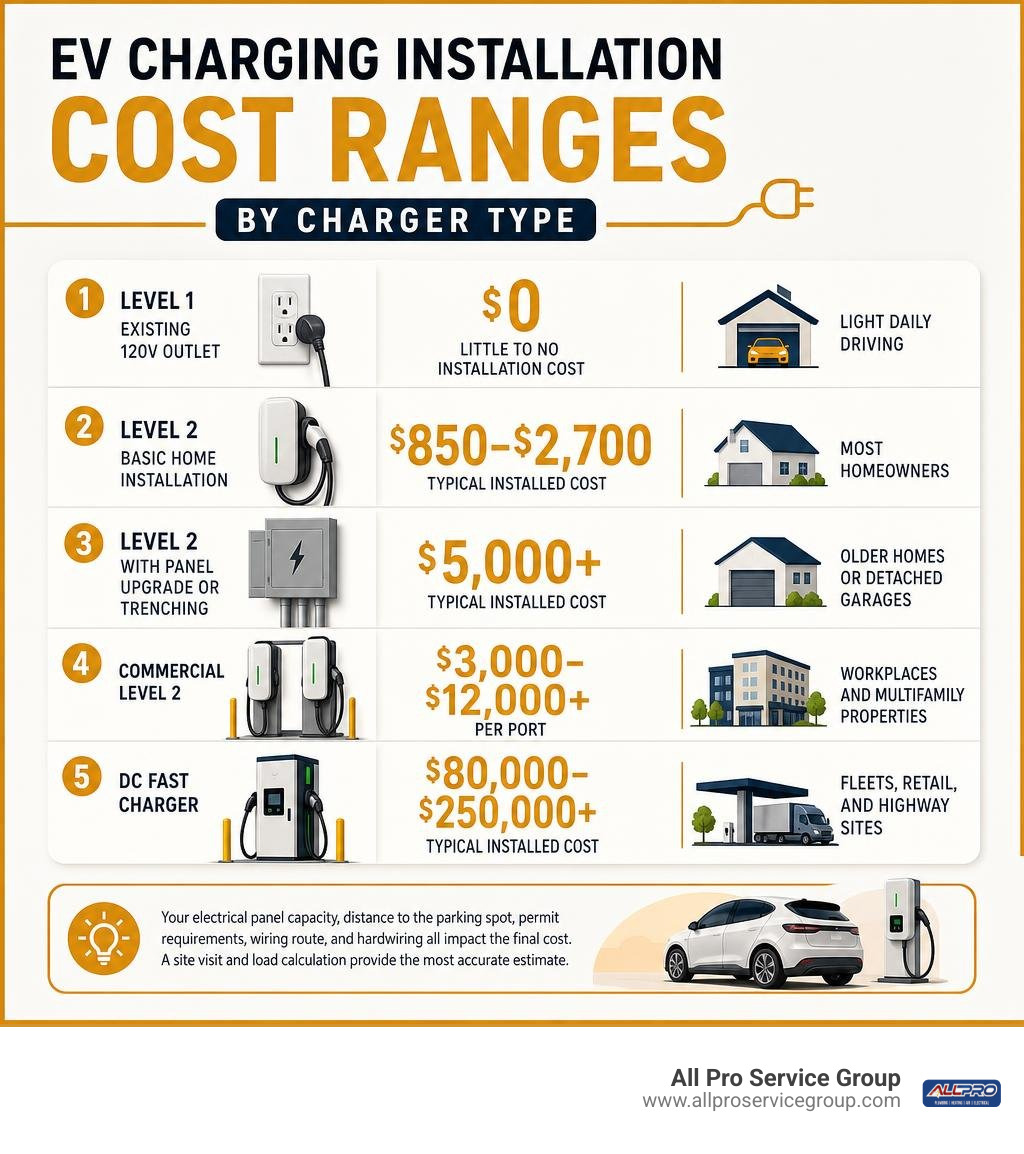
Charging station installation cost for a home is usually $850 to $2,700 for a basic Level 2 setup with a short wire run, charger equipment, labor, and permit costs. Most homeowners spend about $1,700 for installation, plus local permit fees, but a panel upgrade, long run of heavy wiring, or trenching to a detached garage can raise the total to $5,000 or more.
| Charging setup | Typical installed cost | Best fit |
|---|---|---|
| Level 1, existing 120V outlet | Little to no installation cost | Light daily driving |
| Level 2, basic home installation | $850-$2,700 | Most homeowners |
| Level 2 with panel upgrade or trenching | $5,000+ | Older homes or detached garages |
| Commercial Level 2 | $3,000-$12,000+ per port | Workplaces and multifamily properties |
| DC fast charger | $80,000-$250,000+ | Fleets, retail, and highway sites |
The charger itself is only one part of the price. Your electrical panel's available capacity, the distance from the panel to the parking spot, permit requirements, wiring route, and whether the charger is hardwired all affect the final quote. In the Greater Salt Lake area, a site visit and electrical load calculation are the clearest ways to learn whether your project is simple or needs added electrical work.
I’m All Pro, part of the Greater Salt Lake Valley home-services team serving local homeowners since 2008. We help homeowners understand the electrical safety, panel capacity, and workmanship factors behind a realistic charging station installation cost before work begins.
Total Home Charging Station Installation Cost Breakdown
When you start budgeting for a residential charging setup, breaking down the project into individual line items helps eliminate unpleasant pricing surprises. A complete residential installation consists of four core expense categories: hardware, electrician labor, raw materials, and municipal permits.
Knowing where every dollar goes helps you compare quotes accurately and identify options to save without compromising home safety. You can also consult standard EV Charger Installation Cost Guidelines to build a preliminary planning budget before hiring an electrician.
Here is a typical cost breakdown for a standard residential Level 2 charging station project:
- Charging Hardware (EVSE Unit):$350 to $800. Smart chargers equipped with Wi-Fi scheduling, energy monitoring, and dynamic load balancing fall at the higher end of this scale, while basic "plug-and-charge" units cost closer to $350.
- Electrician Labor Fees:$350 to $900. Licensed electricians usually charge between $75 and $125 per hour. A standard installation located within 15 to 20 feet of the main panel takes about 3 to 5 hours of direct labor.
- Electrical Materials and Supplies:$200 to $800. Heavy copper wiring (such as 6 AWG or 4 AWG copper cable), heavy-duty conduits, specialized GFCI circuit breakers, mounting hardware, and junction boxes make up this expense.
- Municipal Permit and Inspection Fees:$60 to $280. Most municipalities require an electrical permit and a follow-up safety inspection whenever a new 240-volt circuit is added to a home.

Level 1 vs Level 2 Charging Station Installation Cost
The level of charging hardware you choose directly impacts both daily charging speed and initial installation pricing.
Level 1 chargers run on standard 120-volt household alternating current (AC) electricity. Every electric vehicle comes with a portable Level 1 cordset that plugs into a standard three-prong wall outlet. Because no special electrical work is required, installation costs are essentially $0—assuming you already have an accessible outlet near your vehicle. However, Level 1 charging delivers only 3 to 5 miles of range per hour of charging. To fully replenish a 72 kWh battery pack, your car could sit plugged in for 40 to 50 continuous hours.
Level 2 chargers operate on 208-volt to 240-volt AC circuits—the same electrical capacity used by heavy household appliances like electric clothes dryers and central air conditioners. Level 2 units deliver 20 to 40 miles of range per hour, fully recharging most electric vehicles overnight in 4 to 8 hours.
Installing a Level 2 unit requires dedicated 240-volt wiring, a dedicated circuit breaker (typically 40A to 60A), and a permanent mounting bracket. Equipping your home with a dedicated Car Charging Port for Home requires a hardware investment of $350 to $800 and professional electrical labor, bringing total installed costs for a Level 2 setup to $850–$2,700 for a straightforward garage installation.
Hardwired Units vs NEMA 14-50 Plug-In Installations
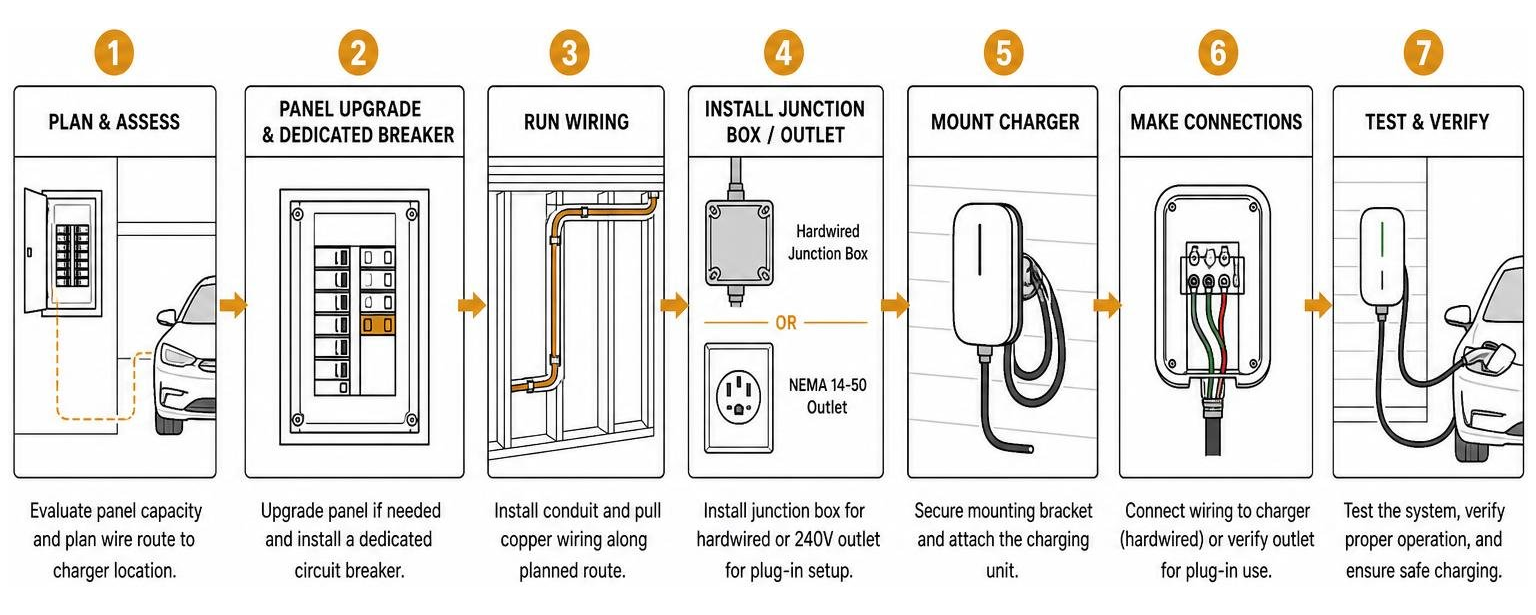
When installing a Level 2 home charger, you must decide between hardwiring the charger directly into a junction box or installing a 240-volt wall receptacle (usually a NEMA 14-50 or NEMA 6-50 outlet) into which your charger plugs.
Plug-in installations offer flexibility. If you move homes or take a road trip, you can easily unplug your charging station and take it with you. However, under recent National Electrical Code (NEC) updates, plug-in EVSE setups require a specialized Ground Fault Circuit Interrupter (GFCI) circuit breaker installed at the electrical panel. Heavy continuous charging can sometimes cause nuisance tripping on GFCI breakers, and high-quality industrial-grade 240V outlets add $80 to $150 in hardware expenses. Reviewing a detailed 240 Volt Outlet for Electric Car Cost breakdown shows that installing a receptacle setup generally costs between $600 and $1,400 for labor and wiring.
Hardwired installations connect the charging unit directly to your home's electrical wiring. Hardwiring eliminates the need for an expensive GFCI breaker in many jurisdictions, lowers thermal resistance at connection points, and provides superior weather resistance for outdoor mounting. Hardwired stations also unlock higher charging power; while plug-in chargers are capped at 40 amps output (requiring a 50 amp circuit), hardwired units can draw up to 48 amps continuous power (on a 60 amp circuit), adding an extra 10 to 12 miles of range per hour.
Key Factors Influencing Installation Expenses
No two home electrical installations are identical. Several structural and electrical variables determine whether your overall charging station installation cost stays near the national baseline of $1,700 or climbs toward $5,000+.

The primary physical cost driver in any home installation is the total distance between your main electrical panel and the planned charging site. EV charging circuits carry heavy electrical currents continuously for hours at a time, requiring thick, heavy-gauge copper conductors (such as #6 or #4 AWG wire). Copper wire is expensive, often costing $3 to $8 per linear foot depending on metal market prices.
If your electrical panel is inside an attached garage right next to the vehicle, the electrician may only need 5 to 10 feet of wire, keeping material and labor costs minimal. But if the wire path must run 60 to 100 feet across a basement, through finished drywall, or across an attic space, labor hours and material costs rise sharply. Installers typically include 30 to 40 feet of wiring in a standard package estimate; runs beyond that distance add $8 to $15 per linear foot in labor and conduit materials.
Trenching presents another significant cost factor when mounting a charger in a detached garage or on an outdoor pedestal. Underground conduit requires digging a trench at least 18 to 24 inches deep through soil, lawns, or under concrete driveways. Open-soil trenching typically costs $15 to $30 per linear foot, while cutting through asphalt or concrete and restoring the surface can cost $50 to $100+ per foot.
Electrical Panel Upgrades and Capacity Load Limits
Your home's electrical panel acts as the distribution heart of your house. Every panel has a maximum power ceiling, typically measured in total amperage (amps). Homes built prior to 2000 often feature 100-amp or 125-amp main service panels. Modern homes equipped with central air conditioning, electric heat pumps, hot tubs, and electric ranges often operate near their capacity limit.
Because EV chargers are classified as continuous loads by the electrical code, a 48-amp charger requires a dedicated 60-amp circuit breaker. If an electrician calculates your home's total load and determines your current panel lacks safety margin headroom, you must address that capacity limit before adding a charger.
- Main Service Panel Upgrade (100A to 200A): Upgrading your main electrical panel to 200 amps costs between $1,800 and $4,000+. This process includes replacing the main panel box, installing new main breakers, coordinating with utility companies like Rocky Mountain Power to pull new utility service feeds, and passing local electrical inspections. Review our Electrical Panel Upgrade Complete Guide to understand how panel upgrades protect your home.
- Electrical Sub-Panel Installation: If your main panel has plenty of total amp capacity but lacks physical space for a new double-pole circuit breaker, an electrician can install a sub-panel near the main service box or in the garage for $500 to $1,500.
Permit Requirements, Code Compliance, and Inspections
Installing a high-voltage 240V continuous circuit is not a weekend DIY job. Municipalities throughout the Greater Salt Lake area—including Salt Lake City, West Valley City, Park City, Provo, and Ogden—require official electrical permits prior to installing high-voltage charging equipment.
Local Authority Having Jurisdiction (AHJ) permit fees generally cost between $60 and $280. A licensed electrician pulls this permit, submits load calculation documentation, and schedules a post-installation safety inspection. Passing inspection ensures your homeowner's insurance policy remains valid and protects your property against electrical fire hazards. You can review regional variations in installation regulations using State-by-State Level 2 Cost Data.
Under Section 625 of the National Electrical Code (NEC), EV charging equipment is classified as a continuous load. Electrical safety codes mandate that continuous loads must not exceed 80% of the maximum rated capacity of the circuit breaker and feeder wires.
| Charger Output Amps | Minimum Required Breaker Size | Wire Gauge Required (Copper) |
|---|---|---|
| 16 Amps continuous | 20 Amp double-pole breaker | 12 AWG |
| 32 Amps continuous | 40 Amp double-pole breaker | 8 AWG |
| 40 Amps continuous | 50 Amp double-pole breaker | 6 AWG |
| 48 Amps continuous | 60 Amp double-pole breaker | 4 AWG |
Commercial Charging Station Installation Costs and Infrastructure
Commercial EV charging installations differ significantly from residential projects in terms of equipment scale, electrical demands, permitting complexity, and total budget. While residential setups cater to single vehicles overnight, commercial installations serve workplaces, apartment complexes, retail plazas, and commercial vehicle fleets.
| Installation Type | Typical Hardware Cost per Port | Installation Labor & Civil Work | Total Cost Range per Port |
|---|---|---|---|
| Residential Level 2 | $350 – $800 | $500 – $1,900 | $850 – $2,700 |
| Commercial Level 2 | $600 – $3,500 | $2,000 – $8,500 | $3,000 – $12,000+ |
| DC Fast Charging (DCFC) | $20,000 – $80,000+ | $60,000 – $170,000+ | $80,000 – $250,000+ |
Commercial vs Residential Charging Station Installation Cost
Commercial Level 2 charging stations range from $3,000 to $12,000+ per port fully installed. Hardware for commercial units is pricier ($600 to $3,500 per charger) because these units feature rugged commercial-grade pedestals, RFID access card readers, credit card payment terminals, cell connectivity, and cloud monitoring software.
Installation labor and site preparation represent the largest share of a commercial invoice. Running electrical conduit across paved parking lots requires saw-cutting asphalt, trenching, pouring concrete mounting pads, installing protective steel bollards, and painting designated parking stalls. Civil work alone frequently runs $40 to $120 per linear foot. Commercial site hosts can reference our detailed Business EV Charger Installation Guide 2026 for enterprise planning frameworks.
High-Powered DC Fast Chargers (DCFC) and Utility Transformers
Direct Current Fast Chargers (DCFC) represent the pinnacle of EV charging speed, operating on 480-volt 3-phase commercial electrical infrastructure. These units deliver 50 kW to 350+ kW of direct current power directly to an EV battery, restoring 100 to 200 miles of range in just 15 to 30 minutes.
However, DC fast chargers carry substantial installation budgets, ranging from $80,000 to $250,000+ per charging port. The equipment alone costs between $20,000 and $80,000 per charger. Because a cluster of fast chargers draws massive instantaneous current, sites almost always require a dedicated utility step-down transformer ($20,000 to $80,000), major switchgear upgrades, and extensive coordination with regional power companies. Property developers can explore a complete Commercial EV EV Charging Installation Cost Guide to analyze commercial deployment expenses and utility demand charges.
How to Reduce Costs with Rebates, Load Management, and Incentives
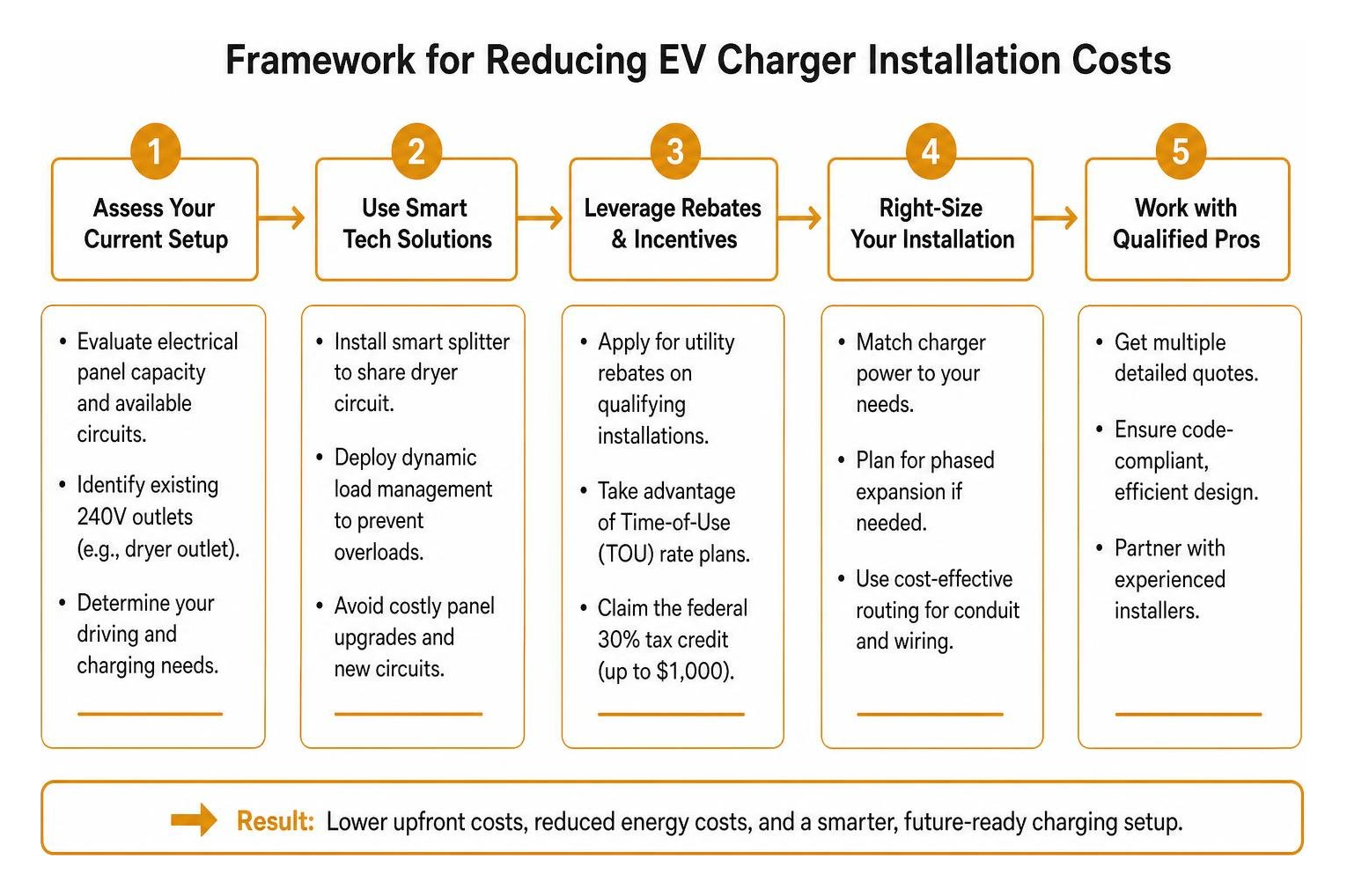
Although installing a high-quality charging setup involves upfront capital, smart tech workarounds and incentive programs can dramatically lower your net expenses.
- Smart Splitters and Dryer Circuit Sharing: If you have an existing, underutilized 240V NEMA 10-30 or 14-30 outlet in your garage (such as an electric clothes dryer outlet), you can install an UL-listed smart splitter for $300 to $500. Smart splitters monitor power demand automatically; when your clothes dryer runs, the splitter pauses vehicle charging, resuming automatically when the dryer finishes. This workaround provides Level 2 charging speeds while eliminating electrician labor fees, panel upgrades, and permitting costs entirely.
- NEC 625.42 Dynamic Load Management: If your electrical panel is close to capacity, intelligent load management modules ($400 to $800) offer an alternative to a $3,000 full main panel upgrade. These systems monitor your home's real-time power draw and automatically throttle EV charging speeds when heavy appliances (like double ovens or AC units) turn on, keeping total household demand safely within panel limits.
- Utility Rebates and Off-Peak Savings: Regional power utilities across Utah offer attractive home charger incentives. Programs frequently provide cash rebates ranging from $200 to $1,000 toward qualifying smart Level 2 hardware and installation costs. Furthermore, enrolling in Time-of-Use (TOU) rate schedules lets you charge overnight at discounted electricity rates, cutting your per-mile fuel costs down to a fraction of a gas-powered car.
- Federal Tax Credits: The federal Section 30C Alternative Fuel Infrastructure Tax Credit allows eligible homeowners in designated non-urban or low-income census tracts to claim a 30% tax credit (up to $1,000) on hardware and installation costs.
Frequently Asked Questions About Charging Station Costs
How much does it cost to install an EV charger in a detached garage?
Installing a Level 2 EV charger in a detached garage typically costs between $3,000 and $7,000+, compared to $850–$2,700 for an attached garage.
The primary cost multiplier is the requirement for underground trenching and direct-buried feeder wire run from the main home panel out to the garage structure. Underground PVC conduit or Direct Burial UF-B cable must be buried at least 18 to 24 inches deep. Trenching in open lawn soil adds $15 to $30 per linear foot, while cutting through concrete paths or asphalt driveways can add $50 to $100 per foot. Additionally, detached garages frequently require a dedicated electrical sub-panel ($600 to $1,500) to safely distribute power for both garage lighting and high-power vehicle charging.
Can I avoid an electrical panel upgrade when installing a Level 2 charger?
Yes! Homeowners with older 100-amp or fully populated electrical panels can often avoid a costly $2,000–$4,000 service panel upgrade using smart load management solutions.
By installing an energy management device or choosing a smart EV charger equipped with dynamic load management (compliant with NEC 625.42), the system monitors total household electrical draw in real time. When overall home energy consumption approaches panel capacity, the device automatically dials back charger amperage, restoring maximum charge rates when household power demand drops overnight. Alternatively, utilizing a smart splitter on an existing 240V appliance circuit lets two high-draw appliances share a single breaker safely.
What are the ongoing electricity and maintenance costs of home EV charging?
Operating a home Level 2 charging station is extremely cost-effective, with minimal recurring maintenance expenses.
Unlike gas-powered vehicles or complex mechanical systems, home EVSE units have no moving parts, oil filters, or pumps. Routine maintenance consists simply of keeping the charging cable neatly coiled and inspecting the plug head for dirt or physical damage.
Your primary ongoing operational cost is residential electricity. At the regional Utah average residential rate of roughly $0.11 to $0.14 per kilowatt-hour (kWh), fully recharging a standard 70 kWh EV battery costs approximately $8.00 to $10.00, yielding a driving range of 230 to 300 miles. Driving 1,000 miles per month in an EV costs roughly $30 to $40 in electricity, compared to $120 to $160+ for a comparable gas-powered vehicle, generating annual fuel savings of over $1,200.
Conclusion
Installing a home electric vehicle charger is one of the most rewarding home upgrades you can make. While a standard residential Level 2 charging station installation cost falls between $850 and $2,700, taking time to evaluate your home's electrical panel capacity, selecting the optimal charger mounting site, and taking advantage of utility rebates ensures you receive the maximum ROI on your investment.
At All Pro Service Group, our licensed, certified electricians have served homeowners throughout Salt Lake City, West Valley City, Park City, Provo, Ogden, and the Greater Salt Lake Valley since 2008. As a Gephardt Approved home service contractor, we handle every stage of your installation—from load calculations and panel upgrades to permit filing and final testing.
Ready to equip your home with fast, reliable EV fueling? Contact our expert team today to explore our Professional EV Charger Installation Services and schedule your in-home consultation.