What Does It Cost to Update an Electrical Panel in 2026?
The cost to update your electrical panel typically falls between $1,500 and $4,000 for most Salt Lake area homeowners in 2026 — but the final number depends on your current amperage, what else needs replacing, and whether your utility needs to get involved.
Here's a quick snapshot to answer the most common question right away:
| Upgrade Type | Typical Cost Range (2026) |
|---|---|
| Panel replacement (same amperage) | $1,200 – $2,500 |
| 100A to 200A upgrade | $1,500 – $4,000 |
| 150A to 200A upgrade | $1,500 – $3,000 |
| 200A to 400A upgrade | $2,500 – $5,000 |
| Full service upgrade (utility involvement) | $5,000 – $25,000 |
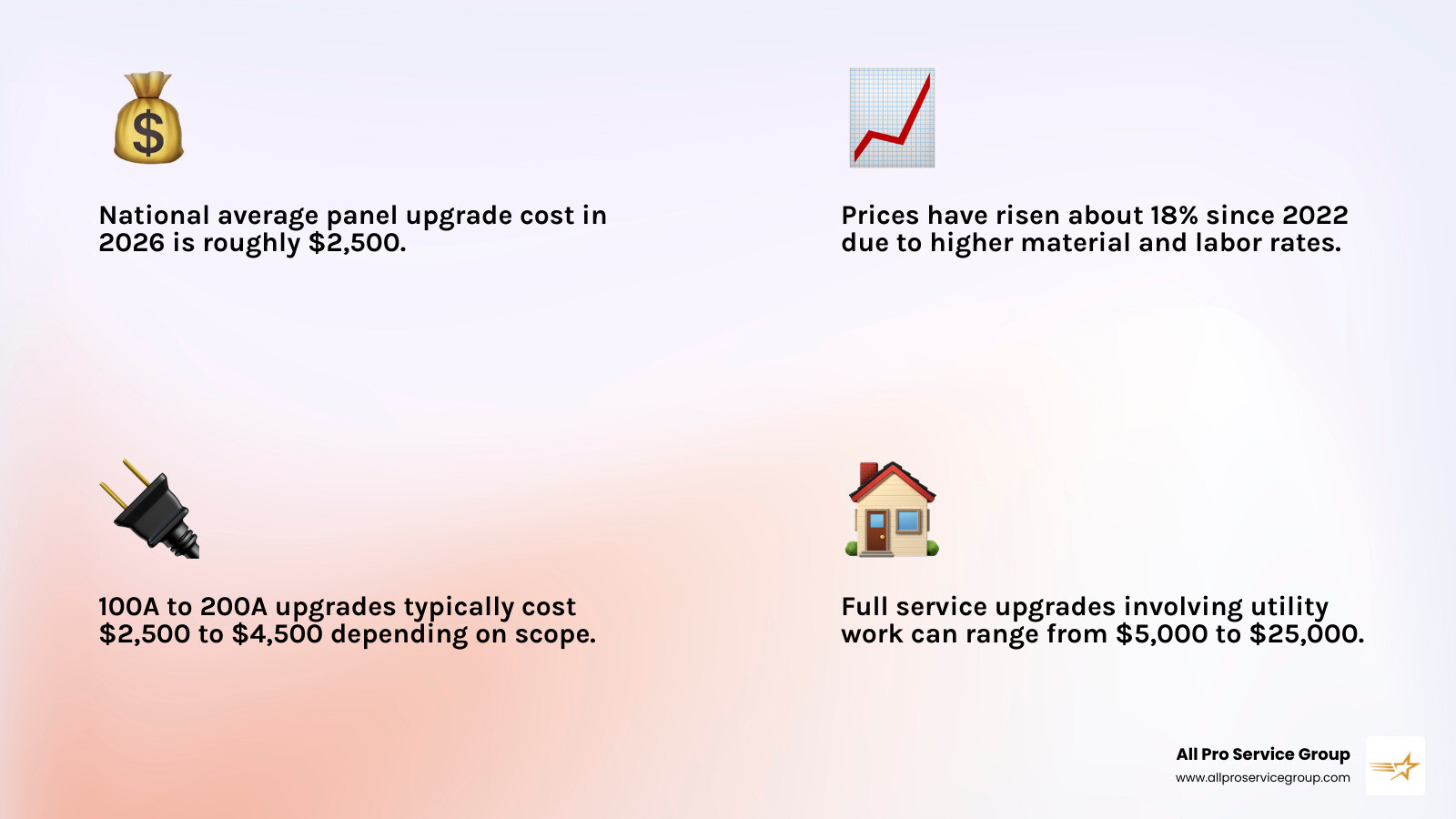
National average in 2026: ~$2,500. Prices have risen about 18% since 2022.
Our homes are demanding more electricity than ever. EV chargers, heat pumps, smart home devices — they all add up fast. And when your panel can't keep up, you feel it: tripped breakers, flickering lights, or a gut-feeling that something just isn't right.
An outdated or undersized panel isn't just inconvenient. It's a real safety risk — and a common flag on home inspection reports that can slow down or kill a home sale.
This guide breaks down exactly what you can expect to pay, what drives those costs up or down, and how to know when it's time to act.
We are All Pro Service Group, and we've been helping Greater Salt Lake Valley homeowners navigate the real cost to update their electrical panel since 2008. In that time, we've handled everything from simple breaker-box swaps to full service upgrades on homes with outdated wiring — so the guidance here comes straight from the field.
Average Cost to Update Electrical Panel in 2026
When we talk about the cost to update electrical panel systems, we have to look at the whole picture. It’s not just the metal box on the wall; it’s the labor of a licensed professional, the permits required by your local Utah city, and the sophisticated breakers that keep your family safe.
As of May 2026, the national average for a residential panel upgrade sits at roughly $2,500. However, if you are simply replacing an old, failing panel with a new one of the same amperage, you might see prices closer to $1,300 to $2,000. If you are pushing into the "heavy-up" territory—moving from a 100-amp service to a 200-amp service—the price typically moves into the $2,500 to $4,500 range.
Why the price hike? Inflation has been a real factor in the electrical world. Prices for these upgrades have increased by approximately 17.8% over the last five years. In 2022, you might have paid $2,123 for a job that now costs $2,500. This is largely due to the rising cost of copper and the increased complexity of modern safety codes.
For a deeper dive into these numbers, check out this Electrical Panel Upgrade Cost Guide (2026) or explore more info about electrical panel upgrades on our service page.
Cost to Update Electrical Panel from 150 to 200 Amps
This is a very common "mid-range" upgrade. Many homes built in the 1990s and early 2000s were equipped with 150-amp panels. While 150 amps was plenty for a standard home back then, today’s demand for 200 Amp Power Panel installations is driven by high-draw items like fast-charging EV stations and electric tankless water heaters.
To jump from 150 to 200 amps, you can expect to pay between $1,500 and $3,000. If your existing service entrance wires (the big ones coming from the street) are already rated for 200 amps, this might be a straightforward panel swap. If they aren't, the price climbs as we have to pull new, thicker wire through your mast.
Regional Variations in the Cost to Update Electrical Panel
Geography plays a massive role in what you’ll see on your final invoice. While Chicago homeowners might see averages around $1,400 for a simple replacement due to high competition, our local market here in the West is slightly different.
In the Greater Salt Lake area—including South Jordan, West Jordan, and Provo—the cost to update electrical panel service is often influenced by our unique housing stock. Many older homes in Salt Lake City require more extensive "bringing up to code" than newer builds in the suburbs. On average, Utah homeowners spend about $2,375, which is slightly below the national average but can vary based on the specific city's permit fees. For example, an Electrical Panel Upgrade in South Jordan, UT - Costs 02 / 2026 might differ from a project in Park City due to local building department requirements.
Key Factors Influencing Your Upgrade Investment

When we provide a quote, we aren't just looking at the panel. Several "hidden" components can swing the price by hundreds or even thousands of dollars.
- The Meter Base and Service Mast: If you are increasing your amperage, your old meter socket and the pipe (mast) attached to your house might not be rated for the new load. Replacing these is a standard part of a "service upgrade" and adds to the labor and material costs.
- Grounding Systems: Modern codes are much stricter about grounding. We often have to install two new copper ground rods driven eight feet into the earth and bond your home’s water piping to ensure safety.
- AFCI and GFCI Protection: This is a big one. The 2026 National Electrical Code (NEC) requires Arc-Fault Circuit Interrupters (AFCI) in most living areas. These specialized breakers cost about $65 each, compared to just $8 to $15 for a standard breaker. If your home has 20 circuits, that’s an extra $1,000 just in safety hardware!
- Whole-Home Surge Protection: Many jurisdictions now mandate this during a panel upgrade. It protects your expensive appliances from power spikes. You can learn more about this on our Whole Home Surge Protection page.
Permitting and Utility Coordination
You cannot legally (or safely) upgrade a panel without a permit. In the Salt Lake Valley, permit fees typically range from $100 to $350.
The process also requires coordination with the utility provider (like Rocky Mountain Power). We have to schedule a "disconnect/reconnect" where they pull the power from the street so we can work safely. While the utility doesn't usually charge a fee for the disconnect itself, the coordination adds time to the project. As experts, we handle all of this for you. For more on the logistics, see this How Much Does Electrical Panel Upgrade Cost? (2026 Guide) | CostWhale.
Electrification and Load Management
Are you planning to ditch gas for a heat pump? Or perhaps you've finally bought that Tesla or Rivian? These "electrification" goals are the #1 reason for panel upgrades today.
A standard Level 2 EV Charger Installation requires a dedicated 40-amp or 50-amp circuit. If your current panel is full or maxed out on its total load, an upgrade is non-negotiable.
However, there is a "smart" way to save. Some homeowners opt for smart panels or load management devices. These technologies can cost an extra $2,000 to $5,000 but allow you to "throttle" certain appliances so you don't exceed your panel's limit. This can sometimes prevent the need for a $20,000 utility transformer upgrade in rural areas.
Signs Your Home Requires a Panel Upgrade

How do you know if you're actually due for a change? Sometimes the signs are subtle; other times, they are literally "screaming" at you.
- The 25-Year Rule: Electrical panels generally have a lifespan of 25 to 40 years. If your home was built before 2000 and still has its original box, it’s time for an inspection.
- Flickering Lights: If your lights dim when the AC or microwave kicks on, your panel is struggling to distribute the load.
- Tripped Breakers: A breaker that trips once a year is a nuisance. A breaker that trips once a week is a warning.
- Physical Heat or Smells: If the panel is warm to the touch or smells like ozone or burning plastic, shut off your main breaker and call us immediately. This is an active fire hazard.
- Outdated Brands: If you see the names Federal Pacific (FPE), Zinsco, or Challenger on your panel, you should replace it regardless of how it "seems" to be working. These brands are notorious for failing to trip during a surge, which has led to thousands of house fires.
For a full checklist, read our Electrical Panel Upgrade Complete Guide.
Age and Physical Condition
Corrosion and rust are the silent killers of electrical systems. In Utah, we deal with temperature swings that can cause condensation inside outdoor panels. If you see white powdery residue (oxidation) or rust streaks on your breakers, the internal connections are likely degrading. This increases resistance, which creates heat, which—you guessed it—starts fires.
Keeping your system updated isn't just about capacity; it's about the physical integrity of the "heart" of your home. If you're unsure of your panel's health, our Electrical Services Salt Lake team can perform a safety audit.
The Installation Process and Timeline
A typical panel upgrade is a one-day affair, but the preparation takes longer. Here is what the journey usually looks like:
- Site Assessment (1 Hour): we come out, perform a load calculation, and check your existing wiring and grounding.
- Permitting (1-2 Weeks): We submit the paperwork to your city (Ogden, Provo, etc.) and wait for approval.
- The "Big Day" (4-8 Hours): On the day of installation, your power will be completely off. We remove the old box, install the new one, wire in the new breakers, and update the grounding.
- Inspection (1-3 Days Later): A city inspector will visit to "sign off" on the work, ensuring it meets the 2026 NEC standards.
Professional vs. DIY Considerations
We’ll be blunt here: Do not DIY an electrical panel upgrade.
This isn't like painting a room or even swapping a light fixture. When you pull the "main" breaker, the wires coming from the utility are still live. One slip of a screwdriver can be fatal. Furthermore, unpermitted electrical work can void your homeowners insurance. if a fire occurs—even if it wasn't caused by your work—the insurance company may deny the claim because the system wasn't professionally certified.
For smaller tasks like moving a switch, check out our Electrical Wiring Rewiring guide, but leave the panel to the pros.
Frequently Asked Questions about Panel Upgrades
Do I always need to upgrade the meter base?
Not always, but often. If you are moving from 100A to 200A, your existing meter base is likely only rated for 100A or 125A. To safely handle the increased flow, we must install a 200A-rated socket. If you are just replacing a 200A panel with a newer 200A panel, the meter base can usually stay.
How long does a typical panel upgrade take?
The actual time your power is out is usually 4 to 8 hours. However, the total project timeline—from the first phone call to the final city inspection—usually spans 2 to 3 weeks.
Can I save money with rebates or tax credits?
Yes! Under current federal guidelines in 2026, many homeowners can claim a tax credit of 30% (up to $600) for an electrical panel upgrade if it's done in conjunction with installing energy-efficient equipment like a heat pump or solar panels. Additionally, local Utah utilities occasionally offer rebates for "make-ready" electrical work for EV chargers.
Conclusion
Updating your electrical panel is one of the smartest investments you can make in your home. It improves safety, boosts your property value (with a typical 53% ROI), and ensures you are ready for the electric future of the Salt Lake Valley.
At All Pro Service Group, we pride ourselves on being "Gephardt Approved" and providing dependable, 24/7 service to our neighbors in Ogden, Park City, Provo, and the entire Greater Salt Lake Area. We offer transparent pricing and financing options to make your home’s safety affordable.
Don't wait for a "spark" to tell you it's time. Schedule your electrical panel upgrade today and let our experts give you the peace of mind you deserve.