Your Home's Electrical Backbone: What a 200 Amp Power Panel Actually Does
A 200 amp power panel is the standard electrical service size for modern homes in the United States — and if yours is still running on an older 100-amp system, your home is likely struggling to keep up.
Quick answer: What is a 200 amp power panel?
| Feature | Details |
|---|---|
| What it is | The main electrical distribution hub for your home |
| Capacity | Up to 48,000 watts (200A × 240V) |
| Voltage | 120/240V AC, single-phase |
| Typical spaces | 40–42 breaker spaces |
| Best for | Homes with modern appliances, EVs, solar, or HVAC systems |
| Lifespan | 30–40 years with proper maintenance |
Think of your electrical panel as the heart of your home. It receives power from the utility, splits it into individual circuits, and protects everything — your appliances, your wiring, and your family — from overloads and faults.
Most homes built before the 1970s were wired for 60 or 100 amps. That was fine when your biggest electrical draw was a few lights and a refrigerator. Today? An EV charger alone can pull 40–50 amps continuously. Add central air, a heat pump, a home office, and a modern kitchen, and an undersized panel isn't just inconvenient — it's a safety risk.
I'm Gary Leany, owner of All Pro Service Group, and I've been helping Greater Salt Lake Valley homeowners diagnose and upgrade their electrical systems — including 200 amp power panel installations — since 2008. In this guide, I'll walk you through everything you need to know to make a confident decision for your home.
What is a 200 Amp Power Panel?
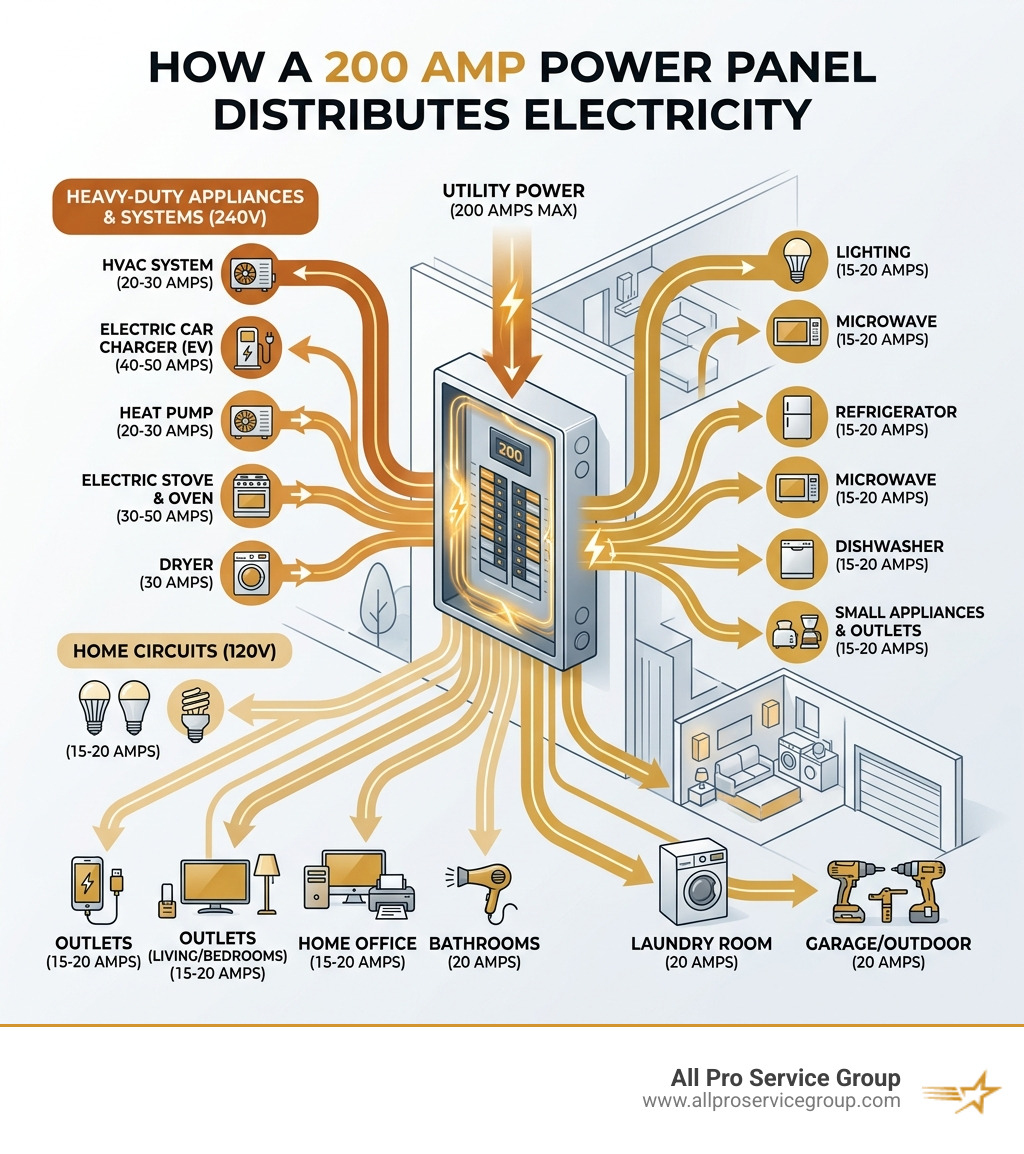
At its core, a 200 amp power panel(also known as a load center or breaker box) is the mission control for your home's electricity. Its primary function is to take the high-voltage power provided by your utility company and safely distribute it into smaller branch circuits throughout your house.
In technical terms, a 200-amp service provides a theoretical maximum capacity of 48,000 watts (calculated as 200 amps multiplied by 240 volts). This is a massive jump from the 24,000 watts provided by a 100-amp panel. For residential use in areas like Salt Lake City or West Valley City, these systems operate on a 120/240V AC, single-phase, 3-wire system.
Every panel features a main service disconnect—usually a large breaker at the top—that allows you to shut off power to the entire house in an emergency. Beyond just being a box of switches, modern panels are engineered for Power Distribution efficiency, ensuring that your high-demand appliances don't starve for power when the AC kicks on. If you're noticing your lights dimming or breakers tripping, it’s often a sign that your current "heart" can’t pump enough "blood" to your home’s extremities. In these cases, Electrical Panel Upgrades are the most effective solution.
Main Breaker vs. Main Lug 200 Amp Power Panel
When you start shopping for a new panel, you’ll encounter two main types: "Main Breaker" and "Main Lug."
- Main Breaker Panels: These come with a factory-installed large circuit breaker that serves as the main disconnect. This is the gold standard for a primary service entrance. It provides built-in overcurrent protection for the entire bus bar assembly.
- Main Lug Panels: These do not have a main breaker. Instead, the "lugs" are the terminals where the incoming wires connect directly to the bus bar. These are typically used as subpanels (for a garage or home addition) where the main disconnect is located elsewhere, like at the primary service panel or a separate outdoor disconnect.
For most of our customers in South Jordan or Ogden, a main breaker panel is the required choice for the primary service entrance to meet local building codes.
Understanding Convertible Main Panels
If you want to future-proof your home, you might look into "convertible" main panels. These are incredibly flexible because they allow us to switch between a main lug and a main breaker configuration in the field.
For example, if you are installing a panel in a workshop today as a subpanel (Main Lug), but might want to turn that building into a primary residence later with its own utility meter, a convertible panel makes that transition easy. These models often feature high-conductivity bus bars and are designed to accept field-installable breakers, making them a favorite for homeowners who value long-term versatility.
Choosing the Right 200 Amp Power Panel for Your Needs
Selecting the right hardware is about more than just the "200" on the label. You need to consider where the panel will live and how much room you need for future growth.
Indoor vs. Outdoor Ratings
The environment determines the "NEMA" rating of your panel.
- NEMA 1 (Indoor): These are designed for dry, indoor locations like your basement or garage. They protect against accidental contact and dust but are not waterproof.
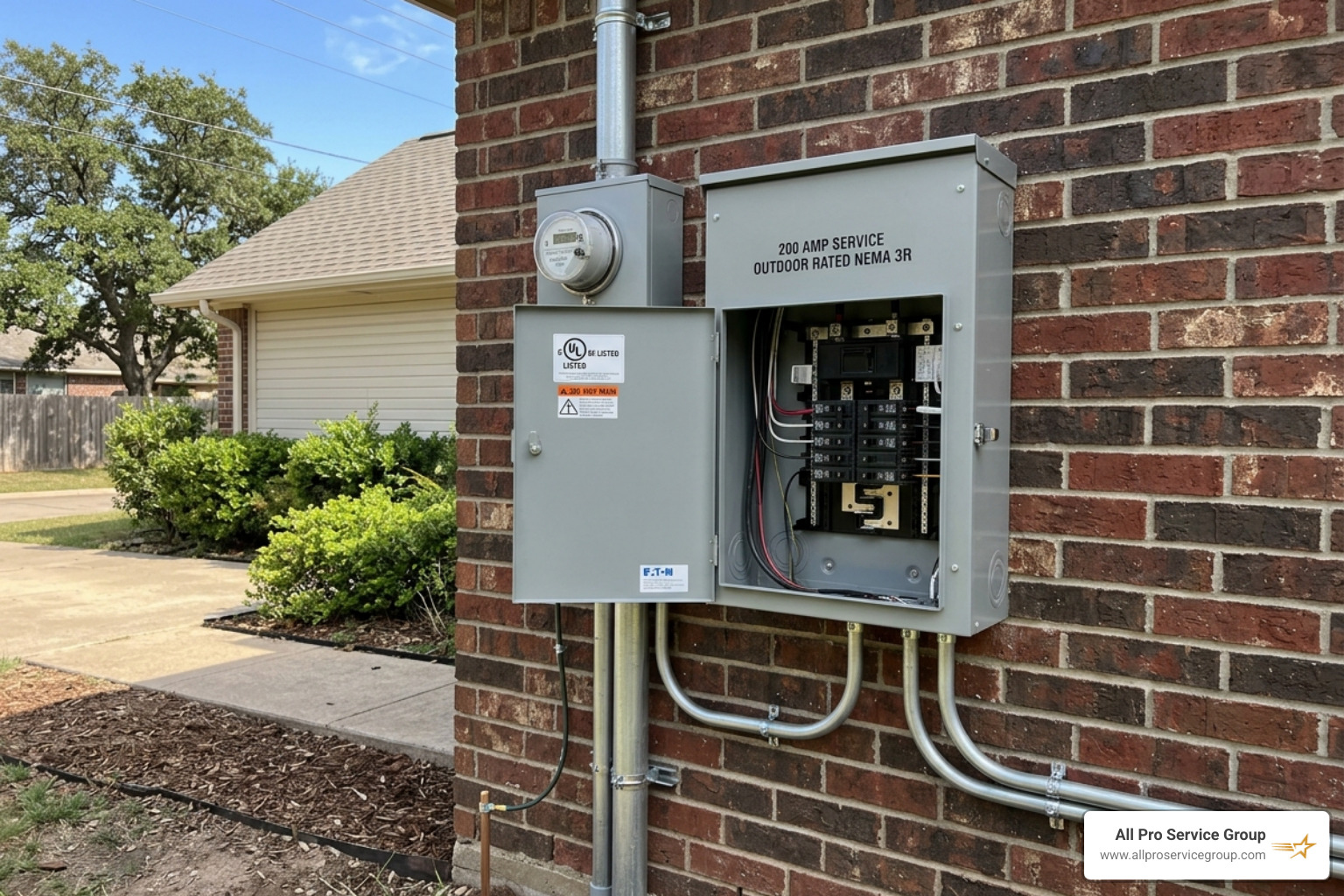
- NEMA 3R (Outdoor): These are rainproof and weather-resistant. If your electrical meter and panel are located on the exterior of your home in Bountiful or Park City, you must use a NEMA 3R enclosure.
| Feature | NEMA 1 (Indoor) | NEMA 3R (Outdoor) |
|---|---|---|
| Water Resistance | None | Rain/Ice/Sleet Resistant |
| Mounting | Flush or Surface | Surface Mounted |
| Typical Location | Garage, Basement, Utility Room | Exterior Wall |
| Enclosure Material | Painted Steel | Galvanized/Coated Steel |
Most modern 200-amp panels come with convenient conduit knockouts on all sides, allowing us to route wiring cleanly regardless of whether we are doing a flush mount (hidden in the drywall) or a surface mount (bolted onto the wall).
Circuit Capacity and Breaker Spaces in a 200 Amp Power Panel
One of the biggest benefits of a 200 amp power panel upgrade is the "real estate" inside the box. While older panels might only have 20 spaces, a modern 200-amp load center typically offers 40 to 42 spaces.
Thanks to "tandem" breakers, a 40-space panel can often support up to 80 circuits. This is vital for modern homes where we are adding dedicated circuits for home theaters, wine fridges, and high-end kitchen appliances.
We highly recommend looking for panels with Plug-on Neutral (PoN) technology. This feature eliminates the need for "pigtail" wires on AFCI and GFCI breakers, resulting in a much cleaner gutter (the space inside the panel) and a faster, more reliable installation. Additionally, top-tier models often feature tin-plated copper bussing, which offers superior conductivity and corrosion resistance compared to standard aluminum bus bars.
Specialized Applications for Agricultural and Industrial Use
For our neighbors running agricultural operations—such as poultry or swine farms—the standard residential panel might not cut it. These environments are often corrosive due to high humidity and ammonia levels. In these cases, specialized suppliers like Hog Slat provide heavy-duty 200-amp panels designed to withstand harsh conditions. These agricultural panels often feature specialized NEMA ratings and stainless steel components to prevent the "guts" of the panel from rotting away over time.
When to Upgrade: 100 Amp vs. 200 Amp Service
Is a 100-amp panel "bad"? Not necessarily. But it is increasingly obsolete. A 100-amp service provides 24,000 watts, which sounds like a lot until you start doing the math on modern living.
- EV Charging: A Level 2 charger can pull 48 amps. That’s nearly 50% of a 100-amp panel’s total capacity!
- Solar-Ready Systems: If you're planning to go solar in Salt Lake City, a 200-amp panel provides the necessary bus bar capacity to safely "backfeed" power from your panels into the grid.
- HVAC Upgrades: Moving from a gas furnace to a high-efficiency electric heat pump can add 40–60 amps of demand.
- Kitchen Remodels: Modern induction cooktops and double ovens are power hogs that can easily overwhelm an old 100-amp system.
Upgrading to 200 amps essentially doubles your power ceiling, providing the "headroom" needed to run multiple high-demand appliances simultaneously without the fear of a blackout. For a deeper dive into the technical steps, you can check out this 100-Amp to 200-Amp Panel Upgrade Guide or our Electrical Panel Upgrade Complete Guide.
Warning Signs of an Overloaded System
How do you know if your home is "begging" for an upgrade? Your electrical system will usually give you warning signs before a total failure occurs:
- Flickering Lights: If your lights dim when the vacuum or the AC kicks on, your panel is struggling to manage the "inrush" of current.
- Frequent Tripping: If you find yourself walking to the garage to flip a breaker once a week, the circuit (or the panel itself) is overloaded.
- Burning Odors or Scorch Marks: This is an emergency. If you smell ozone or burning plastic near your panel, it indicates "arcing" or overheating.
- Warm Panel Cover: Your panel should never feel hot to the touch. Heat is a sign of resistance and poor connections.
- Age: If your home is over 20 years old and still has its original panel, it’s time for an inspection. Many insurance companies are now mandating upgrades for homes with legacy brands like Federal Pacific (FPE) or Zinsco, which have known safety defects.
Installation and Safety Considerations
Upgrading to a 200 amp power panel is not a weekend DIY project. It involves handling the "service entrance"—the wires coming directly from the utility that cannot be turned off by a simple switch.
NEC 2023 Compliance and Grounding
In 2026, we strictly adhere to the latest National Electrical Code (NEC) standards to ensure your home is safe. This includes:
- Article 250 Grounding: We must establish a robust grounding electrode system. This typically involves driving two 8-foot ground rods into the earth at least 6 feet apart.
- AFCI/GFCI Protection: Modern codes require Arc-Fault and Ground-Fault protection on almost every circuit in the home. Upgrading your panel is the perfect time to bring your entire home up to modern safety standards.
- Load Calculations: Before we pull a single wire, we perform an NEC Article 220 load calculation. This ensures that the 200-amp service is actually sufficient for your specific home's demands.
For more information on general electrical safety, visit our electrical service page.
Professional Requirements and Utility Coordination
A panel upgrade is a coordinated dance between All Pro Service Group, your local utility (like Rocky Mountain Power), and the city inspectors.
- Permits: We handle the permit application with the AHJ (Authority Having Jurisdiction) in Salt Lake, Provo, or South Lake.
- Utility Coordination: We schedule the "disconnect/reconnect" with the utility. They have to physically pull the meter to de-energize the lines so we can safely replace the meter base and service entrance conductors.
- The Swap: We remove the old panel, install the new 200 amp power panel, transfer all your circuits, and install the new grounding system.
- Inspection: A city inspector must sign off on the work before the utility will put the meter back in and turn your power back on.
A Note on Safety Warnings: You may see CA Prop 65 warnings on some panels regarding nickel or lead exposure. These are standard manufacturing disclosures and do not pose a risk once the panel is installed and closed. Additionally, always check the warranty—top brands like Square D often offer a 10-year warranty, giving you peace of mind for a decade or more.
Frequently Asked Questions about 200 Amp Panels
How much does it cost to upgrade to a 200 amp service in 2026?
While prices can vary based on the complexity of your home's wiring, a standard upgrade in the Greater Salt Lake Area typically ranges from $1,500 to $4,000. This includes the panel, the new meter base, labor, permits, and the final inspection. If your home requires new service lateral wires (the lines from the street to the house), costs may be on the higher end.
Can a homeowner perform their own 200 amp panel installation?
In Utah, while homeowners can sometimes perform minor electrical work, service-level upgrades involving the meter and main utility connection are almost universally restricted to licensed electricians. Because of the lethal voltages involved and the strict coordination required with utility companies, this is a job for professionals.
What is the typical lifespan of a modern 200 amp electrical panel?
A high-quality, professionally installed panel should last 30 to 40 years. We recommend having a professional inspection every 5 to 10 years to check for loose connections, signs of moisture, or corrosion—especially in our varied Utah climate.
Conclusion
Your home’s electrical panel is the foundation of your modern lifestyle. Upgrading to a 200 amp power panel isn't just about being able to run the toaster and the microwave at the same time; it’s about safety, future-proofing your investment, and increasing your home’s resale value.
At All Pro Service Group, we’ve been the trusted choice for electrical services across the Wasatch Front—from Ogden to Provo—since 2008. As a "Gephardt Approved" company, we pride ourselves on transparent pricing, 24/7 emergency support, and expert installations that pass inspection the first time.
Don't wait for a burning smell or a total power failure to address your home's aging electrical heart. Give us a call today to schedule a comprehensive inspection.