Hard Water Is Quietly Destroying Tankless Water Heaters Across the Salt Lake Valley
A water softener for tankless water heater systems isn't a luxury — in most of Utah, it's essential protection for one of the most expensive appliances in your home.
Quick answer: Do you need a water softener with a tankless water heater?
- Yes, in most cases. Over 85% of U.S. homes have hard water, and the Salt Lake Valley is one of the hardest-water regions in the country.
- Hard water minerals (calcium and magnesium) build up rapidly inside a tankless unit's narrow heat exchanger.
- Just 1/8 inch of scale can cut heating efficiency by 20–30% and restrict water flow.
- Many major brands (Rinnai, Navien, Takagi) will void your warranty if water hardness exceeds 11 grains per gallon (GPG) and no treatment system is installed.
- Your two main options are a salt-based water softener(removes minerals via ion exchange) or a salt-free conditioner(changes mineral structure to prevent scale without removing them).
Imagine paying $2,000–$4,000 for a brand-new tankless water heater, only to watch it choke on mineral buildup within a year or two — and then have your warranty claim denied because your water was too hard. It happens more than most homeowners realize, and it's almost entirely preventable.
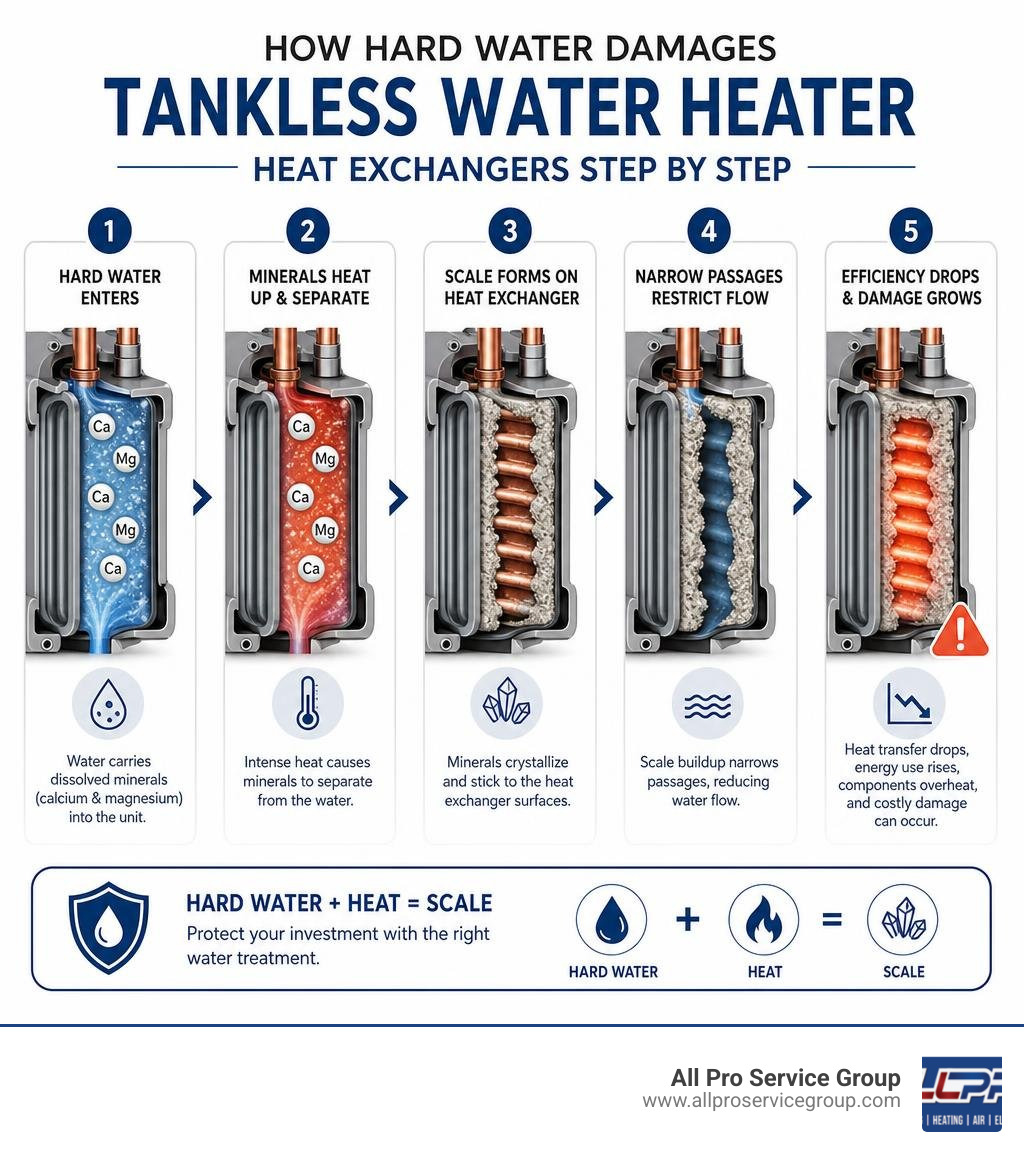
Tankless water heaters heat water on demand , pushing it rapidly through a compact heat exchanger. That intense, concentrated heat is exactly what causes dissolved calcium and magnesium to crystallize and stick. Unlike a traditional tank where scale settles slowly at the bottom, in a tankless unit it coats the narrow passages where heat transfer happens — strangling efficiency and triggering error codes.
The good news: the right water treatment system installed before your heater can stop this damage completely.
At All Pro Service Group, our team has spent nearly two decades helping Greater Salt Lake Valley homeowners protect their plumbing investments — including pairing the right water softener for tankless water heater setups to keep systems running efficiently for 20+ years. Let's walk through exactly what you need to know.
Why Your Tankless System Needs Protection
Tankless water heaters are prized for their efficiency, space-saving design, and ability to deliver endless hot water. However, the very engineering that makes them so efficient also makes them incredibly vulnerable to hard water.
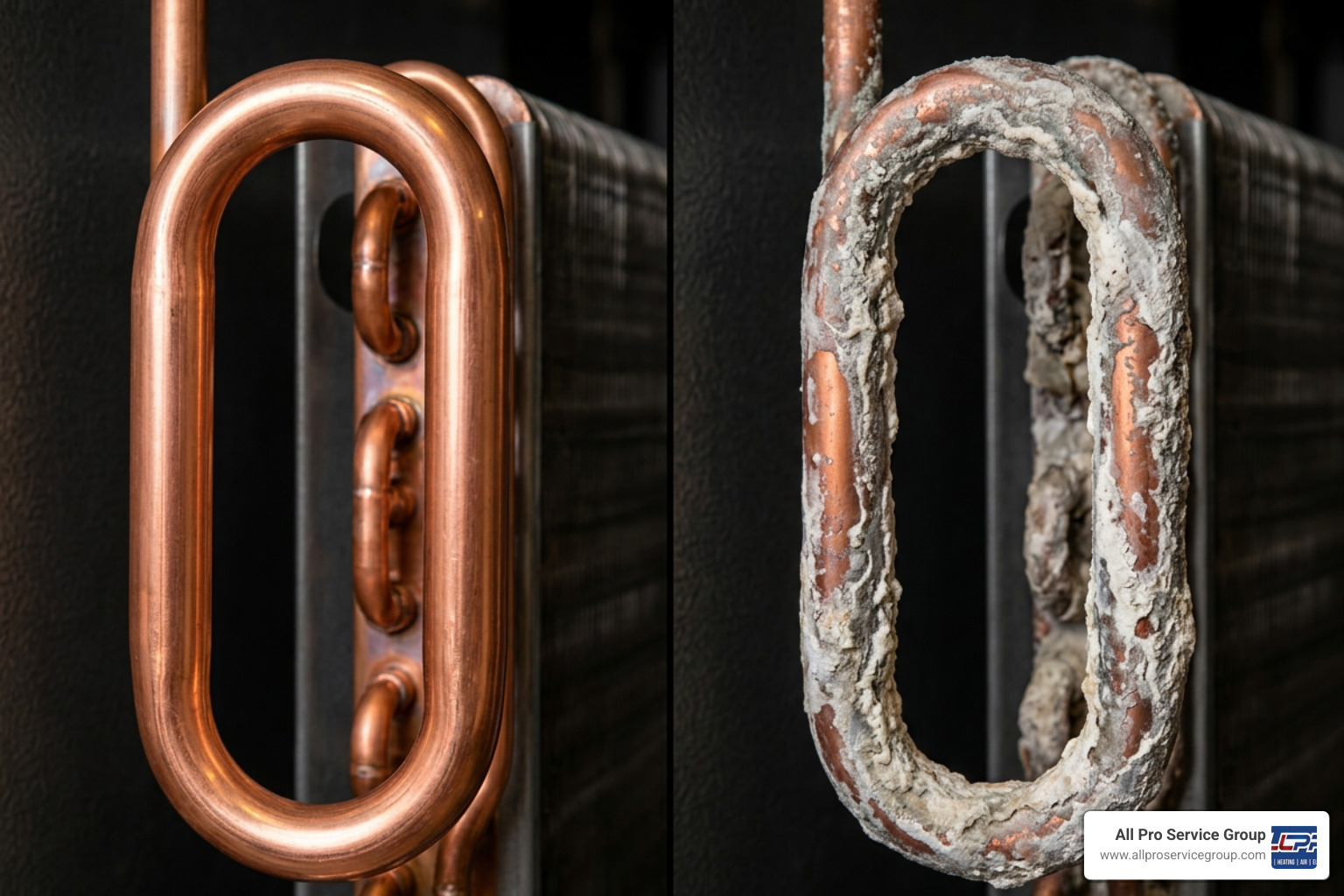
To understand why, we have to look at the heart of the system: the heat exchanger. In a traditional tank-style water heater, water sits in a massive steel drum, and sediment slowly settles to the bottom. In contrast, a tankless unit uses a highly compact, winding network of narrow copper or stainless steel pipes wrapped around a high-powered burner or electric element.
When you turn on a hot water tap, cold water rushes through these tiny passages and is instantly heated to your target temperature. This rapid temperature spike creates a localized "hot zone" that forces dissolved calcium and magnesium ions out of solution, causing them to crystallize instantly.
If you want to dive deeper into how these systems operate, check out our Guide to Tankless Water Heaters. If your system is already showing signs of struggle, you may need to schedule water heater repair services to clear existing blockages before installing a treatment system. Taking these steps is the ultimate way of Protecting Your Investment and ensuring your home has reliable hot water.
The Danger of Scale on Heat Exchangers
When calcium and magnesium crystallize inside your heat exchanger, they form a rock-hard layer of limescale. Limescale acts as an extremely effective thermal insulator.
Think of it this way: instead of the burner heating the metal pipe and directly heating the water, the burner now has to heat the metal, heat the thick stone layer of scale, and then heat the water.
Even a tiny layer of scale can have devastating consequences:
- Efficiency Loss: Just a 1/8-inch layer of scale can reduce your unit’s thermal efficiency by 20% to 30%. This means your system must burn more gas or consume more electricity to heat the same amount of water, causing your energy bills to skyrocket.
- Overheating and Stress: Because the heat cannot easily escape into the water, the metal of the heat exchanger gets much hotter than designed. This extreme thermal stress causes the metal to expand, contract, and eventually crack, leading to pinhole leaks and total system failure.
- Flow Restriction: As the scale layer thickens, it physically chokes the narrow water pathways. You will notice a steady drop in water pressure at your showers and faucets, and eventually, the unit may fail to ignite altogether because it cannot detect enough water flow.
The Manufacturer Warranty Trap
Many homeowners believe that if their high-end tankless water heater fails early, the manufacturer's 10- or 15-year warranty will cover the replacement. Unfortunately, this is where many run into a legal and financial trap.
Almost every major tankless manufacturer (including Rinnai, Navien, and Takagi) explicitly states in their user manuals that damage caused by scale buildup is not covered under warranty. In fact, many brands include a strict clause that voids the entire heat exchanger warranty if the input water hardness exceeds a specific limit—typically 11 Grains Per Gallon (GPG) or roughly 200 Parts Per Million (PPM) —unless an approved water treatment system is active.
When a technician comes out to inspect a failed heat exchanger, one of the first things they do is test the water. If your water exceeds the hardness threshold and you do not have a water softener for tankless water heater protection, your multi-thousand-dollar warranty claim will be denied on the spot.
To see where your water falls on the national spectrum, you can refer to the official Water Hardness Scale provided by the USGS. Across the Greater Salt Lake Valley—from Ogden down to Provo—municipal water hardness frequently ranges from 15 to over 25 GPG, putting our entire region deep into the "Very Hard" category.
Choosing a Water Softener for Tankless Water Heater Systems
To protect your tankless water heater from scale, you need to treat the water before it enters the unit. There are two primary types of whole-house water treatment systems designed for this job: traditional salt-based water softeners and salt-free water conditioners (often called descalers).
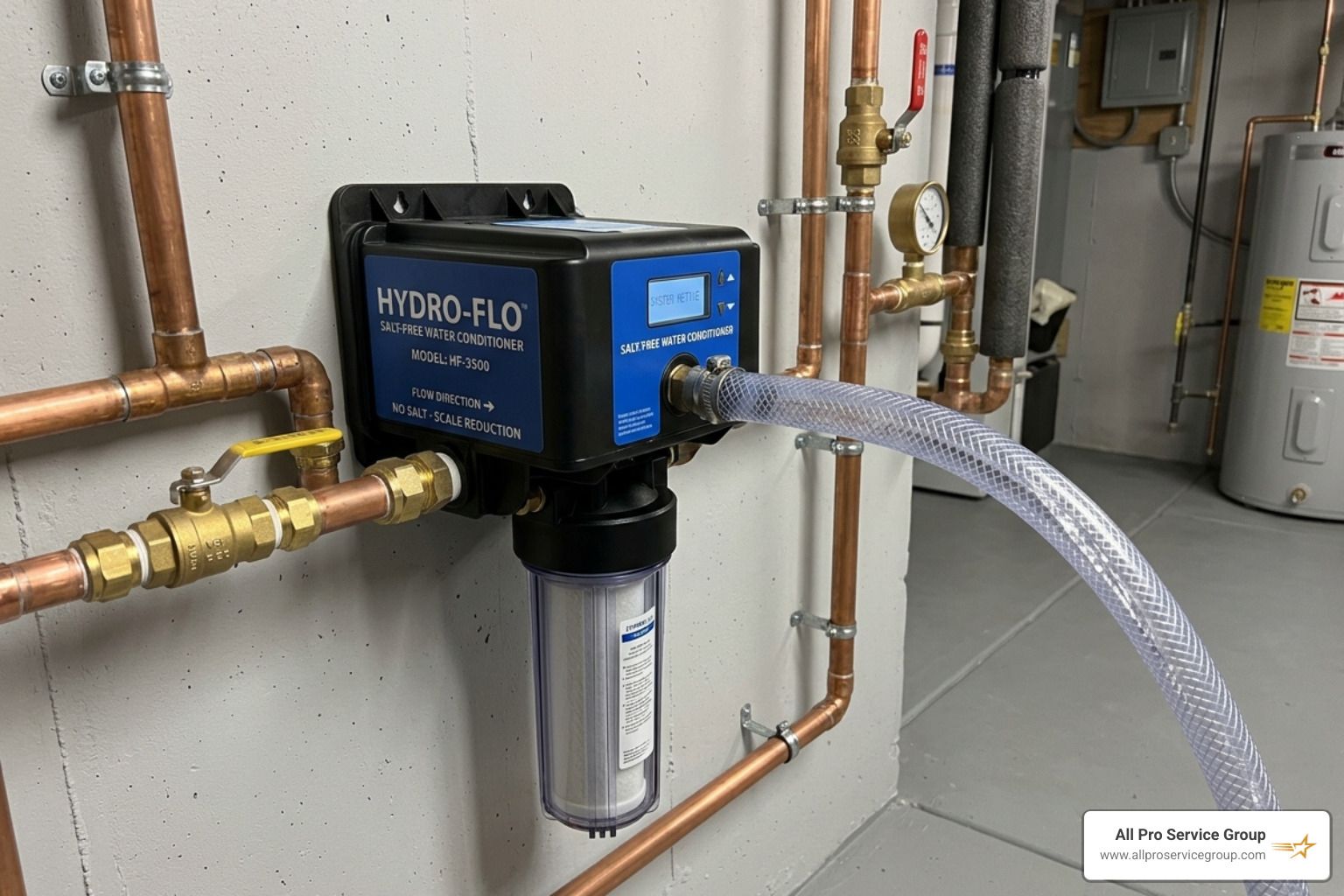
Choosing between these systems depends on your water hardness levels, budget, maintenance preferences, and environmental goals. Let's break down how each technology works. If you are ready to explore your options, you can read about our water softener installation services and view new water softener pricing to plan your budget.
Traditional Salt-Based Water Softener for Tankless Water Heater Units
A traditional salt-based water softener is the gold standard for hard water treatment. It is the only technology that physically removes calcium and magnesium from your water supply.
These systems operate using a chemical process called ion exchange:
- The Resin Bed: Inside the softener's main tank is a bed of tiny plastic beads called resin. These beads are chemically formulated to hold a negative electrical charge. During setup, the resin bed is charged with positively charged sodium ions (from the salt you add to the brine tank).
- The Exchange: As hard water enters the tank, the calcium and magnesium ions—which carry a much stronger positive charge than sodium—are magnetically attracted to the resin beads. They push the sodium ions off the beads and take their place.
- Softened Water: The water leaving the tank now contains a tiny, harmless amount of sodium instead of calcium and magnesium. It is completely soft and incapable of forming scale.
- The Regeneration Cycle: Eventually, the resin beads become completely saturated with calcium and magnesium. The system then initiates a regeneration cycle, flushing the resin bed with a highly concentrated salt-water brine from the salt tank. This washes away the hard minerals down the drain and recharges the resin with sodium, ready for the next cycle.
Using a salt-based water softener guarantees that your tankless heat exchanger will remain 100% scale-free, preserving your warranty and maintaining peak energy efficiency for decades.
Salt-Free Water Conditioner for Tankless Water Heater Systems
If you prefer not to use salt, carry heavy 40-pound bags, or discharge salty wastewater into the local sewer system, a salt-free water conditioner is an alternative. However, it is important to understand that salt-free conditioners do not soften water.
Instead of removing minerals, salt-free systems use a technology called Scale Control Media (SCM) or Template Assisted Crystallization (TAC):
- Physical Conditioning: As water passes through the conditioner tank, the SCM media alters the physical structure of the dissolved calcium and magnesium ions.
- Micro-Crystals: It coaxes these minerals to bind together into microscopic, inert crystals.
- Suspended Minerals: Because these crystals are chemically stable, they remain suspended in the water and cannot stick to the hot metal surfaces inside your tankless water heater. They simply flow right through the heat exchanger and out of your tap without building up.
While salt-free systems do a great job of preventing scale inside pipes and appliances, they do not change the "feel" of your water. You will still have hard water minerals in your system, meaning you won't get the luxurious, bubbly lather with soaps, and you will still see white spots on your dishes if water is left to evaporate.
For a complete breakdown of this technology, check out our Salt-Free Water Conditioner Guide. You can also research certified systems through the Salt-Free Technology resources on the Water Quality Association website.
Comparing Salt-Based and Salt-Free Systems
To help you decide which water softener for tankless water heater protection is right for your home, we have put together this comparison:
| Feature | Salt-Based Water Softener | Salt-Free Water Conditioner |
|---|---|---|
| Mineral Removal | Yes (Physically removes calcium & magnesium) | No (Alters crystal structure; minerals remain) |
| Limescale Prevention | 100% Effective (Best for very hard water) | Highly Effective (Up to 15 GPG hardness) |
| Water "Feel" | Silky, smooth; lathers easily with soap | Normal hard water feel; no soapy lather boost |
| Cosmetic Spotting | Eliminates water spots on glass and fixtures | Some harmless spotting remains after evaporation |
| Maintenance | Add salt pellets every 4–8 weeks; annual cleaning | Replace sediment pre-filter (2–6 mos); media (2–10 yrs) |
| Wastewater | Yes (Discharges brine during regeneration) | No (Zero wasted water) |
| Electricity Required | Yes (For the control valve and timer) | No (Operates entirely on water pressure) |
Alternative Scale Prevention: Electronic and Magnetic Descalers
In your research, you may have run into ultra-compact, inexpensive devices called electronic or magnetic water descalers. These systems claim to prevent scale without salt, chemicals, or plumbing modifications.
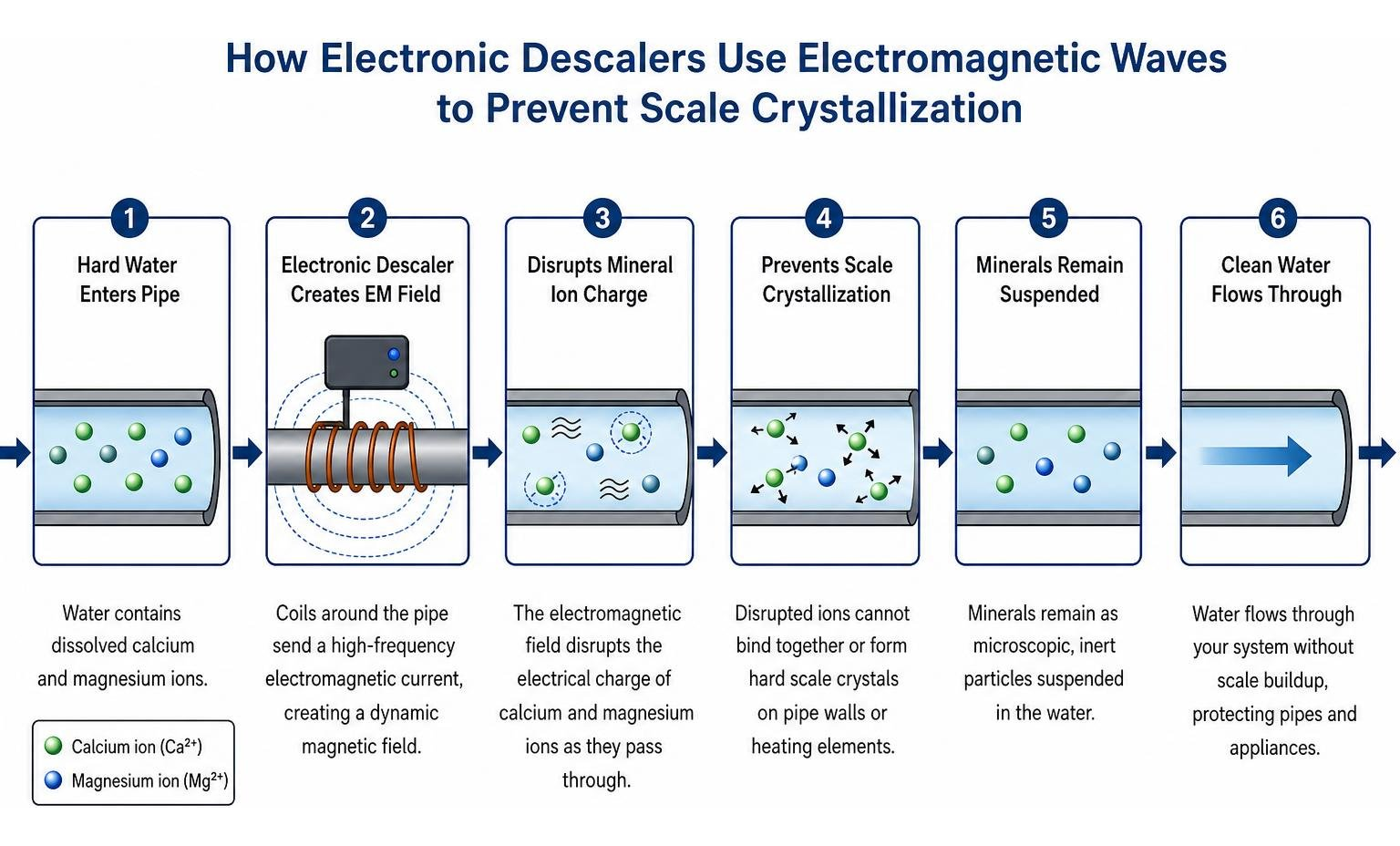
These systems work by wrapping wire coils around your main incoming cold water pipe. An electronic control box sends a varying high-frequency electromagnetic current through the coils, creating a dynamic magnetic field inside the pipe.
According to manufacturers, this electromagnetic field disrupts the electrical charge of dissolved mineral ions as they pass through. This temporary disruption prevents the calcium and magnesium from binding together and adhering to pipe walls and heating elements, similar to how salt-free chemical media works.
The Pros:
- Extremely easy to install (no pipe cutting required).
- Absolutely maintenance-free.
- No salt, no water waste, and negligible electricity usage.
The Reality: While electronic descalers can provide minor scale reduction in areas with mild to moderate water hardness, they are generally not reliable enough to serve as the sole line of defense for a tankless water heater in very hard water zones.
Because the electromagnetic effect is temporary and depends heavily on water flow rates, pipe material, and water temperature, these systems cannot guarantee the level of protection required to keep your tankless warranty active in places like Salt Lake City, West Jordan, or South Jordan. We typically recommend these only as secondary, supportive systems rather than your primary method of scale prevention.
Key Factors to Consider When Selecting Your System
Selecting a water softener for tankless water heater systems isn't just about picking a brand; you must size the system correctly to match your home's water chemistry and usage patterns.
If you aren't sure where to start, scheduling our plumbing inspection services is an excellent first step. Our certified technicians can test your water and help you calculate the exact specifications you need.
Flow Rate and GPM Requirements
A tankless water heater requires a massive, uninterrupted flow of water to function. When sizing a water softener or conditioner, you must ensure its continuous Service Flow Rate(measured in Gallons Per Minute, or GPM) meets or exceeds your home's peak hot water demand.
If you install a water softener with a service flow rate of only 5 GPM, but your tankless water heater is trying to pull 7 GPM to run two showers and a washing machine simultaneously, you will experience a severe pressure drop. This restricted flow can cause your tankless heater to overheat, trigger an error code, or shut down completely.
- Standard Homes (1–3 bathrooms): Look for a softener with a minimum continuous flow rate of 8 to 10 GPM.
- Large Homes (4+ bathrooms): You will need a high-capacity system rated for 12 to 15+ GPM.
Water Hardness and Grain Capacity
If you choose a salt-based water softener, you must select the correct grain capacity. This number (typically 32,000, 48,000, or 64,000 grains) represents how much hardness the system can remove before it must run a regeneration cycle.
To calculate your daily softening needs, use this formula:
- Determine Hardness (GPG): Have your water tested. Let's assume your water hardness is 20 GPG(very common in West Valley City and Provo).
- Calculate Daily Water Usage: The average person uses about 75 gallons of water per day. A household of 4 uses roughly 300 gallons per day.
- Calculate Daily Grains: Multiply daily gallons by GPG hardness. $$\text{300 gallons} \times \text{20 GPG} = \text{6,000 grains of hardness to remove daily}$$
- Choose Capacity: To ensure your system only regenerates about once a week (which saves water and salt), you want a system that can handle at least 7 days of capacity. $$\text{6,000 grains/day} \times \text{7 days} = \text{42,000 grains}$$ In this scenario, a 48,000-grain water softener would be the perfect fit.
Installation and Maintenance Demands
To get the most out of your water treatment setup, proper installation is key:
- Location: The water softener must be installed on the main cold water line before it splits to serve your water heater and household fixtures. Never install a water softener on a hot water line, as hot water will ruin the delicate resin beads.
- Sediment Pre-Filter: Always install a 5-micron sediment pre-filter upstream of both your water softener and your tankless heater. This inexpensive filter catches dirt, rust, and silt, preventing these particles from fouling your softener resin or clogging the tankless heat exchanger.
- Bypass Valves: Ensure your system has a high-quality bypass valve. This allows you to easily divert water around the softener when watering your lawn or filling a pool, saving you money on salt.
- Flushing Schedule: Even with a water softener, we still recommend performing a standard descaling flush on your tankless unit every 1 to 2 years (or every 6 months if you operate without a softener in hard water) to keep the heat exchanger pristine.
If you are planning to upgrade your entire hot water system, pairing a softener with a professional tankless water heater installation is the best way to ensure everything is sized and calibrated perfectly from day one.
Frequently Asked Questions About Tankless Water Softeners
Does a water softener cause corrosion in tankless water heaters?
This is a common concern among homeowners. Traditional salt-based softeners exchange calcium ions for sodium ions, which increases the water's electrical conductivity. Highly conductive water can accelerate galvanic corrosion inside steel water heater tanks, rapidly depleting their sacrificial anode rods.
However, tankless water heaters do not use sacrificial anode rods and do not store water. Because they are on-demand systems made primarily of copper or high-grade stainless steel, they are highly resistant to this type of corrosion.
As long as your water softener is programmed correctly and does not over-soften or dramatically alter your water's pH, the risk of corrosion is negligible. In fact, the physical protection against scale far outweighs any theoretical corrosion risks. You can read more about the electrochemistry of this phenomenon in academic resources on Water Softener Corrosion Risks.
How often should I flush my tankless water heater if I have a softener?
If you have a properly functioning salt-based water softener, you have virtually eliminated the minerals that cause scale. In this case, you only need to perform a preventative descaling flush using food-grade white vinegar or a commercial descaling kit once every 2 to 3 years to clear out minor sediment.
If you are using a salt-free conditioner, electronic descaler, or no treatment system at all, you must perform a descaling flush at least once a year —and potentially every 6 months if your water is exceptionally hard—to keep your system clean and protect your warranty.
Can I install an external tankless water heater with a softener?
Yes! Outdoor tankless water heaters are popular in many regions because they free up interior wall space and eliminate the need for complex indoor venting.
However, if you live in Utah, you must take freeze protection seriously. While outdoor units have built-in electric heaters to protect their internal components down to a certain temperature, any external water lines leading to and from the unit must be heavily insulated and heat-taped.
If you are considering an outdoor setup, check out our External Tankless Water Heater Guide to learn how to prepare your plumbing for Utah's freezing winters.
Conclusion
Your tankless water heater is an incredible investment in your home’s comfort and energy efficiency. But without a reliable water softener for tankless water heater protection, the harsh minerals in Utah’s water will slowly choke your system, spike your utility bills, and ultimately void your manufacturer warranty.
At All Pro Service Group, we pride ourselves on delivering honest, dependable plumbing solutions across the Greater Salt Lake Area. As a "Gephardt Approved" company, our highly trained experts are ready to test your water, help you select the perfect softening or conditioning system, and perform a flawless professional installation.
Don't let hard water cut your tankless system's life short. Schedule professional water softener installation with All Pro Service Group today and enjoy endless, efficient hot water with total peace of mind!