What Does a New Water Softener Actually Cost?
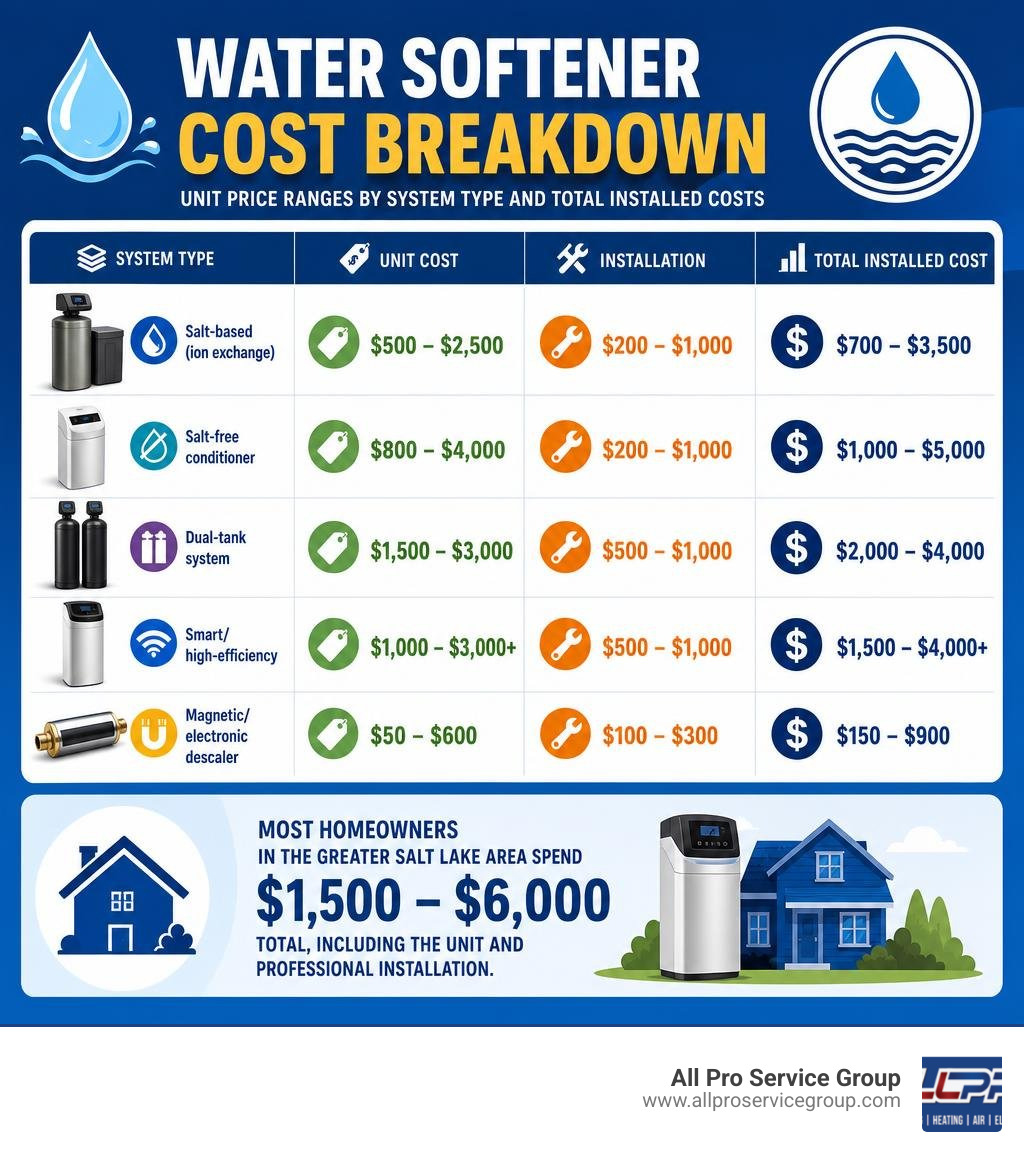
New water softener price ranges vary widely depending on the system type, size, and whether you hire a professional to install it. Here's a quick snapshot to help you plan your budget:
| System Type | Unit Cost | Installation | Total Estimated Cost |
|---|---|---|---|
| Salt-based (ion exchange) | $500 - $2,500 | $200 - $1,000 | $700 - $3,500 |
| Salt-free conditioner | $800 - $4,000 | $200 - $1,000 | $1,000 - $5,000 |
| Dual-tank system | $1,500 - $3,000 | $500 - $1,000 | $2,000 - $4,000 |
| Smart/high-efficiency | $1,000 - $3,000+ | $500 - $1,000 | $1,500 - $4,000+ |
| Magnetic/electronic descaler | $50 - $600 | $100 - $300 | $150 - $900 |
Most homeowners in the Greater Salt Lake area spend between $1,500 and $6,000 total, including the unit and professional installation.
If you've noticed white crusty buildup around your faucets, stiff laundry, or soap that won't lather properly, you're likely dealing with hard water. Salt Lake City's municipal water supply is well known for its high mineral content — and it quietly does damage every single day to your pipes, appliances, and even your skin and hair. A water softener can stop that damage. But before you buy, it helps to know exactly what you're getting into financially.
Hard water isn't just a nuisance — it's expensive. Over a 10-year period, untreated hard water can cost a household anywhere from $5,000 to $15,000 in premature appliance wear, plumbing repairs, and wasted soap and cleaning products.
At All Pro Service Group, we've been helping homeowners across the Greater Salt Lake Valley navigate decisions around plumbing systems — including new water softener pricing and installation — since 2008. In this guide, we'll walk you through everything that affects what you'll actually pay, so you can make a confident, informed decision.
Understanding the New Water Softener Price in 2026
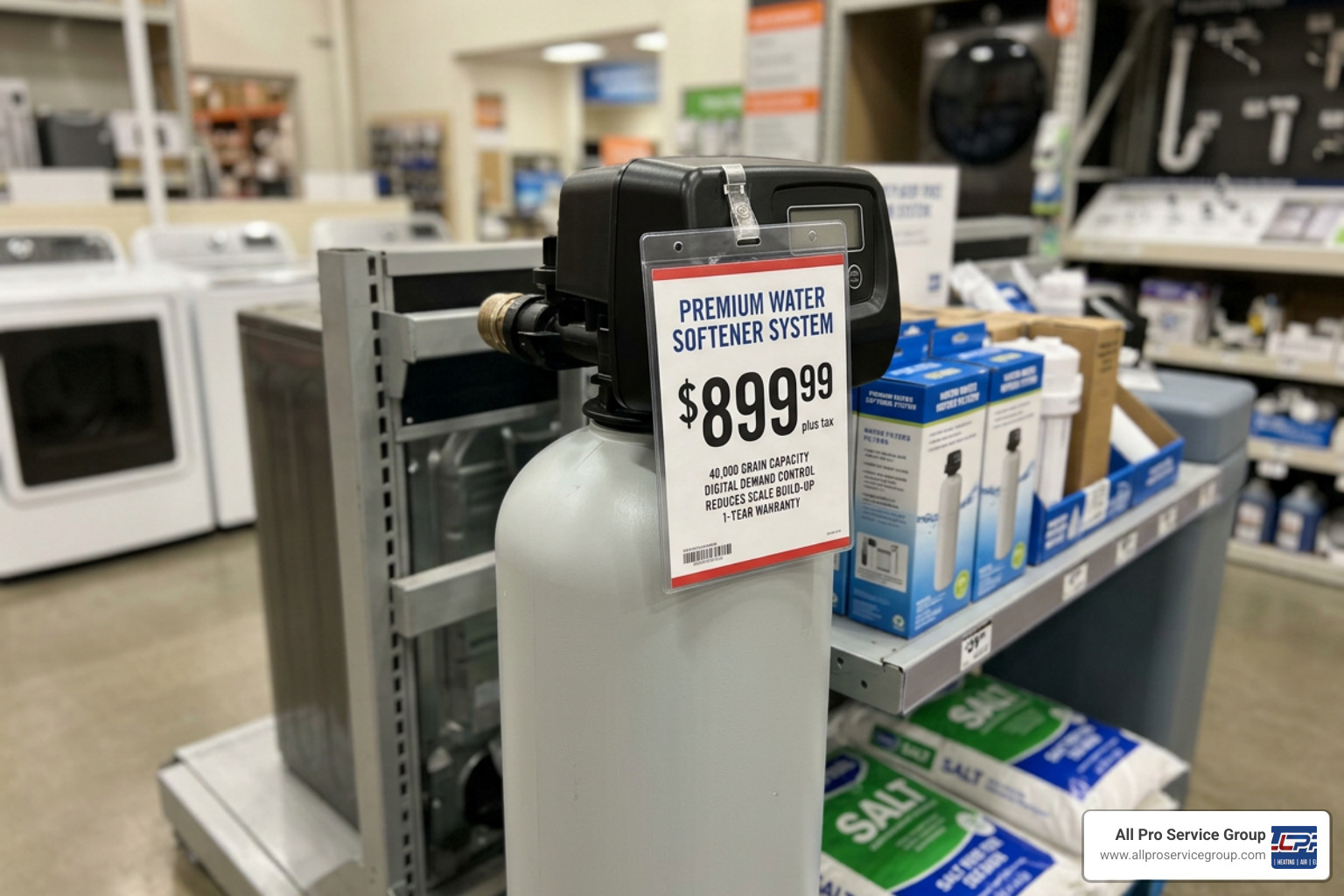
When researching a new water softener price, it is easy to get overwhelmed by the massive price gap between different options. You might see a basic, bare-bones unit online for $400, while a local service provider quotes you $5,000 for a fully installed, professional-grade system. Why is there such a massive difference, and what should you actually expect to pay?
As we look at the landscape in June 2026, the complete cost of a water softener setup involves more than just the box that sits in your basement. To map out your expenses accurately, you need to look at the total cost of ownership, which includes the upfront equipment cost, the installation labor, and the recurring maintenance. For a detailed breakdown of these components, you can check out the Water Softener System Cost 2026: Budget Guide.
In Utah, our water is notoriously hard. Cities along the Wasatch Front—from Ogden and Salt Lake City down to Provo—frequently register water hardness levels well above 15 grains per gallon (GPG). In some parts of Park City or South Jordan, those numbers can climb even higher. This high mineral concentration means that standard, low-cost retail units often have to work overtime, leading to premature breakdown. Investing in a system that is built to handle our local water quality is key to long-term budget planning.
Key Factors That Determine Your New Water Softener Price
The final price tag on your water treatment system isn't arbitrary. It is driven by several critical technical and practical specifications:
- Grain Capacity: This is the measure of how many hardness minerals the system can remove before it needs to run a regeneration cycle. A small system (24,000 to 32,000 grains) is perfect for a small household, while larger homes with high water usage require 48,000 to 80,000 grains, which naturally increases the equipment cost.
- Water Hardness Level: The harder your water, the harder your system has to work. If you live in West Jordan or West Valley City where municipal water is heavy with calcium and magnesium, you will need a larger capacity unit to avoid constant, wasteful regeneration cycles.
- Household Size: A family of five uses significantly more water than a couple. More water usage means the system must process more volume daily, requiring a larger tank and a more robust control valve.
- System Features: High-tech control valves, smart monitoring, and premium build materials all influence the price. For a deeper dive into how these factors balance out, read more about Water Softener Cost: What You'll Pay (2026).
How Brand and Retailer Choice Affects Your New Water Softener Price
Where you buy your water softener has a major impact on both the initial cost and the long-term value.
If you walk into a big-box retail store, you will find budget-friendly systems priced between $400 and $800. While these prices are tempting, these systems are often manufactured with consumer-grade plastic rotary valves and standard 8% crosslink resin. They are designed as "disposable" appliances, meaning that when a component fails after 3 to 5 years, replacement parts are rarely available, forcing you to purchase an entirely new system. Furthermore, these basic units are notoriously inefficient, consuming up to 30% more salt and water during regeneration than high-efficiency models.
On the other hand, professional-grade systems purchased through certified plumbing professionals range from $1,500 to $3,000 for the equipment alone. These systems utilize heavy-duty control valves (such as digital demand-initiated valves) and high-density 10% crosslink resin, which is highly resistant to chlorine and physical breakdown. These systems are fully rebuildable, meaning individual seals, spacers, or motors can be replaced easily. With proper maintenance, a professional-grade system will easily last 15 to 20 years, offering a much lower lifetime cost of ownership.
Additionally, professional-grade systems come with robust warranties—often covering the control valve for 5 years and the mineral tank for 10 years to life—giving you peace of mind that your investment is fully protected.
Cost Breakdown by Water Softener System Type
Not all water softeners operate the same way. The technology used to treat your water is one of the primary drivers of the new water softener price. Let's break down the most common systems available on the market today.
| System Type | Average Equipment Cost | Lifespan | Best Suited For |
|---|---|---|---|
| Ion Exchange (Salt-Based) | $500 - $2,500 | 10 - 20 Years | Moderate to extremely hard water; whole-house mineral removal |
| Salt-Free Conditioner | $1,000 - $3,000 | 10 - 15 Years | Moderate hardness; households wanting chemical-free maintenance |
| Dual-Tank System | $1,500 - $3,500 | 15 - 20+ Years | Large families; high water usage; continuous soft water needs |
| Magnetic/Electronic Descaler | $50 - $400 | 5 - 10 Years | Very mild hardness; budget-conscious renters |
Salt-Based vs. Salt-Free Water Softeners
The debate between salt-based and salt-free systems is one of the most common topics we discuss with homeowners.
Salt-based systems are the traditional, time-tested champions of water softening. They use an active ion exchange process. Inside the mineral tank are millions of tiny, negatively charged resin beads. As hard water passes through, the positively charged calcium and magnesium ions stick to the resin, while a tiny, harmless amount of sodium is released. When the resin becomes saturated, the system flushes itself with a saltwater brine solution to clean the beads and start the process over. This is the only technology that actually removes the hard minerals from your water.
Salt-free systems, often called water conditioners, do not actually remove minerals. Instead, they use template-assisted crystallization (TAC) to alter the physical structure of the minerals, preventing them from binding to your pipes and heating elements as scale. While they don't give you that slick, "slippery" feeling of truly soft water, they require no salt refills and waste no water. To learn more about how these systems function and whether they are right for your home, read our Salt-Free Water Softeners Complete Guide.
Smart and High-Efficiency Water Softeners
If you want to save money on utility bills and salt refills, smart, high-efficiency systems are well worth the investment. Older, traditional softeners operate on simple timers, regenerating every few days whether you used water or not. This wastes an incredible amount of water and salt.
Modern smart systems use demand-initiated regeneration. They monitor your actual water usage in real time and only regenerate when the resin is nearly exhausted. High-efficiency systems also leverage upflow regeneration technology. By driving the brine solution upward through the resin bed, the system cleans the most depleted resin first, reducing salt usage by up to 75% and water waste by up to 64% compared to older downflow models.
For premium performance, systems like the SoftPro Elite Smart HE Water Softener for City Water (Industry's Best) offer precision brining, vacation modes, and auto-refresh features that maximize efficiency. If you are looking for a reliable, budget-friendly alternative designed specifically for municipal water, the SoftPro ECO™ City Water Softener - Best Water Softener Systems for Cit is an excellent choice that balances upfront affordability with long-term operating efficiency.
Sizing Your System: Grain Capacity and Household Needs
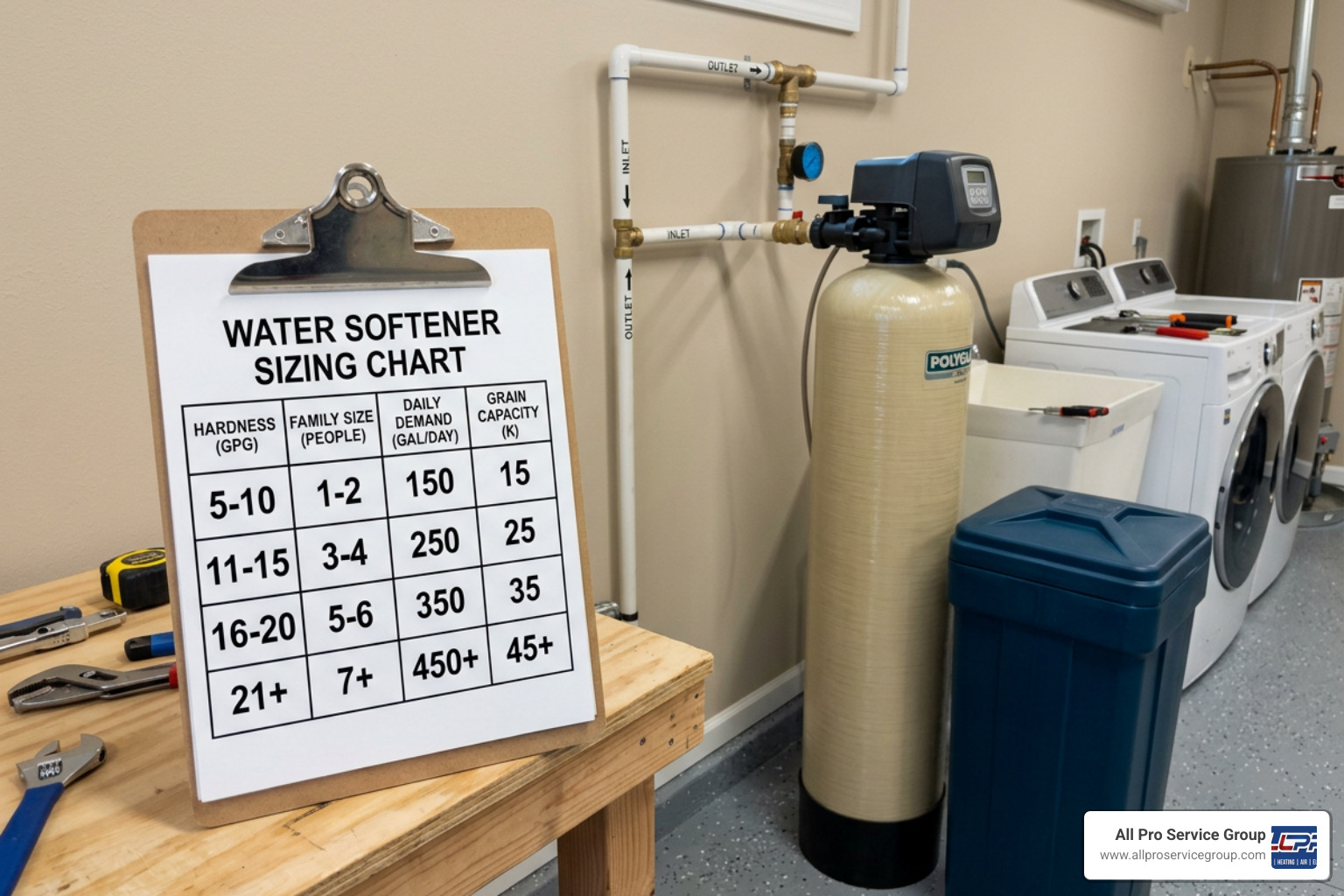
Buying a water softener that is too small for your home is a recipe for disaster. It will be forced to regenerate constantly, wasting water and salt while wearing out the internal valve components in record time. Conversely, buying a system that is vastly oversized means you paid too much upfront for capacity you will never use. Finding the "sweet spot" is essential.
Water softener size is measured in "grains" of capacity. This refers to the maximum number of grains of water hardness the system can remove before it must run a regeneration cycle.
Calculating the Right Size for Your Home
To calculate the exact system capacity your household needs, use this simple three-step formula:
- Determine Your Daily Water Usage: On average, a single person uses about 75 to 100 gallons of water per day. Multiply the number of people in your home by 80 gallons to get a reliable daily average.
- Find Your Water Hardness: You can get a test kit or look up your local water quality report. Hardness is measured in Grains Per Gallon (GPG).
- Calculate Daily Softening Demand: Multiply your daily water usage by your water hardness level.
For example, let's look at a family of four living in South Jordan with a water hardness level of 15 GPG:
- 4 people × 80 gallons = 320 gallons of water used per day.
- 320 gallons × 15 GPG = 4,800 grains of hardness that must be removed daily.
To ensure your system runs efficiently, it should only regenerate once every 7 days.
- 4,800 grains per day × 7 days = 33,600 grains of capacity.
In this scenario, a 32,000 to 40,000-grain system is the ideal size.
When planning your installation, always ensure your system includes a high-quality bypass valve. This allows you to easily bypass the water softener when watering your lawn or filling a pool, saving your softened water (and your salt supply) for where it matters most inside the house.
Professional Installation and Ongoing Operating Costs
While the cost of the equipment itself is a major factor, professional installation and ongoing maintenance are equally important parts of the financial equation. To get a complete picture of your investment, you must account for the labor required to integrate the system into your home's plumbing.
Proper installation ensures that your system performs optimally and complies with local building codes. If you are ready to explore your options, you can learn more about our professional Plumbing services and schedule an inspection.
Professional Installation vs. DIY Costs
If you are handy with a pipe cutter and have some basic plumbing experience, you might consider installing your water softener yourself. DIY installation can save you anywhere from $500 to $1,000 in labor costs. However, DIY plumbing is not without significant risks.
A proper installation requires cutting into your home's main water line, installing bypass valves, running dedicated drain lines, and ensuring there is no risk of cross-contamination with your drinking water. In many Utah municipalities, including West Jordan and Provo, you are required to secure a plumbing permit for water treatment installations.
If you run into unexpected issues—such as corroded copper pipes, a lack of a pre-plumbed softener loop, or tricky drain configurations—a simple afternoon project can quickly turn into an expensive emergency plumbing call. Hiring a professional guarantees the job is done right the first time, protects your manufacturer warranty, and ensures your system operates at peak efficiency. For a detailed look at what a professional setup involves, check out our guide on the Installation of Water Softeners.
Ongoing Maintenance and Salt Expenses
Once your system is installed, there are minor ongoing expenses to keep in mind:
- Water Softener Salt: A typical household with a salt-based system will use about one to two 40-pound bags of salt per month. At $5 to $15 per bag, your annual salt cost will range from $60 to $120.
- Water and Electricity: Regeneration cycles use water to flush the resin beads. Depending on your system's efficiency, this can slightly increase your water bill. The electronic control valve runs on minimal power, typically costing less than $10 per year in electricity.
- Resin Replacement: The resin bed inside your mineral tank is highly durable, but it won't last forever. On municipal city water, resin typically lasts 10 to 15 years. Replacing the resin bed costs between $300 and $800, which is much cheaper than replacing the entire system.
Frequently Asked Questions About Water Softener Costs
What is the typical lifespan of a new water softener?
A high-quality, professional-grade water softener typically lasts between 10 and 20 years. The actual lifespan of your system depends heavily on three factors: the quality of the incoming water, how consistently you maintain the system, and the type of resin used.
To maximize your system's lifespan, check your salt levels monthly, clean out the brine tank once a year to prevent salt bridges, and have a professional plumber perform a routine inspection every few years. Investing in a system with a durable control valve and premium 10% crosslink resin will significantly extend the life of your equipment, protecting your home's appliances for decades.
Does a water softener help protect other home appliances?
Yes, absolutely! Hard water is incredibly destructive to water-using appliances. When hard water is heated, the calcium and magnesium minerals crystallize and settle out of the water, forming a rock-hard scale layer on heating elements and inside internal plumbing lines.
By installing a water softener, you protect your appliances from this scale buildup, extending their lifespans by 30% to 50%. This is especially crucial for water heaters, which are highly susceptible to scale damage. For more information on protecting your home's hot water systems, read our Water Heater Installation Guide 2026 and explore our Tankless Water Heater Complete Guide.
Are salt-free water conditioners more expensive than salt-based softeners?
In terms of upfront equipment costs, salt-free water conditioners are generally more expensive, often starting around $1,000 to $3,000, compared to entry-level salt-based systems that start around $500.
However, salt-free conditioners can offer long-term savings because they do not require monthly salt refills, use no electricity, and do not waste water during regeneration cycles. While they are a fantastic, low-maintenance, chemical-free option, they do not actually remove minerals from the water, meaning they may not be as effective for homes experiencing severe, high-GPG water hardness.
Conclusion
Investing in a water softener is one of the smartest upgrades you can make for your home. While the new water softener price can vary, the long-term savings on appliance lifespans, plumbing maintenance, soap usage, and energy bills make it an investment that quickly pays for itself.
At All Pro Service Group, we are proud to serve homeowners throughout the Greater Salt Lake Area—including Ogden, Park City, South Jordan, West Jordan, West Valley City, and Salt Lake City. As a "Gephardt Approved" service provider, we are committed to delivering honest, competitive pricing, professional installation, and customer service that exceeds your expectations.
If you are ready to say goodbye to hard water scale and enjoy the benefits of clean, soft water, contact us today to schedule a consultation or explore our professional Plumbing services. We are here to help you find the perfect system for your home and your budget!