
What Is an External Tankless Water Heater — and Is It Right for You?
An external tankless water heater is a wall-mounted, on-demand hot water unit installed outside your home — no indoor space required, no venting needed.
Quick answer for homeowners comparing options:
| Feature | External Tankless | Indoor Tankless | Traditional Tank |
|---|---|---|---|
| Venting required | No | Yes | Yes (most models) |
| Indoor space used | None | Yes | Yes |
| Installation cost | Lower | Higher | Moderate |
| Lifespan | 15–20 years | 15–20 years | 10–15 years |
| Energy efficiency | Up to 34% better than tank | Up to 34% better than tank | Baseline |
| Best climate | Mild to moderate | Any | Any |
If you're weighing the switch to tankless — or specifically wondering whether an outdoor unit makes sense for your Salt Lake area home — you're in the right place.
Outdoor tankless units deliver hot water on demand, just like their indoor counterparts. The key difference is where they live: mounted directly on an exterior wall, exposed to the elements, with combustion exhaust venting straight into the open air. That one change simplifies installation significantly and frees up valuable space inside your home.
I'm Gary Leany, owner of All Pro Service Group, and my team has installed and serviced countless external tankless water heater systems across the Greater Salt Lake Valley since 2008. In the sections below, I'll walk you through everything you need to know to decide if an outdoor unit is the right fit for your home.
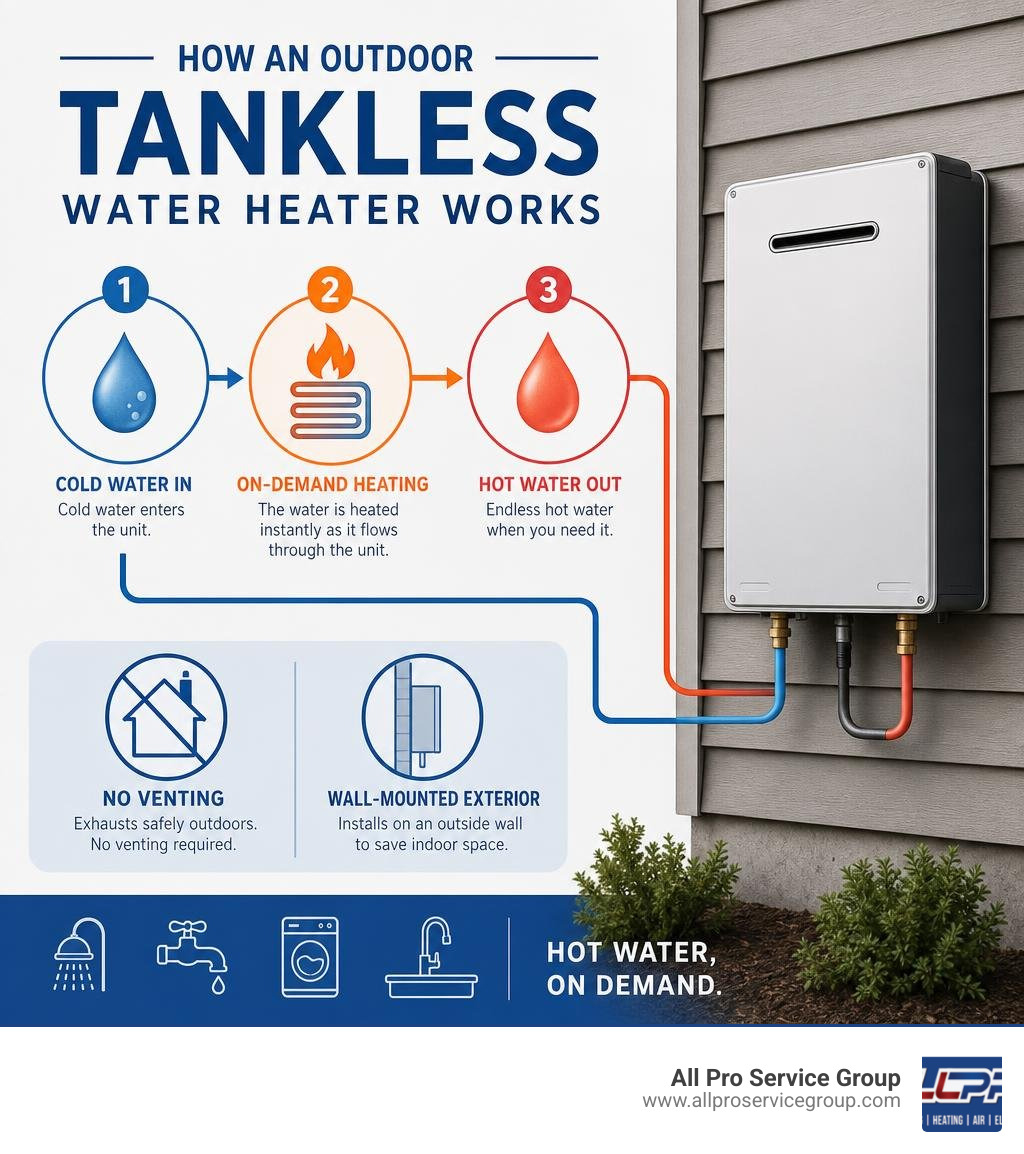
Understanding the external tankless water heater

To truly understand what makes an external tankless water heater unique, it helps to look at how on-demand heating works in a outdoor setting. Traditional tank water heaters keep 40 to 50 gallons of water hot 24/7, even when you are sleeping or away at work. This constant heating results in standby energy loss, which drives up utility bills.
A tankless water heater, by contrast, only heats water when you turn on a hot water tap. When a faucet is opened, cold water enters the unit, a flow sensor detects the demand, and a powerful gas burner ignites. The water circulates through a high-efficiency heat exchanger, warming up instantly to your target temperature before flowing to your shower, sink, or washing machine.
An external model takes this space-saving technology a step further by moving the entire heating apparatus to the outside of your home. By mounting the unit on an exterior wall, you eliminate the need to sacrifice closets, crawlspaces, or utility rooms. For a deeper dive into the inner workings of these modern systems, take a look at our tankless water heater complete guide.
How an external tankless water heater differs from indoor models
While indoor and outdoor tankless water heaters share the same core heating technology, their designs differ significantly to accommodate their respective environments:
- Venting Requirements: This is the most significant difference. Indoor models require dedicated, sealed venting systems (often using expensive materials like Category III stainless steel or specialized PVC/CPVC runs) to safely exhaust combustion gases through a roof or side wall. An external tankless water heater vents directly into the open air through integrated exhaust slots on its front cover, completely eliminating the need for complex indoor vent piping.
- Weatherproofing and Protective Cabinets: Outdoor units are engineered to withstand rain, wind, snow, and direct sunlight. They feature heavy-duty, rust-resistant metal cabinets and sealed electrical components.
- Freeze Protection: Because they live outdoors, external units are equipped with internal heating elements that activate automatically when temperatures drop, protecting the heat exchanger from freezing and cracking.
- Clearance and Safety Regulations: Outdoor units must be installed in locations that meet strict building codes. For example, they must maintain minimum clearances from windows, doors, soffits, and mechanical air intakes to prevent exhaust gases from re-entering the home.
For an example of a high-performance outdoor-specific design, you can review the technical specs of the State Water Heaters GTS-240-NEH 100 Spec Sheet, which showcases commercial-grade construction designed for external residential use.
Sizing, Flow Rates, and BTU Ratings
When selecting an external tankless water heater, sizing is everything. Unlike traditional tanks, which are sized by gallon capacity, tankless units are sized by their maximum BTU (British Thermal Unit) input and their flow rate, measured in GPM (Gallons Per Minute).
- BTU Input: This represents the maximum heating power of the unit. Residential outdoor gas models typically range from 140,000 BTU/h to 199,000 BTU/h. A higher BTU rating allows the unit to heat more water quickly, which is crucial in colder climates where incoming ground water temperatures are low.
- Gallons Per Minute (GPM): This is the volume of hot water the unit can deliver simultaneously. Typical outdoor units provide maximum flow rates ranging from 5.3 GPM to 10.0 GPM.
- Temperature Rise: Your actual GPM is determined by "temperature rise"—the difference between the temperature of the cold water entering your home and your desired output temperature (usually 120°F). In Utah, winter ground water can drop to a chilly 40°F, requiring an 80°F temperature rise.
To ensure you never experience a cold shower while the dishwasher is running, we carefully calculate your household's peak hot water demand. For instance, the high-capacity State Water Heaters GTS-340-NEH 100 Spec Sheet demonstrates how an 180,000 BTU condensing unit can efficiently manage high-demand households even during colder seasonal transitions.
Benefits of Choosing an Outdoor Tankless Unit
Opting for an outdoor installation offers several key advantages that make it an attractive choice for many homeowners. By moving the system outside, you can reclaim valuable square footage indoors. If you are curious about how this upgrade can transform your daily routine, read about how a tankless water heater can help your home.
Cost Savings and Installation Efficiency
One of the most compelling reasons to choose an external tankless water heater is the upfront installation savings. Because outdoor units vent directly into the atmosphere, they completely eliminate the need for expensive venting systems.
Venting an indoor gas tankless unit often requires drilling through exterior walls or roofs and running specialized piping, which can quickly drive up labor and material costs. Eliminating these venting requirements can reduce overall installation costs by up to 30%.
| Installation Requirement | Indoor Tankless | External (Outdoor) Tankless |
|---|---|---|
| Vent Piping | Required (PVC, CPVC, or Stainless Steel) | None (Vents directly through cabinet) |
| Combustion Air Supply | Must be piped in or drawn from room | Plentiful, natural outdoor air |
| Indoor Footprint | Occupies wall space in closet/utility room | Zero indoor space used |
| Condensate Drain | Required (for condensing models) | Required (for condensing models) |
| Gas Line Upgrades | Often required | Often required |
Additionally, outdoor units simplify the installation process, allowing our technicians to complete the job quickly and with minimal disruption to your daily life.
Energy Efficiency and Long-Term Value
Tankless water heaters are highly efficient. According to the U.S. Department of Energy:
- They can be 24% to 34% more energy efficient than traditional tank water heaters for homes that use 41 gallons or less of hot water daily.
- They remain 8% to 14% more energy efficient for larger households using more than 86 gallons of hot water per day.
Given that the average household uses roughly 64 gallons of hot water daily, the monthly savings on natural gas or propane can be substantial. Furthermore, while traditional tanks have a lifespan of only 10 to 15 years, a high-quality tankless unit can last more than 20 years with proper care.
To explore premium, ultra-high-efficiency options featuring advanced scale prevention technologies, check out A. O. Smith's Gas Tankless Signature Series.
Key Installation and Weather Considerations
While the benefits of an outdoor unit are clear, proper installation requires careful planning. Unlike indoor models, an external unit is exposed to local weather conditions, making professional installation essential to ensure safety, code compliance, and optimal performance. If you are planning an upgrade, our detailed water heater installation guide offers a comprehensive look at what to expect during the process.
Is an external tankless water heater right for your climate?
The biggest question Utah homeowners ask is: Can an outdoor unit survive our freezing winters?
The short answer is yes, but with important caveats. Modern outdoor tankless water heaters are engineered with built-in electric freeze protection. These systems utilize internal heating elements (often drawing around 100W to 122W of power) to keep the water inside the heat exchanger from freezing, even when outdoor temperatures drop well below freezing.
However, this protection relies entirely on continuous electrical power. If your neighborhood experiences a winter power outage, the freeze protection will fail, leaving the unit vulnerable to damage. For this reason, we take extra precautions when installing these units in colder areas:
- Heat Tracing and Pipe Insulation: All external water and gas pipes leading to the unit must be meticulously wrapped with electric heat tape and heavy-duty foam insulation.
- Sheltered Placement: We install units under roof overhangs or in recessed boxes to protect them from direct snow accumulation and biting winds.
- Solenoid Drain Valves: In some cases, we install automatic drain valves that empty the unit's water if power is lost during a freeze event.
For detailed specifications on how top-tier outdoor units handle freezing temperatures, you can review the Rinnai REP199e Spec Sheet, which outlines electrical freeze protection ratings and operating parameters.
Maintenance and Longevity
To protect your investment and ensure your system runs at peak efficiency for 20+ years, regular maintenance is non-negotiable.
- Annual Flushing: Over time, dissolved minerals in your water (especially hard water common in Utah) will deposit scale inside the copper heat exchanger. This scale acts as an insulator, forcing the burner to run hotter and longer, which reduces efficiency and can eventually crack the heat exchanger. An annual flush with a food-grade descaling solution removes these deposits.
- Filter Cleaning: Outdoor units feature water inlet filters and air intake screens that must be checked and cleaned periodically to maintain proper flow and combustion.
- Cabinet Inspections: Because the unit lives outside, we inspect the cabinet annually to ensure no pests have nested inside and that the venting slots remain clear of debris.
For a step-by-step breakdown of how to care for your system, read this external tankless water heater yearly maintenance guide or consult our own gas hot water heater maintenance guide.
Frequently Asked Questions
Do outdoor tankless water heaters freeze?
Yes, they can freeze if they lose electrical power during a cold snap or if the external piping is not properly insulated. While the units have internal electric heating elements to protect their internal components, these require electricity to function. Properly insulating all exposed water lines and utilizing heat tape is essential in cold climates.
Do you have to vent an outdoor tankless water heater?
No additional vent piping is required. Outdoor units are designed to vent their exhaust directly into the open air through integrated vents on the cabinet. This open-air exhaust design is what makes them simpler and up to 30% cheaper to install than indoor models.
How long do outdoor tankless water heaters last?
With regular annual maintenance and proper freeze protection, a high-quality outdoor tankless water heater can last 20 years or more. This is nearly double the lifespan of a traditional tank water heater, providing excellent long-term value.
Conclusion
An external tankless water heater is an excellent, space-saving option that eliminates indoor venting costs and frees up valuable room inside your home. While Utah's cold winters require careful installation and proper insulation, these units are highly reliable when installed by experienced professionals.
At All Pro Service Group, we have been helping homeowners throughout the Greater Salt Lake Valley — including Ogden, Park City, Provo, South Jordan, West Jordan, West Valley City, and Salt Lake City — find the perfect hot water solutions since 2008. As a "Gephardt Approved" company, we pride ourselves on exceptional customer service, transparent pricing, and dependable workmanship.
Ready to reclaim your indoor space and enjoy endless hot water? Schedule your professional tankless water heater installation with the experts at All Pro Service Group today!