
Commercial EV Charger Install: Planning, Electrical, and Site Assessment
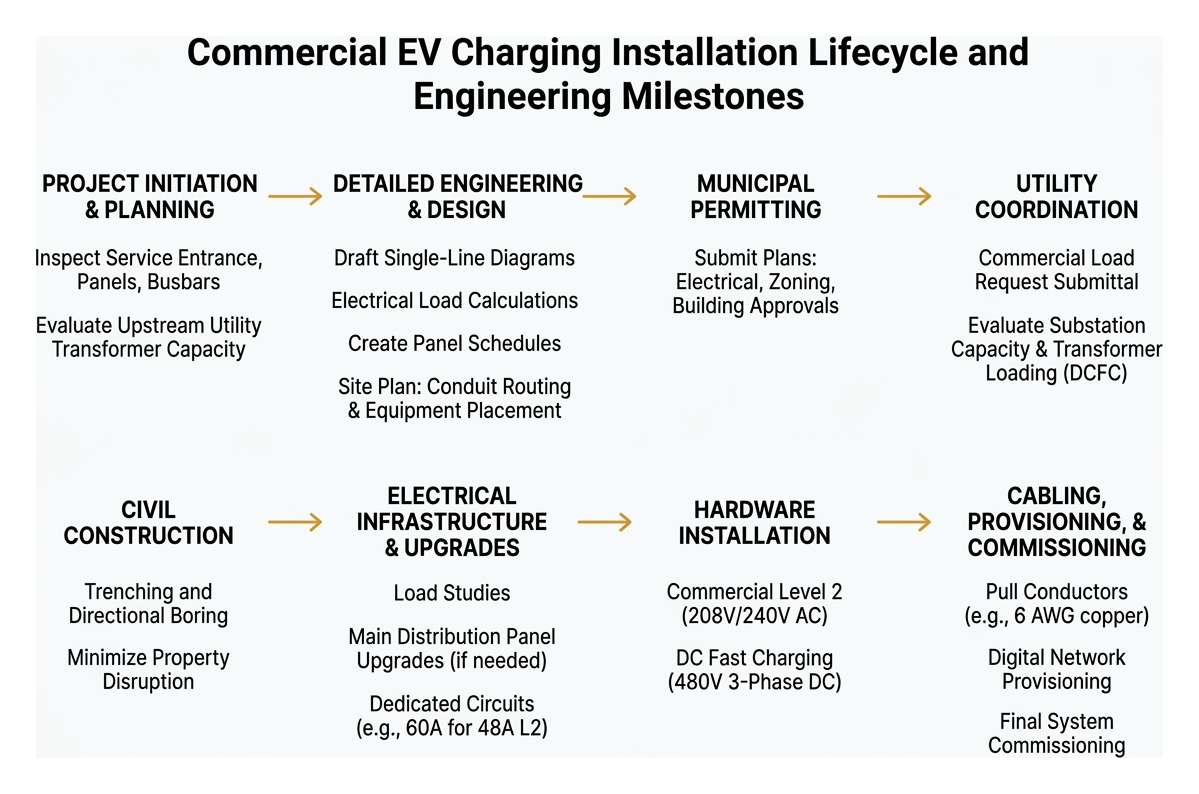
A commercial EV charger install typically moves through five core steps: site assessment, engineering and permitting, utility coordination and electrical infrastructure upgrades, civil installation, and final commissioning. The assessment confirms spare service capacity, conduit routes, ADA access, parking circulation, and the right charger type for the property's dwell time. From there, engineers size circuits under NEC Article 625, secure approvals, coordinate utility capacity, trench or bore conduit paths, mount pedestals or dispensers, pull conductors, test protection systems, and activate network software.
Planning a commercial charging project also requires looking far beyond the physical hardware mounted in a parking space. A proper deployment functions as a critical piece of your building's electrical infrastructure, requiring a balanced review of your service capacity, site layout, and customer accessibility. Reviewing our comprehensive commercial EV charging guide for 2026 can give you a high-level view of how these elements come together before engineering begins.
During an initial site assessment, a qualified team evaluates:
- Spare electrical capacity: Calculating historical peak demand to see what headroom remains on the main switchgear.
- Civil pathing: Mapping the shortest, least disruptive route from the electrical room to the parking stalls.
- ADA accessibility: Planning compliant path of travel, accessible parking stall widths, and operational reach ranges (typically 15 to 48 inches above finished grade).
- Parking circulation: Ensuring cable reach doesn't create trip hazards or obstruct vehicle turnaround areas.
Electrical Backbone and Switchgear Capacity
Under the National Electrical Code(NEC Article 625), electric vehicle charging equipment is classified as a continuous load. This designation carries a strict requirement: branch circuits, overcurrent protection devices, and feeders must be sized at 125% of the charger's maximum rated draw.
For example, a standard 48-amp commercial Level 2 charging station requires a dedicated 60-amp circuit breaker and appropriately rated conductors (such as 6 AWG copper). If your property plans to deploy a bank of ten 48-amp chargers, your electrical infrastructure must support a continuous 480 amps of capacity on paper - unless smart energy management systems are put in place.
Our team inspects the service entrance, main distribution panels, busbar ratings, and upstream utility transformer capacity before drafting any final engineering prints. When businesses need specialized support with their existing infrastructure, our licensed electricians handle everything from load studies to full distribution upgrades through our certified commercial electrical services.
Matching Charging Levels to Property Dwell Times
Selecting the right hardware comes down to one metric: dwell time. How long does a driver actually remain on your property?
| Charging Level | Power Delivery & Voltage | Range Added per Hour | Ideal Property Type & Application |
|---|---|---|---|
| Commercial Level 2 | 6 kW to 19.2 kW (208V / 240V AC) | 20 to 60 miles | Workplaces, multifamily complexes, hotels, commercial parking garages (Dwell time: 2-8 hours) |
| DC Fast Charging (DCFC) | 50 kW to 350+ kW (480V 3-Phase DC) | 150 to 1,000+ miles (80% charge in 20-45 min) | High-turnover retail, highway corridors, convenience stores, fleet depots (Dwell time: 15-45 minutes) |
Installing a multi-gun 150 kW DC fast charging dispenser at an apartment building or office park is rarely cost-effective because vehicles sit idle for hours after reaching 100% state of charge. Conversely, putting Level 2 stations at a fast-casual dining spot or highway-adjacent convenience store often leaves drivers with only a nominal charge during their brief visit.
The End-to-End Commercial Installation Process
Executing a reliable deployment requires careful project management spanning engineering, city permitting, physical site construction, and digital network provisioning.

Engineering, Permitting, and Utility Interconnection
Every commercial EV station build begins with detailed plan sets. Licensed electrical engineers draft single-line diagrams, electrical load calculations, panel schedules, and site plan drawings showing conduit routing and equipment placement.
Once drafted, these plans enter two simultaneous tracks:
- Local Municipal Permitting: Submitting documentation to the local building and safety department for electrical, zoning, and building approvals.
- Utility Coordination: Submitting a commercial load request to your regional electric utility. For small Level 2 arrays, this step may move quickly; for high-output DC fast chargers, the utility must evaluate regional substation capacity and transformer loading.
Civil Construction, Cabling, and Commissioning
Once permits are approved, physical site work gets underway:
- Trenching and Directional Boring: Saw-cutting concrete, trenching through asphalt or green spaces, or utilizing directional boring to minimize property disruption.
- Conduit Rough-In: Laying heavy-duty raceways (such as Schedule 40 or 80 PVC) with pull strings and stubbing conduits for planned expansion.
- Concrete Equipment Pads & Bollards: Pouring reinforced concrete bases for dual-port pedestals and placing heavy-duty steel pipe bollards to protect chargers from vehicle impacts.
- Wiring and Terminations: Pulling THHN/XHHW copper or aluminum conductors, torquing terminations to manufacturer specifications, and landing circuits in dedicated subpanels.
- Commissioning and Network Validation: Energizing the station, validating phase voltages, verifying ground-fault protection, and provisioning Open Charge Point Protocol (OCPP) software over secure cellular backhaul or local Ethernet.
To explore how these technical phases fit into a broader facility plan, property managers can read our comprehensive commercial EV charger installation overview to understand how different deployment sizes alter timeline requirements.
Selecting a Certified Electrician for Your Commercial EV Charger Install
Commercial high-voltage equipment demands commercial-grade electrical expertise. A standard residential setup does not involve continuous 480V three-phase switchgear, dynamic power sharing, or municipal plan approvals. Selecting a licensed master electrician ensures compliance with local safety codes, correct conductor sizing, and manufacturer-backed warranties.
At All Pro Service Group, our licensed electricians take pride in managing every step of the commercial electrical process. We provide dependable, turnkey workmanship that keeps your property compliant, safe, and built to perform for years to come.
Commercial EV Charging Costs, Incentives, and ROI
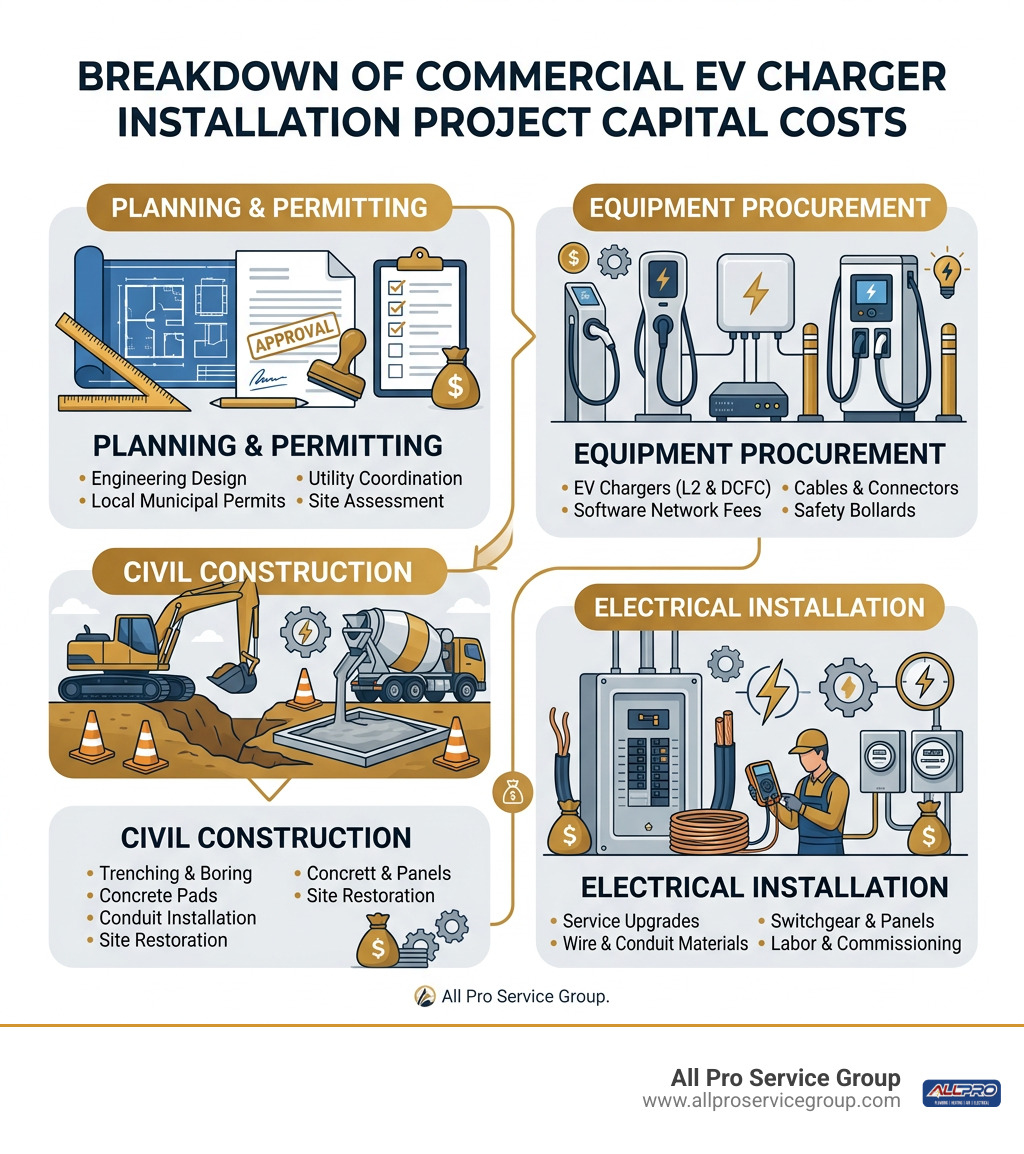
Developing a practical budget requires factoring in initial equipment procurement, physical site improvements, utility connection expenses, and ongoing cloud network fees.
Budget Factors for a Commercial EV Charger Install
For a clear picture of project expenses, consider our in-depth review of commercial EV charging station cost factors, alongside our business EV charger installation guide for 2026.
The primary cost components include:
- Hardware Costs: Commercial-grade Level 2 dual-port pedestals range from $1,500 to $9,000 per unit depending on screen displays, cable retraction, and weatherproofing ratings. DC fast chargers range from $20,000 to over $100,000 per dispenser based on kilowatt output.
- Civil and Electrical Labor: Trenching, boring, pouring concrete pads, pulling wire, and installing switchgear often represent 40% to 60% of total project costs.
- Utility Upgrades: Replacing transformers or installing new 400A–1200A 480V services can range from a few thousand dollars to upwards of $50,000 when heavy utility infrastructure is involved.
- Network & Software Fees: Networked stations with cellular connectivity, payment processing, and remote diagnostics generally run $250 to $600 per port annually in SaaS subscriptions.
Leveraging NEC 625.42 Load Management to Cut Costs
One of the most effective strategies to protect your budget is utilizing automated Energy Management Systems (EMS) under NEC 625.42.
Without load management, if a property installs ten 11.5 kW Level 2 chargers, the service panel must be sized for the full 115 kW continuous load. If the building only has 40 kW of spare electrical headroom, the owner is forced into a major transformer and service upgrade costing $30,000 to $80,000.
With dynamic load sharing, the intelligent system caps total cumulative draw at 40 kW. If two vehicles are plugged in, each receives full power; if ten vehicles plug in, the system shares available amperage across all ports. Because workplace and hotel utilization patterns show that vehicles rarely demand peak power at the exact same second, load management delivers an exceptional driver experience while eliminating unnecessary utility construction.
Incentives, Demand Charges, and Revenue Models
To maximize your return on investment, take advantage of available financial incentives and optimize your operational model:
- Federal Section 30C Tax Credit: Qualifies commercial properties in eligible census tracts for tax credits covering a percentage of hardware and installation costs (up to $100,000 per charger for qualifying projects).
- NEVI and Utility Programs: National Electric Vehicle Infrastructure (NEVI) formula programs and local electric utility make-ready rebates frequently offset electrical infrastructure costs by 30% to 80%.
- Managing Demand Charges: Commercial electric rates often include utility demand charges—fees tied to the single highest 15-minute power peak during a billing cycle. Deploying load management software or co-locating battery storage prevents charging spikes from inflating your property's monthly electric bill.
- Direct Revenue Generation: Property owners can set fee structures (per kWh, per hour, or session-based parking fees) through OCPP back-office software to recover electricity costs and generate recurring operating margins.
Frequently Asked Questions About Commercial EV Charging
How much does it cost to install commercial EV chargers?
Commercial Level 2 installations typically cost between $4,000 and $12,000 per port all-in, including commercial-grade hardware, permitting, electrical runs, and civil trenching. Direct Current Fast Charger (DCFC) installations range from $60,000 to $180,000+ per port due to 480V three-phase service requirements, dedicated transformers, and heavier civil engineering.
How long does a commercial EV charger installation take?
A turnkey Level 2 installation generally takes 6 to 14 weeks from initial engineering assessment to final commissioning. Most of this time is spent on utility review, site plan approvals, and equipment procurement; physical on-site construction usually takes just a few days to two weeks. Complex DC fast charging projects requiring major transformer upgrades can take 4 to 9 months depending on utility lead times.
Does installing commercial EV chargers require a utility service upgrade?
Not always. While high-power DC fast chargers almost universally require high-capacity 480V three-phase service upgrades, many Level 2 deployments can be installed on existing electrical service. By conducting an NEC 220 load calculation and implementing dynamic load management under NEC 625.42, properties can often deploy multiple charging ports using existing electrical capacity.
Conclusion
Commercial EV charging is rapidly transitioning from a novelty amenity into a vital business asset that drives customer traffic, lengthens dwell times, supports employee retention, and future-proofs commercial properties. By prioritizing comprehensive site assessments, engineering review, and intelligent power management, your business can build an electric vehicle infrastructure program that scales smoothly over time.
At All Pro Service Group, our team is proud to help businesses navigate every phase of their infrastructure build. From electrical load studies and panel upgrades to trenching and station commissioning, we provide the dependable craftsmanship your commercial facility deserves. Reach out to our team today to schedule your site assessment and get started with expert commercial EV charger installation.