
Is a 3 Unit Mini Split Right for Your Home?
A 3 unit mini split uses one outdoor heat pump and three indoor air handlers to heat or cool three separate spaces. It is often the best fit when you want independent comfort in areas such as a primary bedroom, home office, and main living room without adding ductwork.
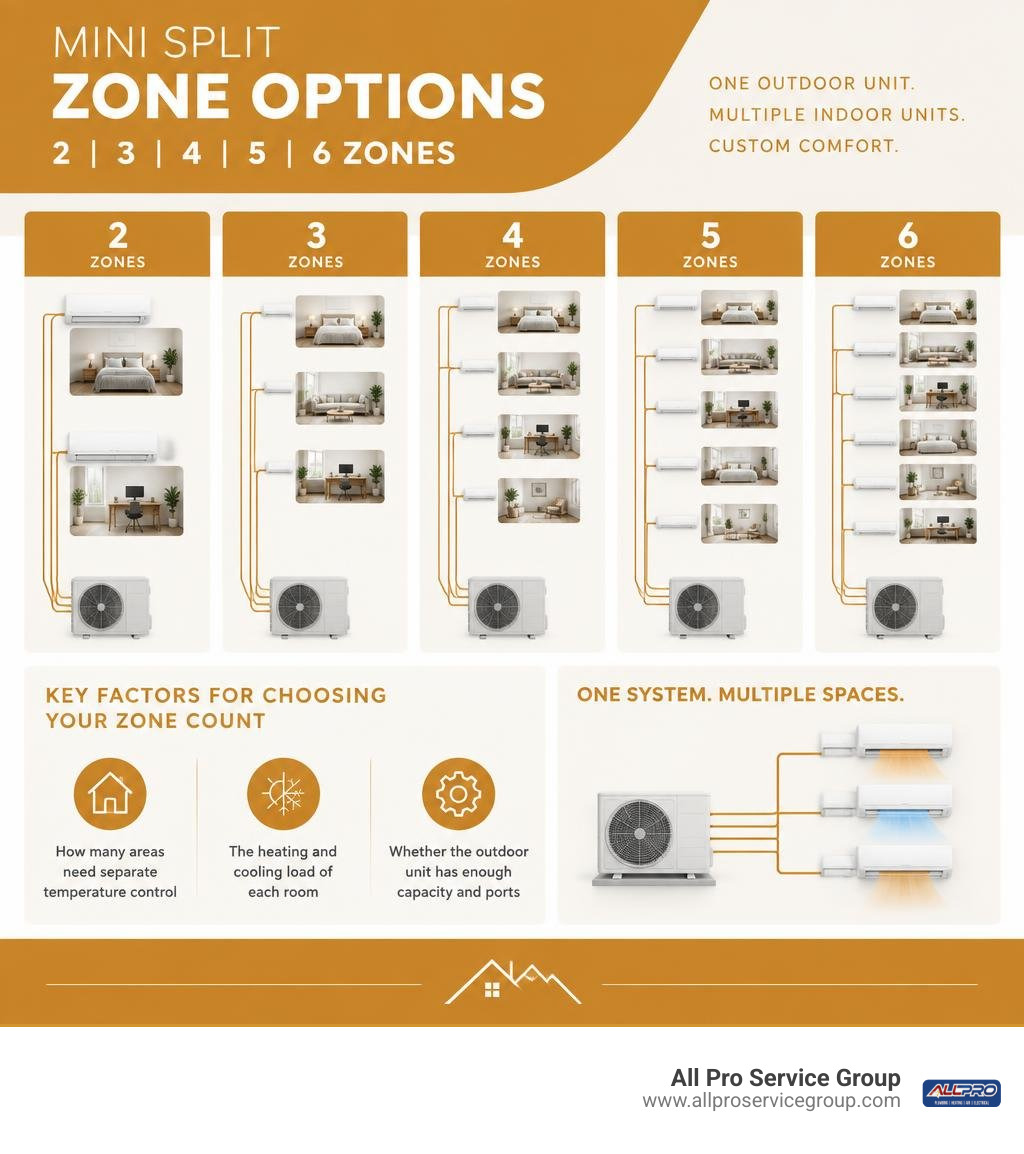
Choose between 2 and 6 zones by focusing on three factors:
- How many areas need separate temperature control
- The heating and cooling load of each room, not just its square footage
- Whether the outdoor unit has enough capacity and ports for every indoor unit
Most three-zone systems offer roughly 18,000 to 36,000 BTU of total capacity. Proper sizing matters more than choosing the biggest system: an oversized unit can cycle too often, while an undersized one may struggle during Salt Lake's hottest and coldest weather.
At All Pro, our team has helped Greater Salt Lake homeowners since 2008 evaluate heating and cooling needs, including selecting and installing the right 3 unit mini split configuration for real home layouts.
Understanding Multi-Zone Ductless HVAC Systems
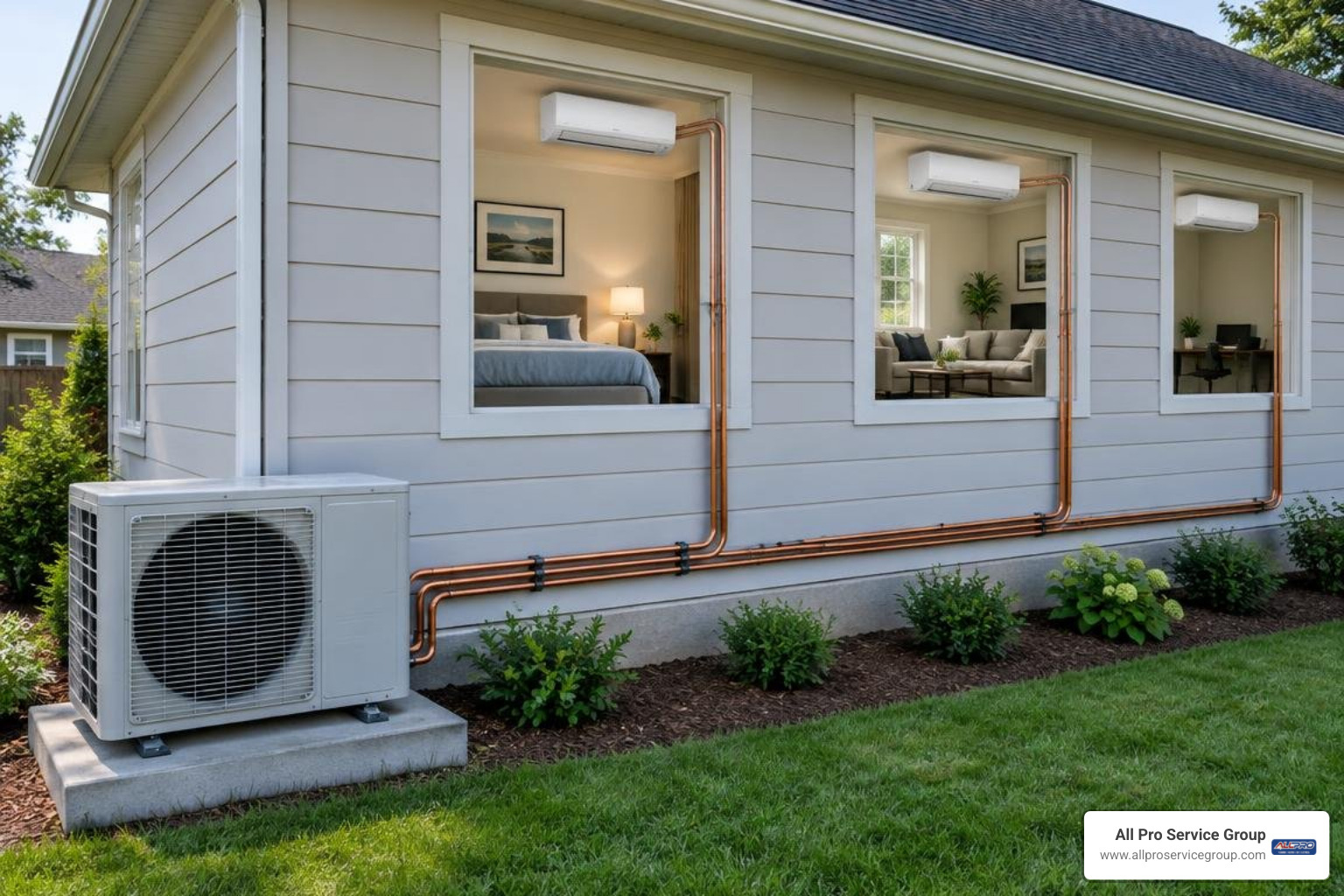
A multi-zone ductless heat pump operates on a simple yet sophisticated principle: one robust outdoor condenser powers multiple indoor air handlers. Instead of relying on a network of leaky sheet-metal ductwork, small, insulated copper line sets circulate refrigerant directly between the outdoor compressor and each living area.
Inside the outdoor unit sits an inverter-driven compressor. Unlike traditional fixed-speed systems that blast on at 100% capacity and abruptly shut off, an inverter system continuously modulates its motor speed. It delivers variable refrigerant flow matching the exact thermal demand across your home. If only your home office needs cooling in the afternoon, the outdoor unit throttles down to provide just enough refrigerant for that single zone, conserving substantial amounts of electrical energy.
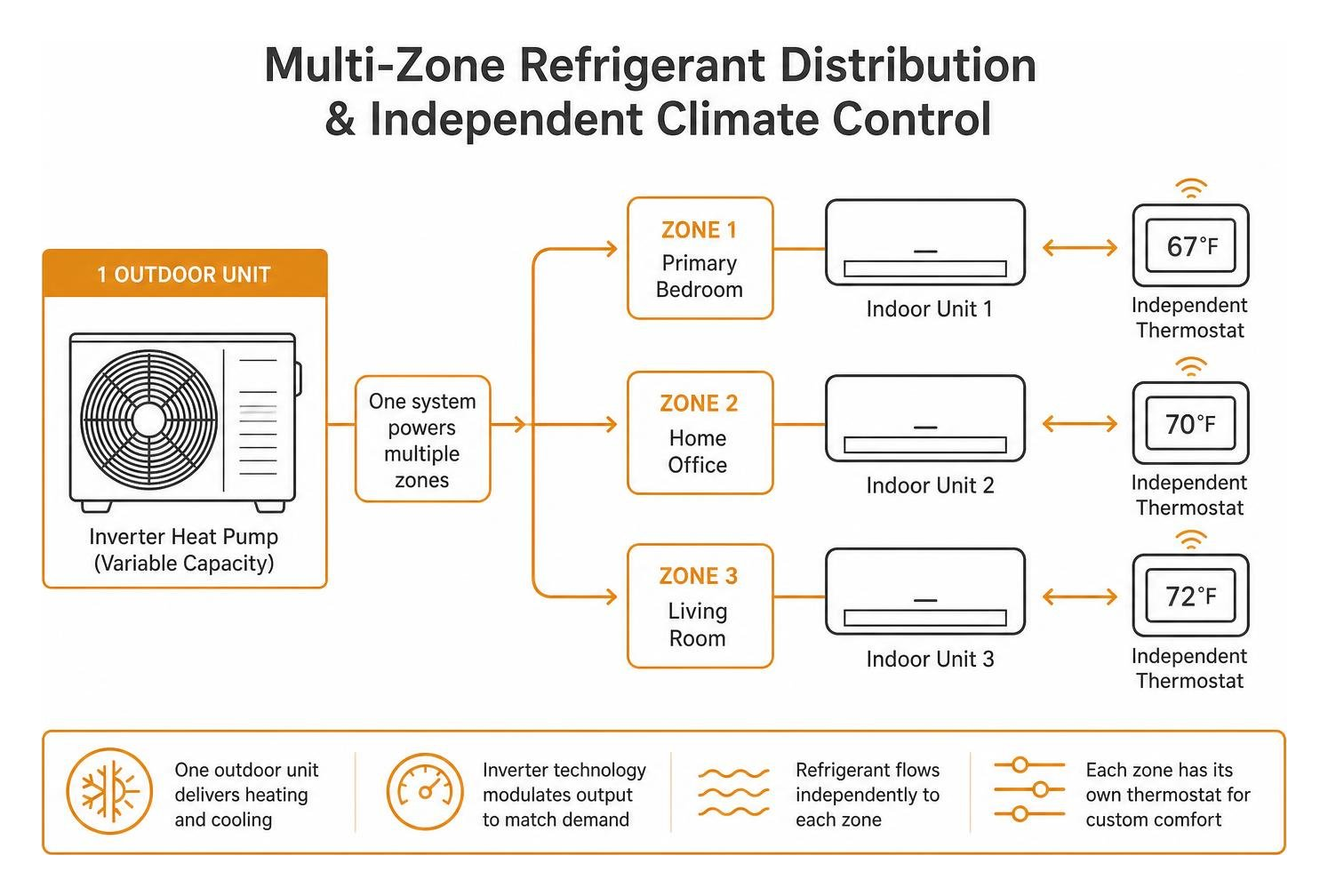
Each indoor head features its own dedicated thermostat, electronic expansion valve, and wireless remote control. This means someone can sleep comfortably at 67°F in the master bedroom while the living area stays at a relaxed 72°F—all powered seamlessly by the same whisper-quiet outdoor condenser.
Comparing Configurations: From 2-Zone to 6-Zone Systems
Multi-port condensers give homeowners tremendous versatility when designing a whole-home zoning layout. Depending on your home's square footage, architectural layout, and lifestyle needs, the number of zones you select directly influences overall comfort, installation complexity, and efficiency.
| Configuration | Typical Outdoor Capacity (BTU) | Typical Coverage Area | Ideal Residential Application |
|---|---|---|---|
| 2-Zone (Dual) | 18,000 – 24,000 BTU | 800 – 1,400 sq. ft. | Master suite + nursery, guest house, or basement apartment |
| 3-Zone (Tri) | 24,000 – 36,000 BTU | 1,200 – 2,400 sq. ft. | Ranch-style home, main floor + 2 bedrooms, or flat |
| 4-Zone (Quad) | 36,000 – 48,000 BTU | 1,800 – 3,000 sq. ft. | Two-story home (2 upstairs bedrooms, kitchen, living room) |
| 5-to-6 Zone | 48,000 – 60,000+ BTU | 2,500 – 4,000+ sq. ft. | Large custom home, multi-generational layout, light commercial |
For smaller spaces or simple layouts, our guide to 24000 BTU dual-zone mini split systems provides deeper insight into paired setups. However, as family dynamics and home sizes grow, adding dedicated indoor heads ensures every occupant enjoys simultaneous comfort without thermostat tugs-of-war.
Why the 3 Unit Mini Split Is the Sweet Spot for Most Homes
For a significant number of households across the Salt Lake Valley, a tri-zone setup represents the perfect balance of upfront cost, architectural practicality, and targeted comfort. Covering anywhere from 1,500 to 2,400 square feet, a 3-zone system allows you to condition the core living spaces that consume the vast majority of your daily life:
- Primary Bedroom Suite: Kept cool and restful through the night without cooling empty daytime spaces.
- Home Office or Guest Room: Conditioned on demand during working hours.
- Main Open Living Area (Kitchen/Living Room): Handled by a higher-capacity indoor head during family gatherings.
From an engineering perspective, a typical 27,000 to 36,000 BTU outdoor unit matches standard residential electrical services effortlessly while providing enough compressor modulation range to prevent inefficient short-cycling during mild spring and autumn days.
High-Capacity 4-Zone to 6-Zone Layouts for Larger Properties
When conditioning larger multi-story homes or sprawling single-level properties, 4-zone to 6-zone systems become essential. These larger systems often use multi-circuit outdoor units combined with external branch boxes. Branch boxes act as central refrigerant manifolds, reducing the number of individual line sets that must travel across the exterior siding of your home.
High-capacity systems demand careful planning regarding extended line-set runs, oil return traps, and electrical load requirements. A 48,000 or 60,000 BTU condenser often pulls higher amperage and requires dedicated 40A to 50A breakers, making proper electrical evaluation during the initial design phase vital.
How to Properly Size and Configure a 3 Unit Mini Split
Proper HVAC sizing is not a game of rough guesses or simply multiplying square footage by a generic number. At All Pro, we perform detailed Manual J load calculations to measure heat gain and heat loss accurately.
To explore system fundamentals across different home types, read our detailed ductless mini split system guide. Key factors influencing proper sizing include:
- Insulation Quality: Wall R-values, attic batts, and air infiltration rates.
- Window Exposure: West-facing windows in Utah summers absorb immense radiant solar heat.
- Ceiling Height: Vaulted ceilings significantly increase the total volume of air requiring conditioning.
- Occupancy and Internal Loads: Kitchen appliances, electronics, and lighting all contribute to room heat loads.
Calculating BTU Distribution for Each Indoor Air Handler
Indoor air handlers generally range in capacity from 6,000 to 18,000 BTU or more. Selecting the right size for each room prevents high humidity, uneven temperatures, and noisy fan operation. Understanding baseline requirements starts with determining square footage per ton of cooling capacity, where one ton equals 12,000 BTU of heat removal.
For standard bedrooms (250–400 sq. ft.), a 9,000 BTU head is frequently ideal. For expansive master suites, living rooms, or open-concept kitchens, sizing 12,000 BTU individual zone units or 18,000 BTU handlers ensures the space cools rapidly even during triple-digit July heat.
Consider a common 27,000 BTU outdoor condenser paired with a 9k + 9k + 9k
or 9k + 9k + 12k
indoor combination. Inverter technology allows connected indoor heads to slightly exceed nominal outdoor capacity (often up to 130% diversity factor) because rarely do all three rooms demand maximum heating or cooling simultaneously.
Indoor Unit Styles: Wall Mounts, Ceiling Cassettes, and Concealed Ducts
Multi-zone systems allow you to mix and match different indoor head styles on the same outdoor heat pump:
- High-Wall Mounted Units: The most popular, cost-effective, and easy-to-service option. Modern designs are sleek, quiet, and integrate smoothly into standard rooms.
- Four-Way Ceiling Cassettes: Mounted flush against the ceiling between standard ceiling joists. They distribute airflow evenly in four directions—perfect for open-concept layouts or rooms with limited wall space.
- Concealed Ducted Units: Tucked completely out of sight in an attic, crawlspace, or drop ceiling. They connect to small architectural grilles, combining ductless efficiency with a hidden aesthetic. For larger open spaces, explore 24000 BTU ducted mini split configurations.
- Floor-Mounted Consoles: Installed low on the wall near baseboards, making them great replacements for old radiators or rooms with slanted attic ceilings.
Multi-Zone Efficiency, Installation Realities, and Investment Costs
Modern multi-zone heat pumps achieve remarkable efficiency ratings, frequently surpassing 21 to 24 SEER2 (Seasonal Energy Efficiency Ratio) and 10+ HSPF2 (Heating Seasonal Performance Factor). Industry transitions toward next-generation low-GWP refrigerants like R454B and R32 further enhance heat transfer efficiency while lowering environmental impact.
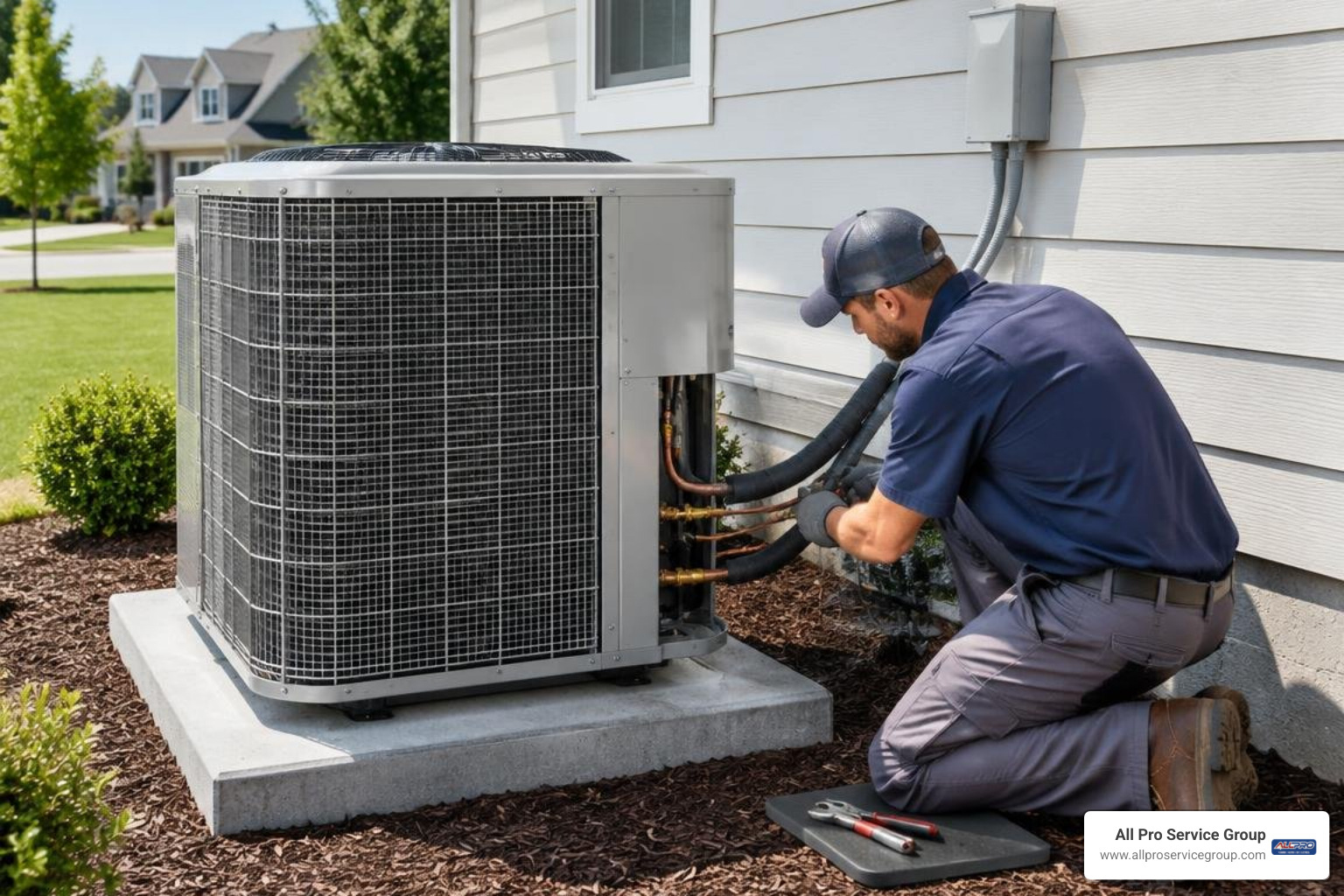
Understanding these metrics helps lower monthly utility bills; review our breakdown of 18000 BTU multi-split efficiency ratings to see how inverter compressors outperform standard central air units.
What Goes into Installing a 3 Unit Mini Split?
Installing a tri-zone heat pump is a comprehensive mechanical and electrical project typically requiring 2 to 3 days of labor.
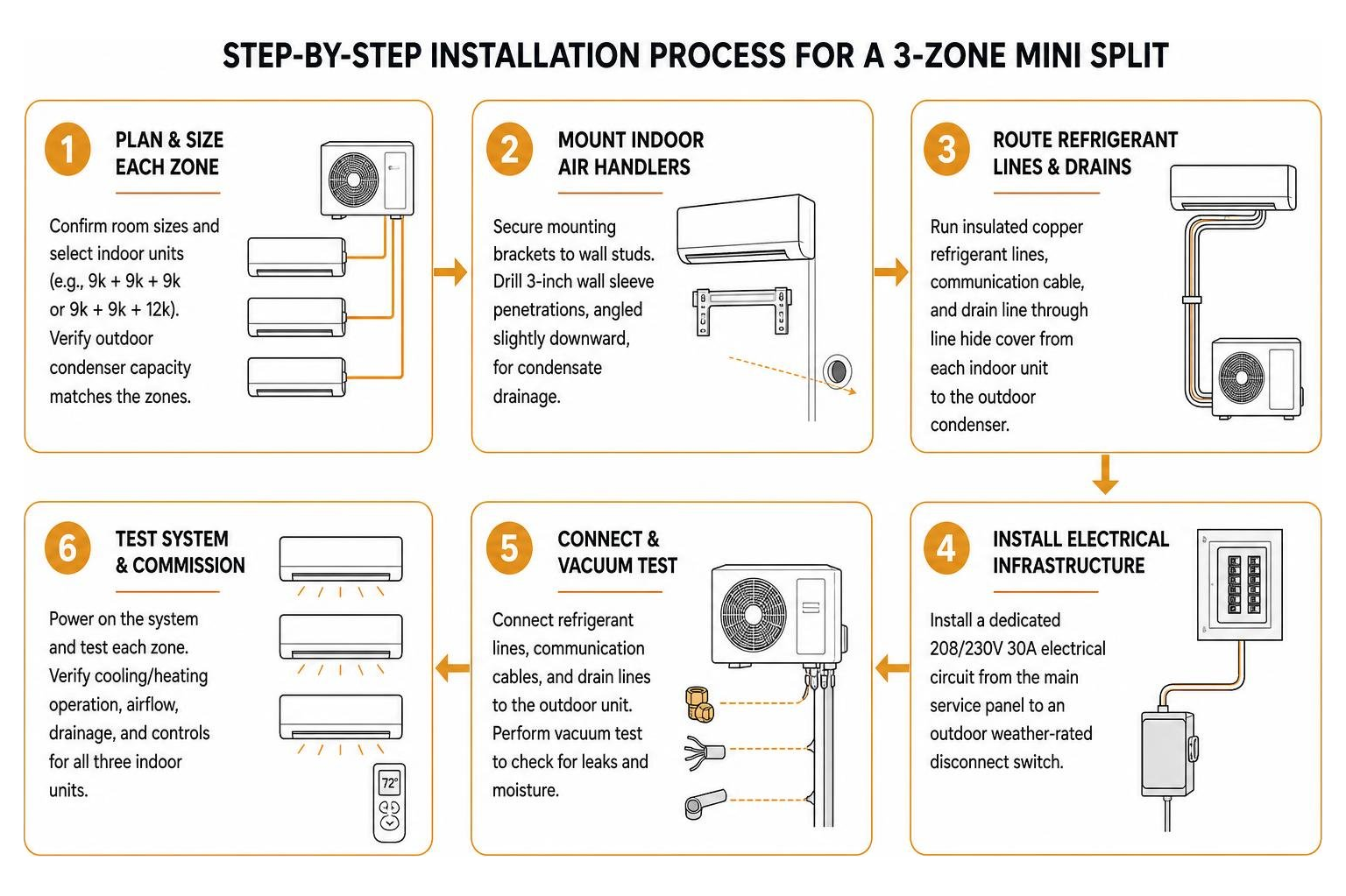
The process involves:
- Mounting Indoor Air Handlers: Securing mounting brackets to wall studs and drilling 3-inch wall sleeve penetrations angled slightly downward for condensate drainage.
- Refrigerant Line Routing: Running insulated copper lines, communication cabling, and drain lines through protective, paintable exterior line hide covers back to the condenser.
- Electrical Infrastructure: Installing a dedicated 208/230V 30A electrical circuit from the main service panel to an outdoor weather-rated disconnect switch.
- Pressure Testing & Evacuation: Pressurizing the lines with dry nitrogen to test for leaks, followed by pulling a deep vacuum below 500 microns to remove all moisture from the circuits before releasing refrigerant.
Cost Breakdown and Long-Term Operating Savings
A complete, professionally installed 3-zone ductless heat pump system typically ranges from $5,000 to $15,000, depending on equipment capacity, line run distances, electrical upgrades, and indoor unit styles.
- Equipment & Materials:$3,500 – $9,000 (condenser, indoor heads, line sets, mounting brackets, line covers).
- Labor & Permitting:$1,500 – $5,000 (licensed HVAC and electrical installation, system commissioning, city permits).
- Operational Savings: By turning off conditioning in unused zones and benefiting from inverter-driven SEER2 efficiency, homeowners often save 25% to 40% on heating and cooling utility costs compared to older electric baseboards or ducted systems. Many local Utah utility providers also offer substantial clean-energy rebates for qualifying ENERGY STAR rated heat pumps.
Essential Maintenance for Multi-Zone Heat Pump Longevity
Keeping your multi-zone mini split running smoothly requires regular homeowner care and periodic professional tune-ups.
- Wash Air Filters Quarterly: Slide out the removable mesh filters from each indoor head, rinse them under warm tap water, let them air dry completely, and pop them back in. Clean filters ensure maximum airflow and protect the evaporator coils.
- Run Self-Cleaning Cycles: Many modern units include a frost-and-dry self-clean mode that washes away indoor coil dust and prevents mildew buildup.
- Maintain Outdoor Clearances: Keep at least 12 to 24 inches of clear space around your outdoor condenser. Trim back shrubs, clear fall leaves, and brush away deep winter snowdrifts.
- Inspect Remote Batteries: If a unit will sit idle in a guest room, remove the remote control batteries to prevent terminal corrosion.
- Schedule Professional Inspections: Have a certified technician check flare fittings, verify operating pressures, and clean outdoor coils every few years.
Frequently Asked Questions About Multi-Zone Mini Splits
Can you add more indoor units to an existing mini split system later?
Only if your outdoor condenser was originally purchased with unused connection ports and adequate BTU capacity. For example, if you install two indoor heads on a 3-port, 27,000 BTU outdoor unit, you can easily connect a third head later. However, if your condenser only has three ports and all three are in use, expanding to a fourth room requires replacing the outdoor unit or installing an additional single-zone mini split.
How low can a multi-zone heat pump operate in freezing winter weather?
Modern cold-climate multi-zone heat pumps operate reliably in sub-zero conditions, with many advanced systems delivering steady heating down to -13°F or lower. These units utilize built-in base pan heaters to prevent ice buildup, along with advanced inverter vapor-injection compressors that maintain full heating output even when Utah winter temperatures drop sharply.
Can different rooms run heating and cooling at the same time on one outdoor unit?
Standard residential multi-zone mini splits operate on a single shared refrigeration circuit, meaning all active indoor heads must run in the same overall mode (either all heating or all cooling). If one room calls for cooling while another calls for heat, the system typically locks into the mode requested by the master unit or primary zone. For simultaneous independent heating and cooling in different rooms, larger commercial-grade heat recovery systems are required.
Choosing the Perfect Multi-Zone Setup for Your Home
Selecting the right multi-zone ductless system brings customized comfort, whisper-quiet operation, and lower monthly utility bills to your home. Whether you are outfitting a historic home without ductwork, finishing a basement, or solving stubborn hot and cold spots, proper design and precision installation are key to long-term performance.
At All Pro Service Group, our trained HVAC specialists perform comprehensive load calculations and electrical evaluations to help you choose the ideal equipment configuration. As a Gephardt Approved contractor proudly serving the Greater Salt Lake Valley since 2008, we are committed to delivering dependable craftsmanship, flexible financing options, and top-tier customer care.
Ready to transform your home comfort? Schedule professional ductless mini split installation and service with our expert team today!