
Choosing an Electric Tankless Water Heater for a Two-Bathroom Home
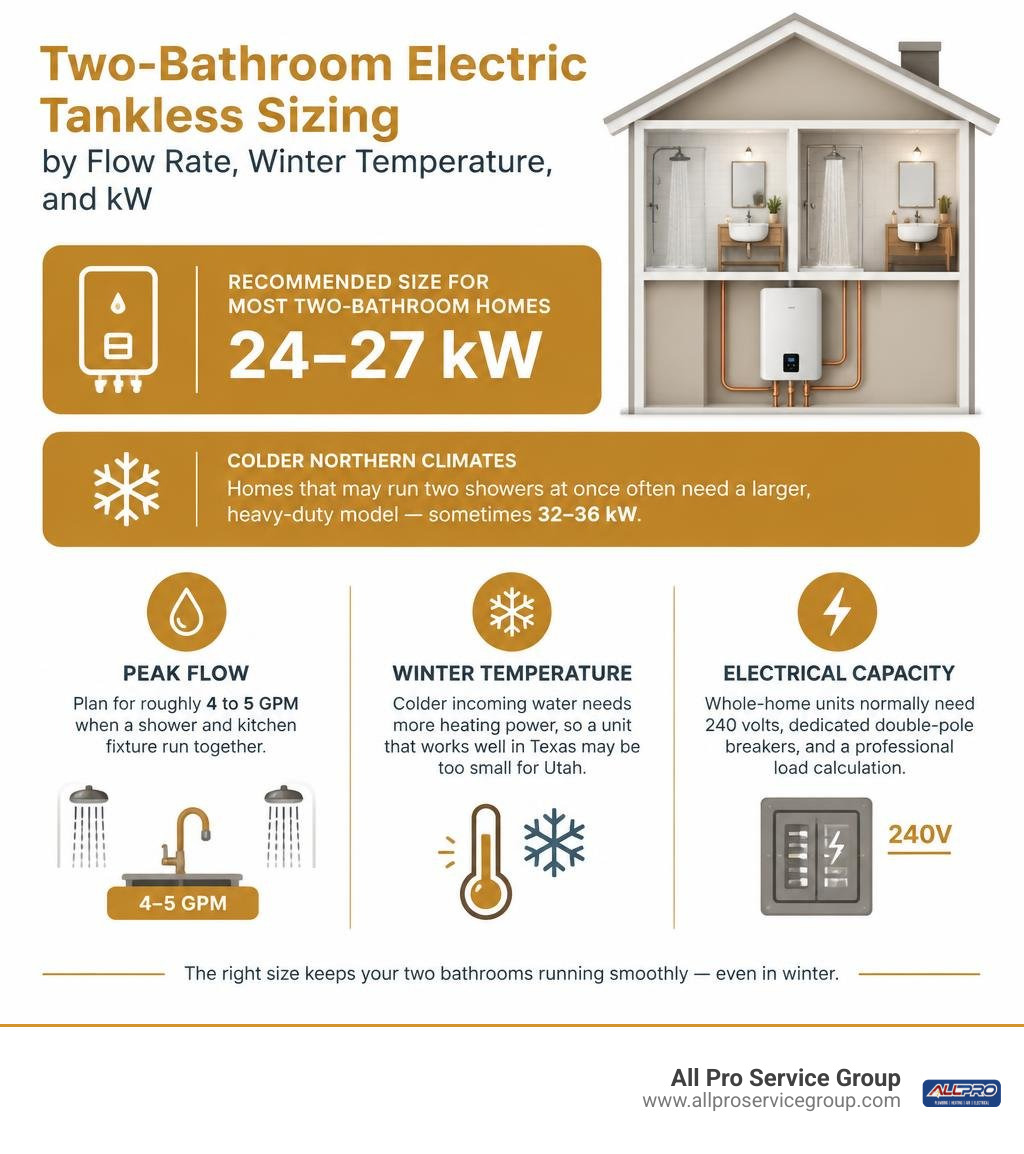
For most two-bathroom homes, a whole-house electric tankless unit in the 24 kW to 27 kW range is the starting point. In colder northern climates, including the Salt Lake area, homes that may run two showers at once often need a larger, heavy-duty model - sometimes 32 kW to 36 kW- to maintain the set temperature during winter.
Before buying an electric tankless water heater for a 2-bathroom house, confirm these three things:
- Peak flow: Plan for roughly 4 to 5 GPM when a shower and kitchen fixture run together. Two simultaneous showers can require more.
- Winter water temperature: Cold incoming water needs more heating power, so a unit that works well in Texas may be too small for Utah.
- Electrical capacity: Whole-home units normally need 240 volts, dedicated double-pole breakers, and a professional load calculation. A 200-amp panel may work, but it is not an automatic yes.
Electric tankless heaters are compact and highly efficient because they heat water only when a fixture calls for it. But unlike a storage tank, their real-world output is limited by available kW, incoming-water temperature, and the number of fixtures used at the same time.
All Pro has been serving Greater Salt Lake homeowners with plumbing, heating, cooling, and electrical work since 2008. Our experience evaluating an electric tankless water heater for a two-bathroom house helps homeowners match hot-water demand with the electrical system their home can safely support.
Sizing an Electric Tankless Water Heater for a 2-Bathroom House
Choosing the right tankless system comes down to physics: flow rate and temperature rise. Unlike a conventional 50-gallon tank that steadily preheats water over hours, an on-demand unit must flash-heat every drop of water in real time as it rushes across internal heating elements. If your peak morning demand exceeds what your unit's heating chambers can handle, your water temperature drops immediately.
Proper sizing requires looking beyond the number of bedrooms or square footage. We have to calculate the maximum volume of hot water your home uses at any single moment, paired with how cold your city's municipal water gets before it reaches your front door. For a detailed breakdown of these systems, check out our comprehensive tankless water heater guide.
Peak Flow Rate (GPM) Calculation for Simultaneous Fixtures
To ensure you never get an unexpected blast of ice water while someone else turns on a faucet, we calculate the total gallons per minute (GPM) your home might demand simultaneously.
Standard modern fixtures have predictable flow rates under standard water pressure:
- Standard Showerhead: 2.0 to 2.5 GPM
- WaterSense Showerhead: 1.5 to 1.75 GPM
- Kitchen Sink Faucet: 1.5 to 2.2 GPM
- Bathroom Vanity Faucet: 0.5 to 1.5 GPM
- Automatic Dishwasher: 1.0 to 1.5 GPM
- Washing Machine: 2.0 GPM
According to ENERGY STAR fixture flow rates guideline, a typical 2 to 3 person household faces peak morning demand periods around 7:00 AM to 8:00 AM. If one person takes a shower (2.5 GPM) while someone rinses dishes at the kitchen sink (2.2 GPM), your system faces a combined peak demand of 4.7 GPM.
If both bathrooms feature simultaneous showers running alongside a bathroom vanity, that demand quickly surges past 5.5 GPM. Sizing your system to handle these realistic overlapping events prevents morning scheduling battles.
Groundwater Temperature Rise and Climate Factors
Flow rate is only half the equation. The second critical metric is the required temperature rise, known in the plumbing trade as Delta T ($\Delta T$).
$$\Delta T = \text{Desired Output Temperature} - \text{Incoming Groundwater Temperature}$$
Most homeowners prefer their hot water delivered at a comfortable $115^\circ\text{F}$ to $120^\circ\text{F}$.
In southern states like Florida or parts of Texas, municipal groundwater rarely dips below $65^\circ\text{F}$ to $75^\circ\text{F}$. Heating $70^\circ\text{F}$ water to $120^\circ\text{F}$ requires a modest $50^\circ\text{F}$ rise. A modest 18 kW to 24 kW electric unit can easily deliver 4 to 5 GPM under those mild conditions.

In colder mountain and northern climates like Northern Utah, winter groundwater coming from mountain reservoirs or deep aquifers often drops to $40^\circ\text{F}$ to $45^\circ\text{F}$.
Raising $40^\circ\text{F}$ water to a steamy $120^\circ\text{F}$ requires an intense $80^\circ\text{F}$ temperature rise. Because the heating elements must transfer twice as much thermal energy per gallon, the same unit will produce only half its rated flow rate during the coldest weeks of January. Sizing your system for average summer temperatures is one of the most common mistakes homeowners make.
Power and Electrical Requirements for Whole-House Units
Electric tankless systems do not use energy when water is idle, achieving up to 99% thermal efficiency. However, the moment multiple hot-water valves open, their electrical appetite spikes dramatically. Understanding your home's electrical backbone ensures your system delivers reliable performance without tripping breakers.
Choosing the Right kW Electric Tankless Water Heater for a 2-Bathroom House
Electric tankless units are measured by their electrical power consumption in kilowatts (kW). To heat water instantly at high flow rates, units contain between two and four independent heating chambers that modulate their power draw depending on how fast water flows through them.
Here is how power output translates to real-world performance across different temperature rise conditions:
| Unit Power Rating | Approximate Amps @ 240V | Flow Rate @ $40^\circ\text{F}$ Rise (Warm Climate) | Flow Rate @ $60^\circ\text{F}$ Rise (Moderate Climate) | Flow Rate @ $80^\circ\text{F}$ Rise (Cold Climate Winter) |
|---|---|---|---|---|
| 18 kW | 75 A | 3.1 GPM | 2.0 GPM | 1.5 GPM |
| 24 kW | 100 A | 4.1 GPM | 2.7 GPM | 2.0 GPM |
| 27 kW | 112.5 A | 4.6 GPM | 3.1 GPM | 2.3 GPM |
| 32 kW | 133 A | 5.5 GPM | 3.6 GPM | 2.7 GPM |
| 36 kW | 150 A | 6.1 GPM | 4.1 GPM | 3.1 GPM |
In warmer regions, a 24 kW or 27 kW unit can comfortably power two showers at the same time. But in colder regions with an $80^\circ\text{F}$ winter temperature rise, running two simultaneous low-flow showers (totaling 3.5 to 4.0 GPM) demands a heavy-duty 32 kW or 36 kW unit to keep water hot.
Electrical Panel Capacity and Breaker Configuration
A heavy-duty 27 kW to 36 kW electric water heater requires significant electrical infrastructure. You cannot simply plug a whole-house tankless unit into an ordinary 120V wall receptacle.
Key electrical specifications for whole-house units include:
- Voltage: Dedicated 240V single-phase electrical supply.
- Breaker Space: High-wattage units do not use a single giant circuit breaker. A 36 kW unit typically requires four separate 40-amp double-pole breakers or three 50-amp breakers inside your main panel.
- Wiring Gauge: Each individual circuit requires heavy-gauge copper wiring, typically 8 AWG wire, run directly from the main panel to the unit terminals.
- Panel Capacity: Standard residential homes often feature 100-amp, 150-amp, or 200-amp main service panels. A 36 kW heater draws up to 150 amps on its own at maximum output.
If your home has a 100-amp or 150-amp electrical panel, installing a whole-home electric tankless unit will require a service upgrade. Even with a 200-amp panel, you need a load calculation to verify that your central air conditioner, electric dryer, EV charger, and range leave enough headroom. When additional capacity is required, our team provides dedicated electrical panel upgrade services to ensure your system meets local safety codes. You can also explore available hardware on The Home Depot's residential tankless water heaters overview.
Top Heavy-Duty System Types: Whole-House vs. Multi-Point Units
When outfitting a two-bathroom home, you have two primary configuration strategies: a single centralized whole-house system or multiple point-of-use units dedicated to specific plumbing zones.
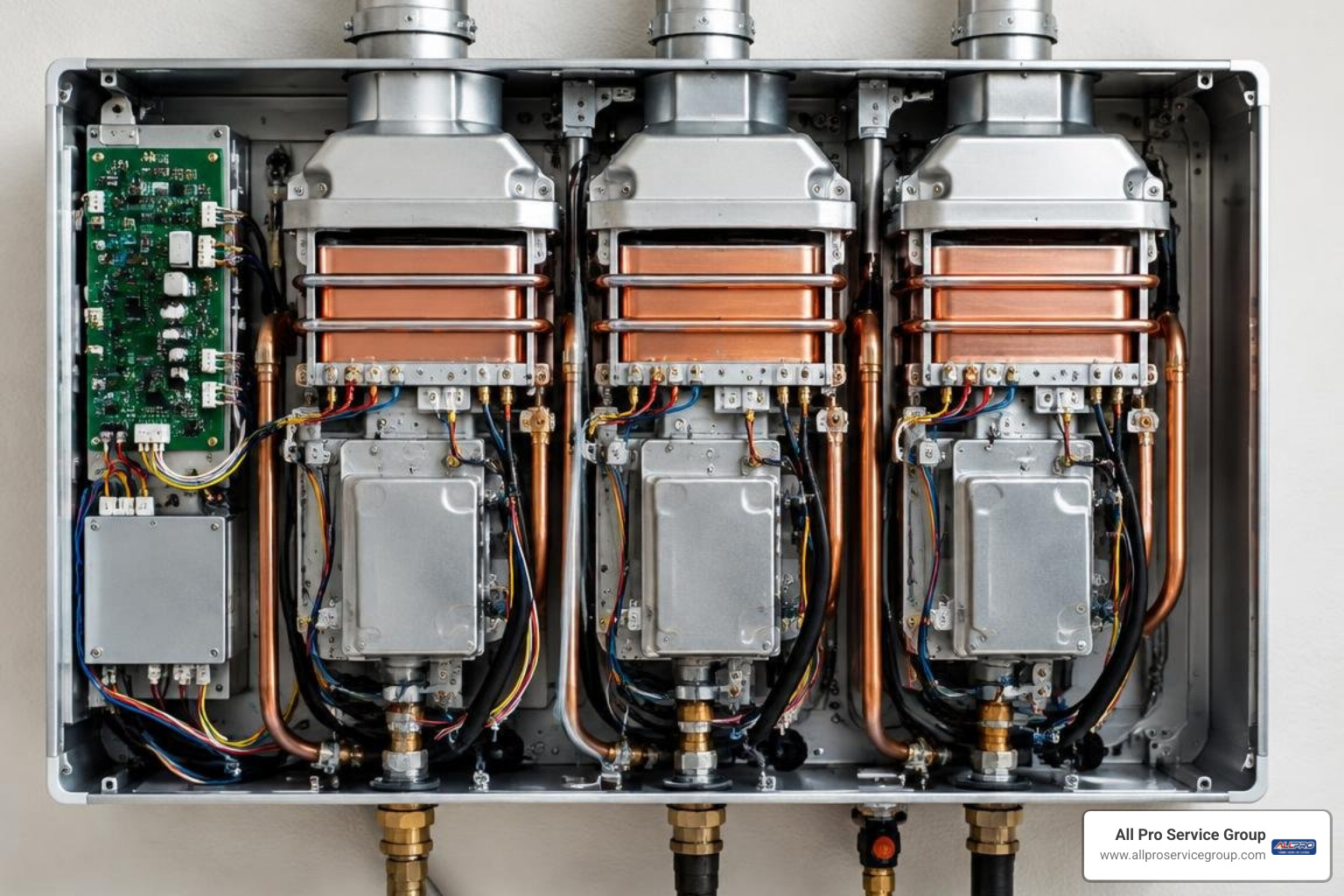
Installing a Whole-Home Electric Tankless Water Heater for a 2-Bathroom House Layout
A centralized whole-house system replaces your existing tank in the basement, utility room, or garage. It ties directly into your central hot-water trunk line and distributes hot water throughout the entire property.
Advantages of Whole-House Systems:
- Centralized Maintenance: All filters, heating elements, and isolation valves are located in one accessible utility space.
- Self-Modulating Efficiency: Units dynamically activate only the heating chambers necessary to satisfy the current flow rate, conserving power when only a single faucet is running.
- Clean Aesthetics: Compact wall-hung footprints free up roughly 12 to 16 square feet of floor space compared to bulky storage tanks.
To review step-by-step installation practices and code requirements, take a look at our new 2026 water heater installation guide.
Dedicated Point-of-Use Alternatives for Distant Bathrooms
In split-floorplan ranch homes or multi-story properties where bathrooms sit on opposite ends of the house, a single central heater can create a frustrating delay while cold water purges from long plumbing runs.
An alternative approach involves installing two smaller point-of-use (POU) heaters (such as a 12 kW to 14 kW unit dedicated to each bathroom zone).
When Point-of-Use Makes Sense:
- Eliminating Pipe Lag: Placing a compact unit under a vanity or in an adjacent closet delivers near-instant hot water to that specific bathroom.
- Eliminating Standby Pipe Losses: Water does not cool down sitting inside dozens of feet of copper pipe running through cold crawlspaces.
- Staggered Electrical Loads: Rather than running multiple heavy 8 AWG lines to a single central location, electrical runs are distributed closer to their respective subpanels or branch circuits.
However, installing multiple point-of-use units requires adequate physical clearance and electrical wiring run to multiple living areas, which can increase overall installation labor.
Total Cost, Energy Savings, and Fuel Comparisons
Transitioning to an on-demand electric water heating system involves equipment costs, electrical adjustments, and long-term utility savings.
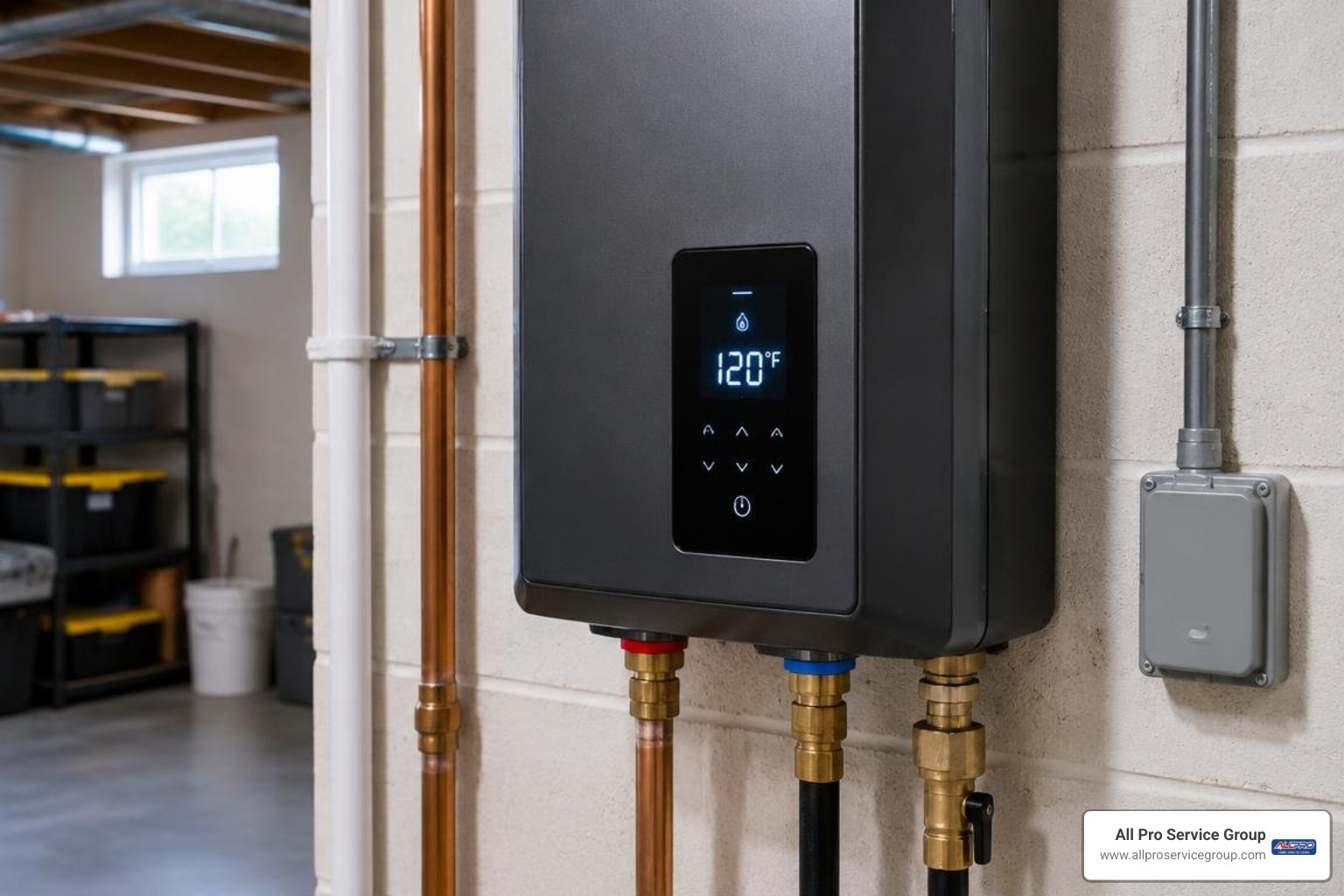
Equipment and Installation Costs
The purchase price of an electric tankless water heater is often lower than a comparable high-output gas model. However, overall project costs depend heavily on your home's existing electrical service.
- Unit Purchase Price: A heavy-duty 24 kW to 36 kW whole-house unit typically costs between $600 and $1,200.
- Plumbing Installation: Mounting the unit, installing code-compliant isolation service valves, expansion adjustments, and plumbing tie-ins typically ranges from $800 to $1,500.
- Electrical Upgrades: Running multiple 240V lines, installing dedicated breakers, and completing a 200-amp service panel upgrade (if needed) can range from $500 to $3,500+ depending on panel capacity and distance to the utility connection.
To help manage these home improvements comfortably, we provide flexible payment options with home improvement financing solutions.
Electric vs. Gas Tankless: A Practical Comparison
Homeowners weighing electric against natural gas models should consider several key operational differences:
- Venting Requirements: Gas units require specialized category III or IV stainless steel or PVC/polypropylene direct venting through an exterior wall or roof, along with fresh combustion air intake. Electric units require zero venting, making placement flexible.
- Gas Supply Lines: Upgrading to a whole-house gas tankless unit often requires upsizing existing black iron gas pipes from 1/2-inch to 3/4-inch or 1-inch to supply 150,000 to 199,000 BTUs.
- Maintenance Needs: Electric units have no burners, gas valves, or ignition rods to foul with soot, though they still require periodic flushing in areas with hard water to prevent scale accumulation on heating elements.
- Operating Efficiency: Electric tankless units operate at 98% to 99% energy efficiency, whereas standard non-condensing gas units achieve roughly 80% to 85% (and condensing units reach 90% to 96%).
Frequently Asked Questions About 2-Bathroom Tankless Units
Can a 200-amp electrical panel support an electric tankless water heater?
Yes, in many homes a 200-amp panel can support an electric tankless water heater, but it depends on your home's other electrical loads. A heavy-duty 27 kW or 36 kW unit draws between 112 and 150 amps at maximum demand. If your home also runs an electric central heat pump, electric range, electric clothes dryer, and Level 2 electric vehicle charger, a standard 200-amp panel may experience peak overloads.
A licensed professional must perform an official NEC (National Electrical Code) load calculation. If continuous and non-continuous loads exceed 80% of panel capacity, you may need a 225-amp or 300-amp service upgrade, or smart energy management load-shedding devices.
What happens if incoming winter groundwater gets too cold?
If winter groundwater drops to $40^\circ\text{F}$ and your demand exceeds the heater's kilowatt heating capacity, modern self-modulating units automatically protect your comfort using one of two methods:
- Flow Restriction: Advanced units feature an internal motorized flow-control valve that throttles water volume down (for example, reducing flow from 4.5 GPM to 2.8 GPM) to ensure the water leaving the tap reaches your set temperature.
- Temperature Drop: Units without automatic flow restrictors will maintain full water flow, but the delivered water temperature will dip below your setpoint, resulting in lukewarm showers during peak simultaneous use.
This is why sizing your unit for winter peak conditions is essential.
Is electric tankless cheaper to install than gas in a two-bathroom home?
If your electrical panel already has adequate amperage headroom and open breaker slots within close distance to the installation site, electric tankless installation is often simpler and less expensive than gas because it eliminates the need for roof penetrations, dedicated exhaust blowers, and gas line enlargements.
However, if your home requires a full 200-amp or 300-amp service panel replacement from the utility connection, the electrical upgrade costs can make the initial installation investment comparable to or higher than a gas installation.
Conclusion
Upgrading to an on-demand hot water system is a smart way to reclaim square footage, boost energy efficiency, and enjoy continuous hot water. But for a two-bathroom home, proper sizing is everything. Balancing your family's peak simultaneous fixture usage against winter groundwater temperatures ensures your new system keeps up year-round.
At All Pro Service Group, our licensed plumbing and electrical technicians handle every phase of your transition—from calculating hot water loads and verifying electrical panels to complete installation and maintenance.
Contact our team today for a home assessment and expert tankless water heater installation tailored to your household.