
Why a Rinnai Gas Hot Water System Belongs in Your Home
A Rinnai gas hot water system heats water only when you need it — no tank, no standby waste, no cold surprises mid-shower. Here's what you need to know at a glance:
- How it works: Cold water flows through the unit, gets heated instantly by a gas burner, and delivers continuous hot water to your tap.
- Key benefit: You never run out of hot water, even with back-to-back showers.
- Energy savings: Rinnai condensing models reach up to 0.98 UEF (Uniform Energy Factor), meaning nearly all the energy used goes directly into heating your water.
- Lifespan: Rinnai tankless units last up to twice as long as traditional storage tank heaters.
- Best for: Homes of any size — from single-bathroom to large multi-bathroom households.
Rinnai has over 100 years of manufacturing experience and produces more than 12 million gas hot water appliances every year. That kind of scale and history means tight quality control, individually tested units, and a product line that covers everything from compact 12L-per-minute systems to high-output models serving multiple showers at once.
If you're tired of a bulky tank eating up space, rising energy bills, or the dreaded cold blast at the end of a shower, a Rinnai continuous flow system is worth a serious look.
At All Pro Service Group, our team has been installing and servicing Rinnai gas hot water systems across the Greater Salt Lake Valley since 2008. We've seen how the right tankless system transforms daily comfort — and we're here to help you choose and install yours correctly the first time.
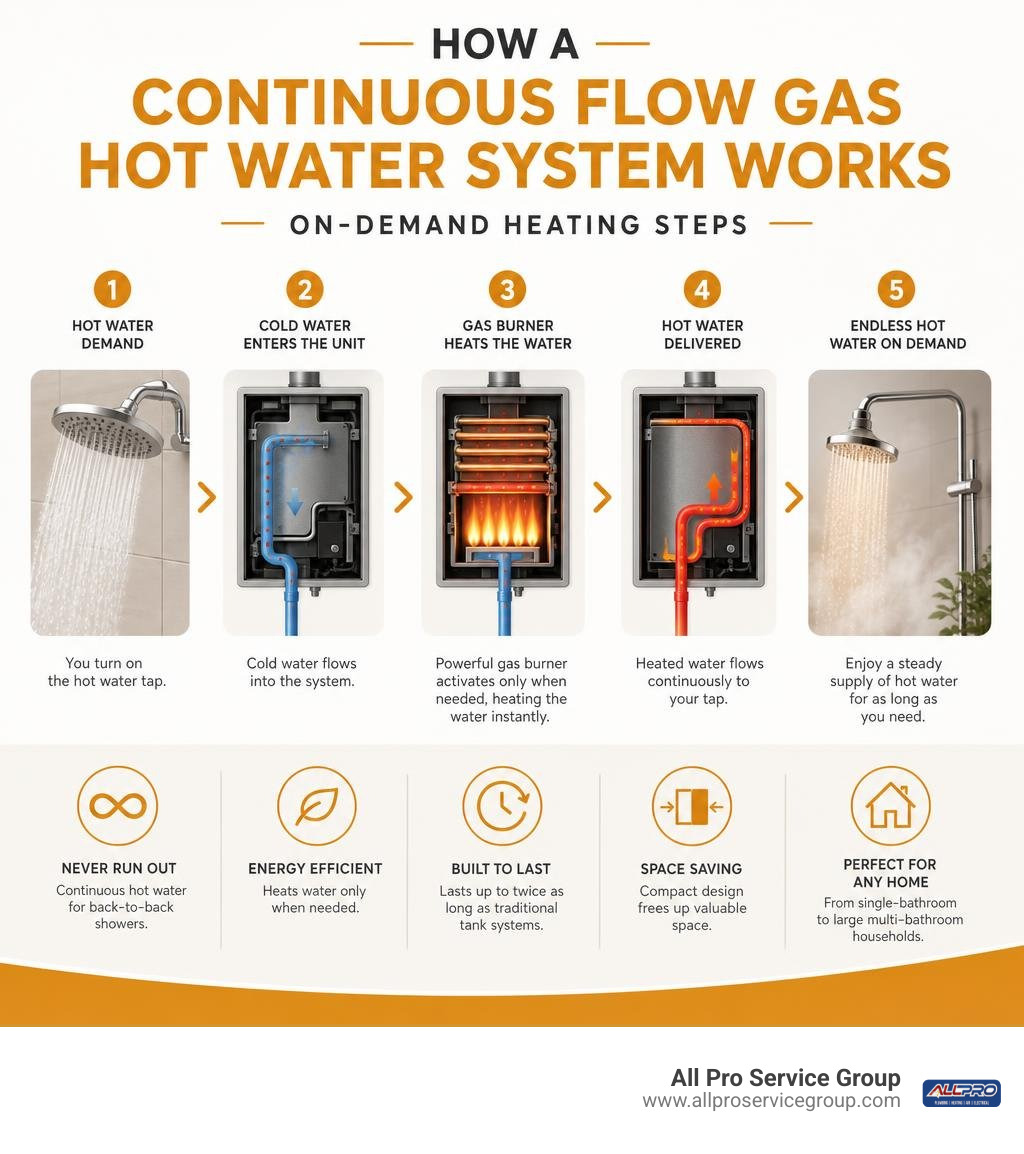
Key Benefits of a Rinnai Gas Hot Water System
When you think about traditional water heaters, you probably picture a massive, metal cylinder hiding in your basement or utility closet. For decades, that was the standard way to keep a household in hot water. But standard doesn't necessarily mean efficient.
Traditional storage tanks suffer from a major design flaw known as standby heat loss. To ensure you have hot water ready when you turn on the tap, a storage tank must constantly heat and reheat those 40, 50, or 80 gallons of water all day and all night—even when everyone is fast asleep or away at work. It is the energy equivalent of leaving your car idling in the driveway just in case you need to run an errand later.
A Rinnai gas hot water system completely eliminates standby heat loss. By heating water only on demand, these continuous flow systems can reduce your gas usage by up to 30% compared to traditional storage tank water heaters. You only burn gas when a hot water tap is actually turned on. Learn more in our Tankless Water Heater Complete Guide to see how making the switch can permanently lower your monthly utility costs.
Endless Hot Water and Space Savings
Beyond the substantial energy savings, the most immediate lifestyle upgrade is the luxury of endless hot water. In a home with a traditional tank, hot water is a finite resource. Once those 50 gallons are drained by back-to-back showers, a load of laundry, and the dishwasher running simultaneously, the system goes cold. You are forced to wait up to an hour for the tank to recover.
With a tankless system, the hot water keeps flowing as long as the tap is open. If you have guests staying for the holidays or a large family getting ready in the morning, everyone gets a hot shower.
Furthermore, Rinnai systems feature an incredibly compact, wall-mounted design. Usually about the size of a carry-on suitcase, these units free up valuable square footage in your home. Instead of sacrificing an entire closet or a large corner of your basement to a bulky tank, a tankless unit can be neatly mounted on an interior or exterior wall.
For those looking to maximize their home's spatial efficiency, models like the Infinity B26 Gas Continuous Flow Hot Water System | Rinnai Australia showcase just how much heating power can be packed into a sleek, space-saving chassis.
Lifespan and Warranty Advantages
Investing in a home appliance is as much about longevity as it is about daily performance. Traditional storage tanks have a relatively short life expectancy, typically lasting between 8 and 12 years before the internal lining corrodes and the tank begins to leak (often causing expensive water damage in the process).
Rinnai tankless water heaters are built to commercial-grade standards, allowing them to last up to 20 years—twice the average lifespan of a traditional tank. Because Rinnai manufactures the vast majority of its own key components rather than outsourcing them, their quality control is incredibly tight. If a single part does wear out over time, individual components can easily be replaced. This is a massive advantage over storage tanks, where a single structural failure means you must scrap the entire unit and pay for a brand-new system.
To back up this commercial-grade durability, Rinnai offers industry-leading warranties. On select models, you can secure up to a 25-year extended heat exchanger warranty by participating in their scheduled service program. Additionally, registering your newly installed Rinnai product within 90 days of installation adds four years of labor coverage at no extra cost—a valuable $250 bonus that provides ultimate peace of mind. To ensure your new system is set up to qualify for every available warranty protection, it is always best to schedule a professional Water Heater Installation.
Condensing vs. Non-Condensing Rinnai Models
If you have decided to upgrade to a Rinnai gas hot water system, your next major decision is choosing between a condensing and a non-condensing model. Both options deliver continuous hot water, but they use different internal technologies to manage the heat generated during the combustion process.
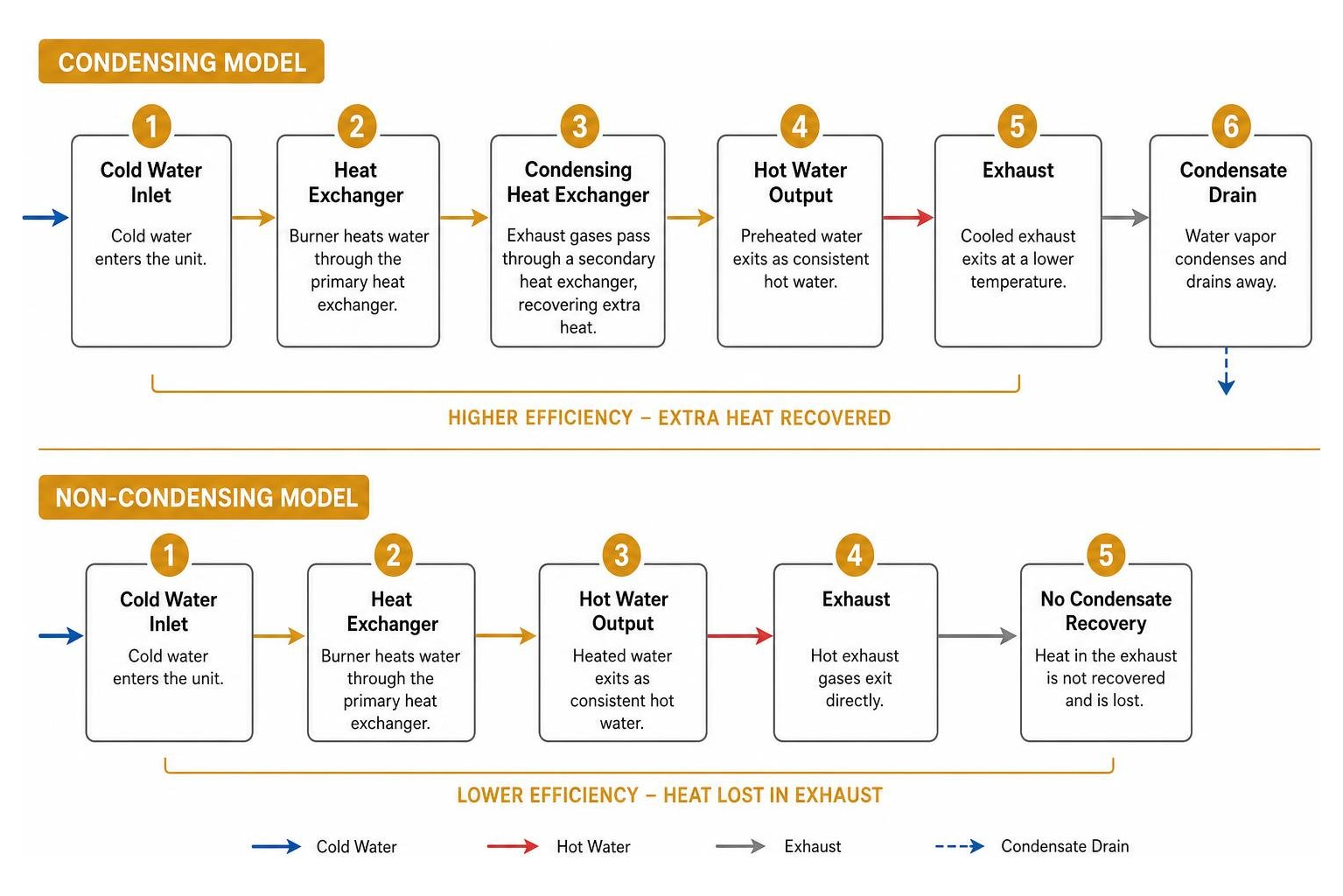
To help you visualize the core differences in efficiency, operating costs, and design, here is a direct comparison of the two technologies:
| Feature | Condensing Models (e.g., SENSEI RX/RXP) | Non-Condensing Models (e.g., RE/REP) |
|---|---|---|
| Uniform Energy Factor (UEF) | Up to 0.98 | 0.81 to 0.82 |
| Thermal Efficiency | Exceeds 95% | Approximately 80% to 82% |
| Heat Exchangers | Dual (Primary Copper + Secondary Stainless Steel) | Single (Copper) |
| Exhaust Gas Temperature | Cool (around 100°F to 110°F) | Hot (up to 300°F or more) |
| Venting Material | Low-cost PVC or CPVC | Heat-resistant Metal (Category III Stainless Steel) |
| Condensate Drain | Required (produces acidic runoff) | Not Required |
| Best Suited For | Larger homes, high hot water demand, maximum green savings | Budget-conscious installations, smaller homes, retrofits |
SENSEI RX and RXP Condensing Series
Condensing tankless water heaters represent the absolute pinnacle of energy-efficient water heating. In a standard non-condensing unit, the hot exhaust gases created by burning natural gas or propane are vented directly outside, carrying a significant amount of unused heat energy with them.
Condensing models feature a dual heat exchanger design. After the water passes through the primary copper heat exchanger, it travels through a secondary stainless steel heat exchanger. This secondary exchanger captures the residual heat from the exhaust gases before they leave the unit, preheating the incoming cold water.
By reclaiming this waste heat, Rinnai’s SENSEI RX and RXP condensing models achieve an astonishing Uniform Energy Factor (UEF) of up to 0.98. This means that 98% of the gas burned is directly converted into hot water for your home, leaving only 2% lost as exhaust.
Because the exhaust gas is cooled so thoroughly during this process, it can be safely vented through inexpensive, easy-to-install PVC or CPVC pipes rather than expensive metal venting. Premium condensing models, such as the RXP199iN, also come equipped with built-in Smart-Circ™ recirculation pumps to deliver hot water to your fixtures almost instantly.
For an example of how advanced condensing engineering is utilized globally to minimize environmental impact, you can look to the Infinity Enviro 16 Gas Continuous Flow Hot Water | Rinnai Australia, which generates only a fraction of the greenhouse gas emissions of standard electric water heaters.
RE and REP Non-Condensing Series
While condensing units offer the highest efficiency, Rinnai’s non-condensing RE and REP series remain highly popular, dependable, and budget-friendly options. These units utilize a single copper heat exchanger to heat water on demand.
Because they do not capture the secondary heat from the exhaust, their exhaust gases remain very hot. This requires them to be vented using specialized, heat-resistant metal piping (Category III stainless steel) rather than PVC. Non-condensing Rinnai models typically achieve a UEF of 0.81 to 0.82.
While 0.82 UEF is slightly lower than a condensing unit's 0.98, it is still vastly more efficient than a traditional gas storage tank, which often sits around 0.58 to 0.62 UEF. Non-condensing models are excellent for homeowners who want to upgrade to endless hot water at a lower upfront equipment cost, or for homes where routing a condensate drain line is physically impractical.
Units like the Infinity B16 Gas Continuous Flow Hot Water | Rinnai Australia represent this highly reliable, non-condensing class of continuous flow water heaters, balancing straightforward installation with excellent daily performance.
Choosing the Right Rinnai Gas Hot Water System for Your Home
Choosing the perfect tankless water heater is not a one-size-fits-all process. Because a tankless system heats water on the fly, its capacity is measured by how many gallons of hot water it can produce per minute (GPM), rather than how many gallons it can store.
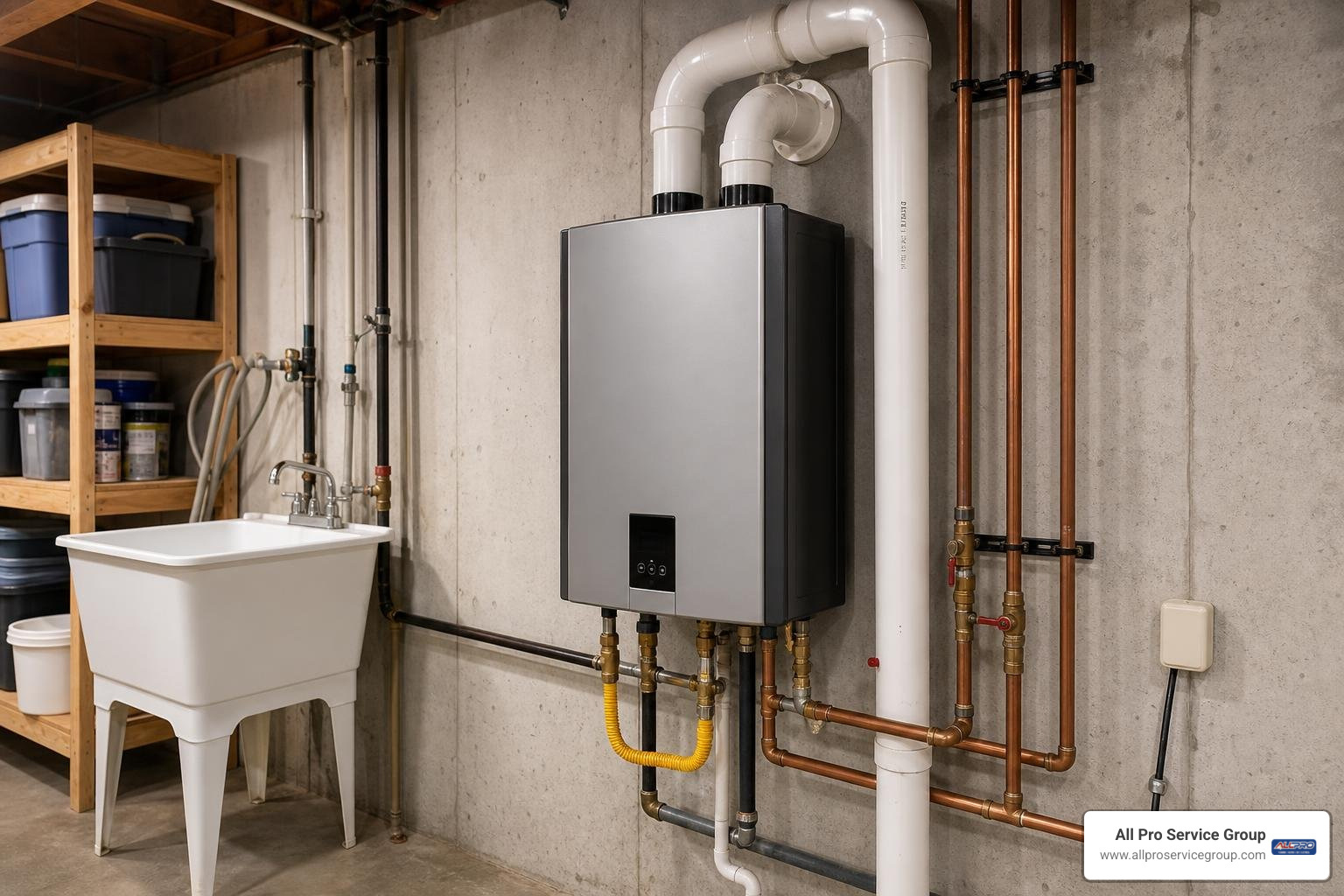
To select the right model, you must evaluate three primary factors:
- The size of your home and the number of bathrooms.
- Your peak hot water demand (how many fixtures you need to run at the exact same time).
- Your local climate and incoming groundwater temperature.
Sizing Your System by Flow Rate and Climate
In the plumbing world, sizing a tankless water heater requires calculating the "temperature rise" needed for your specific geographic area. Temperature rise is the difference between the temperature of the cold groundwater entering your home and your desired hot water output (typically 120°F).
Here in Utah—especially in areas like Salt Lake City, Ogden, and high-altitude locations like Park City—our winter groundwater can drop to a frigid 40°F. To heat that incoming water to a comfortable 120°F, your water heater must achieve an 80°F temperature rise.
Because heating freezing water takes more energy and time, a tankless unit's maximum flow rate (GPM) will be lower in cold climates than it would be in warm climates like Florida or Arizona, where groundwater might start at a mild 70°F.
For example, a high-output Rinnai model rated for 11 GPM in a warm climate might deliver closer to 5.5 or 6.0 GPM during a cold Utah winter.
- A flow rate of 5.3 to 7.5 GPM is generally perfect for smaller, 1-to-2 bathroom homes, easily supporting one or two simultaneous showers.
- Larger homes with 3 to 4 bathrooms will require a more powerful unit rated for 9.0 to 11.0 GPM(such as a 199,000 BTU SENSEI model) to ensure that running a shower in the master bathroom doesn't cause a pressure drop when someone else starts the dishwasher downstairs.
For smaller, single-bathroom homes or accessory dwelling units (ADUs), compact systems like the Infinity B12 Gas Continuous Flow Hot Water | Rinnai Australia demonstrate how precision engineering can deliver reliable continuous hot water even within a highly compact physical footprint.
Smart Features and Recirculation Technology
One of the minor inconveniences of any water heater—tank or tankless—is the time it takes for hot water to travel from the heater through the pipes to your faucet. If your water heater is in the basement and your master shower is on the second floor, you might waste gallons of clean water down the drain while waiting for the shower to get warm.
Rinnai solves this problem with Smart-Circ™ Intelligent Recirculation technology. Models equipped with this feature (such as the RXP series) have an integrated recirculation pump.
This pump circulates hot water through your hot water lines so it is instantly available at the tap when you turn it on. Even better, Smart-Circ is "intelligent"—it actually monitors and learns your household's daily hot water usage patterns over time. If your family typically takes showers between 6:00 AM and 8:00 AM, the system automatically schedules recirculation during those hours, maximizing comfort while saving energy during the hours you are asleep or away.
Rinnai systems also offer advanced smart home integration. By installing the optional RWM200 wireless module, you can connect your water heater to your home's Wi-Fi network. This allows you to control water temperatures, monitor system health, and even activate the recirculation pump on demand using your smartphone or smart home voice assistants.
For those who appreciate modern, high-tech aesthetics alongside advanced performance, Rinnai offers sleek, stylized options like the B26 Black Continuous Flow Hot Water System | Rinnai Australia.
Additionally, while gas remains the premier choice for high-efficiency continuous flow heating, Rinnai also manufactures innovative electric options like the 19kW Efinity Electric Continuous Flow Hot Water | Rinnai Australia for properties where gas lines are unavailable and 3-phase electrical infrastructure is in place.
Installation and Maintenance Requirements
Upgrading to a tankless gas water heater is a highly rewarding home improvement, but it is not a simple "plug-and-play" swap. Because tankless units heat water instantly on demand, they require a high concentration of heat energy very quickly. This means a residential tankless unit can require up to 199,000 BTUs of gas input, whereas a traditional storage tank usually only requires about 40,000 BTUs.
To accommodate this high fuel demand, your home's existing gas lines must be evaluated. While traditional tanks often run on a 1/2-inch gas line, a high-capacity tankless unit may require upgrading a portion of the line to a 3/4-inch pipe to ensure proper gas pressure.
Additionally, venting requirements are highly specific. Non-condensing units must vent their hot exhaust through specialized metal piping, while condensing units require dedicated PVC venting to handle the cool, moist exhaust.
Depending on your home's layout, you must also decide between an indoor or outdoor installation. While outdoor models save indoor space, our freezing Utah winters mean indoor installation is almost always the safest and most efficient choice for homes in Salt Lake City, Provo, and Park City. Check out our External Tankless Water Heater Guide for a deeper look at how climate dictates the best physical placement for your system.
Why Professional Installation of Your Rinnai Gas Hot Water System is Essential
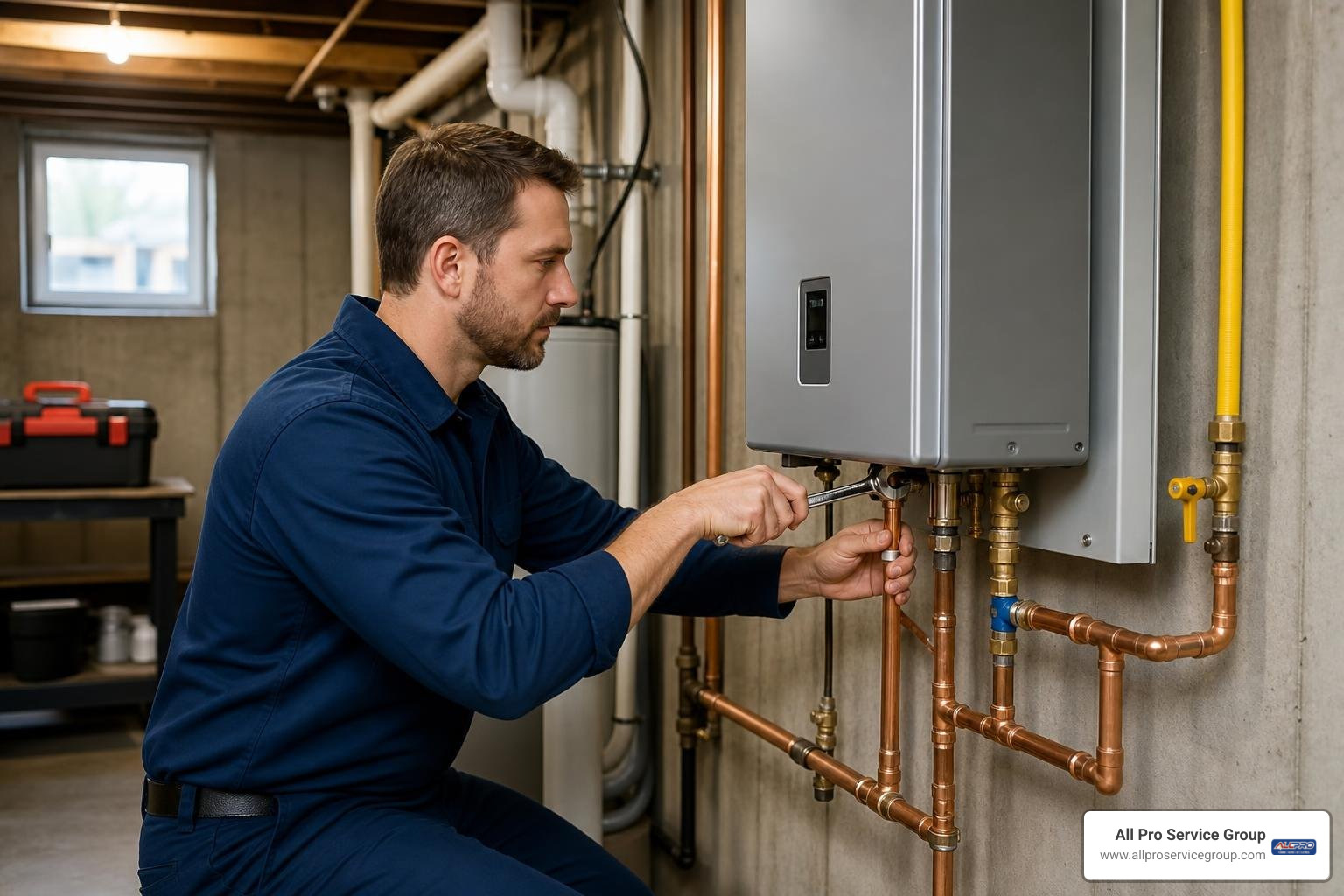
Because installing a Rinnai gas hot water system involves working with high-pressure gas lines, complex venting configurations, electrical connections, and domestic water lines, professional installation is absolutely essential.
A single mistake in gas line sizing can starve your water heater of fuel, causing it to shut down or operate inefficiently. Incorrect venting can lead to dangerous exhaust gases, including carbon monoxide, backing up into your living spaces.
Furthermore, hiring a licensed professional is a strict requirement to keep your manufacturer's warranty fully intact. Rinnai's generous parts and labor warranties are contingent on the system being installed by a certified technician who understands local building and safety codes. If you ever experience an issue down the road, having a professional setup makes securing warranty coverage or scheduling a Water Heater Repair a seamless, stress-free process.
Maintenance Tips for Long-Term Efficiency
While Rinnai tankless water heaters are incredibly durable, they do require basic annual maintenance to preserve their high efficiency and achieve their full 20-year lifespan.
The primary enemy of any tankless water heater is hard water. Here in Utah, our water contains high concentrations of dissolved minerals like calcium and magnesium. As water is heated inside the tankless unit's copper heat exchanger, these minerals can precipitate out and cling to the walls of the exchanger, creating a layer of scale. Over time, this scale acts as an insulator, forcing the gas burner to run hotter and longer to heat the same amount of water, which degrades your energy efficiency and places unnecessary stress on the system.
To prevent scale buildup, we highly recommend performing an annual flush. This simple maintenance process involves connecting a small pump to the unit's service valves and circulating a food-grade descaling solution (like white vinegar) through the heat exchanger for about an hour to safely dissolve and wash away any mineral deposits. For a step-by-step breakdown of how to care for your system, review our comprehensive Gas Hot Water Heater Maintenance Guide.
Frequently Asked Questions about Rinnai Water Heaters
How much money can I save with a Rinnai tankless system?
Because a Rinnai tankless system completely eliminates standby heat loss by heating water only on demand, it uses significantly less fuel than a traditional storage tank. For an average four-person household, switching from a standard gas storage tank to a continuous flow gas system can save approximately $125 per year on your gas bills. Over the 20-year lifespan of the unit, those savings add up to thousands of dollars back in your pocket, quickly offsetting the initial upgrade cost.
What is the lifespan of a Rinnai tankless water heater?
Rinnai tankless water heaters typically last up to 20 years, which is twice the average lifespan of a traditional storage tank water heater. Because they are constructed with commercial-grade components and designed so that individual parts can be easily swapped out, you do not have to replace the entire system if a single component fails. This makes them a far better long-term investment for your home.
Can Rinnai tankless water heaters be installed outdoors?
Yes, Rinnai manufactures dedicated outdoor models that are designed to withstand the elements, saving valuable indoor utility space. However, in regions that experience severe freezing winters—such as Ogden, Park City, and the rest of the Greater Salt Lake Valley—we strongly recommend installing your Rinnai system indoors (such as in a basement, garage, or utility closet). Indoor installations protect the system from extreme sub-zero temperatures and ensure maximum operating efficiency year-round.
Conclusion
Upgrading to a Rinnai gas hot water system is one of the most impactful investments you can make for your home's comfort, energy efficiency, and long-term value. By eliminating standby heat loss, reclaiming valuable floor space, and delivering an endless stream of hot water, a tankless system turns a basic daily utility into a premium, luxury experience.
At All Pro Service Group, we have been helping homeowners throughout the Greater Salt Lake Area transition to high-efficiency plumbing solutions since 2008. As a "Gephardt Approved" service provider, our certified technicians have the specialized training and expertise required to size, install, and maintain your Rinnai system perfectly. We offer flexible financing options to fit your budget, and we are committed to providing exceptional customer service every step of the way.
Ready to say goodbye to cold showers and bulky tanks forever? Schedule your Rinnai tankless water heater installation with All Pro Service Group today, and let our family take care of yours!