When Your Furnace Acts Up, Here's What You Need to Know
If you're dealing with furnace repair issues right now, here are the four warning signs that mean you need professional help fast:
- Inconsistent heating or cold spots in rooms that used to stay warm
- Unusual noises- banging, squealing, or grinding - during operation
- Sudden spikes in your utility bills with no change in usage
- Yellow pilot light or strange odors coming from the unit
Any one of these signals that something is wrong. Two or more means you should call a technician today.
Imagine waking up on a frigid Utah winter morning to find your home at 52 degrees - and no matter what you try, the furnace won't respond. It's one of the most stressful things a homeowner can face, and it often comes without warning.
The good news? Most furnace problems show signs before they become full breakdowns. Knowing what to watch for can save you from a cold night - and a much bigger repair bill.
At All Pro Service Group, our team has been diagnosing and repairing heating systems across the Greater Salt Lake Valley since 2008. Furnace repair is one of the most common calls we handle, especially when Utah temperatures drop fast. In this guide, we'll walk you through exactly what to look for and what to do about it.
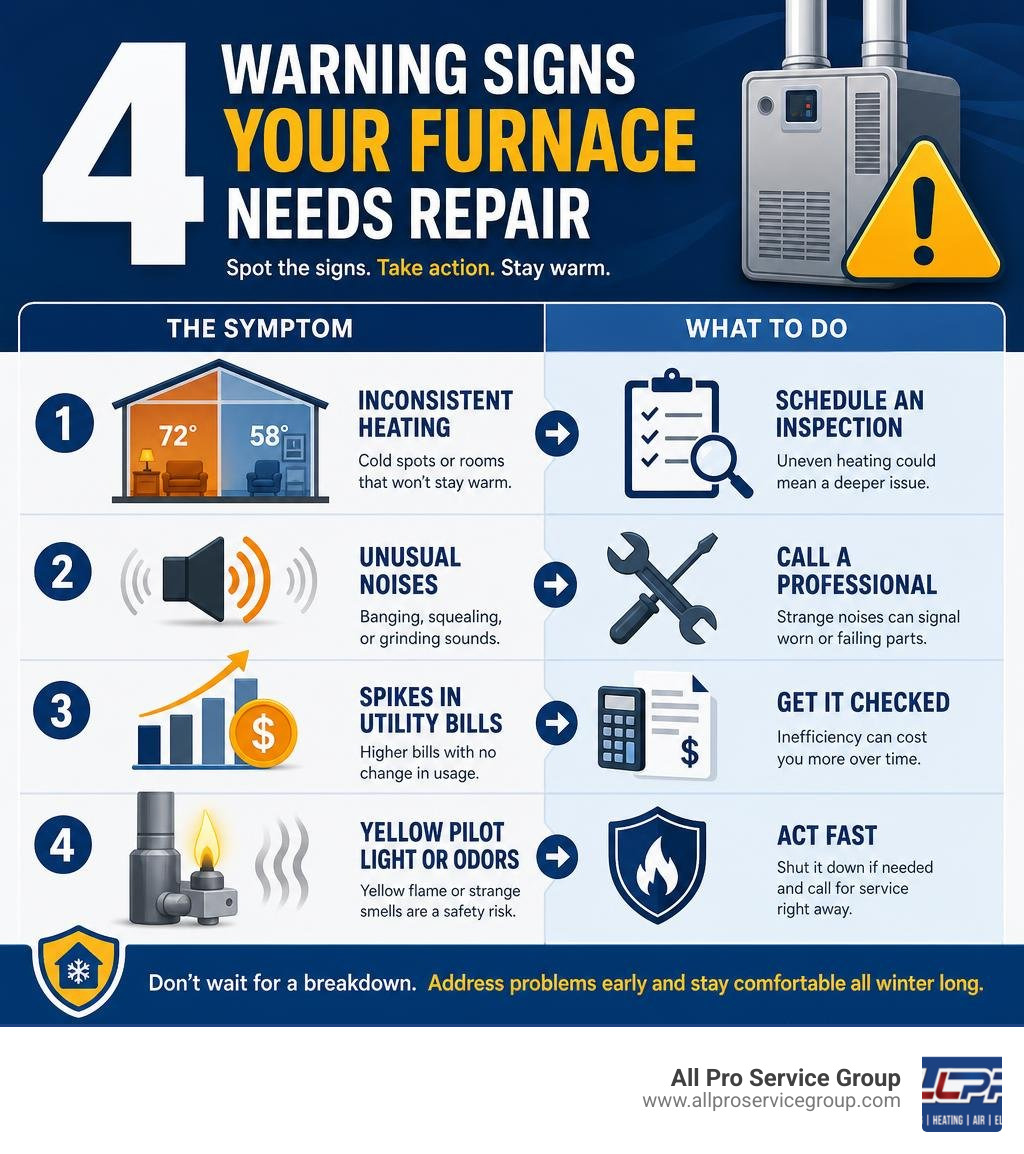
4 Critical Signs Your Heating System Needs Attention
When winter arrives along the Wasatch Front, your heating system transforms from a background appliance into your home’s most critical safety feature. Because we rely so heavily on our heating systems during freezing stretches, normal wear and tear can quickly escalate into mechanical failure.
To protect your comfort and your wallet, it is essential to recognize the warning signs of system performance decline. A furnace rarely fails completely without giving off a few warning signals first. By paying attention to changes in airflow, temperature drops, and unusual system behaviors, you can address minor issues before they leave you stranded in a freezing house.
1. Inconsistent Heating and Cold Spots
Have you noticed that your living room feels like a cozy oasis while your bedroom feels like an icebox? Uneven temperatures and cold spots throughout your home are classic indicators that your heating system is struggling to distribute air properly.
This issue often points to a few potential culprits:
- Leaky or Damaged Ductwork: Warm air can escape through cracks or loose joints in your ducts before it ever reaches your rooms.
- Thermostat Calibration Issues: If your thermostat is miscalibrated or placed in a drafty area, it won't read your home's actual temperature accurately.
- Blower Motor Fatigue: As a blower motor ages, it loses the power required to push air to the furthest corners of your house.
Ignoring these cold spots won't just make you uncomfortable; it forces your system to run longer cycles to compensate, accelerating wear on internal components. If you are noticing these issues more frequently, it may be time to consult our guide on Is It Time for a Furnace Replacement? Signs Utah Homeowners Should Watch For to see if a simple repair will suffice or if a system upgrade is on the horizon.
2. Unusual Noises During Operation
While no furnace is completely silent, you should be familiar with the normal, gentle hum of your heating system kicking on. If your furnace starts sounding like a heavy metal band practicing in your basement, it is trying to tell you something is wrong.
Here are the most common sounds that require immediate attention:
- Banging or Booming Sounds: A loud bang when your furnace starts up is often a sign of delayed ignition. This happens when gas builds up in the combustion chamber before finally igniting, creating a mini-explosion. This constant stress can easily crack your heat exchanger.
- Squealing or Whistling: High-pitched squeals usually point to a slipping or frayed blower belt, or dry motor bearings that require lubrication. Whistling, on the other hand, often points to restricted airflow caused by a severely clogged filter or undersized ductwork.
- Grinding or Scraping: If you hear metal scraping against metal, shut your furnace off immediately. This sound typically means the blower wheel has come loose and is striking the surrounding housing, which can destroy the motor if left running.
3. Sudden Spikes in Utility Bills
It is entirely normal for your fuel consumption to rise during the coldest months of winter. However, if you open your energy bill in June 2026 and notice a massive, unexplained spike compared to the same period in previous years, your furnace is likely losing its energy efficiency.
As mechanical parts wear out, the system has to work twice as hard and run much longer to achieve your desired thermostat setting. This system fatigue directly translates to higher gas or electricity usage. Common culprits of efficiency loss include:
- Dirty burners that prevent clean combustion
- Failing sensors that cause the system to short-cycle (turn on and off rapidly)
- Clogged heat exchangers that restrict heat transfer
Regular maintenance and timely repairs keep your utility bills predictable and prevent your furnace from working itself to death.
4. Discolored Pilot Light or Strange Odors
Your gas furnace relies on precise combustion to heat your home safely. Any change in the flame color or the smells coming from your registers should be treated with the utmost seriousness.
- The Flame Color: A healthy gas furnace should always burn with a steady, crisp blue flame. If you look through the burner window and see a yellow, flickering, or lazy flame, this indicates incomplete combustion. A yellow flame means the burner is not mixing gas and oxygen properly, which is a primary producer of toxic carbon monoxide.
- Strange Odors: When you turn your furnace on for the very first time in autumn, a brief dusty smell is normal as settled dust burns off the heat exchanger. However, if you smell a strong chemical, metallic, burning plastic, or rotten egg odor, you must act quickly. A rotten egg smell is an additive used to detect natural gas leaks. If you suspect a gas leak, evacuate your home immediately and call your utility provider or emergency services.
When to Choose Furnace Repair vs. Replacement
Deciding whether to schedule a furnace repair or invest in a full replacement is one of the most significant financial decisions you'll make for your home. While we always aim to extend the life of your existing unit through high-quality repairs, there comes a point where continuing to patch up an old system becomes a waste of money.
To make the right choice, we recommend using three primary guidelines:
- The Age of the System: Most modern furnaces have a reliable lifespan of 15 to 20 years. If your system is approaching or has surpassed its 15th birthday, major component failures (like a cracked heat exchanger or a dead blower motor) usually signal that replacement is the wiser long-term investment.
- The 50% Rule: If the cost of a single repair exceeds 50% of the price of a brand-new furnace installation, we highly recommend replacing the unit.
- Frequency of Repairs: If you find yourself calling an HVAC technician multiple times a winter just to keep the heat on, those individual repair bills will quickly add up to the cost of a new, highly efficient system.
Comparing the Costs of Fixing vs. Replacing
To help you visualize the financial differences, let's look at how the national averages for repair and replacement compare. That local costs along the Wasatch Front will vary based on your home's size, ductwork condition, and the efficiency rating of the equipment you choose.
| Service Option | Typical Cost Range | Average Lifespan | Best Suited For |
|---|---|---|---|
| Standard Furnace Repair | $133 - $505 (Complex repairs can exceed $1,000) | Extends life by 1-5 years | Systems under 10-12 years old with isolated component issues. |
| Full Furnace Replacement | $4,000 - $8,000+ (Installed) | 15 - 20 Years | Systems over 15 years old, cracked heat exchangers, or frequent breakdowns. |
If you are in West Valley City or surrounding areas, you can rely on our dedicated team at All Pro Service Group to provide clear, upfront pricing. Whether you need a quick fix or a complete system upgrade, we invite you to view our Heating Air Furnace Repair page to explore your options.
Troubleshooting Steps Before Calling for Furnace Repair
Before you pick up the phone to schedule a professional service call, there are a few simple DIY troubleshooting steps you can perform. Quite often, "no-heat" emergencies turn out to be minor issues that you can resolve yourself in just a few minutes.
- Check the Thermostat: Ensure your thermostat is set to "Heat" and the target temperature is set higher than the current room temperature. If the screen is blank, try replacing the batteries first.
- Inspect the Air Filter: A heavily clogged air filter restricts airflow so severely that the furnace's high-limit safety switch will trip, shutting the system down to prevent overheating. If your filter is dirty, replace it immediately and see if the furnace restarts after cooling down.
- Verify the Power Switch: Furnaces have a power switch nearby that looks just like a standard light switch. It is incredibly easy to accidentally flip this switch off while retrieving holiday decorations or cleaning near the unit. Ensure this switch is turned "On."
- Check the Circuit Breaker: Go to your electrical panel and locate the breaker labeled for your heating system. If it has tripped to the middle position, flip it completely to "Off" and then back to "On."
If you have completed these checks and your system still refuses to run, it is time to bring in the professionals.
Safety Risks and Essential Maintenance Guidelines
Operating a malfunctioning furnace isn't just uncomfortable; it can be incredibly dangerous. Because gas furnaces utilize combustion and generate toxic exhaust gases, a cracked or poorly maintained system poses serious safety risks to your household.
The single most critical safety component inside your gas furnace is the heat exchanger. This metal chamber keeps the toxic combustion byproducts (including carbon monoxide) completely separate from the clean air being circulated through your home's vents. If this component cracks due to age, overheating, or delayed ignition, carbon monoxide can escape directly into your living spaces.

To protect your family, we highly recommend reading our detailed guide on Understanding Your Gas Furnace Maintenance and Safety Tips from All Pro. Additionally, make sure you have working carbon monoxide detectors installed on every level of your home, especially near sleeping areas, and test them monthly.
What to Expect During a Professional Furnace Repair Visit
When you schedule a service call with a certified technician, knowing what to expect can help ease any anxiety. A professional repair visit is a systematic process designed to identify the root cause of your heating issue while ensuring your system is safe to operate.
- The Diagnostic Process: The technician will first perform safety checks, measuring gas pressure, inspecting electrical connections, and checking the system's static pressure.
- Component Testing: Using specialized diagnostic tools, they will test the ignitor, flame sensor, draft inducer motor, and blower motor to locate the exact point of failure.
- Upfront Estimate: Before any physical repairs begin, you should receive a clear, upfront explanation of the findings and a firm price for the required work.
- Repair Execution: A typical furnace repair takes between 1 to 3 hours to complete, depending on the availability of replacement parts.
- Safety Verification: Once the repair is complete, the technician will run the furnace through a full cycle and perform a combustion analysis to guarantee there are no carbon monoxide leaks. If a cracked heat exchanger is found, our team is equipped to handle a specialized Furnace Repair Heat Exchanger service to restore your system's integrity safely.
Regional Considerations: Heating Needs Along the Wasatch Front
Living along the Wasatch Front means experiencing beautiful summers and brutal, freezing winters. From Ogden down to Provo, our local climate puts unique demands on home heating systems.
Because winter temperatures routinely drop into the 20s and teens, gas furnaces remain the most common and cost-effective heating option for Utah homeowners. While heat pumps have grown in popularity, a high-efficiency gas furnace provides the reliable, intense heat needed to keep a home comfortable during extended cold snaps.
Whether you are looking for local support in the northern end of the valley in Ogden, heading up into the mountains in Park City, or searching for experts further south in Provo, finding a local professional who understands Utah's unique climate is key.
If you live in the Salt Lake metro area, you can easily find highly-rated professionals by checking resources like THE BEST 10 HEATING & AIR CONDITIONING/HVAC NEAR ... - Yelp. No matter where you are along the Wasatch Front, our team at All Pro Service Group is always ready to help. You can learn more about our local services on our main Heating Air Furnace Repair page.
Frequently Asked Questions About Heating Systems
How often should a furnace be serviced?
To prevent unexpected breakdowns and keep your system running at peak efficiency, your furnace should be professionally serviced once a year, ideally in the autumn before the heavy heating season begins.
Regular maintenance is proven to prevent up to 95% of unexpected breakdowns and can improve your system's overall operating efficiency by 15% to 30%. Between professional visits, your primary responsibility as a homeowner is to check and replace your air filter every 1 to 3 months. To learn more about the benefits of seasonal care, explore our article on Maximizing Efficiency Annual Tune-Ups for Your Furnace and AC or check out our dedicated Heating Air Furnace Maintenance resource page.
Do heating companies offer emergency service?
Yes! Because losing your heat during a freezing Utah winter is a major safety hazard, reputable heating companies offer 24/7 emergency repair services. If your heat goes out in the middle of the night, or if you suspect a carbon monoxide leak or gas issue, you should never wait until regular business hours to call for help.
How quickly can technicians respond to emergency calls?
While response times can vary depending on the severity of the weather and call volume, a local heating company should prioritize "no-heat" emergencies. During extreme cold snaps, our team at All Pro Service Group aims to have a certified technician at your door as quickly as possible—often within a few hours of your call. We serve Salt Lake, Davis, and surrounding counties to ensure our neighbors never have to freeze in their own homes.
Conclusion
Your furnace is the heart of your home's winter comfort and safety. Recognizing the warning signs of a failing system—such as cold spots, strange noises, rising bills, or pilot light discoloration—allows you to take action before a minor glitch turns into a complete system breakdown.
Since 2008, All Pro Service Group has been providing dependable, honest, and "Gephardt Approved" heating services to families throughout the Greater Salt Lake Area. Whether you are in Ogden, Park City, Provo, or anywhere in between, our licensed experts are available 24/7 to restore your peace of mind and keep your home warm.
Don't wait for your furnace to stop working on the coldest night of the year. If you have noticed any of the warning signs discussed in this guide, visit our Heating Air Furnace Repair page today to schedule a professional inspection and keep your home safe and warm all winter long.