
How Much Does a Solar Water Heater Cost? (2026 Quick Answer)
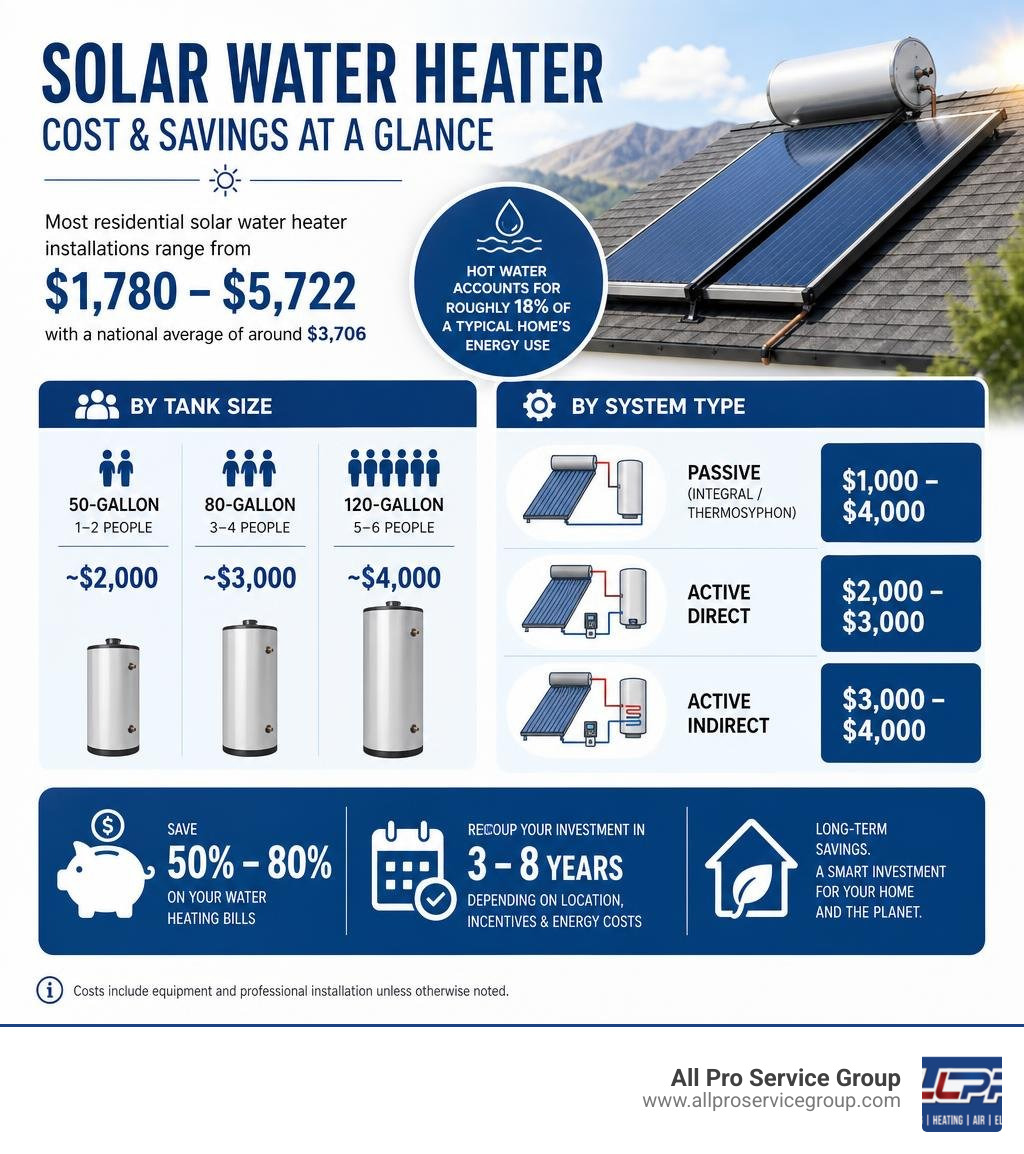
The cost of a solar water heater typically falls between $1,780 and $5,722 for most residential installations, with a national average of around $3,706 including labor and parts. Larger or more complex systems can reach $12,000 or more.
Here's a quick cost snapshot by system size:
| Tank Size | Best For | Typical Installed Cost |
|---|---|---|
| 50-gallon | 1-2 people | ~$2,000 |
| 80-gallon | 3-4 people | ~$3,000 |
| 120-gallon | 5-6 people | ~$4,000 |
And by system type:
| System Type | Typical Cost (before labor) |
|---|---|
| Passive (integral/thermosyphon) | $1,000 - $4,000 |
| Active direct | $2,000 - $3,000 |
| Active indirect | $3,000 - $4,000 |
Most homeowners can expect to save 50% to 80% on their water heating bills after installation — and recoup the investment within 3 to 8 years, depending on location, incentives, and energy costs.
Hot water accounts for roughly 18% of a typical home's energy use. That's a meaningful chunk of your utility bill every single month. For homeowners in the Greater Salt Lake area weighing a water heater upgrade, solar is one option that promises long-term savings — but the upfront price tag and the variables behind it can feel overwhelming at first glance.
This guide cuts through the noise. We'll walk you through every cost factor — from tank size and collector type to permits, maintenance, and available incentives — so you can make a confident, informed decision.
Our team at All Pro Service Group has helped Salt Lake Valley homeowners navigate water heater installation and replacement decisions for over 15 years — including evaluating the real-world cost of solar water heater systems against other efficient options available in our region. Whether you're replacing a failing tank or planning ahead, the breakdown below gives you everything you need to move forward.
Breaking Down the Upfront Cost of Solar Water Heater Systems
When looking at the cost of solar water heater systems, it is essential to separate the price of the equipment from the professional labor required to install it. Because solar thermal systems must be integrated into both your home's roof structure and its plumbing system, installation is significantly more complex than a standard gas or electric tank swap.

According to data from the Estimating the Cost and Energy Efficiency of a Solar Water Heater | Department of Energy , a standard residential solar water heating system typically consists of two thermal collectors (averaging 64 to 80 square feet) and a specialized storage tank.
Here is where your money actually goes during a standard installation:
- Basic Equipment & Parts ($1,000 – $4,000): This covers the solar collectors (panels), the solar storage tank, and the basic system controls. Individual solar collectors generally cost between $800 and $1,500 each.
- Balance of System (BOS) Parts ($1,000 – $2,500): This includes piping, glycol or heat-transfer fluid, pumps, sensors, expansion tanks, and specialized valves.
- Labor Costs ($1,000 – $2,000): Professional labor typically accounts for 40% to 60% of the total project invoice. Licensed plumbers and solar technicians charge an average of $70 to $200 per hour.
While a DIY enthusiast might be tempted to source cheap imported parts online to save on labor, professional installation is critical. Working on a sloped roof, making watertight penetrations, and routing high-pressure lines through your attic requires specialized training to prevent catastrophic water leaks and roof damage.
How Tank Size Affects the Cost of Solar Water Heater Installations
The volume of hot water your household consumes directly dictates the size of your storage tank and the surface area of the collectors required to heat it. Sizing the system correctly prevents you from overpaying for capacity you do not need, while ensuring you never run out of hot water mid-shower.
- 50-Gallon Systems (Best for 1-2 People): A 50-gallon tank paired with a single 40-square-foot collector averages $2,000 for parts and labor.
- 80-Gallon Systems (Best for 3-4 People): An 80-gallon tank paired with roughly 60 square feet of collector space costs around $3,000 installed. This is the most common size for typical suburban households.
- 120-Gallon Systems (Best for 5+ People): Large families with high simultaneous hot water demands require a 120-gallon tank and up to 80 square feet of collector panels, averaging $4,000 or more.
Beware of oversizing. Some sales representatives may try to upsell you to a larger tank than your household actually demands. Sizing should be calculated based on your peak hourly hot water demand rather than simply square footage. For a deeper look at traditional sizing models, you can reference our Water Heater Installation Guide 2026.
Geographic Location and the Cost of Solar Water Heater Collectors
Where you live in Utah plays a massive role in both the upfront equipment costs and the long-term performance of your system.
According to national cost tracking from How Much Does a Solar Water Heater Cost? [2026 Data] | Angi, homeowners in the northern half of the United States face higher equipment costs ($1,000 to $4,000 for thermal collectors alone) compared to the southern half ($1,000 to $3,000). This regional price gap exists because colder, freezing climates require more sophisticated collectors and freeze-protection mechanisms.
For example, a home in South Jordan or West Valley City cannot use a cheap, basic collector because of our freezing winter temperatures. Homeowners in these areas must choose between two main collector designs:
- Flat Plate Collectors ($600 – $1,200): These consist of insulated, weatherproof boxes containing a dark absorber plate under a glass cover. They are highly effective in mild climates but lose efficiency rapidly when outdoor temperatures drop.
- Evacuated Tube Collectors ($1,200 – $4,500): These feature parallel rows of transparent glass tubes. Each tube contains a metal absorber rod suspended in a vacuum. Because a vacuum is an excellent insulator, these collectors retain heat exceptionally well, making them far more efficient for freezing winter days in Ogden, Park City, or Provo.
While the local data on The cost of solar panels in South Jordan, UT (2026) - EnergySage and West Valley City solar cost and payback (June 2026) primarily focuses on photovoltaic (PV) systems, the physical reality of winter sun exposure applies to thermal solar as well. Expect to spend more on high-quality collectors to ensure your system continues to produce hot water when local temperatures drop below freezing.
Active vs. Passive: How System Types Impact Your Budget
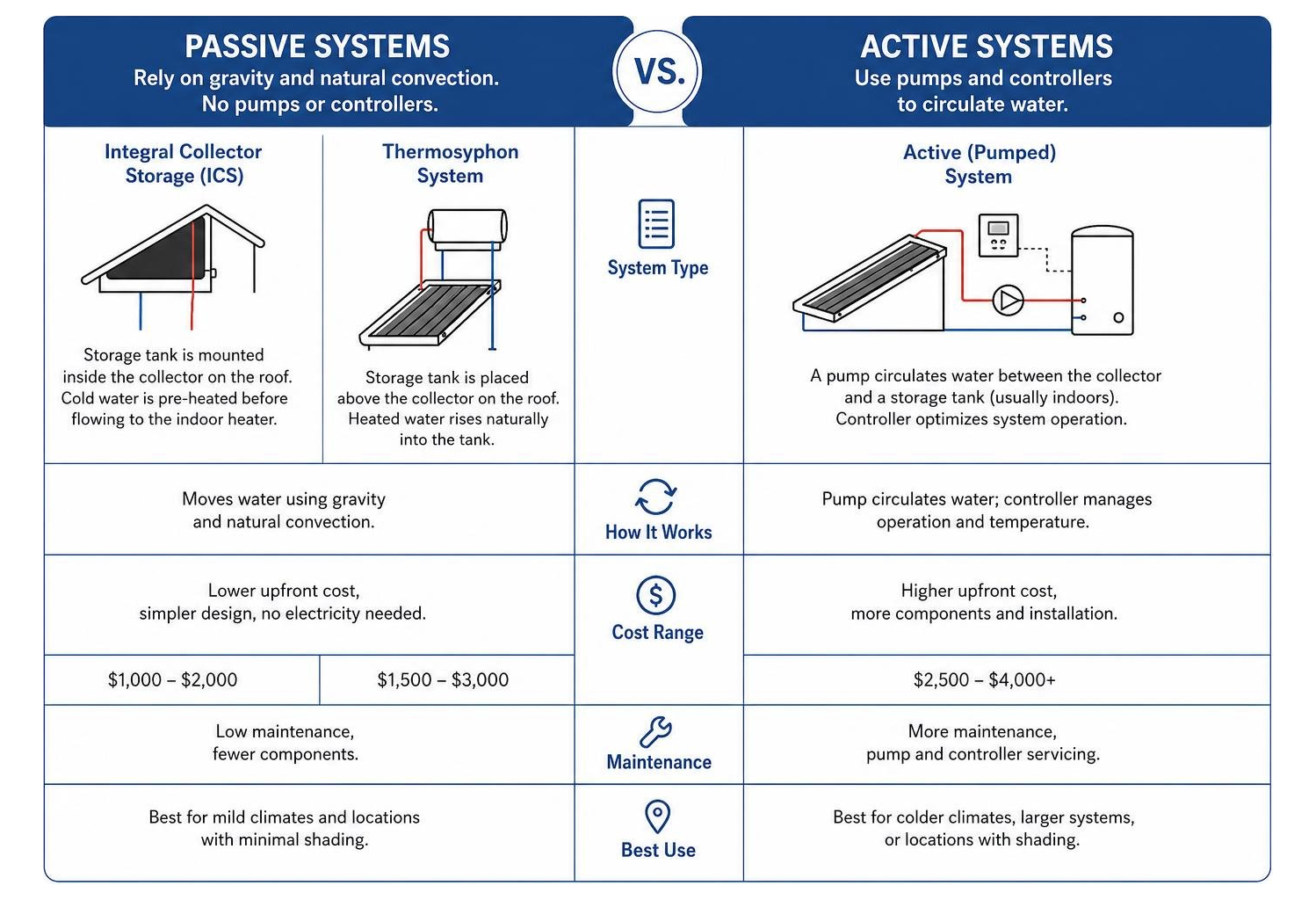
The mechanical design of your solar water heater is the single largest driver of the upfront equipment price. Solar water heaters are divided into two primary categories: passive and active systems.
Passive Solar Water Heaters ($1,000 – $4,000 before labor)
Passive systems rely on gravity and the natural law of convection (warm water rises, cool water sinks) to circulate water. They do not use electrical pumps or electronic controllers.
- Integral Collector Storage (ICS) Systems ($1,000 – $2,000): Also known as "batch" systems, these feature a storage tank mounted directly inside an insulated collector box on the roof. Cold water is pre-heated in this black tank before flowing to your conventional indoor water heater.
- Thermosyphon Systems ($1,500 – $3,000): These systems place the storage tank directly above the solar collector on the roof. As the sun heats the water in the collector, it naturally rises into the overhead storage tank.
While passive systems are highly durable and virtually maintenance-free, they are generally unsuitable for Utah's freezing winters. If water freezes inside a roof-mounted tank or collector, the pipes will burst, leading to expensive property damage.
Active Solar Water Heaters ($2,000 – $4,000 before labor)
Active systems use electric pumps, temperature sensors, and electronic controllers to circulate water or a heat-transfer fluid between your roof collectors and your indoor storage tank.
- Direct Active Systems ($2,000 – $3,000): These pump household drinking water directly from your indoor tank up through the roof collectors and back. They are highly efficient but offer very little freeze protection.
- Indirect Active Systems ($3,000 – $4,000): These pump a non-freezing heat-transfer fluid (typically food-grade propylene glycol) through the roof collectors. The heated fluid then flows down to your indoor tank, where a heat exchanger transfers the heat to your household water.
For homes in the Greater Salt Lake Valley, an indirect active system is the only practical option to safely survive our freezing winter months.
| System Type | Average Upfront Cost | Freeze Protection | Best Suited For |
|---|---|---|---|
| Integral Collector (ICS) | $1,000 - $2,000 | None (High risk of bursting) | Warm, tropical climates |
| Thermosyphon | $1,500 - $3,000 | Poor (Unless drained in winter) | Mild, non-freezing climates |
| Direct Active | $2,000 - $3,000 | Minimal (Recirculation freeze-protection) | Climates with rare light freezes |
| Indirect Active | $3,000 - $4,000 | Excellent (Uses glycol antifreeze) | Cold climates with freezing winters |
Solar Thermal vs. Heat Pump Water Heaters: Which Wins in 2026?
As we move through 2026, the economic landscape of residential green energy has shifted dramatically. Historically, solar thermal water heaters were the undisputed champions of eco-friendly water heating. However, the rapid drop in solar photovoltaic (PV) panel prices and massive advancements in heat pump technology have introduced a fierce competitor: the hybrid heat pump water heater (HPWH).

An electric heat pump water heater works like a refrigerator in reverse. Instead of using direct electrical resistance to heat water, it pulls ambient heat from the surrounding air and transfers it into the storage tank. This allows heat pumps to operate at up to 3 to 5 times the efficiency of a standard electric tank.
Let's look at how these two technologies compare across key metrics:
- Upfront Cost: A heat pump water heater typically costs between $3,600 and $6,500 fully installed. A high-quality indirect active solar water heater system suited for Utah winters ranges from $5,000 to $9,500+ installed.
- Efficiency and Versatility: Solar thermal collectors are incredibly efficient at capturing solar energy, but they can only produce hot water. A heat pump water heater can run off standard grid electricity, or it can be paired with a home's solar PV panels.
- The "PV + Heat Pump" Trend: Many clean energy organizations, as detailed in The Layperson's Guide to Residential Water Heaters – Utah Clean ..., now recommend installing a hybrid heat pump water heater and powering it with a home solar PV system rather than installing a standalone solar thermal loop. This setup allows your solar panels to power your entire home, while the heat pump handles hot water at maximum efficiency.
If you already have a solar PV system installed on your South Jordan or West Jordan home, or if you have limited roof space, a heat pump water heater is almost always the smarter, more cost-effective investment in 2026. You can read more about how these units work in our comprehensive Heat Pump Water Heater Guide 2026 or explore on-demand options in our Tankless Water Heater Complete Guide.
Hidden Costs: Permits, Maintenance, and Backup Systems
When budgeting for the cost of solar water heater systems, many homeowners overlook the secondary expenses that can inflate the final project invoice.
To avoid surprise expenses, make sure to budget for these common hidden costs:
- Building Permits ($100 – $950): Most municipalities in the Greater Salt Lake Area require permits for both plumbing modifications and roof-mounted solar collectors. Plumbing permits generally run $50 to $500, while solar-specific building permits average around $450.
- Roof Modifications ($200 – $1,000): Solar thermal collectors are heavy, especially when filled with water. If your roof structure is older or lacks proper bracing, a structural engineer may require reinforcement work before installation can proceed.
- The "Backup" Heating System ($300 – $2,500): Solar water heaters cannot provide 100% of your hot water year-round in Utah. During extended winter storms or cloudy weeks, you will need a backup heat source. This is typically a gas burner or electric heating element built directly into your solar storage tank, or a separate tankless water heater acting as a booster.
- Annual Maintenance ($100 – $250/year):
Unlike solar PV panels, which are solid-state and require almost no maintenance, active solar thermal systems have moving parts. You must budget for:
- Glycol Replacement ($300 – $600): The antifreeze fluid in indirect active systems breaks down over time and must be flushed and replaced every 3 to 5 years.
- Pumps and Sensors (~$300): Circulating pumps and temperature sensors typically last 7 to 10 years before requiring replacement.
- Hard Water Flushing: The Salt Lake Valley is notorious for hard water. Mineral scale will rapidly build up inside your solar storage tank and heat exchanger. To protect your investment, you must schedule annual professional flushing. If you are dealing with scale issues, we highly recommend checking out our specialized Plumbing Water Heater Repair services or learning about preventative maintenance in our AO Smith Water Heater Maintenance guide.
Frequently Asked Questions About Solar Water Heaters
What is the average payback period for a solar water heater?
For most Utah homeowners, the payback period for a solar water heater ranges from 7 to 15 years.
If you are replacing an expensive electric resistance water heater, you will save roughly $300 to $600 annually, leading to a faster payback period of 7 to 13 years. If you are replacing a natural gas water heater, the payback period is typically longer (10 to 18 years) because natural gas remains relatively inexpensive in Utah.
Do solar water heaters work on cloudy days or during winter?
Yes, but at reduced efficiency. Solar collectors can still absorb diffused solar radiation through thin cloud cover. However, during heavy winter snowstorms or extended overcast periods, your system will rely heavily on its built-in electric or gas backup heating element to keep your water hot.
Indirect active systems also require specialized freeze-protection controls to ensure that cold air on the roof does not freeze the water lines entering your home.
How long do solar water heating systems last compared to traditional tanks?
A professionally installed, high-quality solar water heater system can last 15 to 25 years.
The solar thermal collectors on your roof are highly durable and often carry warranties of 10 years or more. However, individual mechanical components like the circulating pumps, sensors, and the backup heating elements typically need to be replaced every 7 to 10 years. Traditional gas or electric storage tank water heaters, by comparison, generally last only 8 to 12 years in Utah due to our hard water conditions.
Conclusion
Investing in a solar water heater can significantly lower your carbon footprint and slash your monthly utility bills by up to 80%. However, due to Utah's freezing winters and hard water, a successful installation requires a highly specialized indirect active system, proper permitting, and consistent professional maintenance.
At All Pro Service Group, we have spent nearly two decades helping homeowners across the Greater Salt Lake Area — including Ogden, Park City, Provo, and South Jordan — find the most efficient, cost-effective water heating solutions for their homes. Whether you want to explore solar thermal, install an ultra-efficient hybrid heat pump, or upgrade to a modern tankless system, our trained, licensed, and "Gephardt Approved" experts are here to help.
Ready to explore your water heating options? Schedule professional water heater installation with All Pro Service Group today, or call our team to speak with a local water heating specialist.