Is Your Toilet Broken? Here's How to Tell — and What to Do First
A broken toilet can go from a minor annoyance to a costly home repair faster than most people expect. Before diving into the full guide, here's a quick-reference summary of the most common causes and fixes:
| Symptom | Most Likely Cause | Quick Fix |
|---|---|---|
| Toilet runs constantly | Worn flapper or faulty fill valve | Replace flapper ($7–$15) or fill valve ($15–$25) |
| Weak or incomplete flush | Clogged rim jets or low water level | Clean jets or adjust float |
| Leaking at the base | Failed wax ring or loose closet bolts | Reseat toilet with new wax ring |
| Tank leaks onto floor | Cracked tank or bad tank-to-bowl gasket | Epoxy (minor) or tank replacement |
| Phantom flushing | Leaking flapper sending water into bowl | Replace flapper |
| Toilet rocks when sitting | Loose or corroded closet flange | Tighten bolts, add shims, or replace flange |
| Sewage smell at base | Broken wax ring or cracked flange | Replace wax ring |
| Slow tank fill | Partially closed supply valve or dirty fill valve | Open valve fully or clean/replace fill valve |
Most broken toilets are caused by one small, inexpensive part — usually a flapper, fill valve, or wax ring — that any motivated homeowner can replace in under an hour with basic tools.
The numbers make the urgency clear: a running toilet can waste up to 200 gallons of water per day — roughly 6,000 gallons per month — quietly adding $70 to $200 or more to your water bill in a single billing cycle. And worn or warped flapper valves are responsible for roughly 60–70% of all running toilet cases. That means the fix is almost always cheaper and simpler than the damage caused by waiting.
At All Pro Service Group, our plumbing team has diagnosed and repaired broken toilets throughout the Greater Salt Lake Valley for years. In this guide, we'll walk you through exactly how to identify what's wrong and fix it yourself — and we'll be honest about the situations where calling a pro is the smarter move.
Anatomy of a Broken Toilet: Common Causes and Failure Points
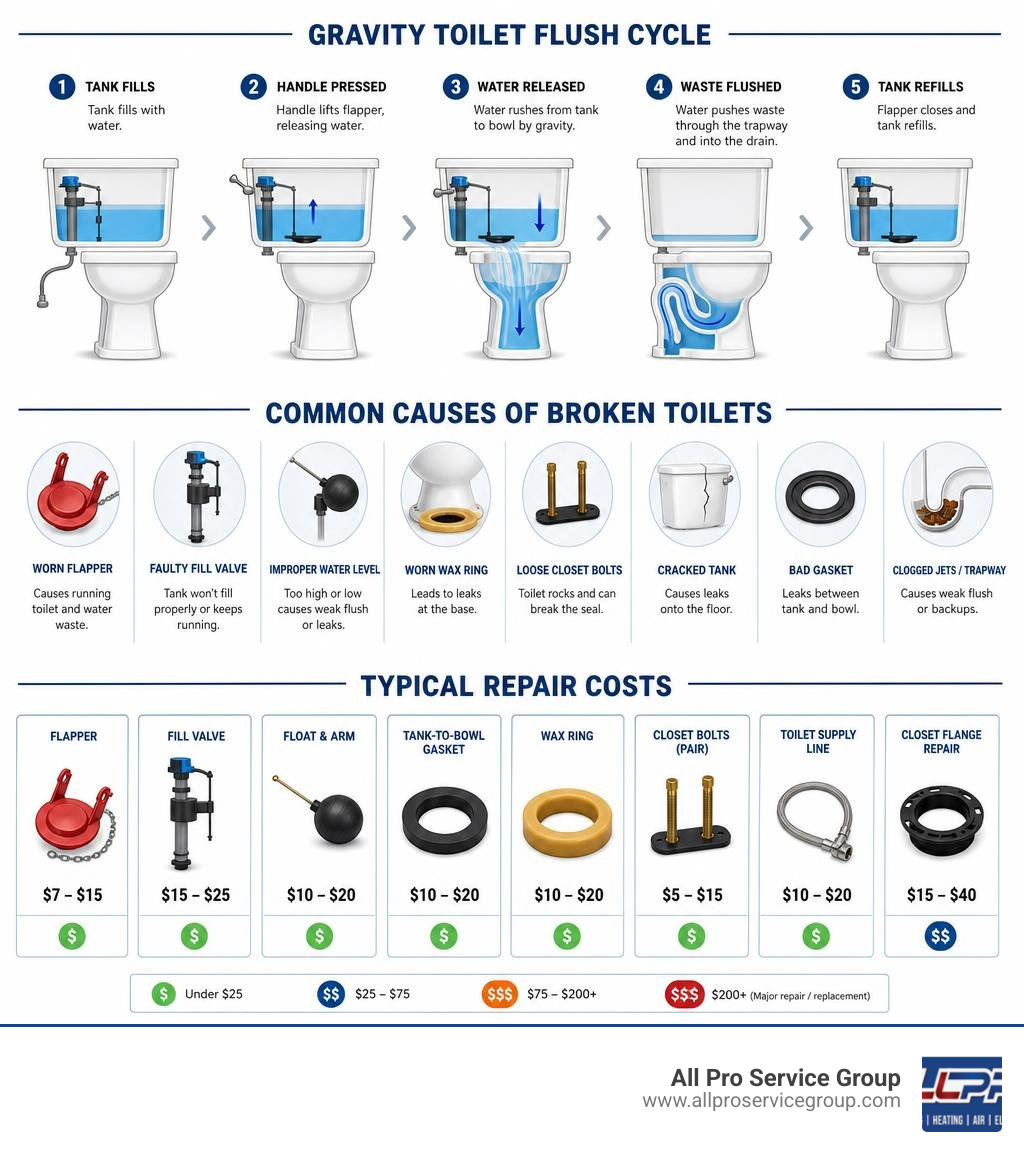
To successfully fix a broken toilet, you first need to understand how the components inside and beneath the porcelain work together. While a toilet looks like a single solid fixture, it is actually a beautifully simple gravity-fed system split into two main sections: the tank (which stores the flushing water) and the bowl (which directs waste into your home's drainage system).
When things go wrong, the culprit is almost always one of these key failure points:
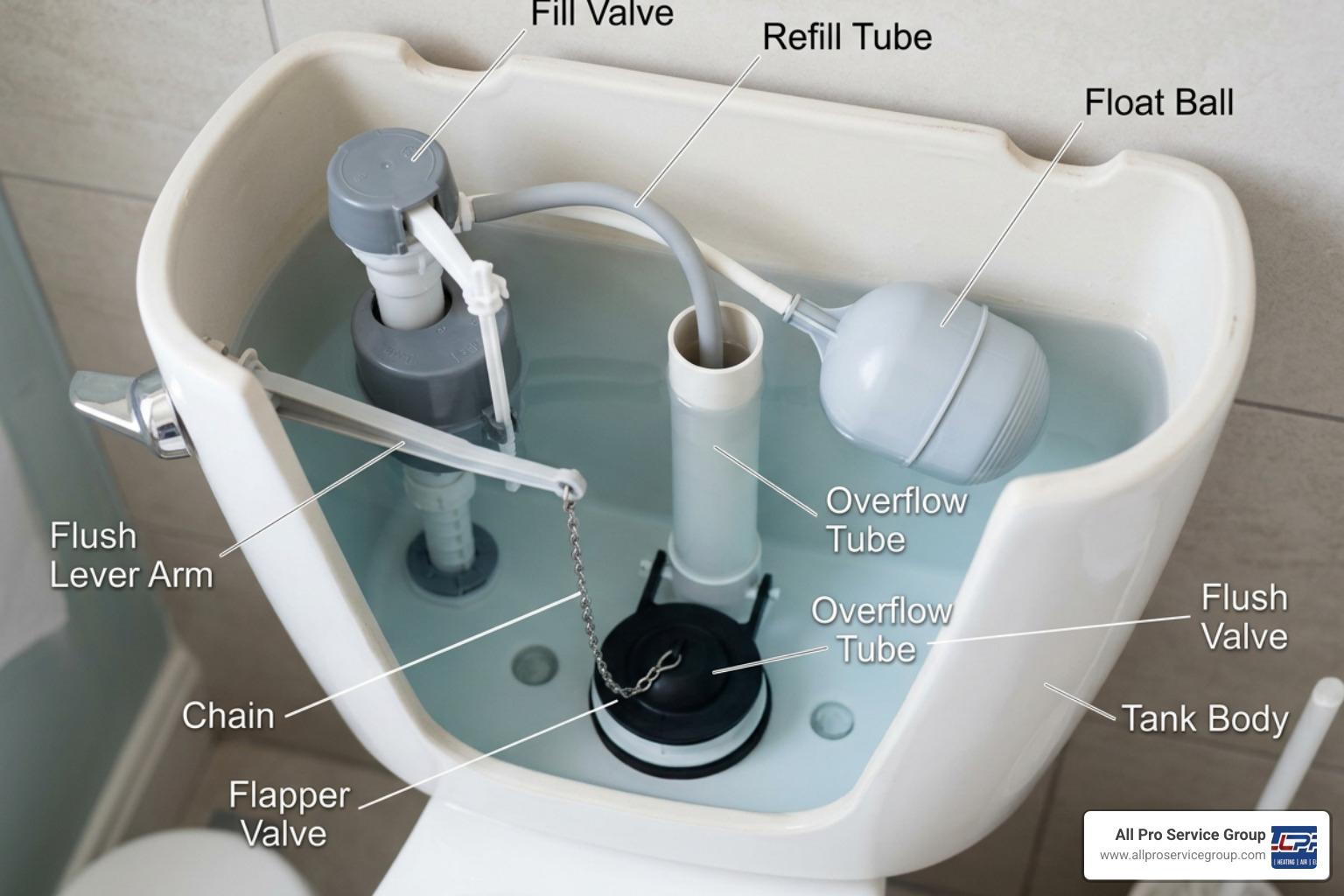
- The Flapper Valve: This is the rubber seal at the bottom of the tank. When you push the flush handle, a chain lifts the flapper, allowing water to rush into the bowl. Over time, constant submersion causes the rubber to warp, crack, or accumulate mineral buildup, preventing a tight seal.
- The Fill Valve: This assembly controls the water refilling the tank after a flush. Modern toilets typically use a float-cup fill valve. If the float is set too high, water will constantly spill into the overflow pipe. If the valve mechanism itself is faulty, it will fail to shut off entirely.
- The Flush Valve and Overflow Pipe: The flush valve is the plastic or brass tower in the center of the tank. Built into this tower is the overflow pipe, which acts as a safety drain to prevent water from spilling over the top of the tank if the fill valve malfunctions.
- The Tank-to-Bowl Gasket: Located on the outside bottom of the tank where it meets the bowl, this thick rubber seal prevents water from leaking onto your floor during a flush.
- The Wax Ring: Hidden beneath the base of the toilet, the wax ring creates a gas- and water-tight seal between the toilet bowl and the closet flange.
- The Closet Flange: This metal or plastic ring is secured to your subfloor and connects the toilet to the waste pipe. If the flange cracks or the closet bolts securing the toilet corrode, the toilet will wobble, leading to a broken wax seal.
For a deeper dive into how these systems interact, check out our Toilet Repair Complete Guide 2026. You can also read more about general diagnostic steps in this helpful How to Fix a Broken Toilet | DIY Home Repair resource.
Diagnosing a Broken Toilet Overflow Pipe vs. Other Internal Parts
If you hear water running constantly, you must determine whether the issue is a simple flapper leak or a physically damaged overflow pipe. A cracked or broken overflow pipe is a sneaky issue because the crack often occurs at the very base of the tube, hidden below the water line.
To diagnose this, perform a simple water level test:
- Remove the tank lid and look at the open tube in the center of the tank.
- If the water level is sitting right at the very top rim of the overflow pipe and spilling in, your fill valve is set too high or is faulty.
- If the water level is below the top of the overflow pipe but you still hear water running, or if the water level has dropped significantly below its normal mark, you likely have a leaking flapper or a cracked overflow pipe.
To narrow it down further, use the food coloring test. Drop 10 to 15 drops of food coloring into the tank water and do not flush. Wait about 20 to 30 minutes. If colored water seeps into the bowl, you have an active leak. If you suspect the overflow pipe itself is broken at the base rather than a warped flapper, look closely at the bottom of the tube with a flashlight. A hairline crack or physical separation at the base of the plastic tube will allow water to drain continuously into the bowl, mimicking a bad flapper seal.
If your toilet won't stop running, read through our guide on Toilet Running Constantly? Fix It Fast Before Your Bill Spikes to narrow down the precise internal failure.
Signs of Water Damage and Base Leaks
A broken toilet doesn't just waste water; it can actively destroy your home. When a wax ring fails or the toilet base cracks, water seeps into your bathroom floor every time you flush. Because this water is often absorbed by subflooring and underlayment, you might not notice a puddle immediately.
Keep an eye out for these warning signs of water damage:
- A Persistent Sewage Smell: The wax ring's primary job is to block sewer gases. If you smell sewer gas near the toilet, the seal is broken.
- Warped or Discolored Flooring: Vinyl tile lifting, laminate swelling, or grout lines cracking around the toilet base are clear signs of moisture beneath the surface.
- A Rocking Toilet: If the toilet moves or wobbles when you sit on it, the closet flange may be broken, or the subfloor beneath it may already be rotting and soft.
- Mold and Mildew: Mold growing along the baseboard behind the toilet or on the ceiling directly below a second-floor bathroom indicates a long-term leak.
If you notice any of these signs, read our guide on what to do when your Commode Leaking Around Base is causing issues. For steps on mitigating structural damage, refer to How to Handle Water Damage From Broken Toilets | Reliable Damage Hub.
Step-by-Step DIY Repairs for Common Toilet Issues
Before you begin any repair, gather the correct tools. Having everything on hand prevents mid-project emergency runs to the hardware store.

For most standard repairs, you will need:
- An adjustable wrench and channel-lock pliers
- A flathead and Phillips screwdriver
- A universal replacement flapper (usually 2-inch or 3-inch, depending on your model)
- A high-quality replacement fill valve (such as a Fluidmaster model)
- A closet auger (for clearing stubborn clogs)
- Plastic shims (to level a rocking toilet)
- A sponge and bucket (to remove remaining water)
If you need to replace the entire valve assembly, consult our detailed instructions on Changing Toilet Valve components, or reference our Toilet Repair Complete Guide for a full overview of common fixes.
How to Fix a Broken Toilet Overflow Pipe
If your diagnostic tests revealed that the overflow pipe is physically broken or cracked at its base, you have two choices: a temporary structural repair or a permanent replacement.
The Temporary Epoxy Fix
If the crack is small and you need a quick fix before you can buy replacement parts, you can use marine-grade epoxy:
- Shut off the water supply and drain the tank completely (see instructions below).
- Dry the area around the crack thoroughly with a towel and a hair dryer. The porcelain and plastic must be completely dry for the epoxy to adhere.
- Mix a two-part marine epoxy putty and press it firmly around the base of the overflow pipe, covering the crack entirely.
- Allow the epoxy to cure fully according to the manufacturer's instructions (usually 1 to 2 hours) before refilling the tank.
Note: This is a temporary "crutch" and will eventually fail. The permanent solution is to replace the flush valve assembly.
The Permanent Flush Valve Replacement
Replacing the flush valve requires removing the toilet tank:
- Disconnect the water supply line from the bottom of the tank.
- Use an adjustable wrench to remove the tank bolts from the underside of the bowl.
- Carefully lift the tank off the bowl and set it upside down on a soft towel to protect the porcelain.
- Remove the large black rubber tank-to-bowl gasket from the bottom of the tank to expose the plastic flush valve mounting nut.
- Use large tongue-and-groove pliers (or a specialized spud wrench) to unscrew the mounting nut. Slide the old flush valve assembly out of the tank.
- Insert the new flush valve assembly, ensuring the rubber seal is seated firmly on the inside of the tank. Tighten the mounting nut on the outside of the tank hand-tight, plus a half-turn with pliers. Do not overtighten!
- Reinstall the tank-to-bowl gasket, place the tank back on the bowl, and gently secure the tank bolts.
For structural cracks on the tank itself, read our companion article: How to Fix a Cracked Toilet Tank: Step-by-Step Guide.
Replacing the Flapper and Fill Valve
If your toilet is running constantly due to a worn flapper or a faulty fill valve, these are the easiest DIY repairs you can perform.
Replacing the Flapper:
- Shut off the water supply and flush the toilet to empty the tank.
- Unhook the flapper chain from the flush lever arm.
- Slide the old rubber flapper off the pegs of the overflow tube.
- Slide the new flapper onto the pegs.
- Connect the chain to the flush lever. Crucial Step: Adjust the chain length so there is approximately 1/2 inch of slack when the handle is at rest. If the chain is too tight, the flapper won't seal; if it is too loose, the flapper won't lift high enough for a full flush.
Replacing the Fill Valve:
- With the tank drained, place a small bucket or towel under the water supply connection at the bottom of the tank.
- Unscrew the water supply line coupling nut.
- Unscrew the plastic locknut holding the fill valve to the bottom of the tank.
- Pull the old fill valve straight up and out of the tank.
- Adjust the height of your new fill valve (most modern valves slide or twist to adjust height) so that the top of the valve sits about 3 inches above the overflow pipe.
- Insert the new fill valve into the tank hole, ensuring the rubber washer is on the inside. Tighten the locknut underneath hand-tight, then snug it slightly with pliers.
- Reattach the water supply line and connect the small rubber refill tube from the top of the fill valve to the clip on the overflow pipe.
Safely Draining the Tank and Avoiding Cracked Porcelain
Porcelain is an incredibly durable material under normal usage, but it is highly brittle. Applying uneven pressure or overtightening metal bolts against porcelain will crack it instantly, turning a $15 repair into a complete toilet replacement.
To work safely:
- Shut Off the Water Properly: Locate the oval shutoff valve on the wall behind the toilet. Turn it clockwise until it stops. If the valve is old and stiff, do not force it with pliers; you could snap the stem. If it won't budge, shut off your home's main water valve instead.
- Drain and Dry: Flush the toilet and hold the handle down to drain as much water as possible. Use a large sponge to soak up the remaining two inches of water at the bottom of the tank, squeezing it out into a nearby bucket.
- The Quarter-Turn Rule: When installing tank bolts or securing the toilet to the floor, always tighten the nuts by hand first. Once they are hand-tight, use your wrench to tighten them one quarter-turn at a time, alternating between the left and right sides. This ensures even pressure and prevents stress fractures. Stop turning the moment the tank or base stops rocking.
DIY vs. Professional Plumbing: When to Call a Plumber
While many toilet repairs are highly accessible for beginners, some scenarios carry a high risk of property damage or require specialized tools.
| Repair Task | Difficulty Level | Recommended Action |
|---|---|---|
| Replacing a flapper or chain | Trivial | DIY |
| Replacing a fill valve | Easy | DIY |
| Replacing a flush valve (requires tank removal) | Moderate | DIY (with caution) |
| Replacing a wax ring and closet bolts | Moderate | DIY / Call a Pro |
| Removing heavily rusted tank bolts | Hard | Call a Pro |
| Repairing a broken closet flange | Hard | Call a Pro |
| Working on pressure-assist toilets | Hard / Hazardous | Call a Pro |
| Repairing a cracked bowl or base | Hard | Call a Pro (requires replacement) |
If you run into an issue that exceeds your comfort level, our team at All Pro Service Group is always ready to help. You can learn more about our local services on our Emergency Plumber Local page or browse our Plumbing Repair Complete Guide 2026.
Handling Rusted Bolts and Pressure-Assist Models
Two specific scenarios should make any DIYer pause: rusted hardware and high-pressure toilet systems.
Rusted Tank-to-Bowl Bolts
Over years of exposure to moisture, the metal bolts holding your tank to the bowl can corrode into a single solid mass. If you try to force a rusted bolt with a wrench, you will likely twist the bolt, slip, and crack the porcelain.
Professionals often use a mini-hacksaw or an oscillating multi-tool to carefully cut through the rubber washers and brass bolts between the tank and the bowl. If you do not have the steady hand or tools to do this safely, it is best to call a professional.
Pressure-Assist Toilets
Unlike standard gravity-flush toilets, pressure-assist toilets feature a sealed plastic pressure vessel inside the porcelain tank. These systems use compressed air to force water into the bowl, creating a powerful flush.
Because these vessels hold water under high pressure, attempting to disassemble or repair the inner chamber yourself can be highly hazardous. If your pressure-assist toilet is leaking or failing to flush, always hire a licensed plumber to service the unit.
Toilet Repair Costs: DIY Parts vs. Professional Service
Fixing a broken toilet yourself is highly cost-effective if the repair is straightforward. However, if a mistake is made, the resulting water damage or structural repair can quickly dwarf the cost of an initial professional service call.
- DIY Parts Costs: Replacing a flapper costs between $7 and $15. A complete fill valve replacement kit costs $15 to $25. A full flush valve rebuild kit runs about $20 to $40.
- Professional Service Rates: A standard professional toilet repair service call typically ranges from $125 to $350, depending on the complexity of the issue. If you need a complete toilet replacement, professional installation usually costs between $200 and $450 (excluding the cost of the toilet itself).
If your toilet is more than 20 to 25 years old, replacing it is often more sensible than repairing it. Older toilets use up to 3.5 to 5 gallons of water per flush, whereas modern EPA WaterSense-labeled models use just 1.28 gallons. Upgrading can save an average family thousands of gallons of water annually.
If you need professional assistance, All Pro Service Group provides expert toilet repair and replacement services across the region, including Salt Lake City, West Jordan, West Valley City, South Jordan, Provo, Ogden, and Park City.
Frequently Asked Questions about Toilet Repair
Why is my toilet running constantly?
A constantly running toilet is almost always caused by a worn-out rubber flapper (responsible for 60–70% of cases) or a faulty fill valve (responsible for 20–25% of cases). When the flapper fails to seal tightly against the flush valve seat, water continuously leaks from the tank into the bowl. This causes the fill valve to turn on periodically to top off the tank, leading to "phantom flushing" and massive water bill spikes. A single running toilet can waste up to 200 gallons of water per day, which can add up to 6,000 gallons per month and cost you hundreds of dollars in wasted water if left unfixed.
Can I use chemical drain cleaners to clear a toilet clog?
No, you should never use chemical drain cleaners to clear a toilet clog. These chemicals rely on intense chemical reactions to generate heat and break down blockages. Because a toilet bowl holds standing water, the chemicals become diluted and sink to the bottom of the trapway. The heat generated can crack the cold porcelain bowl, ruin the rubber seals on your closet flange, and severely damage your plumbing pipes. Instead, always use a high-quality flange plunger or a manual closet auger to safely clear toilet clogs.
How do I know if my toilet needs to be completely replaced?
You should replace your toilet if you notice any of the following:
- Cracked Porcelain: Hairline cracks in the bowl or below the waterline in the tank can fail catastrophically at any moment, causing massive water damage.
- Recurring Clogs: Older low-flow toilets from the 1990s often have poorly designed trapways that clog constantly. Upgrading to a modern gravity-fed model will solve this.
- Wobbling and Soft Floors: If your toilet rocks and the subfloor beneath it is soft, the toilet must be pulled up to repair the rotted wood and install a new flange and wax ring.
- High Water Bills: If you have an outdated toilet that uses 3.5 gallons or more per flush, upgrading to a high-efficiency model will pay for itself in water savings.
Conclusion
A broken toilet doesn't have to disrupt your home or drain your wallet. Armed with a basic understanding of toilet anatomy, a few simple tools, and the steps outlined in this guide, you can confidently tackle most common flapper, fill valve, and minor leak repairs yourself.
However, when you run into stubborn rusted bolts, structural porcelain cracks, or signs of extensive water damage beneath your floorboards, DIY repairs can quickly become overwhelming.
If you live in Ogden, Park City, Provo, South Jordan, West Jordan, West Valley City, or anywhere else in the Greater Salt Lake Area, All Pro Service Group is here to help. Since 2008, we have provided dependable, "Gephardt Approved" plumbing, heating, air, and electrical services. Our trained experts are dedicated to exceptional customer service and offer flexible financing options to fit your budget.
If you would rather leave your plumbing repairs to the professionals, schedule an inspection with us today by visiting our Plumbing Repair page, checking out our Emergency Plumbing solutions, or reviewing our general Plumbing services.