Is Whole Home Surge Protection Worth It?
Yes. Here's a quick summary before we dive in:
| Question | Quick Answer |
|---|---|
| What is it? | A device installed at your main electrical panel that diverts voltage spikes away from your home's circuits |
| Do you need it? | Yes — especially with modern electronics and appliances |
| Is it required by code? | Yes, under current NEC standards for new services and upgrades |
| What does it cost? | $200–$700 installed |
| Does it replace power strips? | No — use both for best protection |
Whole home surge protection is one of the most overlooked upgrades a homeowner can make — until something expensive stops working.
The average home today holds around $15,000 worth of electronics and appliances. And most homes experience up to 100 power surges per month. The majority of those surges don't come from lightning. They come from inside your own home — your HVAC cycling on, your refrigerator compressor kicking in, your hair dryer switching off.
Each small surge does a little damage. Over time, that adds up. It's what electricians call "death by a thousand cuts" — and it quietly shortens the life of everything plugged into your walls.
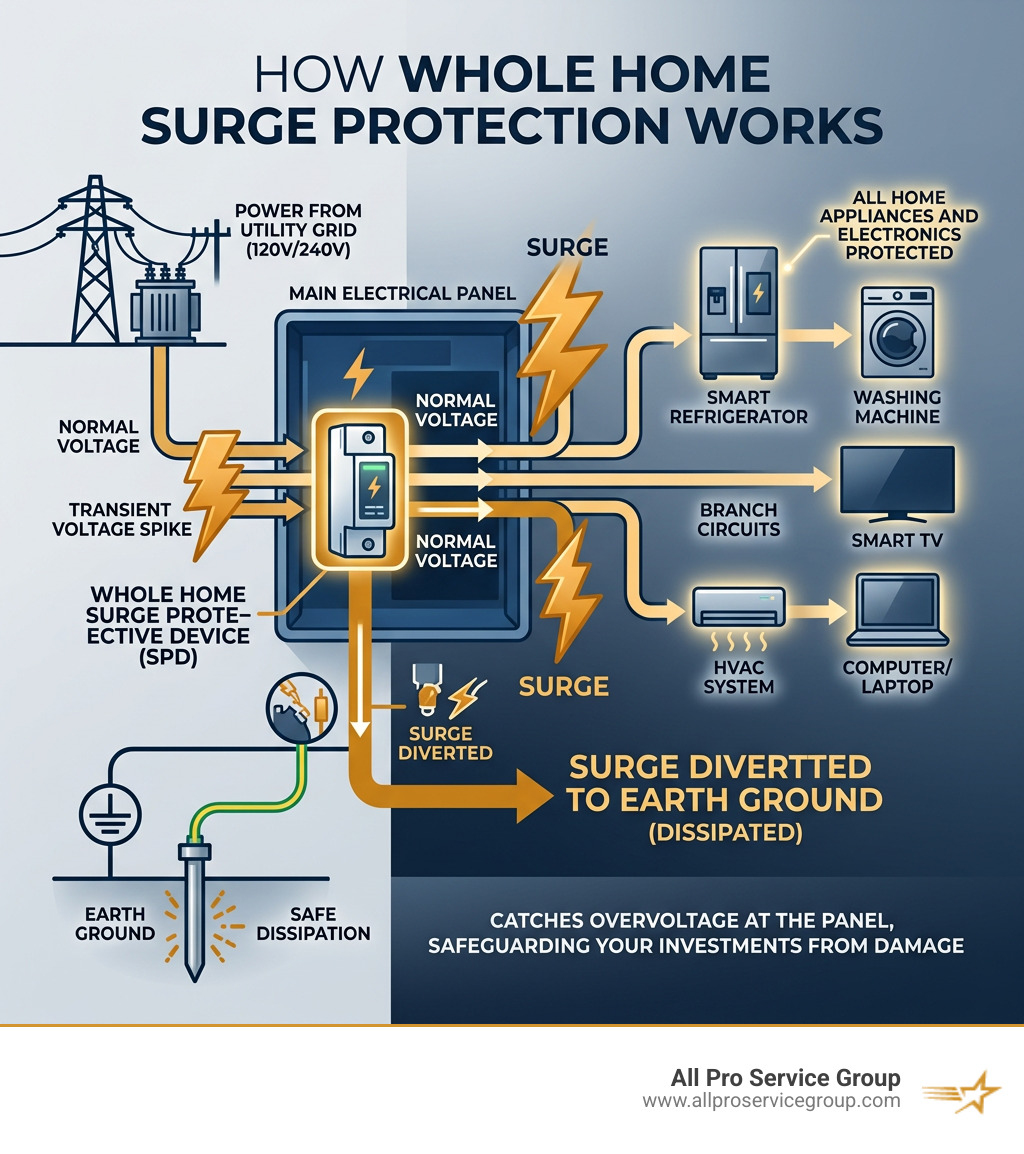
A whole home surge protector sits at your main electrical panel and catches those voltage spikes before they reach your devices. It's a relatively small investment compared to what it protects.
I'm Gary from All Pro Service Group, and after years of responding to electrical issues across the Salt Lake Valley, I've seen how whole home surge protection can mean the difference between a quick panel check and replacing a brand-new HVAC control board. In this guide, I'll walk you through the best devices on the market so you can make a confident, informed choice.
Why Your Modern House Needs Whole Home Surge Protection
Many of our neighbors in West Valley City and Salt Lake City think of power surges as rare, catastrophic events—like a scene from a movie where a bolt of lightning hits a house and everything explodes. While that makes for great cinema, the reality is much more subtle and frequent.
According to NEMA, up to 80 percent of all power surges actually originate from inside your building. These are called "switching transients." Every time your air conditioner kicks on or your refrigerator compressor cycles, it creates a small spike in voltage. These aren't large enough to blow a fuse, but they are large enough to stress the delicate microprocessors in your laptop, smart TV, and LED light bulbs.
External surges are the "big ones." These come from utility grid switching, downed power lines, or lightning. Even if lightning strikes a transformer several blocks away in Ogden, that excess energy can travel through the lines and into your home. In 2018 alone, insurers paid out over $900 million in lightning-related claims. With the average cost per claim soaring due to the high value of modern home electronics, the risk is higher than ever.
The cumulative effect of these surges is often described as "death by a thousand cuts." Your dishwasher might not stop working today, but its motherboard is being slowly "rusted" by electrical transients, leading to a premature failure that could cost you hundreds in repairs.
| Surge Source | Frequency | Severity | Primary Cause |
|---|---|---|---|
| Internal | Multiple times daily | Low to Moderate | Appliance cycling (AC, Fridge, Hair dryers) |
| External | Occasional | High to Extreme | Lightning, utility grid switching, accidents |

Protecting Sensitive HVAC Systems and Smart Appliances
One of the biggest reasons we recommend whole home surge protection to our customers in Provo and Park City is to protect hard-wired equipment. You can plug your computer into a power strip, but you can't do that with your HVAC system, your oven, or your water heater.
Modern HVAC systems are incredibly efficient, but that efficiency comes from complex control boards and variable-speed motors. These components are extremely sensitive to voltage fluctuations. If a surge hits your outdoor condenser unit, it could fry the control board instantly. Replacing that board often costs more than the installation of a whole-house protector!
If you are considering electrical panel upgrades to accommodate a new high-efficiency AC or an ev-charger-installation, that is the perfect time to add surge protection. It ensures that your new, expensive investments aren't vulnerable from day one.
The Benefits of Layered Whole Home Surge Protection
We often get asked: "If I have a whole house protector, can I throw away my power strips?" The answer is a firm no. For the best safety, we recommend a "two-tiered" or layered approach.
- Type 1 or Type 2 Protector: This is your first line of defense, installed at the main electrical panel. It stops large external surges from entering your home’s circuits.
- Type 3 Protector: This is a point-of-use device that resembles a power strip. It protects the specific electronics plugged into it.
Why both? Because a whole-house unit at the panel handles the big external hits and the surges from large appliances, but it might not catch a small transient generated by a vacuum cleaner in the same room as your computer. Furthermore, there is a "30-foot rule" in the industry: point-of-use protectors work most effectively when they are at least 30 feet of wire away from the main panel. This distance allows the wire's natural resistance to help the whole-house unit do its job before the power strip takes over the "cleanup" of any remaining voltage.
NEC Requirements and Electrical Safety Standards
Electrical codes aren't just red tape; they are designed to prevent fires and save lives. The National Electric Code (NEC) requires whole home surge protection for all new residential services and service upgrades.
The NFPA (National Fire Protection Association) pushed for this change because they recognized that surges don't just break TVs—they can cause electrical fires by damaging the insulation of wires over time. As of now, the majority of the country has adopted these standards, and Utah is part of the movement toward safer electrical systems.
If you are building a new home in South Jordan or upgrading an older panel in West Jordan to handle more load, your project will likely require a surge protective device (SPD) to pass inspection. Even if your home is older and you aren't planning an upgrade, installing one voluntarily is a smart move for your insurance and safety.
Top-Rated Whole Home Surge Protection Devices for 2026
When we go out on service calls in the Greater Salt Lake Valley, we look for brands that have a proven track record of reliability. Not all SPDs are created equal. Here are the top contenders we often recommend:
- Eaton CHSPT2ULTRA: This is a powerhouse. It’s rated for 108kA per phase and is widely considered one of the most robust residential units available. It has clear LED indicators to let you know it’s still working.
- Siemens Boltshield: Known for its high amp rating (often up to 140,000 amps), this unit is excellent for areas that might experience more frequent grid issues.
- Leviton Type 1 & 2 Panels: Leviton offers some of the most advanced features, including audible alarms and even LCD screens with surge counters so you can see exactly how many times the device has saved your home.
- Square D HEPD80: A compact, universal unit that works with almost any brand of electrical panel. It’s rated for 80kA and is a fantastic mid-range option for most homes.
Key Specifications: Amps, Joules, and Clamping Voltage
Choosing a protector involves looking at a few "alphabet soup" specifications. Here is what actually matters:
- kA Rating (Kilo-Amps): This tells you how much surge current the device can handle. A minimal whole-house protector should be rated for at least 50,000 amps (50kA). Since a typical lightning strike is around 20,000 amps, a 50kA or 80kA unit provides a healthy margin of safety.
- VPR (Voltage Protection Rating): Also known as "clamping voltage." This is the "ceiling" for the voltage. Once the power spikes above this level (usually 600V or 800V for whole-house units), the protector kicks in and shunts the extra energy to the ground.
- UL 1449 5th Edition: Always look for this certification. It means the device has been tested to the latest safety standards.
- TPMOV vs. GDT Hybrid: Traditional units use MOVs (Metal Oxide Varistors) which can degrade over time. Newer hybrid designs use a combination of MOVs and Gas Discharge Tubes (GDT) to provide a longer lifespan and better protection against tiny, frequent transients.
The Critical Role of Grounding and Professional Installation
Here is a secret that many "big box" stores won't tell you: a surge protector is only as good as your home's grounding system.
Think of a surge protector like a high-speed exit ramp for electricity. If the exit ramp leads to a brick wall (poor grounding), the electricity has nowhere to go and will just back up into your home's wiring. For whole home surge protection to work, it must have a low-impedance path to the earth.
When we perform an installation, we don't just "plug it in." We check:
- The Ground Rod: Is it corroded? Is it deep enough in the Utah soil?
- Bonding: Are your water pipes and gas lines properly bonded to the electrical system?
- Lead Length: The wires connecting the protector to the panel must be as short and straight as possible. Every inch of wire adds "inductance," which can slow down the protector's response time.
This is why we strongly discourage DIY installation for this particular project. Working inside a live electrical panel is dangerous, and if the grounding isn't perfect, you've wasted your money on the device. Our experts at All Pro Service Group ensure your wiring and rewiring is up to code so the protector can actually do its job.
Frequently Asked Questions About Surge Suppression
How long does a whole home surge protector last?
Most high-quality units last between 3 and 5 years, but it depends entirely on how many "hits" they take. These devices are "self-sacrificing." Every time they stop a surge, a little bit of the internal components (the MOVs) wears out. Most units have an LED light. If that light goes out, the device has done its duty and needs to be replaced. We recommend checking your panel once a month—especially after one of our famous Utah thunderstorms!
What is the typical cost for unit and installation?
For a professional installation in the Salt Lake area, you can expect to pay between $200 and $700. This includes the device itself (usually $100–$400) and the labor for a licensed electrician to install it safely and verify your grounding. When you consider that a single surge could destroy a $2,000 refrigerator or a $6,000 HVAC system, the ROI is incredibly high. It’s much cheaper than replacing outlets and switches and fried appliances throughout the house.
Can a surge protector survive a direct lightning strike?
Honestly? Probably not. A direct strike involves millions of volts and tens of thousands of amps. No residential device is guaranteed to stop a direct hit. However, direct strikes are rare. Most lightning damage comes from "indirect" strikes—lightning hitting the ground or a pole nearby. A quality whole-house protector can handle those indirect surges, which are far more common.
Conclusion: Securing Your Home’s Electrical Future
In today's "Digital/LED world," our homes are more vulnerable than ever. From the smart hub in your kitchen to the variable-speed blower in your attic, your comfort and convenience depend on clean, stable power.
Investing in whole home surge protection isn't just about buying a gadget; it's about buying peace of mind. You won't have to worry every time the lights flicker during a storm or wonder why your expensive electronics are failing years before they should.
At All Pro Service Group, we’ve been serving the Greater Salt Lake Area since 2008. We are "Gephardt Approved" and our technicians are experts in providing dependable electrical services. Whether you're in South Salt Lake, Provo, or Park City, we are here to help you protect your home.
Don't wait for the next big storm to realize you're unprotected. Give us a call today, and let’s make sure your home is ready for whatever the grid—or the weather—throws at it. We’re available 24/7 to keep your home safe and powered up!