When Your Bosch Hot Water System Needs Attention
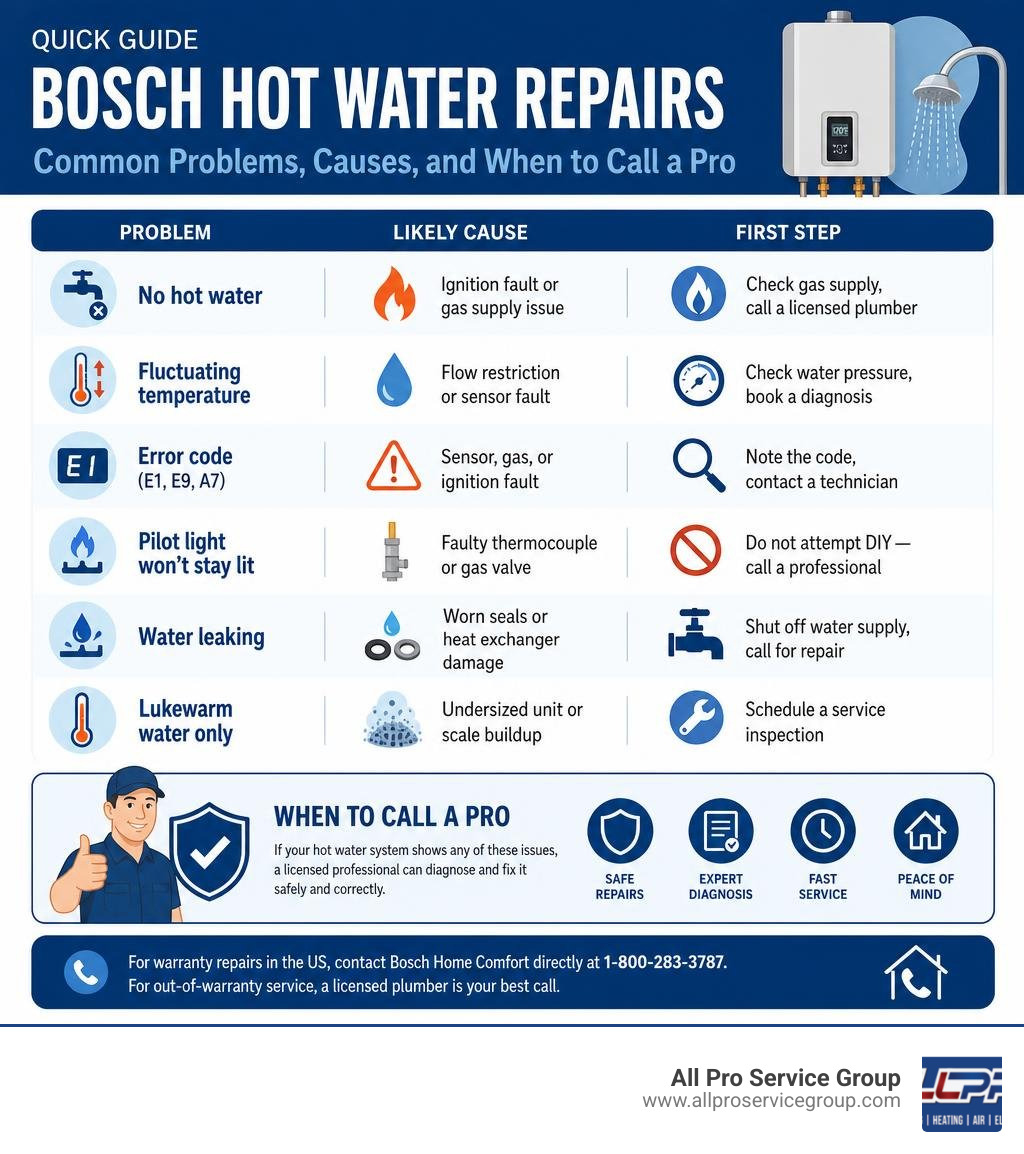
Bosch hot water repairs are often needed when your unit stops heating, flashes an error code, or delivers inconsistent temperatures. Here's a quick overview of what to do:
Quick answers for common Bosch hot water problems:
| Problem | Likely Cause | First Step |
|---|---|---|
| No hot water | Ignition fault or gas supply issue | Check gas supply, call a licensed plumber |
| Fluctuating temperature | Flow restriction or sensor fault | Check water pressure, book a diagnosis |
| Error code (E1, E9, A7) | Sensor, gas, or ignition fault | Note the code, contact a technician |
| Pilot light won't stay lit | Faulty thermocouple or gas valve | Do not attempt DIY — call a professional |
| Water leaking | Worn seals or heat exchanger damage | Shut off water supply, call for repair |
| Lukewarm water only | Undersized unit or scale buildup | Schedule a service inspection |
For warranty repairs in the US, contact Bosch Home Comfort directly at 1-800-283-3787. For out-of-warranty service, a licensed plumber is your best call.
One minute you're stepping into a hot shower. The next, you're hit with cold water and a blinking error code you've never seen before. It's frustrating — and it almost always happens at the worst possible time.
Bosch makes some of the most durable hot water systems available. Their tankless units are built to last at least 20 years, compared to just 6–12 years for a conventional tank heater. But even well-engineered systems need repairs eventually — especially if maintenance has been skipped or the unit is aging.
The good news? Most Bosch hot water problems are diagnosable and fixable quickly by a qualified technician. Knowing what's wrong — and who to call makes the whole process a lot less stressful.
At All Pro Service Group, we've been helping Greater Salt Lake Valley homeowners with bosch hot water repairs and water heater services since 2008. Whether it's a tankless unit throwing error codes or an older pilot ignition system that won't stay lit, our team has the hands-on experience to get your hot water back fast.
Common Issues That Require Bosch Hot Water Repairs
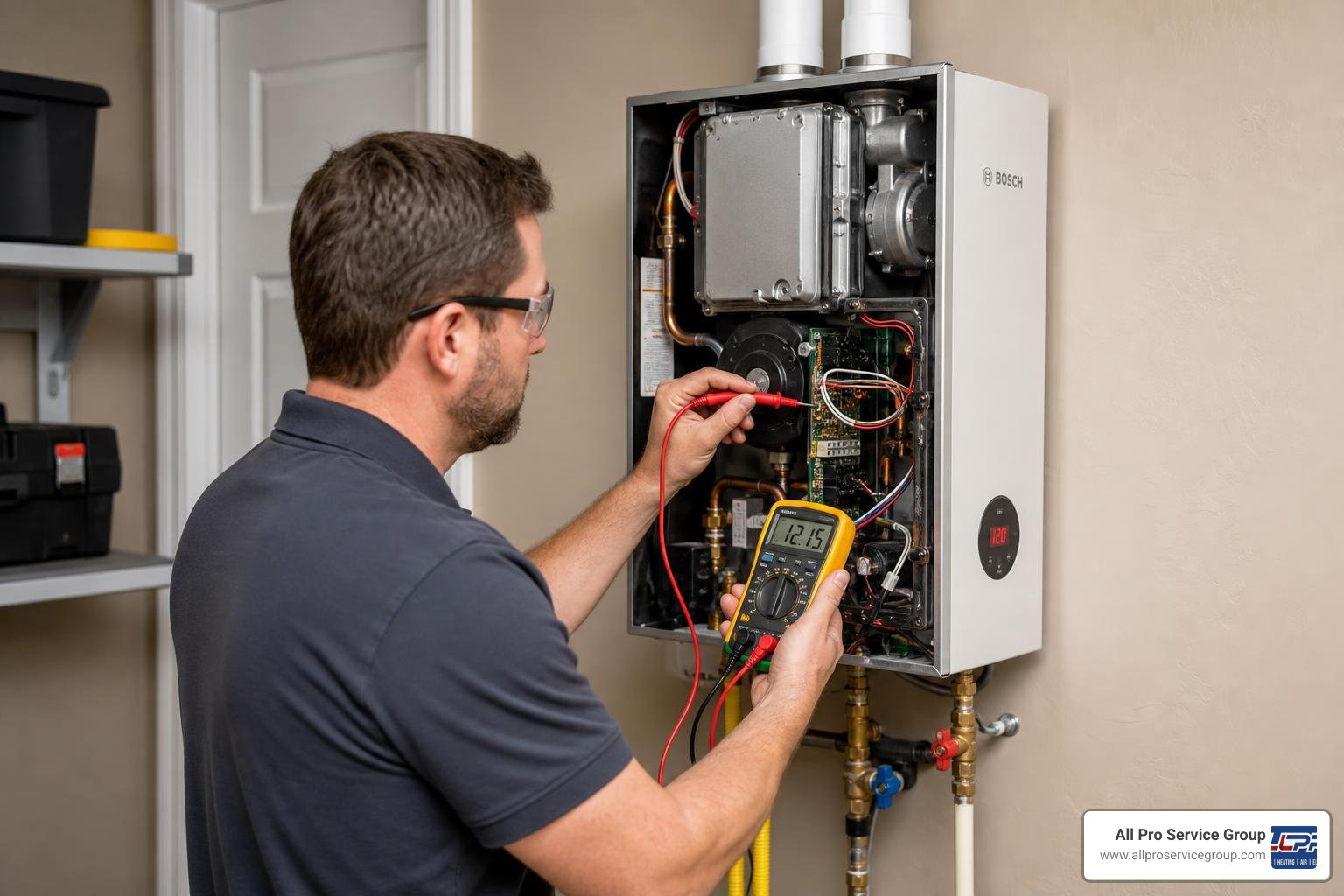
Like any hardworking home appliance, your Bosch water heater can run into a few bumps in the road over its decade-plus lifespan. Because Bosch specializes in high-efficiency continuous flow (tankless) systems, the issues they experience are often quite different from those of traditional storage tanks.
If your hot water has gone on strike, it usually boils down to a handful of common culprits: failing sensors, ignition hiccups, gas pressure imbalances, or mineral scale choking the internal copper pipes. Let's break down the most frequent problems that require professional bosch hot water repairs.
Troubleshooting Fluctuating Temperatures and Low Pressure
Have you ever experienced the dreaded "cold water sandwich"? This happens when you turn on the hot tap, get a brief blast of warm water, followed by a sudden wave of freezing water, before it finally stabilizes. Inconsistent temperatures are one of the most common complaints we hear from homeowners in Salt Lake City and West Jordan.
Often, this temperature fluctuation is caused by a water flow issue. Bosch tankless systems rely on a minimum flow rate to activate the gas burner. If your showerhead or faucet is restricted by mineral deposits, or if your home's water pressure drops, the system may struggle to recognize that water is running. The burner shuts off, leaving you shivering.
Another common cause is a dirty or scale-coated heat exchanger. Over time, the hard water common in the Greater Salt Lake Valley leaves calcium deposits inside the heat exchanger. This acts as an insulating barrier, preventing the burner from efficiently heating the water passing through. If you want to understand how shifting to continuous flow can optimize your home's energy usage, check out our guide on How a Tankless Water Heater Can Help Your Home.
Understanding Error Codes and Ignition Faults
One of the best features of modern Bosch hot water systems is their self-diagnostic capability. When something goes wrong, the digital display on your wall controller or front panel will flash an alphanumeric error code. This takes the guesswork out of troubleshooting, allowing us to arrive at your home with the exact replacement parts needed.
Here are three of the most common Bosch error codes you might encounter:
- E1 Code: This indicates an ignition failure. The unit is trying to light the gas burner but cannot establish a flame. This could be due to a temporary interruption in your gas supply, a faulty spark electrode, or a dirty flame sensor.
- E9 Code: This is a safety limit fault, typically meaning the high-limit temperature limiter has tripped. In plain English, your system is overheating. This is often caused by a severe lack of water flow, a blocked heat exchanger, or a failing internal bypass valve.
- A7 Code: This code points to a sensor fault, specifically with the hot water outlet temperature sensor (NTC). If the control board cannot accurately read how hot the exiting water is, it will shut down the system as a safety precaution.
For more technical details on system specifications and professional installer guidelines, you can consult the Trade FAQ | Bosch Thermotechnology. When these codes pop up, it is highly recommended to have a certified technician clear the system and address the underlying mechanical or electrical fault.
Comparing Bosch Models: Pilot Ignition, Hydropower, and Optiflow
Bosch has a rich history of engineering hot water systems, and over the years, their ignition technologies have evolved significantly. Understanding which model is hanging on your wall is crucial because each generation has its own unique mechanical personality and repair needs.
Whether you have a classic pilot light model, a self-sparking Hydropower unit, or a high-tech Optiflow system, the way they generate heat and manage gas efficiency varies.
| Bosch Model Series | Ignition Type | Power Source | Key Features | Common Repair Focus |
|---|---|---|---|---|
| Classic Pilot (e.g., 10P, 13P, 16P) | Standing Pilot Light | Standing Flame / Thermocouple | No electrical connection needed; highly reliable | Thermocouple wear, pilot orifice blockages |
| Hydropower (e.g., 10H, 13H, 16H) | Hydro Generator Spark | Water Flow Turbine | Self-generating spark; works during power outages | Turbine wear, microswitch adjustments |
| Optiflow (e.g., 20L, 26L) | Electronic Ignition | Mains Electricity (120V) | Bluetooth connectivity, 6+ star efficiency | Electronic sensors, control board issues |
Repair Needs for Classic Pilot Light Models
If you have a classic Bosch model like the 10P or 16P, you own a mechanical workhorse. These systems do not require an electrical connection to operate. Instead, they use a tiny, constantly burning flame called a pilot light. When you open a hot water tap, the gas valve opens, and the pilot light ignites the main burner.
The most common repair issue with these older models is a failing thermocouple. The thermocouple is a simple safety device that detects heat from the pilot light. If the pilot goes out, or if the thermocouple wears out and can no longer detect the flame, it will shut off the main gas valve to prevent gas from leaking into your home.
If your pilot light keeps blowing out or refuses to stay lit after you release the control knob, it is usually time to replace the thermocouple or clean the pilot injector orifice. For comprehensive details on keeping these older systems running smoothly, explore our professional Plumbing Water Heater Repair services.
Hydropower and Optiflow Bosch Hot Water Repairs
For homeowners looking to eliminate the constant gas consumption of a standing pilot light without needing an electrical outlet nearby, Bosch introduced the Hydropower series (such as the 10H and 13H). These ingenious units use a small internal water turbine (a hydro generator). When you turn on a hot tap, the flowing water spins the turbine, generating a small electric spark that ignites the burner.
While incredibly convenient, the moving parts inside the hydro generator can wear down over time due to sediment or hard water. If the turbine gets clogged or fails, the unit will not generate a spark, leaving you with cold water.
The modern flagship series is the Bosch Optiflow. These are highly advanced, electrically powered condensing units that boast incredible energy efficiency. They feature Bluetooth smartphone connectivity, allowing you to monitor water usage and change settings from your phone.
Because Optiflow units rely heavily on electronic control boards, modulating gas valves, and multiple temperature sensors, repairs typically involve diagnostic software and component-level electrical replacements. If you are considering upgrading your home to one of these high-efficiency continuous flow systems, you can learn more about our Tankless Water Heater Installation options.
Lifespan, Maintenance, and Repair vs. Replacement Decisions
A Bosch hot water system is an investment in your home's comfort and energy efficiency. While these systems are famous for their longevity, they are not completely "set-and-forget." To get the absolute most out of your unit, regular preventative care is essential.
How Regular Maintenance Prevents Costly Bosch Hot Water Repairs
The water supply in the Greater Salt Lake Valley — from Provo up to Ogden — is notoriously high in mineral content. As water is heated inside your Bosch system, dissolved calcium and magnesium solidify, forming a crusty layer of scale inside the copper heat exchanger.
This scale buildup forces your water heater to work harder, burning more gas and subjecting the heat exchanger to extreme thermal stress. Over time, this can lead to microscopic cracks in the copper, resulting in water leaks and a ruined unit.
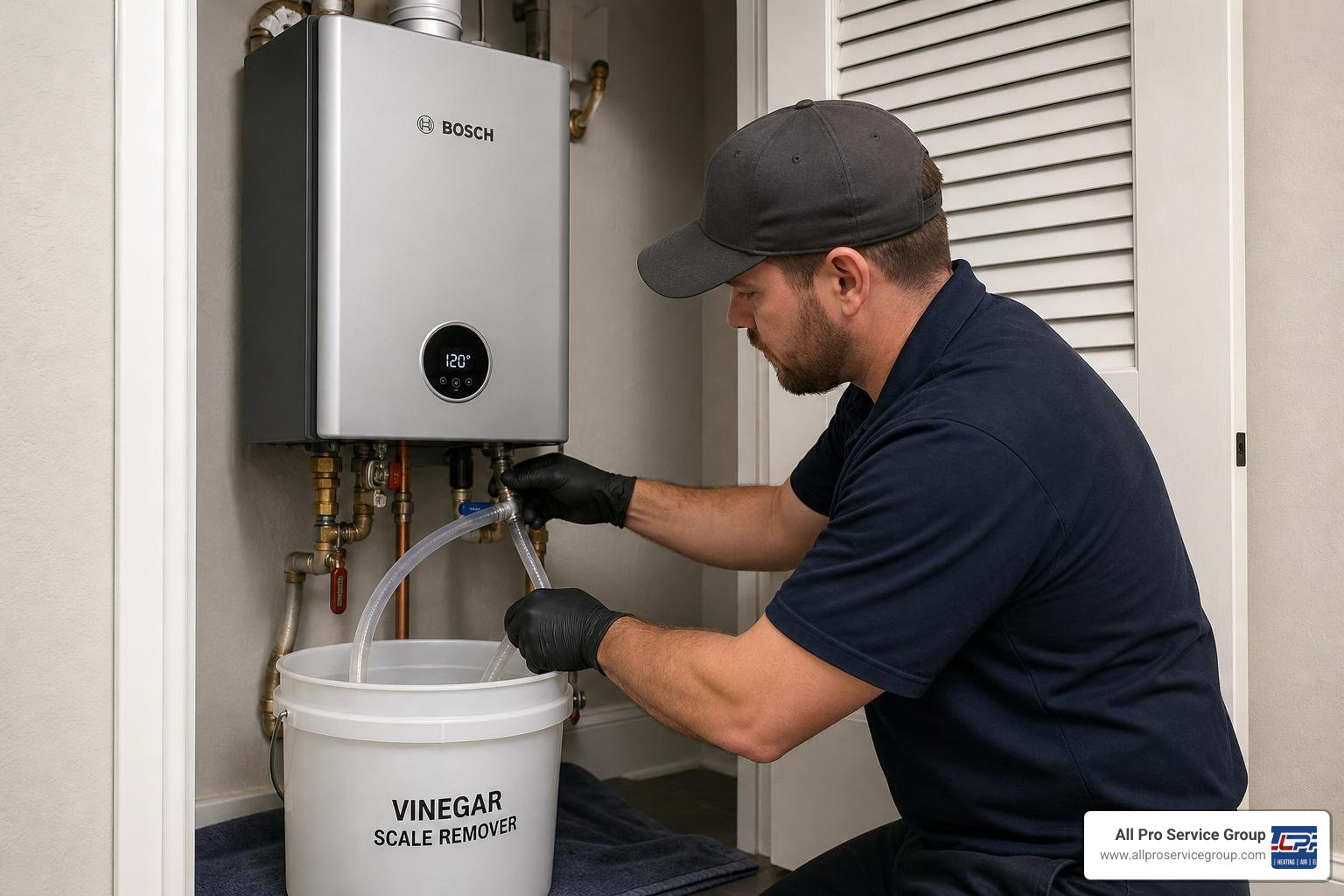
To prevent this, Bosch recommends having your tankless system professionally flushed with a food-grade descaling solution at least once a year. Flushing removes the scale, restores optimal water flow, and keeps your utility bills low. Additionally, checking safety valves like the pressure limiting valve ensures your system remains safe from sudden pressure spikes. For more insights on keeping your water heating systems in top shape, read about AO Smith Water Heater Maintenance, which highlights maintenance principles that apply directly to Bosch systems as well.
Tankless vs. Traditional Tank Reliability
When deciding whether to stick with a tankless Bosch system or opt for a traditional tank, reliability and lifespan are major factors. Traditional storage tank water heaters are constantly holding 40 to 80 gallons of hot water, making them highly susceptible to internal rust and corrosion. Because of this constant exposure, traditional tanks generally last only 6 to 12 years before the tank fails and begins leaking.
In contrast, Bosch tankless units only heat water on demand, meaning they do not store water and are far less prone to corrosion. With proper annual maintenance, a Bosch tankless system can easily last 20 years or more. This long-term reliability makes them an incredibly cost-effective choice over time, saving homeowners up to 50% on their water heating utility bills. If you are comparing different high-efficiency technologies, you might also find our Heat Pump Water Heater Guide 2026 helpful for comparing your options.
When to Repair vs. Replace Your Bosch Unit
If your older Bosch system is acting up, you might find yourself at a financial crossroads: do you repair it or replace it?
As a general rule of thumb, if your Bosch system is under 10 years old and the repair cost is less than half the price of a new unit, a professional repair is almost always the smartest move. However, if your system is approaching the 15-to-20-year mark, has a leaking heat exchanger, or requires frequent service calls, upgrading to a modern, highly efficient model is usually the more cost-effective long-term path.
When you choose to replace, you gain access to modern energy-efficient technology, lower operating costs, and the peace of mind that comes with a brand-new manufacturer's warranty. To explore replacement options and what the installation process looks like, take a look at our Plumbing Water Heater Installation overview. If you want to verify your warranty status or find official manufacturer support details, you can use the official Servicer Finder - Bosch.
Frequently Asked Questions About Bosch Hot Water Systems
How long do Bosch gas hot water systems typically last?
With regular servicing and annual flushing, a Bosch gas hot water system can easily last 20 to 30 years. Their heavy-duty copper heat exchangers and modular designs mean that individual parts can be replaced over time, preventing the need to scrap the entire unit when a single component wears out.
Why is my Bosch hot water system cutting in and out?
If your hot water is fluctuating, it is usually due to a water flow issue or a failing temperature sensor. Tankless systems require a steady, minimum flow of water to keep the burner ignited. If your showerhead is restricted, or if your home's water pressure is inconsistent, the burner may turn off prematurely. Gas pressure issues or scale buildup in the heat exchanger can also cause the system to overheat and cycle on and off.
How often should a Bosch hot water system be serviced?
Bosch recommends having your hot water system professionally serviced every 2 years. For older pilot ignition models, this biennial service is crucial to clean the burner, inspect the thermocouple, and clear any dust or debris from the pilot assembly. If you live in an area with particularly hard water, we recommend an annual flush to keep scale from building up inside the heat exchanger.
Conclusion
Getting your bosch hot water repairs sorted doesn't have to be a stressful ordeal. By understanding how your specific model works, keeping an eye out for early warning signs like fluctuating temperatures, and staying on top of annual flushing, you can enjoy endless hot water for decades.
At All Pro Service Group, we have been the trusted choice for water heater repairs, replacements, and maintenance across the Greater Salt Lake Valley since 2008. From Salt Lake City and South Jordan to West Valley City, Ogden, and Provo, our licensed, "Gephardt Approved" technicians are ready to help. We pride ourselves on transparent, upfront pricing, exceptional customer service, and flexible financing options to fit your budget.
Don't let a cold shower ruin your day. If your Bosch hot water system needs professional attention, Schedule your Bosch hot water repairs with All Pro Service Group today and let our family take care of yours!