The Price of Cool: A Breakdown of AC Installation Costs
Why Every EV Owner in Salt Lake Area Needs a 240 Volt Charger Installation
AC installation price typically ranges from $3,500 to $15,000, depending on the system type, your home's size, and whether ductwork is already in place. Here's a fast breakdown:
| System Type | Typical Price Range |
|---|---|
| Portable AC | $300 - $700 (no install needed) |
| Window AC | $150 - $800 (minimal install) |
| Ductless Mini-Split | $2,000 - $6,000 |
| Central AC (existing ductwork) | $3,500 - $7,500 |
| Central AC (new ductwork needed) | $8,000 - $15,000+ |
These are ballpark figures. Your actual cost depends on several factors — all covered in detail below.
Summer in Salt Lake City hits hard. When your AC gives out — or you're installing one for the first time — the first question on your mind is almost always: "What is this going to cost me?"
It's a fair question, and not always an easy one to answer. Prices vary widely based on your home, your system choice, and your local market. A straightforward unit swap in a home with existing ductwork looks nothing like a full installation in an older house that's never had central air.
The good news? Once you understand what drives the price, the numbers start to make a lot more sense.
I'm Gary, owner of All Pro Service Group, and I've been helping Greater Salt Lake Valley homeowners navigate AC installation price decisions since 2008. Whether it's a simple replacement or a full system install, I've seen just about every scenario — and I'll walk you through exactly what to expect.
Average AC Installation Price by System Type
When we talk about the AC installation price, the "type" of system is the biggest fork in the road. Are you looking for a whole-home solution or just trying to keep one bedroom from feeling like a sauna?
Central Air Conditioning
This is the gold standard for Utah homes. A central AC system uses your home’s furnace fan and ductwork to distribute cool air to every room. On average, homeowners spend about $4,400 for a mid-sized replacement, but a brand-new central air conditioner installation can range from $3,500 to $12,000 depending on the complexity. If you already have a forced-air furnace, adding central AC is often the most cost-effective path to total comfort.
Ductless Mini-Splits
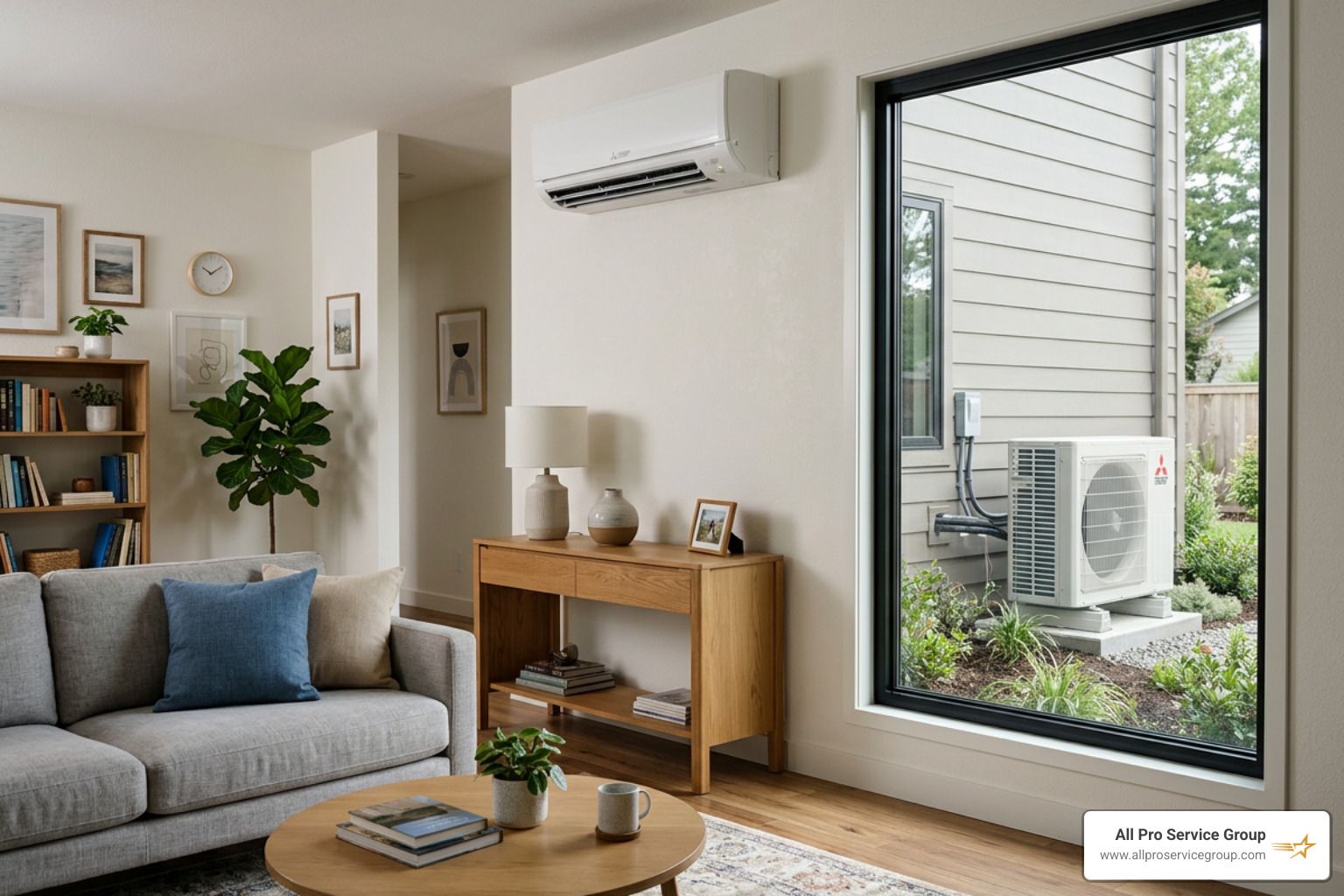
These are incredibly popular for older homes in areas like Park City or the avenues of Salt Lake where ductwork simply doesn't exist. A mini-split consists of an outdoor compressor and one or more indoor "heads" mounted on the wall. They are the most energy-efficient option available today. Prices typically range from $2,000 to $6,000, though costs increase as you add more "zones" (indoor units) to the system. You can explore the comprehensive air conditioning services All Pro offers Utah residents to see if this fits your layout.
Window and Portable Units
If you are on a tight budget, these are the most affordable. A new window unit costs between $150 and $800. Portable units are slightly more expensive, ranging from $300 to $700. While the upfront AC installation price is low (often $0 if you do it yourself), these units are noisy, less efficient, and only cool a single room.
| System Type | Cooling Capacity | Average Installed Cost |
|---|---|---|
| Portable AC | 100 – 1,000 sq. ft. | $300 – $700 |
| Window Unit | 150 – 1,500 sq. ft. | $150 – $1,000 |
| Ductless Mini-Split | Single Zone to Whole Home | $2,000 – $6,000+ |
| Central AC | Whole Home (Up to 3,000+ sq. ft.) | $3,500 – $12,000+ |
Key Factors Influencing Your Total Costs
Why does one neighbor pay $4,000 while another pays $9,000? It usually comes down to the "guts" of the system and the specific needs of the house.
System Tonnage and BTUs
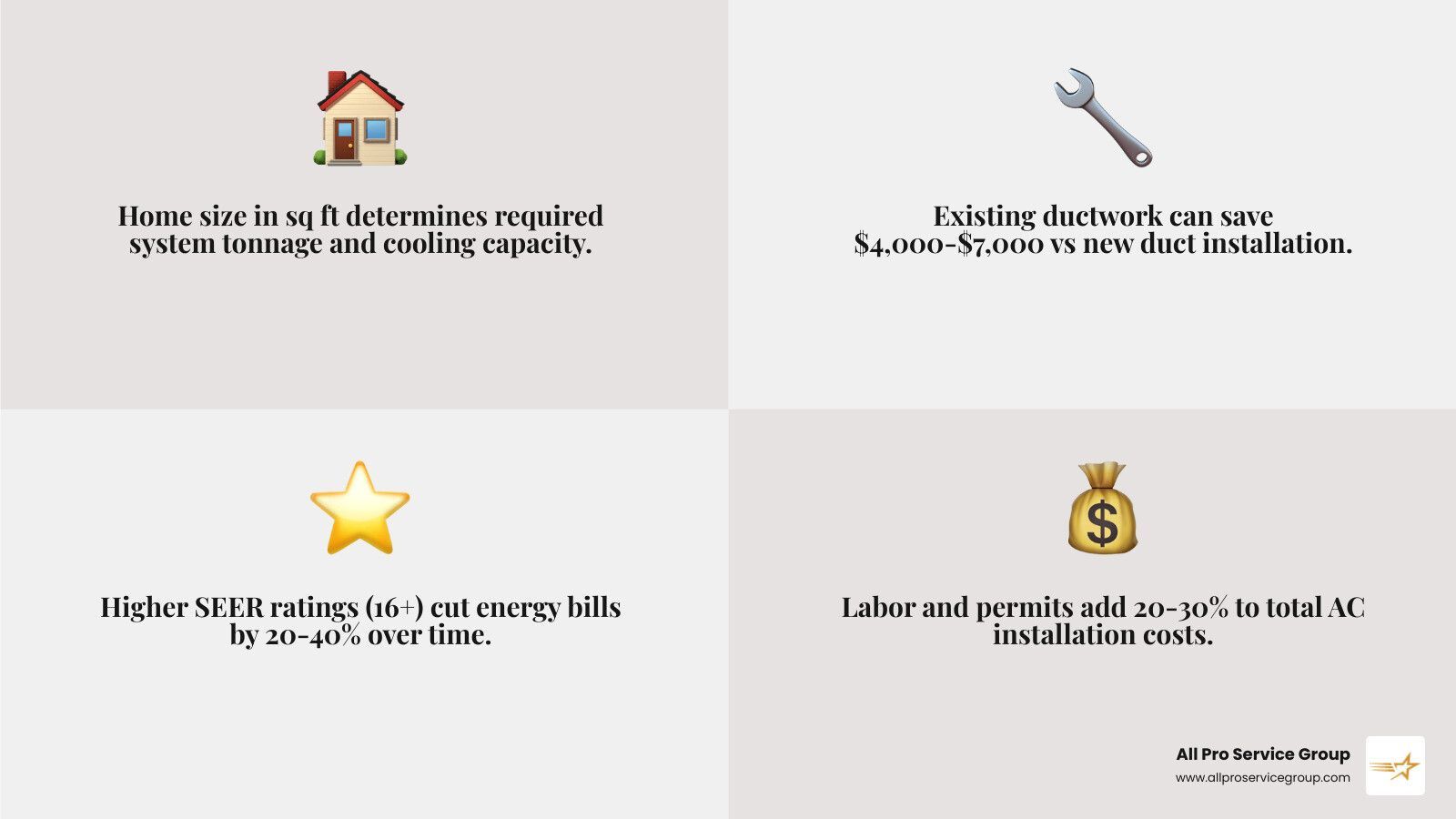
In the HVAC world, size is measured in "tons." This doesn't refer to the weight of the unit, but rather its cooling capacity. One ton of cooling is equal to 12,000 British Thermal Units (BTUs) per hour.
A 2,000-square-foot home typically requires a 3-ton or 3.5-ton unit. If the unit is too small, it will run constantly and never get the house cool. If it's too large, it will "short cycle," turning on and off so fast that it fails to remove humidity, leaving your home feeling clammy. Getting the right AC installation & replacement starts with an accurate sizing calculation.
Brand Reputation and Component Quality
Just like cars, there are "economy" brands and "luxury" brands. Brands like Goodman are often more budget-friendly, while names like Trane or Carrier often come with a premium price tag but offer robust warranties and specialized parts. At All Pro, we focus on brands that handle the Salt Lake climate best—units that can stand up to our dry, dusty summers without constant breakdowns.
Single-Stage vs. Variable-Speed Compressors
- Single-Stage: Like a light switch. It's either 100% on or 100% off. These are the cheapest to install.
- Two-Stage: Has a "high" and "low" setting. It runs on low most of the time to save energy.
- Variable-Speed: The most advanced. It can run at any percentage (like a dimmer switch) to maintain a perfectly steady temperature. These have a higher upfront AC installation price but offer the lowest monthly bills.
System Sizing and Tonnage Requirements
We don't just guess based on square footage. A professional should perform a "Manual J" load calculation. This looks at your home’s insulation, the number of windows, ceiling height, and even which direction your house faces.
The Energy Star sizing chart provides a great baseline, suggesting roughly 20 BTUs per square foot of living space. However, in high-altitude areas like Ogden or Park City, these requirements can shift slightly.
SEER Ratings and Long-Term Efficiency
SEER stands for Seasonal Energy Efficiency Ratio. Think of it like MPG for your air conditioner. The higher the number, the less electricity it uses.
- 14-16 SEER: Standard efficiency. Good for most Utah homeowners.
- 18-20+ SEER: High efficiency. These often qualify for federal tax credits and rebates.
While a 20 SEER unit might cost $2,000 more than a 14 SEER unit, it could save you 30% or more on your monthly cooling bills. Over the 15-to-20-year lifespan of the unit, that's a massive return on investment.
Additional Expenses and Labor Considerations
The price of the box (the AC unit itself) is only about half the story. The rest is the labor and materials required to make it work safely in your home.
Labor Rates and Complexity
Professional labor for a standalone AC unit generally ranges from $1,000 to $2,500. This covers the expertise of a licensed technician who knows how to braze refrigerant lines, wire high-voltage electricity, and calibrate the system. If your unit is in a cramped crawlspace or a difficult attic, labor costs will naturally be higher.
Ductwork and Electrical Upgrades
If you are replacing an old unit, we always inspect the ducts. If they are leaky or uninsulated, your brand-new AC will waste half its effort cooling your attic instead of your living room. New ductwork can add $2,000 to $10,000 to the project. Additionally, modern high-efficiency units may require an electrical panel upgrade (costing $1,000–$3,000) if your home’s current service can’t handle the load.
Permits and Maintenance
Don't skip the permits! In West Valley City and Salt Lake City, permits typically cost between $25 and $125. They ensure the job was done to code for your safety. Also, keep in mind that most manufacturers require professional annual maintenance to keep your warranty valid.
Professional vs. DIY AC Installation Price
It is tempting to look at a DIY mini-split kit and think, "I can do that." But here is the catch: handling refrigerant requires an EPA license. If you release those gases into the atmosphere, you're looking at heavy fines.
More importantly, a DIY install almost always voids the manufacturer's warranty. If a $2,000 compressor fails in year two, you’re on the hook for the full cost. Using a central air installation cost calculator can help you see the value of professional labor versus the risk of doing it yourself.
Regional Variations in AC Installation Price
Location matters. The average cost of central air in 2025 for a 3-ton unit is roughly $5,750 nationally, but Utah's market has its own rhythm.
- Ogden and Provo: Generally follow national averages, though seasonal demand in early June can cause labor prices to spike.
- Salt Lake City: Higher demand for high-efficiency units due to local air quality awareness and rebates.
- Park City: Higher costs often due to travel time and specialized equipment needed for mountain homes.
Maximizing Value: When to Repair vs. Replace
We get calls every day asking: "Gary, can I squeeze one more year out of this thing?"
We usually suggest the "50% Rule." If the cost of the air conditioner repair is more than 50% of the value of a new system, it’s time to replace it.
Other signs it's time to let go:
- Age: If your AC is 15-20 years old, it’s living on borrowed time.
- The Refrigerant: If your old unit uses R-22 (Freon), repairs are becoming astronomically expensive because Freon is no longer produced.
- Energy Bills: If your bills are creeping up every summer despite regular maintenance, the internal components are likely failing.
Replacing your AC isn't just an expense; it's an investment. A new, high-efficiency system can add 5-10% to your home's resale value. Plus, if your furnace is also aging, doing a furnace installation & replacement at the same time as your AC can save you $1,000 or more in combined labor costs.
Frequently Asked Questions about AC Costs
How much does it cost to install central AC in a 2,000 sq. ft. home?
For a 2,000-square-foot home in the Salt Lake area, you can typically expect an AC installation price between $5,000 and $7,500 for a standard 3-ton to 3.5-ton unit with existing ductwork. If you need new ducts, that price can easily double.
Does a new air conditioner increase home value?
Yes! Especially in Utah’s climate, central air is a "must-have" for most buyers. Upgrading to an Energy Star certified system can increase property value and make the home much easier to sell.
What is the most energy-efficient AC system available?
Ductless mini-split heat pumps are currently the most efficient systems on the market. Some high-end models reach SEER ratings of 30+, which is significantly higher than the standard 14-16 SEER found in most central AC units.
Conclusion
Navigating the AC installation price doesn't have to be a headache. While the upfront investment is significant, the comfort of a cool home and the long-term energy savings make it one of the best upgrades you can make for your property.
At All Pro Service Group, we pride ourselves on being "Gephardt Approved" and serving our neighbors across the Greater Salt Lake Valley—from Ogden down to Provo. We offer transparent pricing, 24/7 availability for those middle-of-the-night breakdowns, and flexible financing options to make sure you don't have to choose between your budget and your comfort.
If you’re ready to see what a new system would look like for your specific home, give us a call. We’ll help you find the perfect balance of efficiency, power, and price. Visit our Heating & Air page to learn more or schedule your estimate today!