
Is a 110 Mini Split Unit Right for Your Space?
A 110 mini split unit is a ductless heating and cooling system designed for a standard North American 120V circuit, often labeled as 110V or 115V. It is usually best for one small-to-medium room, such as a bedroom, home office, garage, or workshop. Most models range from 6,000 to 12,000 BTU and can serve roughly 100 to 500 square feet, depending on insulation, ceiling height, sun exposure, and Salt Lake area's winter conditions.
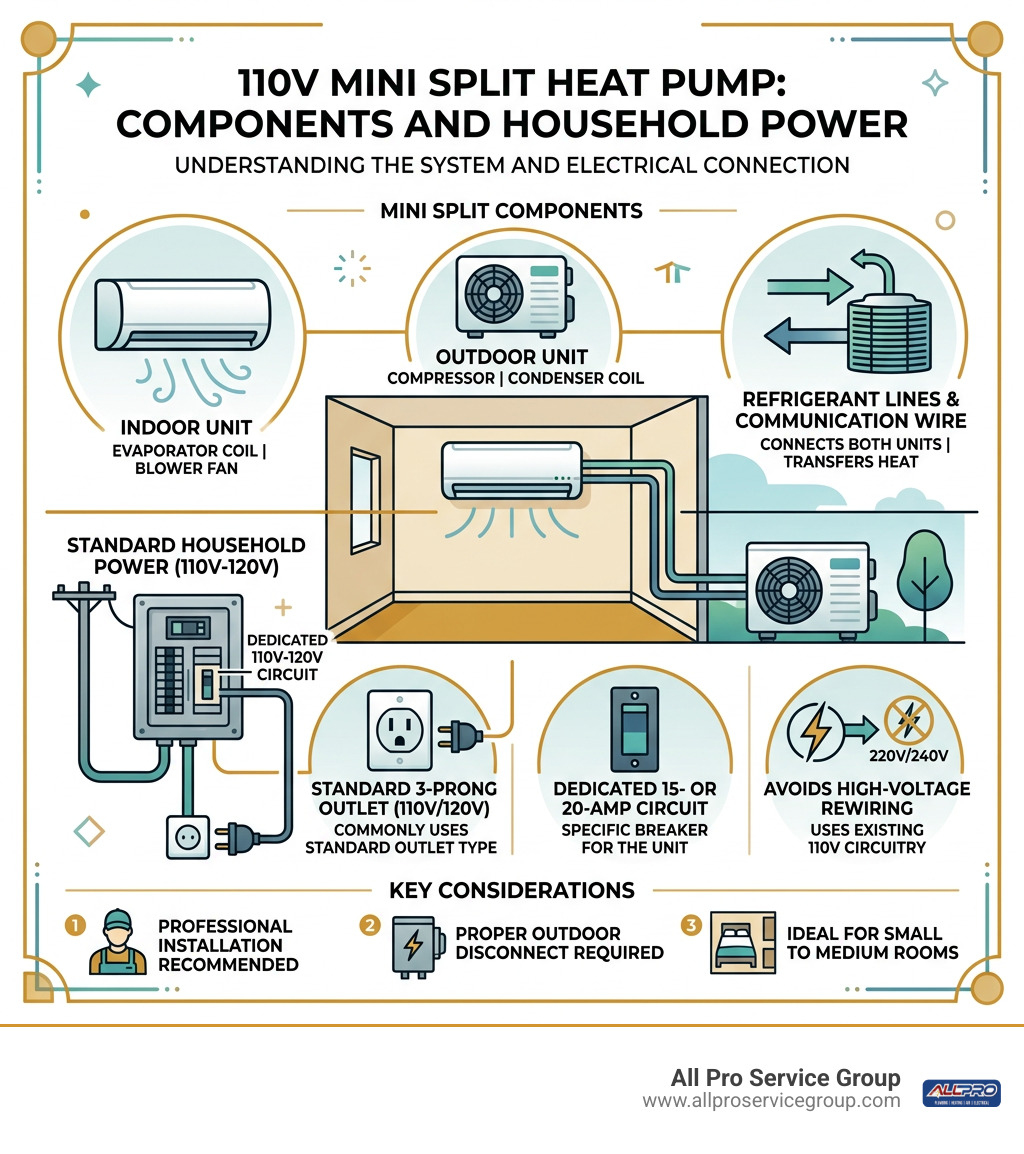
Unlike larger 220V systems, a 110V mini split can avoid the cost of running a new high-voltage circuit. But it still usually needs its own dedicated 15- or 20-amp circuit and a proper outdoor disconnect. Do not assume it can safely share a regular wall outlet with other appliances.
Many current models are reversible heat pumps, so they cool in summer and provide efficient heat in winter. High-efficiency options can reach up to 25 SEER2, while quiet indoor units may operate around 24 dB(A), which is low enough for many bedrooms and focused workspaces.
I'm Gary Leany with All Pro Service Group, serving Greater Salt Lake Valley homeowners with heating, air conditioning, plumbing, and electrical service since 2008. Our team helps homeowners assess whether a 110 mini split unit has the right size, electrical setup, and cold-weather performance for the room they need to condition.
What Is a 110 Mini Split Unit and How Does It Work?
A ductless mini split operates on a straightforward principle: instead of forcing air through extensive, leaky sheet metal ducts, it conditions a space directly at the source. The system consists of two primary parts connected through a small three-inch wall penetration: an outdoor condenser and an indoor air handler.
Refrigerant cycles between these two components, absorbing indoor heat and venting it outside during summer, or extracting ambient heat from the outside air and releasing it inside during winter. To explore the foundational mechanics of ductless systems further, you can check out our ductless mini splits complete guide.
The key distinction with a 110V system is that its compressor, fan motors, and onboard electronics are engineered to run on standard single-phase residential electricity.
Standard 110V vs 220V Ductless Systems: Understanding the Differences
In North American residential wiring, terms like 110V, 115V, and 120V are used interchangeably. They refer to the standard line-to-neutral voltage supplied to standard household outlets and basic single-pole breakers. When evaluating a 110v mini split, you are working with this standard voltage profile rather than the 208V/230V/240V circuits required by heavy-duty appliances.
The practical difference comes down to electrical capacity:
- Circuit Requirements: A 110V system uses a single-pole breaker occupying one slot in your electrical panel. A 220V system requires a double-pole breaker occupying two slots.
- Amperage Draw: Because power (watts) equals volts multiplied by amps ($P = V \times I$), a 110V unit drawing 1,200 watts uses roughly 10 to 12 amps. A 220V system producing the same wattage draws only 5 to 6 amps.
- System Capacity Limits: Because standard household wiring cannot safely handle excessively high amperage, 110V systems are limited to single-zone capacities between 6,000 and 12,000 BTU. Whole-home, multi-zone systems require 220V wiring to supply larger aggregate loads.
Next-Generation Refrigerants: R-32 and R-454B
Modern heat pumps utilize modern low Global Warming Potential (GWP) refrigerants. The industry-wide transition away from older legacy refrigerants like R-410A has introduced superior alternatives, notably R-32 and R-454B.
- R-32: Offers enhanced thermal conductivity, allowing systems to operate with lower refrigerant volume while boosting cycle efficiency.
- R-454B: A low-GWP blend delivering dependable thermodynamic properties under extreme temperature swings.
Modern DIY-friendly and pre-charged linesets use these refrigerants to deliver cleaner, compliant cooling and heating throughout the year.
Sizing, Capacities, and Energy Efficiency
Modern standard-voltage systems utilize DC inverter compressors that dynamically adjust operating speeds rather than cycling abruptly on and off. This variable-speed control allows top models to achieve ratings up to 25 SEER2 while running at whisper-quiet sound levels as low as 24 dB(A)—softer than a quiet library whisper.

Many units feature cold-climate heat pump technology, maintaining reliable heating capacity even when outdoor temperatures plunge to -13°F.
Selecting the Right 110 Mini Split Unit for Room Sizing
Proper load calculation prevents short-cycling (where an oversized unit turns off before dehumidifying) and under-sizing (where a unit runs continuously without reaching the set temperature).
When evaluating 1 ton mini split square footage, match your room dimensions against standard capacity classes:
- 6,000 BTU (0.5 Ton): Ideal for small bedrooms, walk-in closets, nursery spaces, or micro-offices (100 to 250 sq ft).
- 9,000 BTU (0.75 Ton): Best for standard bedrooms, home offices, and sunrooms (250 to 350 sq ft).
- 12,000 BTU (1.0 Ton): Ideal for master suites, open-concept studio spaces, bonus rooms, and converted garages (350 to 500+ sq ft).
For an in-depth breakdown of one-ton options, review our dedicated 12000 btu mini split guide 2026.
Comparing Standard Voltage Capacities and Room Sizes
| Capacity (BTU) | Tonnage | Typical Coverage | Recommended Breaker | Peak Wattage | Max SEER2 |
|---|---|---|---|---|---|
| 6,000 BTU | 0.5 Ton | 100 – 250 sq ft | 15 Amp (Single-Pole) | ~600W – 800W | Up to 22 SEER2 |
| 9,000 BTU | 0.75 Ton | 250 – 450 sq ft | 15 Amp (Single-Pole) | ~800W – 1,100W | Up to 25 SEER2 |
| 12,000 BTU | 1.0 Ton | 350 – 600 sq ft | 20 Amp (Single-Pole) | ~1,200W – 1,440W | Up to 23+ SEER2 |
Electrical Requirements and Safe Installation
One common misconception is that a 110V mini split can simply be plugged into an existing wall outlet near your desk or TV. In reality, electrical codes and equipment safety standards require a dedicated line run from the breaker panel to an exterior disconnect switch.

Before undertaking an electrical project, consult our 110 volt mini split guide 2026 to ensure your panel configuration meets local safety requirements:
- Dedicated Single-Pole Circuit: A 9,000 BTU unit typically requires a 15-amp single-pole breaker, while a 12,000 BTU system generally requires a 20-amp breaker.
- Conductor Sizing: Use 14 AWG copper wire for 15-amp runs and 12 AWG copper wire for 20-amp runs.
- Outdoor Disconnect: A code-compliant disconnect switch must be installed within sight of the outdoor condenser unit for maintenance and emergency shutoff.
How to Install a 110 Mini Split Unit Safely
Installing a ductless system follows a specific sequence to protect the system and ensure reliable operation:
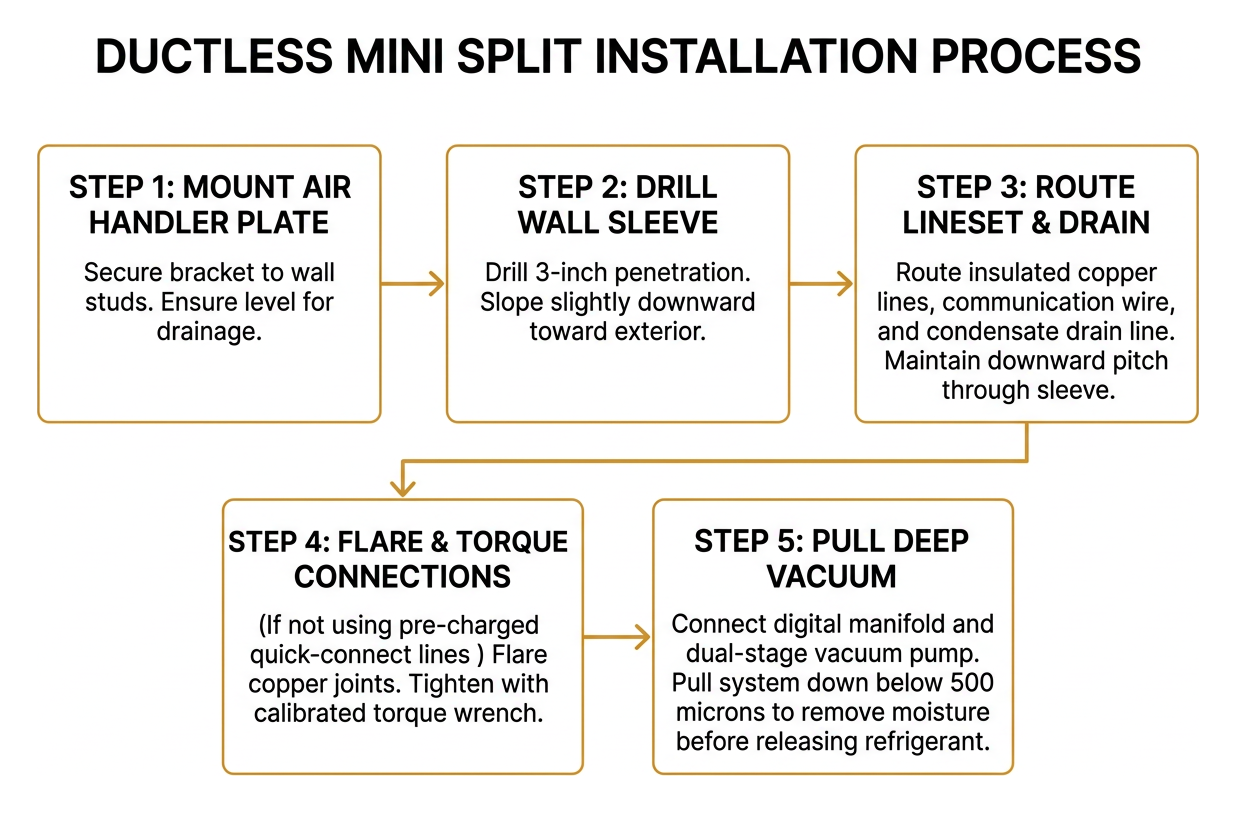
- Mounting the Air Handler Plate: Secure the mounting bracket to wall studs, ensuring it is level so condensate drains properly.
- Drilling the Wall Sleeve: Drill a 3-inch wall penetration sloped slightly downward toward the exterior.
- Routing the Lineset & Drain: Route the insulated copper refrigerant lines, communication wire, and condensate drain line through the wall sleeve, maintaining a downward pitch of at least 1/4 inch per foot.
- Flaring and Torquing Connections: If you are not using pre-charged quick-connect lines, flare copper joints and tighten them with a calibrated torque wrench.
- Pulling a Deep Vacuum: Connect a digital manifold and dual-stage vacuum pump, pulling the system down below 500 microns to remove moisture before releasing the refrigerant.
For technical guidelines on this procedure, see step-by-step ductless installation guidelines.
Smart Features and Maintenance Essentials
Standard-voltage mini splits offer modern control systems, including:
- Wi-Fi Connectivity: Control your system through smartphone apps using 2.4 GHz Wi-Fi networks.
- Voice Integration: Adjust target temperatures hands-free via Amazon Alexa or Google Assistant.
- Washable Air Filters: Slide the indoor filters out every 4 to 6 weeks, rinse them under running water, let them air dry, and reinsert.
- Outdoor Coil Clearance: Keep leaves, dirt, and snow clear of the outdoor condenser to maintain airflow and avoid efficiency losses.
Pros, Cons, and Ideal Use Cases
Standard voltage mini splits are well-suited for spaces that need dedicated temperature control without a complete electrical overhaul:
- Garages & Workshops: Turn an unconditioned garage into a year-round workspace without running heavy subpanels.
- Home Offices & Studios: Maintain comfortable temperatures in specific rooms during work hours without conditioning the entire home.
- Attic & Basement Conversions: Provide zone-specific climate control where running central ductwork is impractical.
- Bedrooms Over Garages: Fix persistent hot or cold spots in isolated rooms.
Benefits and Limitations of Standard Voltage Mini Splits
- Major Electrical Savings: Eliminates the need to add costly 220V breakers or secondary subpanels when panel space is limited.
- High Efficiency Performance: Modern DC inverters deliver high SEER2 efficiency comparable to larger systems.
- Independent Zone Control: Set custom schedules and temperatures without affecting other areas of your home.
- Capacity Limits: Maximum capacity tops out around 12,000 BTU, making these units unsuitable for large, open-concept floor plans.
- Single-Zone Only: Cannot support multiple indoor air handlers from one outdoor condenser on standard 110V power.
Frequently Asked Questions About 110V Ductless Systems
Can a 110V mini split just be plugged into a standard wall outlet?
Most municipal electrical codes and manufacturer warranties require a dedicated circuit wired to an outdoor disconnect switch. Sharing a standard general-use receptacle with lamps, computers, or appliances can overload the circuit and trip your breaker during peak compressor starts.
How cold can it get outside before a 110V heat pump stops heating?
Cold-climate inverter mini splits can extract heat in sub-zero weather, with many models rated to operate down to -13°F. In freezing conditions, the outdoor unit periodically runs a brief automatic defrost cycle to clear frost from the coil before resuming heating.
Is a 110V mini split less efficient than a 220V system?
No. Energy efficiency is measured by SEER2 (cooling) and HSPF2 (heating), not line voltage. A 12,000 BTU unit at 22 SEER2 provides the same cooling output per watt of power consumed whether wired to a 110V or 220V circuit.
Conclusion and Professional HVAC Solutions
A standard voltage mini split provides dependable, efficient heating and cooling for individual rooms, home additions, and workshops without requiring costly electrical upgrades. Proper sizing, correct breaker protection, and clean installation are essential to getting the most comfort and efficiency from your system.
If you need help choosing the right system size, running a dedicated circuit, or installing a heat pump in your home, our team at All Pro is ready to assist. Contact us today for expert ductless mini split installation and service across the Greater Salt Lake Valley.