
How to Install Outlets and Switches: 4 Methods that Guarantee Results
Why Outlet and Switch Installation Can Make or Break Your Home's Safety
Outlet and switch installation is one of the most common electrical tasks homeowners tackle — and one of the easiest to get wrong.
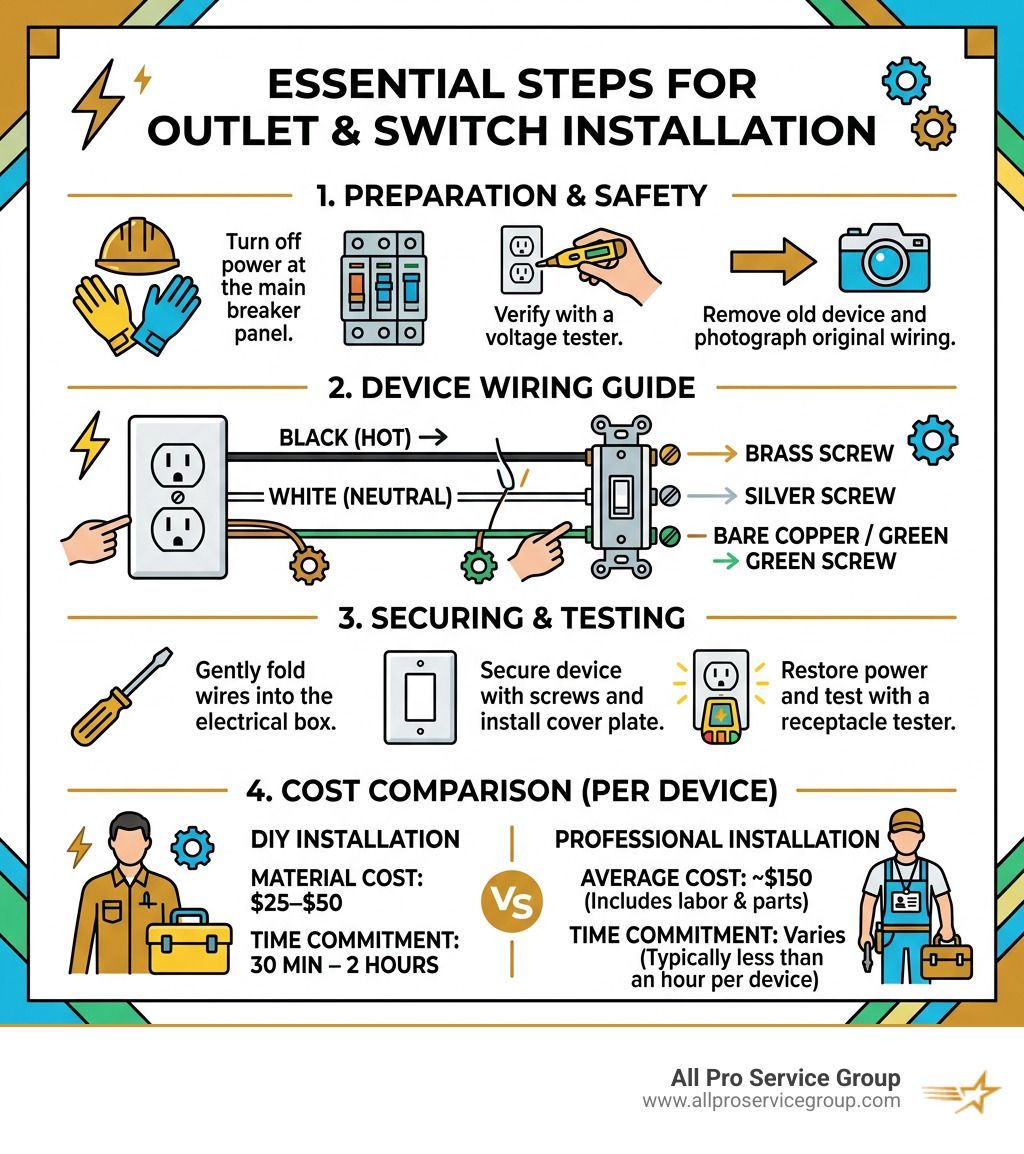
Here's a quick overview of what the process involves:
- Turn off power at the breaker and verify with a voltage tester
- Remove the old device and photograph the existing wiring
- Connect wires to the new device — black (hot) to brass, white (neutral) to silver, bare copper to green
- Secure the device in the box and install the cover plate
- Restore power and test to confirm safe operation
A basic outlet or switch replacement takes 30 minutes to 2 hours and costs $25–$50 in materials if you do it yourself. Professional installation averages around $150, including labor and parts.
But before you grab a screwdriver, there's a lot to know. Reversed polarity, improper grounding, and overloaded circuits are all common mistakes — and they can create real fire and shock hazards.
This guide walks you through four proven methods, from replacing a simple light switch to installing GFCI outlets and smart switches, so you can work safely and get it right the first time.
I'm Gary, owner of All Pro Service Group, and I've been helping homeowners across the Greater Salt Lake Valley with outlet and switch installation and all kinds of electrical work since 2008. Whether you're a confident DIYer or you hit a snag mid-project, this guide has you covered.
Essential Preparation for Outlet and Switch Installation
Before we dive into the wires, we need to talk about the "boring" stuff that keeps you alive. Working with electricity isn't like painting a wall; if you mess up a paint job, you just have an ugly room. If you mess up an outlet and switch installation, you could end up with a house fire or a nasty shock.
Safety First: The Golden Rule of Zero Volts
The most critical step in any electrical project is ensuring the power is truly off. Don't just flip the wall switch and assume you're safe. You need to head to your main service panel (the breaker box).
- Identify the Circuit: Find the breaker that controls the room where you're working.
- Flip and Tape: Switch it to the "OFF" position. We always recommend putting a piece of blue painter's tape over the breaker so a helpful family member doesn't accidentally flip it back on while you're elbow-deep in the wall.
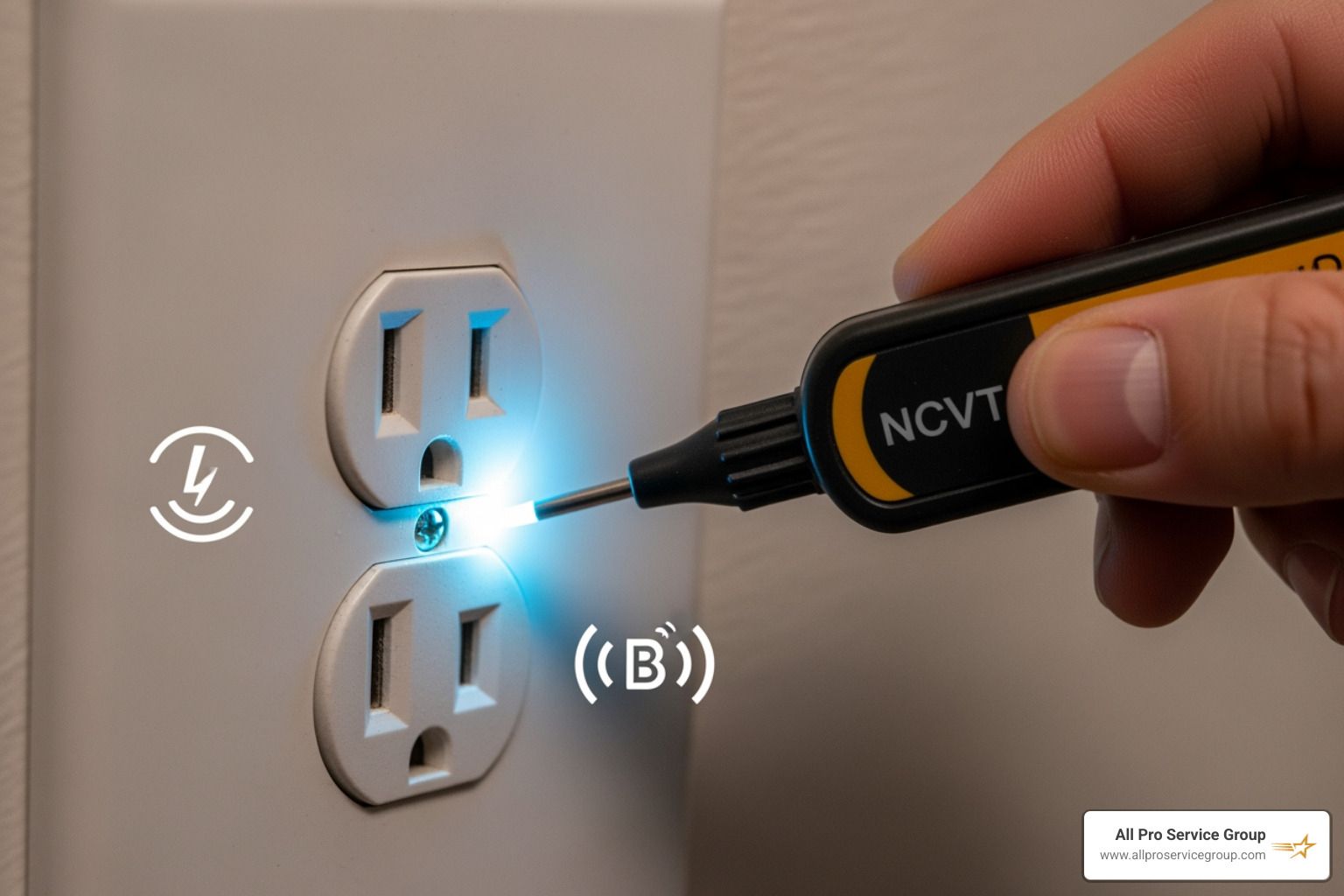
- Verify, Then Verify Again: Use a non-contact voltage tester. Hold it near the outlet or switch. If it chirps or glows red, the power is still live.
The Essential Tool Kit
You don't need a truckload of gear, but the right tools make the difference between a 20-minute job and a two-hour headache. Here is what we keep in our bags:
- Wire Strippers: For removing insulation without nicking the copper.
- Needle-Nose Pliers: Essential for bending those "U" shaped hooks for screw terminals.
- Screwdrivers: Both Phillips and flat-head (and sometimes a Robertson/square drive for modern electrical screws).
- Multimeter: For more advanced troubleshooting and verifying voltage levels.
- Electrical Tape: To wrap around the device terminals for an extra layer of safety.
Understanding the Signs of Failure
When should you stop ignoring that "fussy" outlet? Most outlets are designed to last 15 to 25 years. However, in high-use areas like your kitchen or laundry room, they might wear out in as little as 5 to 10 years. Look for these red flags:
- The "Ozone" Smell: If you smell something fishy or like burnt plastic, that’s an electrical arc.
- Cracked Housing: Physical damage can expose live parts.
- Loose Plugs: If your phone charger falls out of the outlet, the internal tension springs are gone. This creates heat, which leads to fires.
- Discoloration: Any yellowing or charring on the faceplate is an immediate emergency.
For more technical details on identifying worn-out components, check out the Replacing Wall Switches and Receptacles | MU Extension guide. If you see these signs and aren't comfortable DIYing, you can learn more about our electrical services to see how we can help.
NEC Codes and Spacing
The National Electrical Code (NEC) isn't just a suggestion; it's the law. In the Greater Salt Lake Area, we follow these standards to ensure your home stays up to code for insurance and resale purposes. For example, standard outlets in living areas should generally be placed so that no point along the floor line is more than 6 feet from a receptacle. This means you’ll usually find an outlet every 12 feet.
Method 1: Replacing a Standard Single-Pole Light Switch
The single-pole switch is the "bread and butter" of outlet and switch installation. It controls one light (or a set of lights) from one location.
Step 1: Disconnect the Old Switch
Once the power is off and verified, unscrew the faceplate. You’ll see the switch held in by two long screws. Pull it out gently. You'll likely see two black wires (the "hots") and a bare copper or green wire (the "ground").
Pro Tip: Take a photo of the wiring before you disconnect anything! It's the easiest way to ensure you don't get confused later.
Step 2: Prepare the Wires
If the old wire ends look charred or brittle, snip them off and strip back about 3/4-inch of fresh insulation. Use your needle-nose pliers to bend the ends into a "U" shape.
Step 3: Connect the New Switch
- The Ground: Always connect the bare copper or green wire to the green screw first.
- The Hots: On a standard single-pole switch, it doesn't matter which black wire goes to which brass screw.
- The Hook: Always wrap your wire hook clockwise around the screw. This way, when you tighten the screw, it pulls the wire tighter instead of pushing it out.
If you find that your wires are too short to work with comfortably, you may need to learn How Do I Connect Two Wires? using a pigtail. A pigtail is just a short 6-inch piece of wire that you "splice" onto the existing wires using a wire nut to give yourself more slack.
Step 4: Finishing Up
Gently fold the wires back into the box like an accordion. Don't just shove them in; you don't want to pinch the insulation. Screw the switch into the box, ensuring it’s straight (nobody likes a crooked switch!), and pop the faceplate on. If your electrical box feels crowded or your breakers are frequently tripping, it might be time for electrical panel upgrades.
Method 2: Wiring a Basic Electrical Outlet and Switch Installation
Standard 15-amp or 20-amp receptacles are what power your life. While they look simple, the wiring order is vital for safety.
Hot, Neutral, and Ground: The Big Three
In a standard outlet and switch installation, you’ll usually find three colors of wires:
- Black (or Red): These are the "Hot" wires. They carry the current to the device.
- White: This is the "Neutral" wire. It carries the current back to the panel.
- Bare Copper (or Green): This is the "Ground." It’s your safety net in case of a fault.
The Color-Coding Secret
The outlet itself is color-coded to help you:
- Brass Screws: These are for the Black(Hot) wires. (Think: "Black to Brass.")
- Silver Screws: These are for the White(Neutral) wires. (Think: "White to Silver.")
- Green Screw: This is for the Ground wire.
Side-Wiring vs. Back-Stabbing
Many modern outlets have small holes in the back where you can just "stab" the wire in. Don't do it. We call this "back-stabbing," and it’s a common cause of failure. These connections are held by a tiny spring that can loosen over time, leading to arcing and fires. Always use the side screw terminals for a secure, long-lasting connection.
For a deeper dive into these connections, How to Replace an Electrical Outlet: A Step-by-Step Beginner Guide offers excellent visual aids.
Polarity Reversal
If you accidentally swap the black and white wires, you have "reversed polarity." The device you plug in will still work, but the "shell" of the light bulb or the internal components of an appliance will be energized even when the switch is off. This is a major shock hazard. Always double-check your colors! If your home has older wiring that doesn't follow these colors, you might need our wiring and rewiring services to bring things up to modern safety standards.
Method 3: Installing GFCI Outlets for Wet Areas
GFCI stands for Ground Fault Circuit Interrupter. These are the outlets with the "Test" and "Reset" buttons. They are designed to trip the power in milliseconds if they detect a leak in current—like if you drop a hair dryer in a sink full of water.
Where Do They Go?
Per NEC code and local Utah regulations, GFCI outlets are required in:
- Kitchens (within 6 feet of the sink)
- Bathrooms
- Garages
- Outdoors
- Unfinished basements
LINE vs. LOAD: The Most Important Distinction
When you look at the back of a GFCI, you'll see two sets of screws labeled LINE and LOAD.
- LINE: This is where the power coming from your breaker panel goes.
- LOAD: This is used only if you want this GFCI to protect other "downstream" outlets on the same circuit.
If you're just replacing one outlet and don't need to protect others, only use the LINE terminals. Leave the yellow tape over the LOAD terminals so you don't accidentally use them. If you're adding high-power devices like an EV charger, the wiring becomes even more critical—check our EV charger installation page for more info.
Testing Your GFCI
Once installed, you must test the GFCI monthly. Press the "Test" button; the "Reset" button should pop out, and the power should cut off. If it doesn't, the outlet is faulty or miswired and must be replaced immediately.
Method 4: Advanced Configurations and Future-Proofing
Once you've mastered the basics, you might want to tackle more complex outlet and switch installation projects.
3-Way and 4-Way Switches
Ever wanted to turn off the hallway light from both ends of the hall? That’s a 3-way switch. These are trickier because they use "traveler" wires to pass the signal between switches.
- The Common Terminal: One screw on a 3-way switch is darker than the others (usually black or dark bronze). This is the "Common."
- The Travelers: The other two screws (usually brass) are for the traveler wires, which are often red and black.
Switch-Outlet Combo Devices
These are great for small bathrooms where wall space is limited. You can have a switch for the light and an outlet for your electric toothbrush in the same single-gang box. Important : If you want the outlet to stay "hot" all the time (not controlled by the switch), you usually have to break a small metal tab on the side of the device. Check the manufacturer's diagram carefully!
Future-Proofing with Smart Tech
The Greater Salt Lake Area is a hub for tech, and many of our customers in Park City and South Jordan are upgrading to smart switches and USB-C outlets.
- USB-C Outlets: These allow you to charge phones directly from the wall. They take up more room in the electrical box, so you might need "deep" boxes.
- Smart Switches: Most require a "Neutral" wire (the white one) to power the internal Wi-Fi or Bluetooth radio. Older homes built before the 1980s often don't have neutrals at the switch box, which can make smart home integration difficult.
DIY vs. Professional Costs
| Project Type | DIY Cost (Estimated) | Professional Cost (Average) |
|---|---|---|
| Single-Pole Switch | $1 - $15 | $100 - $150 |
| Standard Outlet | $2 - $10 | $100 - $150 |
| GFCI Outlet | $15 - $30 | $150 - $200 |
| Smart Switch | $30 - $60 | $150 - $250 |
If you're dealing with complex issues or older homes, a professional electrical inspection is the best way to ensure your system can handle these modern upgrades.
Frequently Asked Questions about Outlet and Switch Installation
Can I add a new outlet to an existing circuit?
Yes, but you have to be careful not to overload the circuit. A standard 15-amp circuit can handle about 1,440 watts of continuous load (80% of its total 1,800-watt capacity). If you're already running a space heater and a vacuum on that circuit, adding another outlet for a treadmill will likely trip the breaker. To get help with adding new lines, you can Find Local Pros to assess your home's capacity.
What are the most common wiring mistakes to avoid?
- Loose Connections: If the wire can wiggle, it can arc. Arcing creates heat, and heat creates fire.
- Polarity Reversal: As mentioned, swapping hot and neutral is a major safety risk.
- Improper Grounding: Skipping the ground wire because "it works without it" removes your primary defense against electrocution.
- Wrong Wire Gauge: Using 14-gauge wire on a 20-amp circuit is a fire hazard. 20-amp circuits require thicker 12-gauge wire.
When is it necessary to hire a professional electrician?
While we love a good DIY project, you should call us if:
- You find aluminum wiring: Common in the 1960s and 70s, this requires special connectors (CO/ALR) and is very dangerous if handled incorrectly.
- The box is a "rat's nest": If there are 6+ wires in a single box and you can't tell what's what.
- You need a new circuit: Running wire through finished walls and into a live service panel is not a beginner DIY task.
- Flickering lights: This often indicates a loose neutral at the main panel, which is a fire risk for the whole house.
Conclusion
Mastering outlet and switch installation is a fantastic way to improve the functionality and safety of your home. Whether you're upgrading to sleek new dimmers in West Jordan or installing weather-resistant GFCIs for your patio in Park City, the key is patience and a strict adherence to safety protocols.
Electricity doesn't give second chances. If you open up a wall and feel overwhelmed, or if you just want the peace of mind that comes with a "Gephardt Approved" installation, All Pro Service Group is here for you. We’ve been serving the Greater Salt Lake Valley since 2008 with 24/7 emergency service and a team of experts who treat your home like their own.
Don't leave your family's safety to chance. Schedule your professional outlet and switch installation today, and let us handle the sparks!