Your Gas Lines Power Your Home — Here's What You Need to Know
Gas line plumbing is the network of pipes, valves, and fittings that delivers natural gas or propane to your home's essential appliances — your furnace, water heater, stove, and more.
Here's what homeowners need to know at a glance:
| Topic | Key Facts |
|---|---|
| Who handles it | Licensed plumbers with gas line certification |
| Warning signs | Rotten egg smell, hissing sounds, dead plants, spiking bills |
| Emergency action | Evacuate immediately, don't touch switches, call your gas company |
| DIY? | Never — it's dangerous and often illegal |
| Average install cost | Around $523 nationally |
| Typical repair time | 1 to 3 days |
Most homeowners only think about their gas lines when something goes wrong. And when something does go wrong — a faint sulfur smell near the stove, a hissing sound behind the wall, or a gas bill that suddenly doubles — it can be genuinely alarming. That gut-tightening moment is your home telling you to pay attention.
The stakes are real. Natural gas is odorless on its own, so utility companies add a chemical called mercaptan to give it that distinct rotten egg smell — a deliberate safety signal. Ignoring that signal, or putting off routine care, can put your household at serious risk.
I'm Gary, owner of All Pro Service Group, and I've been helping Greater Salt Lake Valley homeowners stay safe with dependable plumbing and home system services since 2008 — including gas line plumbing inspections, repairs, and installations. In this guide, I'll walk you through everything you need to know to protect your home and your family.
Understanding the Essentials of Gas Line Plumbing
When we talk about plumbing, most people immediately think of leaky faucets or clogged toilets. However, gas line plumbing is a critical subset of the trade that deals with the distribution of fuel gas. Whether your home runs on natural gas provided by a municipal utility or propane from a private tank, the system of pipes that carries that fuel is just as vital as the pipes carrying your water.
A residential gas system is comprised of several key components. It starts at the gas meter (or the propane tank regulator), which measures the volume of gas entering your home. From there, a network of pipes branches out to reach various appliances. Each branch should have its own shut-off valve, allowing us to isolate a single appliance—like a water heater or stove—without turning off the gas to the entire house.
At All Pro Service Group, we see gas lines as the "energy veins" of the home. Because these lines carry highly flammable materials, the components must be installed with absolute precision. This includes "drip legs" or sediment traps—small vertical pipe extensions designed to catch moisture or debris before they can enter and damage sensitive appliance valves.
If you are curious about how these systems integrate with the rest of your home’s infrastructure, you can find More info about plumbing services on our website.

Is Gas Line Plumbing Different from Water Piping?
While the pipes might look similar to the untrained eye, gas piping and water piping are governed by entirely different sets of rules and physics. The most significant difference lies in the consequences of a failure. A water leak causes property damage; a gas leak can cause a catastrophic explosion or carbon monoxide poisoning.
In terms of pressure, residential gas lines actually operate at a much lower pressure than water lines. While your home's water pressure might sit between 40 and 60 PSI (pounds per square inch), a standard natural gas line inside the house often operates at less than 1 PSI. Despite this lower pressure, the regulations surrounding gas are far more rigid because gas is a compressible fluid that can fill a room quickly.
| Feature | Water Piping | Gas Line Plumbing |
|---|---|---|
| Primary Material | Copper, PEX, PVC | Black Steel, CSST, HDPE |
| Common Pressure | 40–80 PSI | 0.25–2 PSI (Residential) |
| Leak Detection | Visual (puddles/stains) | Smell (Mercaptan), Hissing, Bubbles |
| Primary Danger | Water damage/Mold | Explosion/Asphyxiation |
| Sealant Used | Standard Teflon tape/Dope | Specialized Gas-Rated Dope/Tape |
Because gas molecules are smaller and more prone to escaping through tiny gaps, we use specialized sealants. You cannot use standard white Teflon tape on gas lines; we use a thicker, yellow-coded tape or specialized pipe "dope" specifically rated for fuel gases to ensure a gas-tight seal.
Approved Materials for Gas Piping
Not all pipes are created equal. In the Greater Salt Lake area, from the high-altitude homes in Park City to the valley floors of West Jordan, we must use materials that can withstand local conditions and meet strict safety codes.
- Black Steel Pipe: This is the traditional "gold standard" for indoor gas lines. It is incredibly strong and heat-resistant. However, it is heavy and requires a lot of labor to thread and install.
- CSST (Corrugated Stainless Steel Tubing): This is a flexible, stainless steel pipe with a yellow plastic coating. It’s popular in newer construction because it can be snaked through walls like electrical wire, reducing the number of joints where leaks could occur. Note: CSST requires very specific electrical bonding to prevent damage from lightning strikes or power surges.
- HDPE (High-Density Polyethylene): This plastic piping is used exclusively for underground exterior lines. It is resistant to corrosion and soil chemicals, making it perfect for running a line to an outdoor fire pit or a pool heater.
- Schedule 40 Iron: Often used interchangeably with black steel in many residential contexts, this provides the wall thickness necessary to handle gas safely.
It is also important to note what we don't use. For instance, there are significant Galvanized steel restrictions in many modern codes. While galvanized steel was used in the past, the zinc coating can flake off over time and clog appliance regulators. Similarly, copper is often prohibited or strictly limited because the sulfur in natural gas can cause the copper to flake, leading to similar blockages.
Recognizing the Warning Signs of a Gas Leak
Because gas is invisible, your senses of smell and hearing are your first line of defense. As mentioned, the "rotten egg" scent is the most obvious sign, but it isn't the only one.
- Hissing Sounds: If a pipe has a significant crack or a connection has come loose, you might hear a faint whistling or hissing sound near an appliance or behind a wall.
- Dead Vegetation: This is a subtle sign of an underground leak. If you notice a patch of grass or a row of flowers that has suddenly turned brown and died while the rest of your lawn is green—especially if it's near your gas meter—natural gas may be leaking into the soil and displacing the oxygen the plants need to survive.
- Spiking Utility Bills: If your gas usage hasn't changed but your bill has skyrocketed, you might have a "slow" leak somewhere in the system that is constantly bleeding fuel.
- Bubbles in Standing Water: After a rainstorm, if you see bubbles rising through a puddle in your yard, it could be gas escaping from a buried line.
For more detailed information on how to identify environmental signs of leaks, you can review the EPA pipeline safety guidelines.
Immediate Steps to Take During an Emergency
If you suspect a leak, do not hesitate. Gas line problems are not something you "wait and see" about.
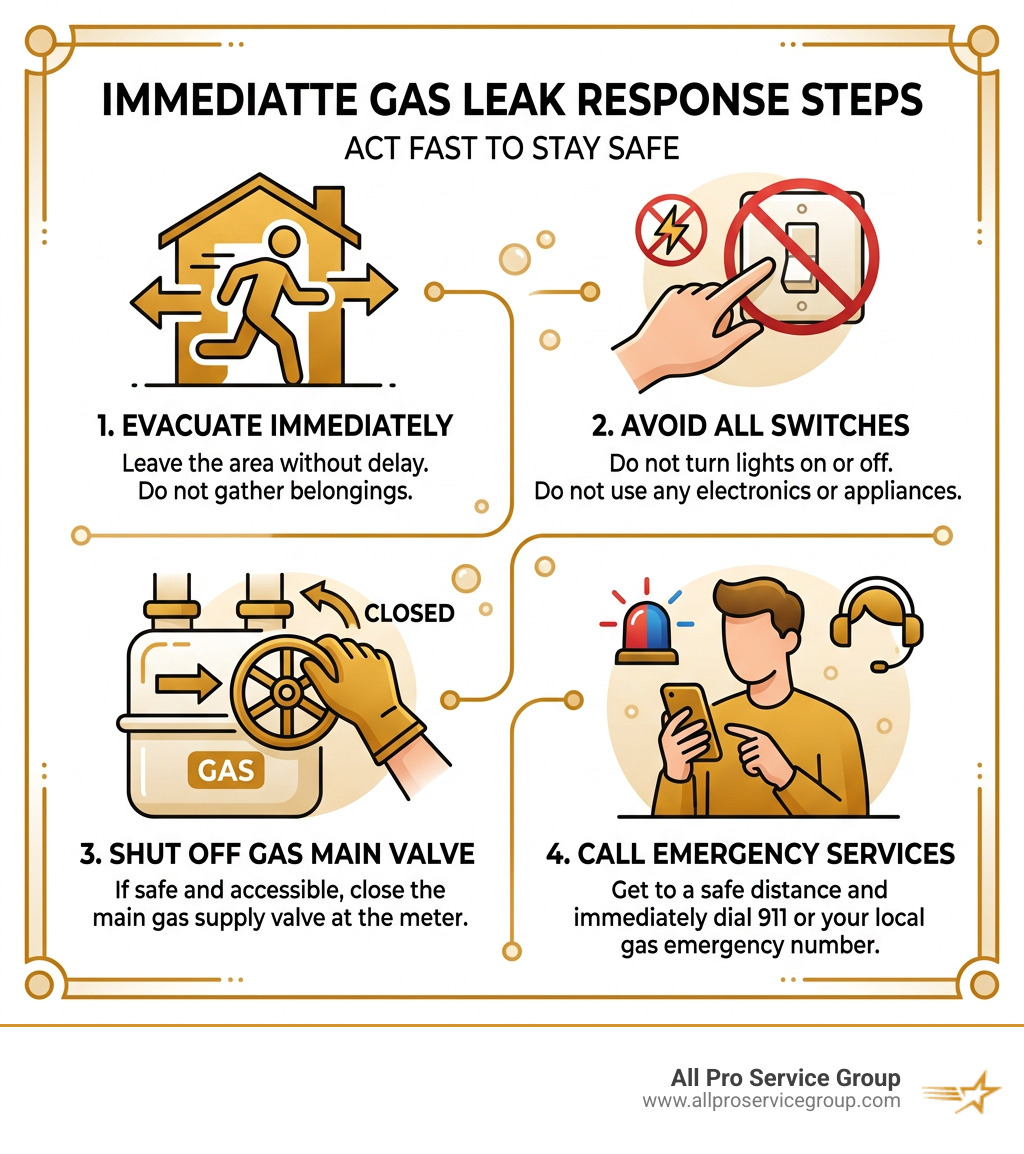
- Evacuate Immediately: Get everyone out of the house, including pets.
- Avoid All Sparks: Do not turn lights on or off. Do not use your phone inside the house. Do not unplug any appliances. Even the tiny spark created by a light switch can be enough to ignite a high concentration of gas.
- Leave the Door Open: As you exit, leave the door open to help ventilate the area.
- Shut Off the Supply: If you know where your main gas shut-off valve is (usually at the meter) and it is safe to reach, turn the valve 90 degrees so it is perpendicular to the pipe. If you are unsure how to do this safely, check this guide on Shutting off gas supply.
- Call for Help: Once you are a safe distance away (at least 100 feet from the home), call 911 or your local gas utility provider.
Only after the utility company or fire department has cleared the home should you contact us for professional intervention to find and fix the source of the leak.
Professional Installation and Repair Services
When it comes to gas line plumbing, the installation process is a meticulous multi-step journey. Whether we are hooking up a new gas range in a Salt Lake City kitchen or running lines for a whole-home generator in Park City, we follow a strict protocol.
For new installations, the process often starts with a load calculation. We don't just "run a pipe." We have to ensure the pipe is sized correctly to provide enough BTUs (British Thermal Units) for all appliances to run simultaneously. If the pipe is too small, your furnace might starve for fuel when the water heater kicks on, leading to inefficient operation or appliance failure.
In terms of repair, we utilize both traditional and modern methods:
- Pressure Testing: We cap the lines and pump them full of air to a specific pressure (usually much higher than the actual gas pressure). If the gauge drops even a fraction over a set period, we know there is a leak.
- Soap Bubble Test: For visible connections, we apply a specialized solution. If bubbles form, we’ve found the leak.
- Trenchless Repair (CIPP/SIPP): In some cases, we can repair underground lines using Cured-In-Place Pipe (CIPP) or Sprayed-In-Place Pipe (SIPP) technology. This involves inserting a resin-coated liner into the existing pipe, which then hardens to create a new, seamless pipe within the old one—saving your landscaping from being dug up.
If you are planning a renovation or need a new appliance hookup, you can find More info about gas line plumbing on our dedicated service page.
When to Repair vs. Replace Your Gas Lines
Not every leak requires a full repiping of the house, but there are times when replacement is the only safe option.
- Pipe Age: Most gas lines have a functional lifespan of about 50 years. If your home in the Greater Salt Lake area was built in the 1960s or 70s and still has its original black iron pipes, they may be reaching the end of their reliable life.
- Internal Corrosion: While gas lines don't rust from the inside as quickly as water lines, moisture in the gas or external environmental factors can cause internal degradation. If we find rust or "scaling" inside the pipe during a repair, it’s a sign the whole system is compromised.
- Recurring Leaks: If we fix a leak in one spot only for another to appear a month later, the material itself is likely failing.
- Renovation Upgrades: If you are adding a high-output professional range or a large tankless water heater, your existing lines might not be large enough to handle the increased demand. In this case, a replacement or a "parallel" line installation is necessary.
The True Cost of Professional Gas Line Work
Pricing for gas line work can vary significantly based on the complexity of the job. Nationally, the average cost for a standard gas line installation is around $523, but this can range from a couple of hundred dollars for a simple appliance hookup to several thousand for a full-home repipe.
Several factors influence the final cost:
- Pipeline Length: The further the appliance is from the meter, the more material and labor are required.
- Obstacles: Running a line through an open crawlspace is much cheaper than snaking it through finished drywall or trenching under a concrete patio.
- Permit Fees: In municipalities like Provo or West Valley City, permits are required for gas work. These fees ensure that a city inspector verifies the safety of the work.
- Material Choice: CSST is often faster to install (saving labor costs) but the material itself is more expensive than black steel.
Timeline Expectations:
- New Gas Service: If you are switching from electric to gas and need a new line from the street, expect a 4-6 week timeline. This includes the utility company's paperwork, site surveys, and the actual burial of the service line.
- Repairs: Most standard gas line repairs can be completed in 1 to 3 days. We often provide same-day emergency service for urgent leaks in the Salt Lake Valley.
Frequently Asked Questions about Gas Line Plumbing
Do all plumbers work on gas lines?
No. While gas piping is technically a form of plumbing, it requires specialized training and, in many jurisdictions, a specific "Gas Fitter" certification or a master plumber license with a gas endorsement. At All Pro Service Group, our technicians are specifically trained and certified to handle fuel gas systems. You should always ask a contractor for proof of their gas-specific qualifications before they touch your lines.
Why is gas line plumbing not a DIY job?
There are three main reasons:
- Safety: A mistake with a water pipe leads to a wet floor. A mistake with a gas pipe can lead to a house fire or a fatal explosion.
- Legal Requirements: In most parts of Utah, it is actually illegal for an unlicensed homeowner to perform gas line work. If a fire occurs and it is discovered that the gas work was not done by a licensed professional with a permit, your homeowner's insurance may deny the claim.
- Code Compliance: Gas codes are incredibly specific regarding pipe sizing, venting, and support. A professional ensures your home remains up to code, which is vital for both safety and future home resale.
How often should gas lines be inspected?
We recommend a professional inspection once a year, ideally during your annual furnace or water heater tune-up. During these checks, we look for signs of corrosion, ensure all shut-off valves are operational, and check the integrity of flexible appliance connectors, which can become brittle over time.
Conclusion
Your home’s gas lines are silent servants, providing the energy needed for warm showers, home-cooked meals, and a cozy living room. But they require respect and professional care. "Ghosting" your gas line needs—ignoring that faint smell or skipping that annual inspection—is a risk no homeowner should take.
Since 2008, All Pro Service Group has been the dependable choice for homeowners throughout Ogden, Park City, Salt Lake City, and the entire Greater Salt Lake Valley. We are proud to be Gephardt Approved, a testament to our commitment to integrity and exceptional customer service.
Whether you need an emergency repair, a safety inspection, or a new installation for your dream outdoor kitchen, our trained experts are available 24/7 to ensure your home remains safe and efficient. Don't leave your family's safety to chance.
Schedule your gas line plumbing service today and experience the peace of mind that comes with professional, expert care.