What It Really Costs to Repipe the Main Sewer Line to the Street
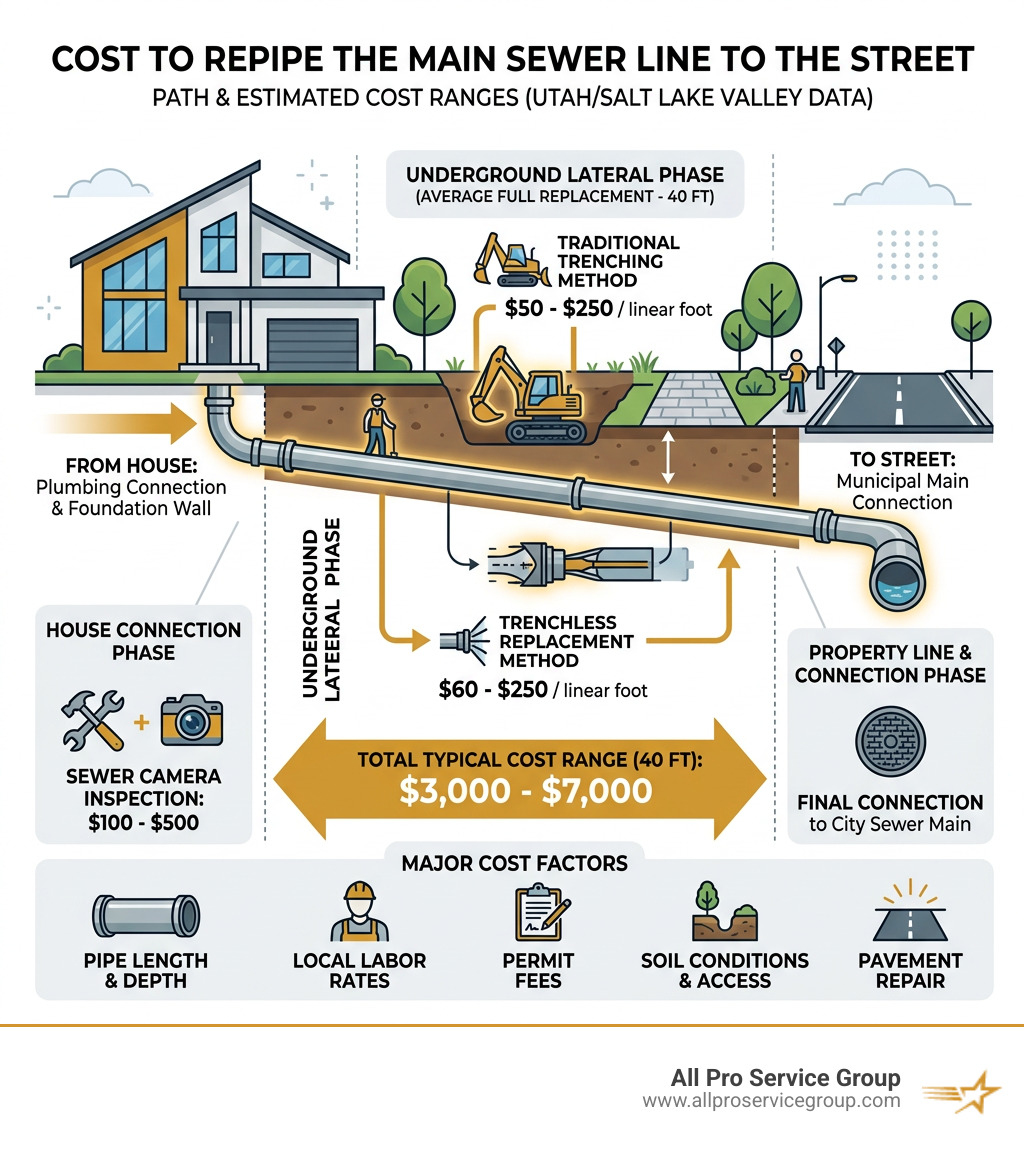
The cost to repipe the main sewer line to the street typically falls between $3,000 and $7,000 for most homeowners, with a national average around $5,000. Here's a quick snapshot:
| Scenario | Typical Cost Range |
|---|---|
| Average full replacement (40 ft) | $3,000 – $7,000 |
| Per linear foot (traditional) | $50 – $250/ft |
| Per linear foot (trenchless) | $60 – $250/ft |
| Utah/Salt Lake area average | $3,300 – $10,000+ |
| Sewer camera inspection | $100 – $500 |
Your final number depends on pipe length, depth, method, and local labor rates — all covered in detail below.
Every time you flush a toilet or run the dishwasher, wastewater travels through your home's sewer lateral — the pipe that connects your house to the city's main sewer line at the street. That pipe is your responsibility, from your foundation all the way to the property line connection. When it fails, the repair bill lands on you.
For homeowners in the Salt Lake Valley, that can feel overwhelming — especially when the problem shows up suddenly and you're not sure what you're even looking at, let alone what it should cost.
I'm Gary from All Pro Service Group, and after more than 15 years serving the Greater Salt Lake Valley, I've helped hundreds of homeowners understand and navigate the real cost to repipe the main sewer line to the street. Let me walk you through exactly what to expect.
Breaking Down the Cost to Repipe the Main Sewer Line to the Street
When we talk about the cost to repipe the main sewer line to the street, we are looking at a project that involves more than just a few pieces of plastic pipe. It is a major infrastructure project for your home. Nationally, most homeowners find themselves paying between $2,000 and $10,000 for a full replacement, but the bulk of residential jobs land right around the $5,000 mark.
In the Greater Salt Lake Area—from Ogden down to Provo—our local geography plays a big role. In more densely packed areas like South Salt Lake or West Valley City, the distance to the street might only be 20 to 40 feet. However, if you live in a more rural part of the valley or have a large setback, that line could easily stretch beyond 80 feet, which naturally doubles the material and labor requirements.
Per Linear Foot Rates
The industry standard for pricing these jobs is by the "linear foot." You can expect to pay anywhere from $50 to $250 per linear foot. This wide range exists because a shallow pipe in soft soil is much easier to replace than a deep pipe buried under a concrete driveway.
Labor Fees
Labor is a massive component of the total bill. Professional plumbers in the Utah market typically charge between $45 and $200 per hour. When you factor in the need for heavy machinery operators and specialized technicians for trenchless methods, labor often accounts for 50% to 70% of the total project cost.
Comparing Methods: A Quick Look
How we get the pipe into the ground changes the price significantly. Traditional excavation is often cheaper upfront in terms of raw labor but carries high "hidden" costs for yard repair. Trenchless methods might have a higher technical fee but save your landscaping.
| Method | Cost Per Foot | Landscape Impact |
|---|---|---|
| Traditional Excavation | $50 – $250 | High (Trenching required) |
| Pipe Bursting (Trenchless) | $60 – $200 | Low (Two small pits) |
| CIPP Lining (Trenchless) | $90 – $250 | Very Low (Access point only) |
Understanding the average cost of sewer line replacement helps you set a realistic budget before the digging begins.
Key Factors Influencing Your Total Investment
No two yards in Utah are the same. A home in Park City might deal with rocky, frozen earth, while a property in South Jordan might have sandy soil but a very deep connection point. Here are the primary variables that move the needle on your estimate.
- Pipe Depth: This is a huge one. Most sewer lines sit between 18 inches and 6 feet deep. However, if your line is deeper than 6 feet, we have to bring in shoring equipment to keep the trench from collapsing on workers. This safety requirement can add thousands to the bill.
- Line Length: The average residential lateral is 40 feet. If yours is 80 feet, you aren't just buying more pipe; you're paying for more hours of excavation and more backfill material.
- Soil Conditions: Hard clay, large boulders, or high water tables make digging slower and more dangerous, which increases the labor hours.
- Utility Interference: If your sewer line crosses paths with gas, water, or electrical lines, we have to dig by hand around those areas to avoid a catastrophe. Hand-digging is significantly more expensive than using a backhoe.
For more technical details on how we handle these variables, you can check out our page on main line repiping.
Material Choices and the Cost to Repipe the Main Sewer Line to the Street
The type of "straw" we put in the ground matters for both your current budget and the future value of your home.
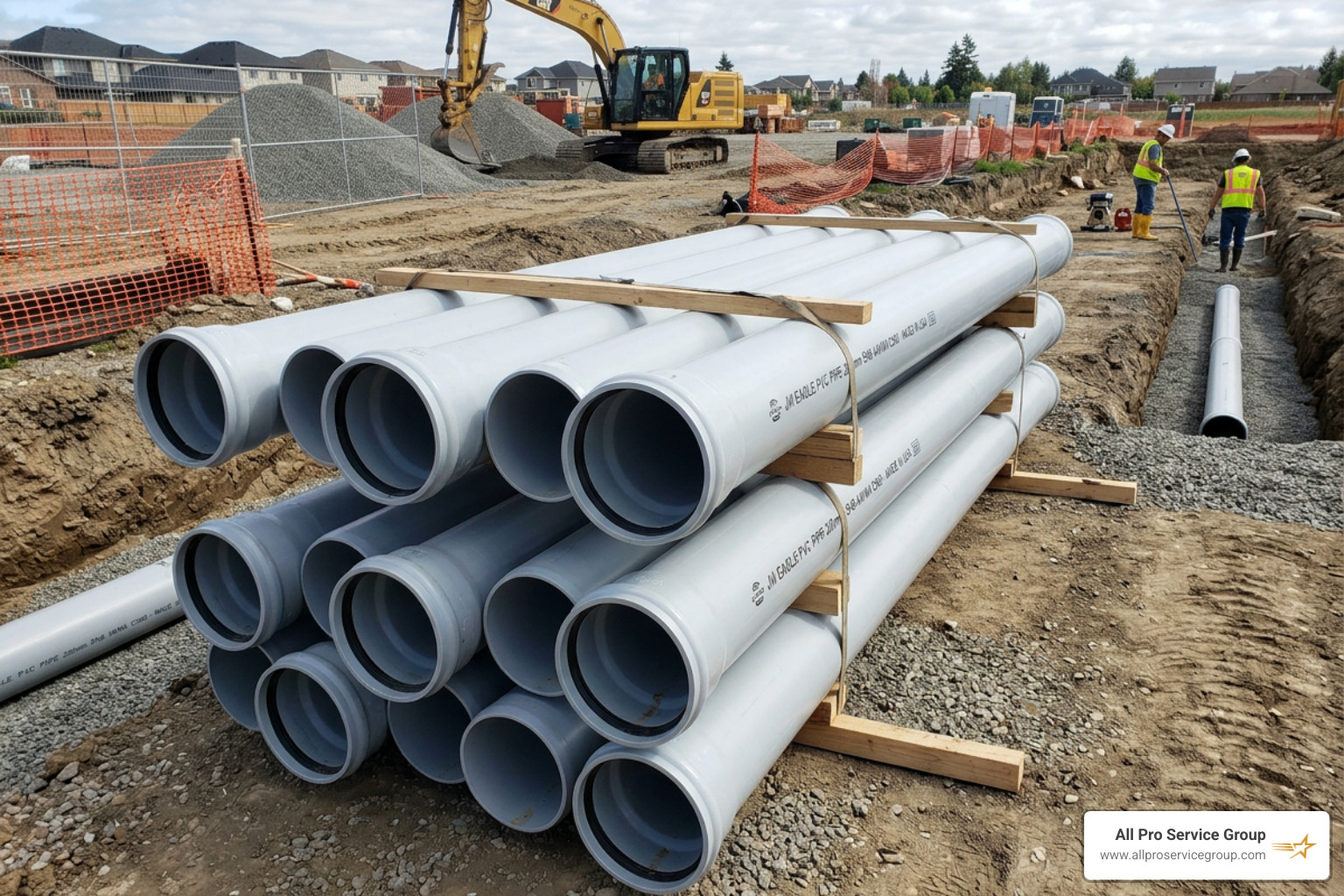
- PVC (Polyvinyl Chloride): This is the modern standard. It’s affordable ($3 to $8 per foot for materials), lightweight, and incredibly durable. It doesn't corrode and has a smooth interior that resists clogs. A well-installed PVC line can last 100 years.
- Cast Iron: While very strong, cast iron is expensive ($20 to $75 per foot) and prone to internal rusting over decades. We rarely use this for residential laterals today unless there is a specific structural need.
- HDPE (High-Density Polyethylene): Used primarily in "pipe bursting" trenchless replacements. It’s a seamless, flexible pipe that is nearly indestructible. While the material cost is higher than PVC, the 50+ year lifespan and ease of installation make it a favorite.
- Copper: You might see copper used in very specific high-pressure scenarios, but at $80 to $90 per foot, it is rarely the choice for a standard sewer line to the street.
Reviewing the latest sewer line replacement data can give you more insight into how these materials perform over time.
Accessibility and Property Obstacles
Where is your pipe? If it’s under a beautiful, clear lawn, the job is straightforward. But if the pipe runs under a concrete driveway, a brick patio, or a 50-year-old oak tree, the cost to repipe the main sewer line to the street will climb.
Breaking through a concrete slab typically costs between $300 and $350 per linear foot. If we have to remove and replace a section of your driveway, you could be looking at an additional $1,000 to $5,000 just in surface restoration. This is exactly why we often recommend trenchless sewer repair for homes with complex landscaping or paved surfaces.
Trenchless vs. Traditional Excavation Methods
In the "old days," the only way to fix a sewer line was to dig a massive trench from the house to the street. While we still do this when a pipe has completely collapsed, modern technology has given us better options.
Traditional Trenching
This involves an excavator digging up the entire length of the pipe.
- Pros: It’s the only way to fix a pipe that has "bellied" (sagged) or completely collapsed. It also allows us to verify the "slope" of the pipe perfectly.
- Cons: It destroys your yard. You'll have to pay for new sod, sprinklers, and potentially sidewalk repairs.
Pipe Bursting
We pull a large, cone-shaped head through your old pipe. This head breaks the old pipe apart and pulls a brand-new HDPE pipe in behind it.
- Pros: Only requires two small access pits. It’s fast and doesn't ruin your lawn.
- Cons: Costs about $60 to $200 per foot, which can be slightly higher than raw excavation labor.
CIPP (Cured-In-Place Pipe) Lining
We insert a flexible, resin-saturated felt tube into your existing pipe, then inflate it. The resin hardens, creating a "pipe within a pipe."
- Pros: No digging required at all in many cases. It seals cracks and stops root intrusion permanently.
- Cons: It cannot be used if the original pipe has lost its structural integrity or has collapsed.
Hidden Expenses in the Cost to Repipe the Main Sewer Line to the Street
When you get a quote, make sure it includes the "boring" stuff that actually costs a lot of money:
- Municipal Permits: Utah cities like Salt Lake City or Provo require permits for sewer work. These can range from $150 to $1,000 depending on the municipality.
- Video Camera Inspections: A professional inspection ($100 to $500) is non-negotiable. It’s the only way to see if you need a full replacement or just a localized repair.
- Yard Restoration: Don't forget the cost of new grass, bushes, or fixing that fence we had to move. This can add $500 to $2,000 to your total "out of pocket" spend.
- City Connection Fees: If we have to touch the "tap" where your line meets the city main, there may be additional inspection fees from the city sewer department.
For a full list of what's included in our work, visit our professional plumbing services page.
When to Repair vs. Replace Your Sewer Main
We always try to save our customers money by repairing a small section if possible. However, sometimes a "patch" is just throwing good money after bad.
Choose Repair If:
- The damage is localized to one spot (like a single root intrusion).
- The rest of the pipe is modern PVC in good condition.
- The cost of the repair is less than 30% of a full replacement.
Choose Full Replacement If:
- Frequent Backups: If you're calling a rooter service every 6 months, the pipe is failing.
- Pipe Age: If your home was built before 1970 and still has clay or cast iron pipes, they are likely at the end of their 50-year lifespan.
- Soggy Patches: If your lawn is extra green or wet in one specific strip, you have a major leak.
- Foul Odors: Sewer gas escaping into your yard or basement is a health hazard.
- Multiple Clogs: If the toilet, shower, and sink all back up at once, the problem is in the main line, not the individual drains.
You can find more help deciding in this sewer line replacement pricing guide.
Frequently Asked Questions about Sewer Repiping
Does homeowners insurance cover sewer line replacement?
In most cases, no. Standard policies cover "sudden and accidental" damage, but they rarely cover wear and tear, age, or root intrusion. However, many Utah homeowners can add a "Sewer Lateral Endorsement" or "Service Line Coverage" to their policy for a few dollars a month. If you have this, it might cover the majority of the cost to repipe the main sewer line to the street.
How long does it take to replace a sewer line to the street?
A typical residential job takes 1 to 3 days. Trenchless methods are usually on the shorter end (sometimes finished in a single day), while traditional excavation takes longer because of the time required to dig and then carefully backfill and compact the soil.
Is a sewer camera inspection worth the cost?
Absolutely. Spending $200 on a camera inspection can save you $5,000 by proving that you don't need a full replacement. It takes the guesswork out of the project. At All Pro Service Group, we provide you with the video footage so you can see exactly what we see.
Conclusion
The cost to repipe the main sewer line to the street is a significant investment, but it’s one that protects your home’s foundation, your family’s health, and your property value. While the average cost of $3,000 to $7,000 can be a surprise, understanding the factors like pipe material, depth, and the benefits of trenchless technology helps you make an informed decision.
Don't wait for a total collapse that floods your basement. If you’ve noticed slow drains or strange odors, the best first step is a professional diagnosis. All Pro Service Group has been the trusted choice in the Greater Salt Lake Area since 2008. We are "Gephardt Approved," offer 24/7 emergency service, and provide flexible financing to make these essential repairs manageable.
Whether you are in Ogden, Provo, or right here in Salt Lake City, we are ready to help. Schedule your sewer line replacement estimate with us today and get your home's plumbing back on track.