When Your AC Control Panel Fails: What You Need to Know
AC control panel replacement is one of the more common — and more confusing — HVAC repairs homeowners face. Here's a quick answer if you need it fast:
Quick Answer: AC Control Panel Replacement at a Glance
| Question | Answer |
|---|---|
| What does it cost? | $473–$523 on average (parts ~$366, labor ~$107–$157) |
| Can I DIY it? | Sometimes — but professional diagnosis is strongly recommended first |
| How long does it take? | 30–60 minutes for a professional; longer for DIYers |
| What are the signs? | Unresponsive buttons, erratic behavior, AC not turning on, blowing warm air |
| First step? | Always disconnect power before touching any components |
When your air conditioner suddenly stops responding — buttons don't work, the display goes blank, or the system short cycles without explanation — it's easy to assume the worst. But before you panic, the problem may be as fixable as swapping out a single component: the control board.
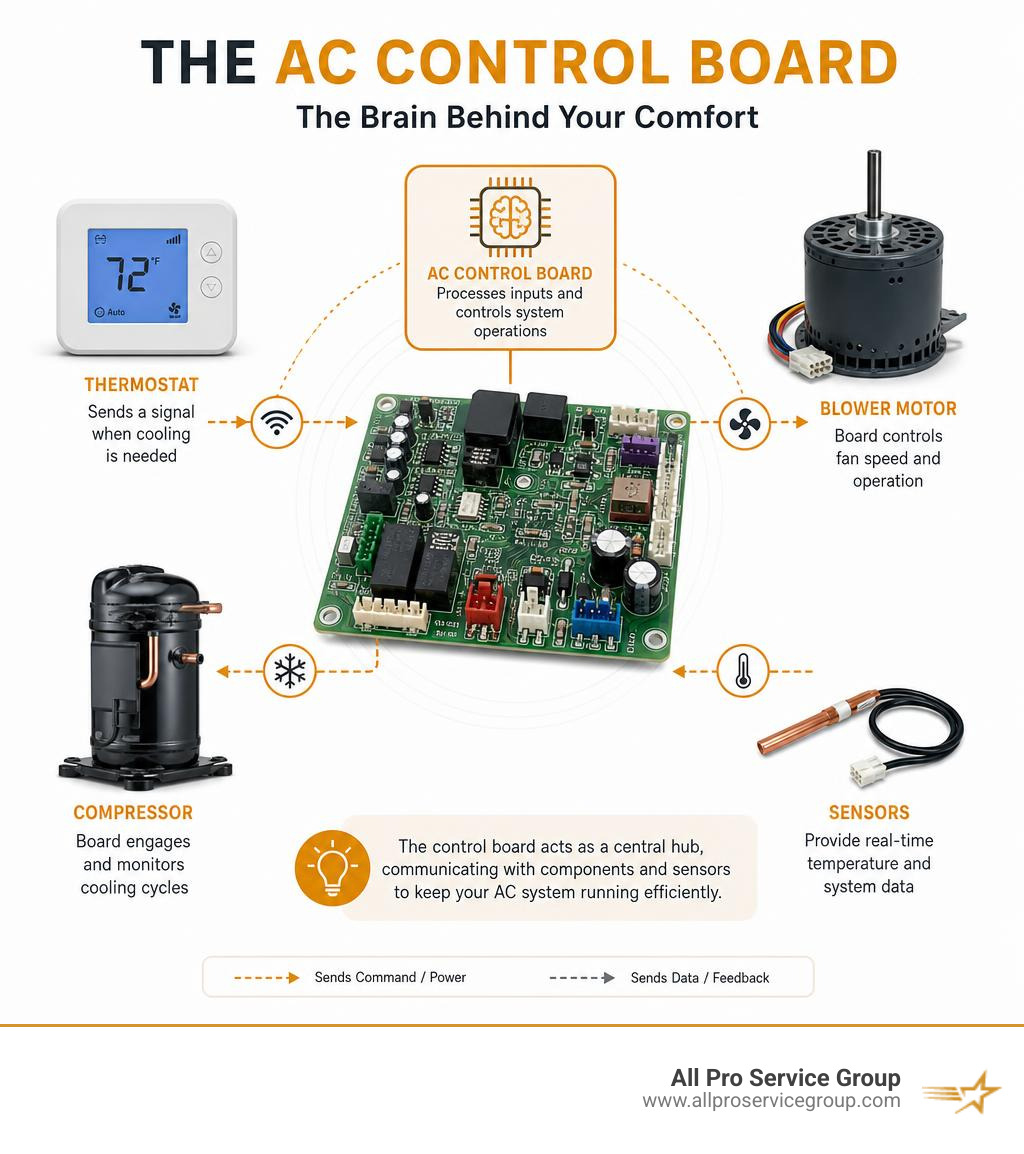
The control board is essentially the brain of your AC system. It processes inputs from your thermostat, manages the blower motor, controls the compressor, and coordinates every function your system performs. When it fails, everything can go wrong — even if the rest of the system is perfectly fine.
The tricky part is that control board failures can look identical to a dozen other problems. A bad capacitor, a failing blower motor, or a loose wire can all mimic a dead control board. That's why proper diagnosis matters as much as the repair itself.
I'm Gary Leany, owner of All Pro Service Group, and our team has diagnosed and performed AC control panel replacement across hundreds of homes in the Greater Salt Lake Valley since 2008. In this guide, I'll walk you through exactly how to identify the problem, find the right part, and decide whether this is a job you can tackle yourself or one to leave to the pros.
What is an AC Control Board and How Does It Fail?
Every modern air conditioning system relies on a central printed circuit board (PCB), commonly referred to as the AC control board or electronic control module (ECM). Think of it as the air conditioner's nervous system. When your thermostat calls for cool air, it sends a low-voltage electrical signal to this board. The board then distributes high-voltage power to the compressor, the outdoor condenser fan, and the indoor blower motor in a precisely timed sequence.

The control board uses relay switches, resistors, and microprocessors to monitor system safety limits, regulate fan speeds, and manage diagnostic codes. Over time, these delicate electronic components are subjected to harsh conditions, including extreme heat, electrical fluctuations, and physical vibrations.
When a board fails, it is usually due to one of the following reasons:
- Voltage Spikes and Surges: Lightning strikes or utility power fluctuations can instantly fry the delicate traces on the circuit board.
- Overheating: If components like the blower motor draw too much current, they can overheat the relays on the board, melting the solder joints.
- Moisture and Corrosion: Humidity, insect intrusion, or dust buildup can create conductive paths that short-circuit the board.
- General Wear and Tear: Relay switches have a finite lifespan. After thousands of cycles, the physical contacts inside the relays simply wear out or stick.
Understanding how these elements interact is key to keeping your home comfortable. For a deeper look at your system's overall health, check out The Essential Guide to Maintaining Your Utah Home's Furnace and Air Conditioner.
Residential vs. Automotive and RV AC Control Panel Replacement
It is important to clarify that "AC control panel" can mean slightly different things depending on the application. The diagnostic and replacement processes vary significantly across these systems:
- Residential HVAC Control Boards: Located inside your indoor furnace or air handler, these boards operate on a mix of 24V AC control voltage and 120V/240V AC line voltage. They manage whole-house heating, cooling, and ventilation.
- Automotive Climate Control Modules: In vehicles, the AC control panel is the physical interface on your dashboard with knobs and buttons. Brands like Dorman supply aftermarket climate control modules designed to match original fit and function. Many Dorman climate control modules offer a direct, seamless repair with no scan tool programming required on most units, allowing vehicle owners to restore cabin climate controls without an expensive dealership visit.
- RV Air Conditioner Control Boards: RV units, such as those using RecPro boards, operate on a combination of 12V DC RV battery power and 120V AC shore power. These boards act as compact computers managing the rooftop unit's sensors, compressor, and fan speeds in a highly compact footprint.
Common Symptoms of a Failing Control Board
How do you know if your control board is on its deathbed? Watch out for these classic warning signs:
- Unresponsive Buttons or Blank Displays: On window units, ductless mini-splits, or automotive panels, a completely unresponsive interface or a dead screen is a prime indicator of control board failure.
- Erratic System Behavior: If your fan runs continuously even when the cooling cycle is off, or if the compressor turns on and off rapidly (short cycling), the board's relays may be stuck.
- Blowing Warm Air: If the indoor blower fan runs but the board fails to send voltage to start the outdoor compressor, your system will circulate warm room air instead of cooling it.
- Diagnostic LED Codes: Most modern residential control boards feature a small LED light that flashes in specific patterns to indicate fault codes. A continuous rapid flash or no light at all often points to a failed board.
Troubleshooting and Selecting the Right Replacement Part
Before jumping straight into an ac control panel replacement, we must rule out simpler issues. Misdiagnosing a control board is incredibly common because its symptoms overlap with other electrical failures.
To troubleshoot effectively, follow these diagnostic steps:
- Verify Thermostat Signals: Ensure your thermostat is actually sending the 24V call for cooling to the control board.
- Test with a Multimeter: Check for incoming voltage at the board's main power terminals. If the board has power but refuses to output voltage to the blower motor or compressor contactor, the board is likely dead.
- Inspect the Capacitor: A bad run capacitor can prevent the compressor or fan from starting, which looks like a board issue. If the capacitor is bulging or tests out of its microfarad (µF) range, replace it first.
- Look for Physical Damage: Turn off the power and visually inspect the board. Look for charred areas, swollen capacitors, or a distinct "burnt electronics" smell.
Maintaining a regular service schedule can help you catch these issues before they lead to a complete system breakdown. Learn more about preventing unexpected failures in our guide on Air Conditioner Maintenance.
Finding the Correct Part for Your AC Control Panel Replacement
If troubleshooting confirms the control board is dead, you must source an exact replacement. Control boards are highly unit-specific; you cannot simply install a generic board and expect it to work safely.
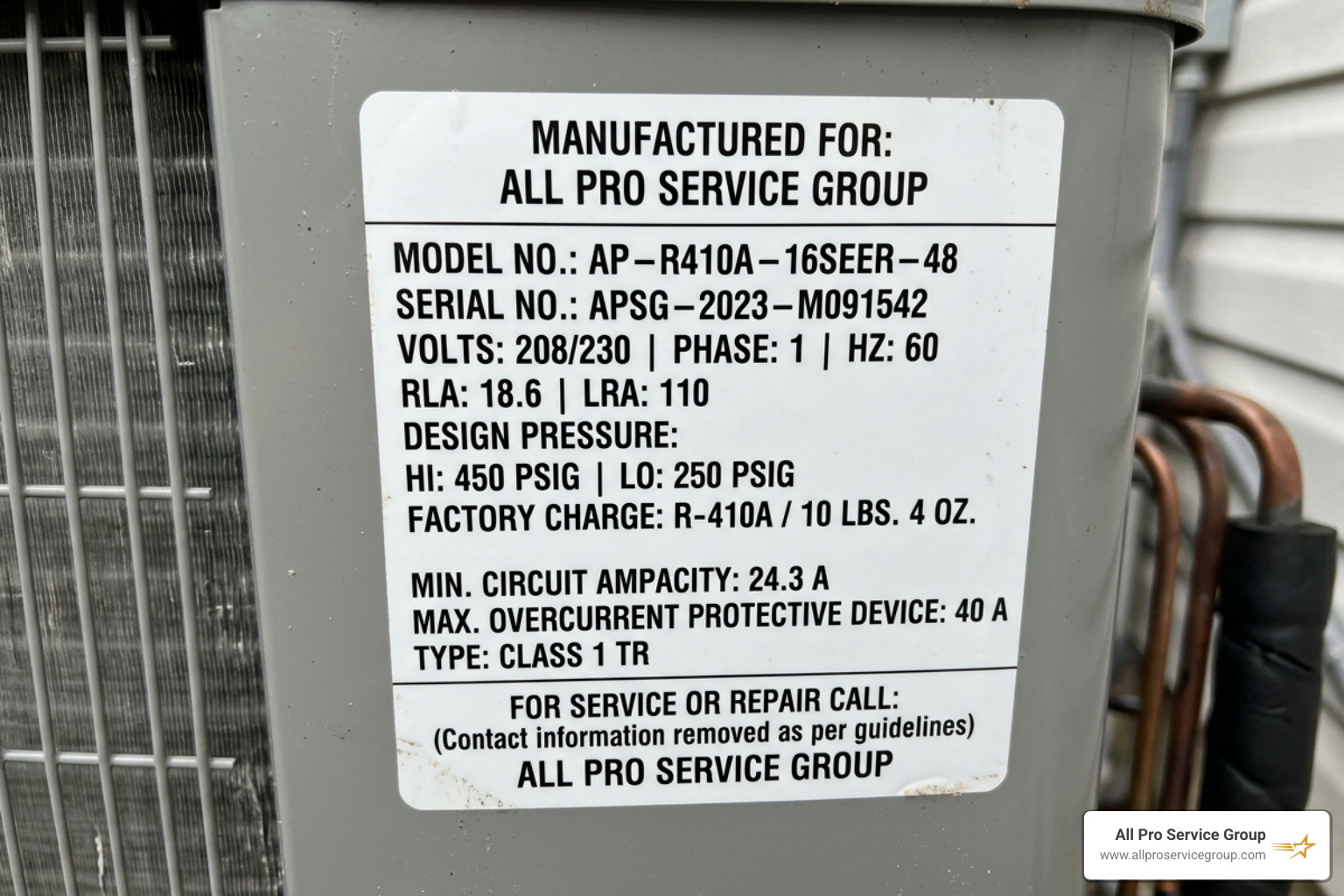
To find the correct part, locate the model number and serial number of your air conditioning unit. This information is typically printed on a metal rating plate on the side of the cabinet. Additionally, look for the part number printed directly on the circuit board itself.
For room air conditioners and smaller units, you can easily source genuine OEM replacement parts online using these specific model identifiers:
- For Frigidaire window or wall units, the Frigidaire Air Conditioner Control Panel comes with the necessary overlay to restore both cosmetic appeal and physical button functionality.
- If you are servicing a GE built-in, cool-only room air conditioner, the GE Air Conditioner Control Panel is designed specifically to slide directly into the original housing for a perfect fit.
Always verify compatibility with your specific model number before purchasing to ensure the wire harnesses and electrical ratings match perfectly.
Step-by-Step Guide to AC Control Panel Replacement
Replacing a residential or room AC control board is a highly precise task. Because you will be working around lethal voltages, safety must be your absolute top priority.
Required Tools and Equipment:
- Screwdrivers (magnetic tip Phillips and flathead)
- Nut drivers (typically 1/4-inch and 5/16-inch)
- Non-contact voltage tester
- Digital multimeter
- Needle-nose pliers
- Wire labels or masking tape
- A smartphone (for taking photos)
The Replacement Process:
- Disconnect All Power: Locate your home's main electrical panel and switch off the circuit breaker dedicated to your HVAC indoor unit. Additionally, pull the outdoor disconnect plug for the condenser.
- Verify the Power is Off: Use a non-contact voltage tester inside the air handler cabinet to confirm there is absolutely no electrical current running to the control board. Never skip this step.
- Document the Original Wiring: Take several clear, high-resolution photos of the old control board from different angles. Every wire is color-coded and connected to a specific terminal (such as R, G, Y, W, and C). Label each wire with masking tape corresponding to its terminal designation.
- Disconnect the Wires: Gently remove the wire connectors from the terminals using needle-nose pliers. Pull from the connector itself, not the wire insulation, to avoid breaking the copper strands.
- Remove the Old Board: Unscrew the mounting screws or squeeze the plastic standoff clips securing the board to the blower housing. Carefully lift the board out.
- Install the New Board: Align the new control board with the mounting holes or plastic standoffs and secure it in place.
- Reconnect the Wiring: Using your photos and labels as a guide, press each wire connector firmly onto its corresponding terminal on the new board. Double-check that every connection is tight and secure.
- Restore Power and Test: Reinstall the cabinet blower door (many units have a safety switch that prevents operation if the door is off). Turn the circuit breakers back on, set your thermostat to cool, and verify that the system starts up and runs through a complete cooling cycle smoothly.
Cost Breakdown: DIY vs. Professional Installation
When deciding whether to tackle an ac control panel replacement yourself or call in a professional, cost is often the deciding factor. While DIYing saves on labor, a misdiagnosis or incorrect wiring can lead to far more expensive damage to your compressor or blower motor.
Here is a realistic look at the average costs you can expect:
| Expense Category | DIY Cost Range | Professional Cost Range |
|---|---|---|
| Diagnostic Fee | $0 (Your own time) | $80 – $150 |
| Replacement Part (Board) | $150 – $380 | $300 – $450 (Includes contractor markup) |
| Labor & Installation | $0 | $107 – $157 |
| Specialized Tools Needed | $20 – $50 (Multimeter, tester) | Included |
| Total Estimated Cost | $170 – $430 | $473 – $523 |
Note: Industry data shows the national average cost for a professional HVAC Electronic Control Module Replacement ranges from $473 to $523. Labor costs typically run between $107 and $157, while the replacement parts themselves average around $366.
If you are trying to budget for an unexpected system breakdown, you can learn more about standard service rates and what to expect by reviewing our breakdown of AC Service Charges Near Me.
Frequently Asked Questions about AC Control Boards
How long does it take to replace an AC control board?
For an experienced HVAC technician, a standard residential AC control board replacement typically takes between 30 to 60 minutes. This includes verifying the power is disconnected, swapping the board, and testing the system. For a DIYer, the process usually takes 1 to 2 hours because of the extra time needed to carefully label every wire and double-check connections.
Can I replace an AC control board myself?
Yes, a homeowner with intermediate DIY skills and a solid understanding of electrical safety can replace an AC control board. However, because these systems handle high voltage (120V to 240V) and complex low-voltage control circuits, any mistake can ruin the new board or damage other system components. If you are uncomfortable reading wiring diagrams or working with electrical testers, we strongly recommend calling a licensed professional.
How do I know if the issue is the control board or the thermostat?
You can isolate the issue by performing a simple bypass test at the furnace or air handler. By safely jumping the "R" (power) terminal to the "Y" (cooling) terminal on the control board with a small piece of insulated wire, you bypass the thermostat entirely. If the AC turns on when jumped but won't turn on via the thermostat, the issue lies in your thermostat or the thermostat wiring — not the control board.
Conclusion
A malfunctioning AC control board can completely paralyze your home's cooling system, leaving you stranded in the Utah heat. Whether you choose to source your own OEM part for a quick room unit repair or need a complete whole-house system diagnostic, understanding how your control board functions is the first step toward a successful fix.
If you are located in the Greater Salt Lake Area — including Salt Lake City, Sandy, West Jordan, South Jordan, Provo, Park City, or Ogden — and would prefer to leave the complex wiring and high-voltage diagnostics to the experts, we are here to help.
All Pro Service Group has provided dependable, "Gephardt Approved" heating, air, plumbing, and electrical services since 2008. Our certified technicians can quickly diagnose your system, perform a safe ac control panel replacement, and get your home back to a comfortable temperature in no time.
Ready to get your air conditioner running perfectly again? Contact us today to schedule your expert Air Conditioner Repair!