
The Ultimate Guide to Power Socket Switch Wiring and Installation
Why 13A Switch Socket Outlet Wiring Is Critical to Get Right
13A switch socket outlet wiring is one of the most common electrical installation tasks in residential and light commercial settings — and one of the most important to do correctly.
Here's a quick overview of the key facts:
| Topic | Key Detail |
|---|---|
| Standard | BS 1363-2:2023 |
| Cable size | 2.5mm² Cu/PVC for Line, Neutral, and Earth |
| Ring circuit protection | 32A MCB, covers up to 100 sq. meters |
| Radial circuit protection | 20A MCB, covers up to 20 sq. meters |
| Back box minimum depth | 25mm |
| Earth fault loop impedance (Zs) | Must be below 1.1 ohms, or use a 30mA RCCB |
| Spurs allowed | One spur per socket or junction box |
A loose connection, the wrong cable size, or a missed earth test can turn a simple socket installation into a serious fire or shock hazard. Getting the wiring right matters — both for safety and for code compliance.
I'm Gary Leany, and through my work at All Pro Service Group, I've seen how improper 13A switch socket outlet wiring leads to costly repairs and dangerous situations. In this guide, I'll walk you through everything you need to know to do this job safely and correctly.
Understanding 13a Switch Socket Outlet Wiring Standards
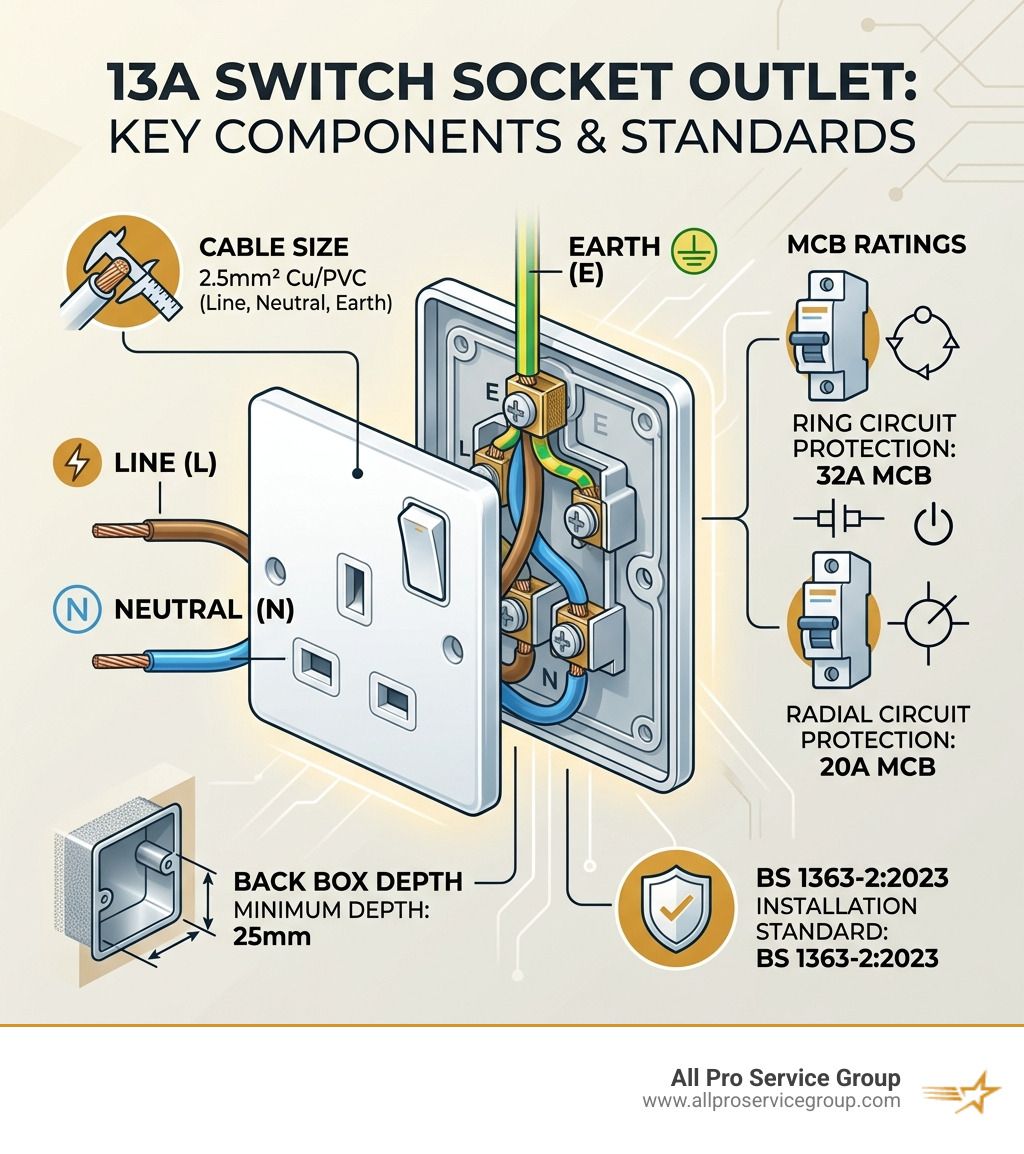
When we talk about 13a switch socket outlet wiring, we aren't just talking about connecting a few colored wires and hoping for the best. In electrical engineering, precision is everything. The primary benchmark for these installations is the BS 1363-2:2023 Specification , which is the latest standard released in June 2023. This 98-page document outlines every tiny detail of how a 13A socket should be constructed, tested, and installed to ensure it can handle 230V AC at a 50Hz frequency without breaking a sweat.
One of the most important technical requirements is the terminal capacity. A standard SINGLE 13A SWITCHED SOCKET must have a terminal capacity large enough to hold up to four 2.5mm² conductors. This is vital because, in a ring circuit, you’ll often have two cables entering the socket and potentially a third for a spur. If the terminals are too small, you end up with "bird-nesting" wires that are prone to coming loose and causing arcs—which is a fancy word for "scary electrical sparks that cause fires."
Key Components of 13a Switch Socket Outlet Wiring
To get the job done right, you need to know your players. Every 13a switch socket outlet wiring setup involves three main conductors:
- Phase (L): Usually brown (in modern UK/standard wiring), this is the "hot" wire that carries the current to the appliance.
- Neutral (N): Usually blue, this completes the circuit by carrying the current back to the source.
- Earth (E): Usually green and yellow striped, this is your safety net. It provides a path for electricity to flow safely to the ground if there’s a fault.
We always use 2.5mm² Cu/PVC (Copper with PVC insulation) cable for these circuits. This cable size is the industry standard because it balances flexibility with the ability to carry high current without overheating. You’ll also need a back box—the plastic or metal box that sits inside the wall. For a standard 13A socket, we recommend a minimum depth of 25mm to allow enough room for the wires to sit comfortably without being crushed. If you're dealing with older homes in the Greater Salt Lake area that have shallow boxes or frayed wires, you might want to look into our wiring & rewiring services to bring things up to modern safety codes.
Circuit Protection and MCB Ratings
Your wiring is only as safe as the breaker protecting it. In your distribution board (the "breaker box"), each circuit is governed by a Miniature Circuit Breaker (MCB).
- Ring Circuits: These are protected by a 32A MCB. Because the power travels in a loop, the load is shared, allowing for a higher amperage.
- Radial Circuits: These are typically protected by a 20A MCB.
- RCCB Protection: Modern standards often require a 30mA Residual Current Circuit Breaker (RCCB). This device is incredibly sensitive; it can detect a tiny leak of electricity (like if someone touches a live wire) and shut off the power in milliseconds.
If you aren't sure if your current panel can handle these loads, our team at All Pro Service Group provides comprehensive Electrical Services Salt Lake to ensure your home's "nervous system" is robust and ready for 2026's high-tech appliances.
| Feature | Ring Final Circuit | Radial Circuit |
|---|---|---|
| MCB Rating | 32 Amp | 20 Amp |
| Cable Size | 2.5mm² | 2.5mm |
| Max Floor Area | 100 m² | 20 m² |
| Circuit Path | Loop (returns to DB) | Single line (ends at last socket) |
Step-by-Step Guide to Wiring Ring and Radial Circuits
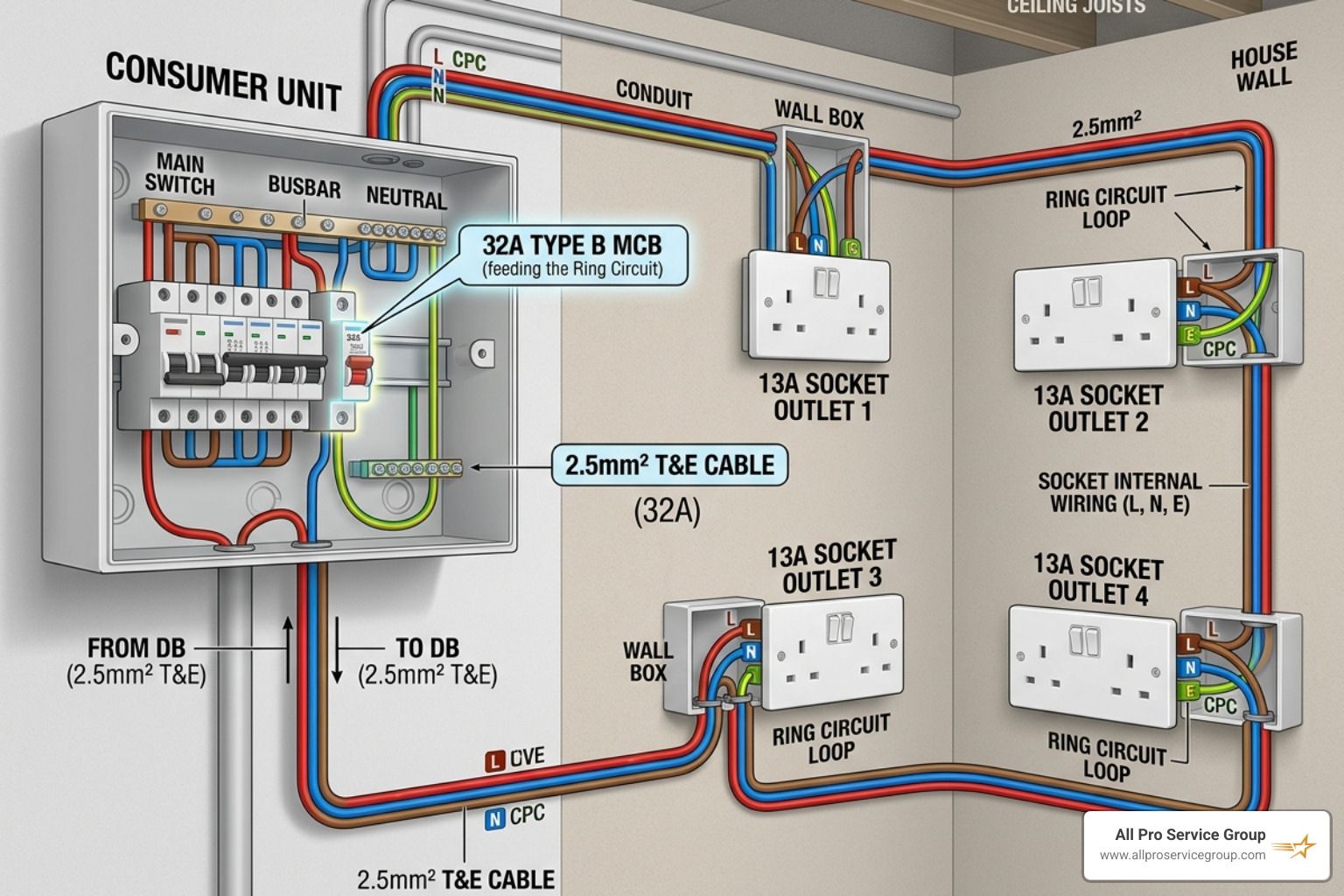
Understanding the difference between a ring and a radial circuit is the first step in Electrical Wiring and installation of 13A Socket Outlet.
A Ring Final Circuit is a bit of a British classic. It starts at the distribution board, visits every socket in a "daisy-chain" fashion, and then—here’s the kicker—returns to the same breaker in the distribution board. This creates a loop. This design allows you to cover a massive 100 square meters of floor area because the current has two paths to reach any given socket.
A Radial Circuit, on the other hand, is a straight line. It starts at the board, goes to the first socket, then the second, and ends at the last one. Because there is only one path for the electricity, we limit these to 20 square meters of floor area to prevent the cable from overheating.
How to Safely Isolate Power Before Installation
Before you even touch a screwdriver, you must ensure the power is dead. We use a process called "Safe Isolation."
- Identify the circuit: Find the correct MCB in your panel.
- Switch it off: Flip the breaker to the 'OFF' position.
- Lock it off: Use a lock-off kit to prevent someone else from accidentally flipping it back on while you're working.
- Test, Test, Test: Use a calibrated voltage tester on a known live source first to make sure the tester works, then test the socket you're working on. Finally, test the tester again on the live source. This "Proving Unit" method is the only way to be 100% sure you won't get a nasty surprise.
If the thought of opening your electrical panel makes your palms sweaty, don't worry—that's what we're here for. We handle Outlet and Switch Installation every day across West Valley City and Provo, ensuring everything is locked down and safe.
Executing the 13a Switch Socket Outlet Wiring Process
Once the power is off, it’s time for the "hands-on" part of 13a switch socket outlet wiring.
- Prepare the Cables: Strip back about 62mm of the outer PVC sheath. Be careful not to nick the inner core insulation! Then, strip about 12mm of the insulation from the copper cores of the Brown (Line) and Blue (Neutral) wires.
- The Earth Wire: Don't forget to slide some green/yellow Earth sleeving over the bare copper earth wire.
- Terminal Connections: Insert the wires into the correct terminals (L for Brown, N for Blue, E for Earth).
- Tighten and Wrap: Tighten the terminal screws firmly. A pro tip we use at All Pro Service Group is to wrap the wire clockwise around the screw if it’s a screw-and-washer type terminal; this ensures that as you tighten the screw, it pulls the wire tighter rather than pushing it out.
- The "Gently" Rule: When pushing the socket back into the box, do it gently. 2.5mm² wires are stiff and can easily pop out of the terminals if you force them. Double-check the tightness one last time before the final screw-in.
Adding Spurs and Ensuring Circuit Safety
Sometimes you just need one extra plug for a new lamp or a TV. This is where a "spur" comes in. A spur is essentially an offshoot from an existing ring or radial circuit. According to Fitting 13 A socket-outlets , you can add a spur by connecting it directly to an existing socket's terminals or by using a junction box.
However, there are strict rules:
- The One-Spur Limit: You are only allowed to run one spur from any single socket or junction box. Trying to run a "spur off a spur" is a major code violation and can easily overload the cable.
- Voltage Drop: Electricity loses "pressure" as it travels through long wires. We must ensure the voltage drop doesn't exceed 10% of the supply voltage. If your cable runs are too long, your appliances might not work correctly, or the wires could get hot.
Post-Installation Testing and Compliance
You aren't finished until you've tested your work with more than just a plug-in lamp. Professional electricians use a Multi-Function Tester (MFT) to check the Earth Fault Loop Impedance (Zs).
For a 13A socket spur, the Zs impedance should ideally be below 1.1 ohms. If the resistance is higher than that, the circuit breaker might not trip fast enough during a fault. If you can't get the impedance down, the circuit must be protected by a 30mA RCCB. This is a non-negotiable safety requirement. If your home's electrical panel is an older model that doesn't support RCCBs, it might be time for Electrical Panel Upgrades to keep your family safe.
Common Installation Practices for Conduits and Boxes
In many Utah homes, especially in areas like Park City or West Jordan, we see a mix of installation styles.
- PVC Conduits: Great for residential walls; they protect the cable and make future rewiring easier.
- GI (Galvanized Iron) Boxes: Often used in industrial settings or garages where the socket might take a physical beating.
- Knockout Blanking: If you remove a "knockout" (the little metal or plastic circle) in the back box but don't use it, you must plug it with a blanking grommet. This prevents dust and—more importantly—spiders and mice from getting into your electrical connections.
Frequently Asked Questions about 13A Socket Wiring
What is the maximum floor area for a 13A ring circuit?
A standard ring final circuit using 2.5mm² cable and protected by a 32A MCB can cover a maximum floor area of 100 square meters. This is roughly the size of a large apartment or a significant portion of a house floor. This limit exists to ensure that the load is distributed evenly and that the cables don't overheat under heavy use.
Can I add more than one spur to a single socket?
No. Safety regulations are very clear: only one spur is allowed per socket or junction box. If you need more outlets, you should ideally extend the ring circuit itself rather than adding multiple spurs, which can lead to localized overloading.
What size cable is required for a 13A switched socket?
The standard requirement is 2.5mm² Cu/PVC cable. This applies to the Line, Neutral, and Earth conductors. While 1.5mm² is often used for lighting, it is not thick enough to safely carry the current required for power sockets, especially when high-draw appliances like kettles or heaters are involved.
Conclusion
Mastering 13a switch socket outlet wiring is about more than just making a light turn on; it's about ensuring your home remains a safe haven. From understanding the BS 1363-2:2023 standards to executing the perfect ring circuit, every detail matters.
At All Pro Service Group, we’ve been serving the Greater Salt Lake Valley since 2008. Whether you’re in Ogden, South Jordan, or Salt Lake City, our "Gephardt Approved" experts are available 24/7 to help with everything from a simple socket replacement to a full home rewire. We pride ourselves on dependable repair, upfront pricing, and the kind of customer service that makes you feel like family.
Don't leave your home's safety to chance. If you’re unsure about your wiring or just want the peace of mind that comes with a professional touch, we're here for you.
Schedule your professional outlet and switch installation today