Why Commercial Gas Range Repairs Keep Your Kitchen Running
Commercial gas range repairs are one of the most critical maintenance needs in any professional kitchen. When a range goes down, food stops moving — and so does revenue.
Here's a quick overview of what you need to know:
| Topic | Quick Answer |
|---|---|
| Most common problems | Yellow flames, burners not igniting, pilot light failures, gas odors |
| When to call a pro | Immediately for gas smells; promptly for ignition or heat issues |
| Average repair cost | Around $627 per service visit |
| First-time fix rate | 91% of hot side equipment issues are resolved in a single visit |
| Preventative maintenance | Clean burners daily; schedule professional inspections annually |
Commercial gas ranges run hard — often 10 to 16 hours a day, six or seven days a week. That kind of constant use puts serious strain on burners, igniters, valves, and gas lines. Small problems like a clogged burner port or a drifting thermostat can quietly grow into bigger, costlier failures if left unchecked.
This guide walks you through everything from spotting early warning signs to deciding whether to repair or replace your equipment.
I'm Gary, owner of All Pro Service Group, and I've spent years helping businesses in the Greater Salt Lake Valley with dependable commercial gas range repairs and equipment service. Let's make sure your kitchen stays safe, efficient, and running at full capacity.
Recognizing the Signs You Need Commercial Gas Range Repairs
In the heat of a lunch rush, it is easy to overlook a burner that is acting a little "fussy." However, your equipment usually tries to tell you it is struggling long before it completely quits. Recognizing these red flags early can save you from an emergency service call on a Saturday night.
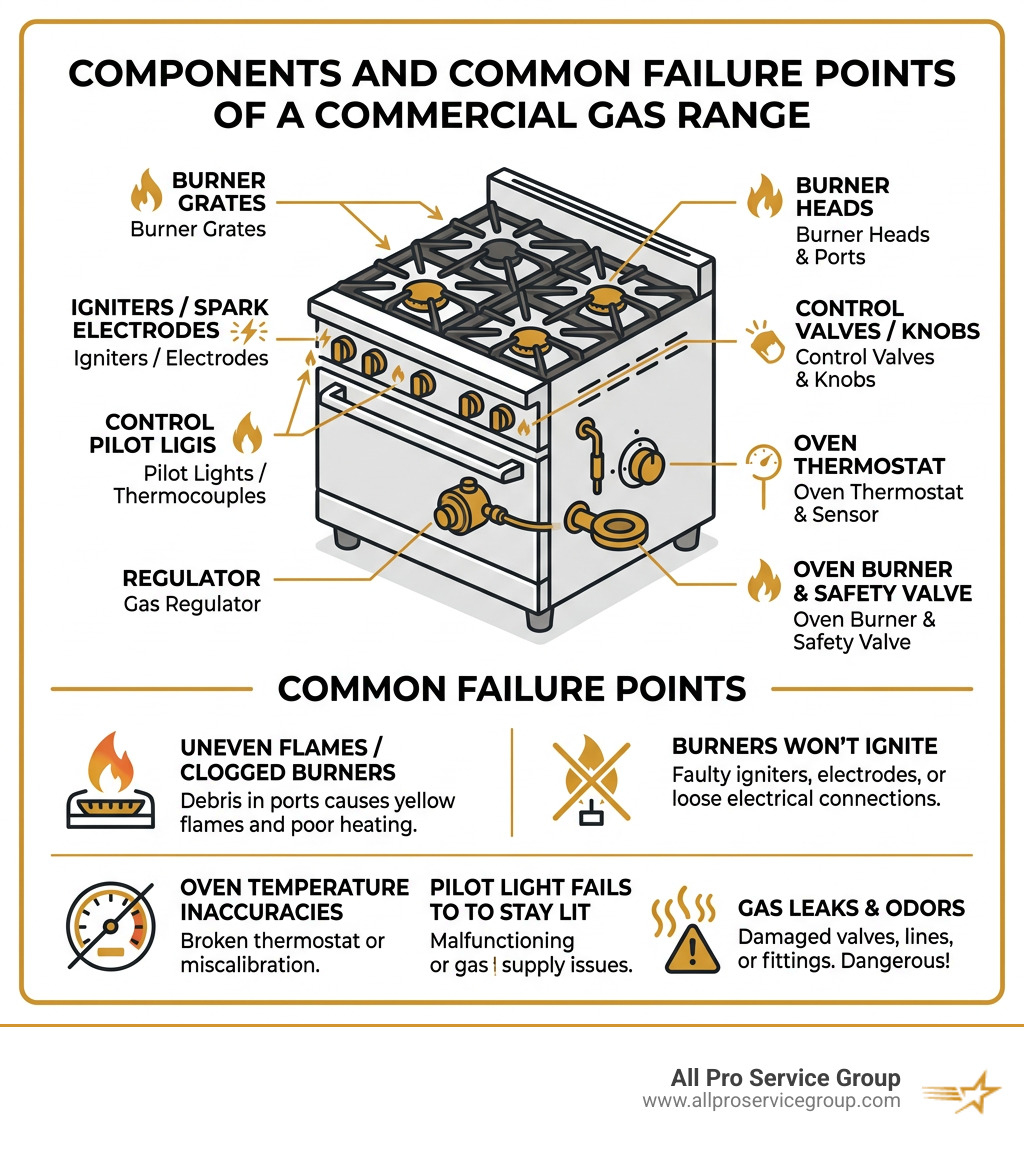
One of the most obvious signs is a change in your burner's behavior. If you notice soot building up around the burners or on the bottom of your pots, that is a major warning. Soot is essentially unburned fuel, and it means your range is wasting gas and potentially creating a fire hazard. You might also hear a constant "clicking" sound that doesn't lead to an ignition, or notice that the oven is taking significantly longer to preheat than it used to.
Identifying Performance Red Flags
Performance issues often manifest as inconsistent results. If your head chef is complaining about "hot spots" or uneven cooking, it is rarely a recipe problem-it is usually an equipment problem. Cracked cooktops are another physical sign that shouldn't be ignored. While they might seem like a cosmetic issue, cracks can harbor bacteria and lead to structural failure under the weight of heavy stockpots.
Loose or "mushy" knobs are more than just an annoyance; they often indicate that the underlying gas valve is wearing out. If a knob doesn't provide a crisp "click" or firm resistance, it might not be fully closing or opening the gas line. For more detailed insights on these components, you can explore our specialized page on stove repair.
Understanding Flame Color and Gas Efficiency
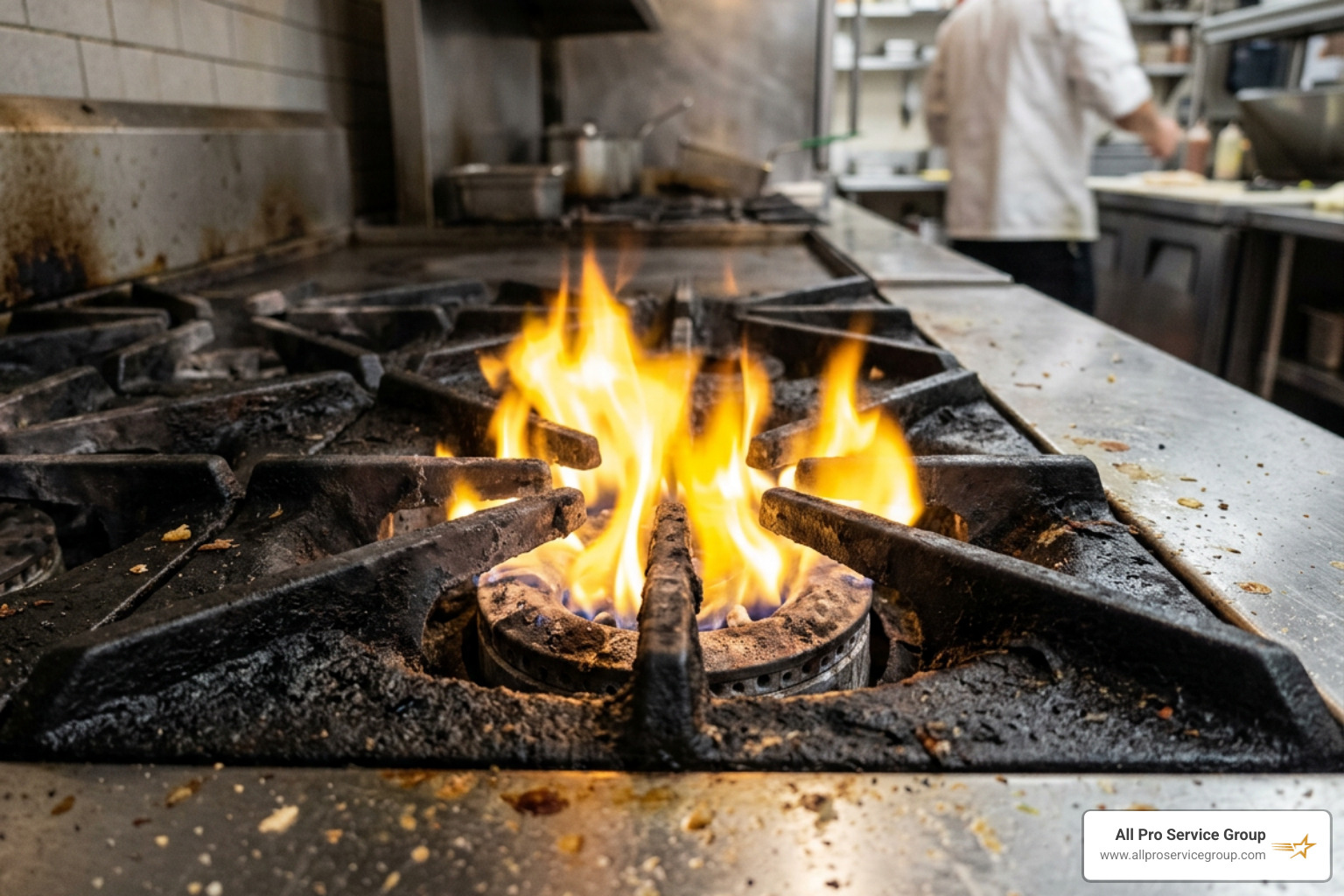
The color of your flame is the "check engine light" of your commercial range. A healthy, efficient flame should be crisp and blue. If you see yellow or orange flames, you have a problem with the oxygen-to-fuel mixture. For a general reference on safe combustion and gas appliance operation, the U.S. Consumer Product Safety Commission provides useful consumer safety guidance.
| Flame Color | Meaning | Action Required |
|---|---|---|
| Bright Blue | Proper combustion; efficient gas use. | None; keep cleaning regularly. |
| Yellow/Orange | Incomplete combustion; low oxygen. | Commercial gas range repairs needed; check air shutters. |
| Red Streaks | Often caused by dust or debris in the air. | Clean the burner heads and surrounding area. |
Yellow flames aren't just inefficient; they are dangerous. Incomplete combustion produces carbon monoxide, an odorless, colorless, and deadly gas. This usually happens because of a clogged burner nozzle, a misadjusted air shutter, or improper gas pressure. If your pots are turning black on the bottom, that yellow flame is the culprit. Professional commercial range repair and installation services can recalibrate these mixtures to ensure you aren't literally burning money through gas waste.
Troubleshooting Common Burner and Pilot Light Issues
When a burner refuses to light, the workflow of the entire kitchen suffers. Most of these issues stem from the pilot light or the ignition system. Because commercial ranges are exposed to constant grease, flour, and food spills, these small parts often get "gunked up."
Why Your Commercial Gas Range Repairs Might Start with the Pilot
The pilot light is the heart of a standing-pilot range. If the pilot won't stay lit, the burner won't fire. Common culprits include:
- Clogged Orifices: Tiny bits of debris or carbon buildup can block the gas flow to the pilot.
- Thermocouple Failure: This is a safety device that senses heat. If it doesn't "feel" the pilot flame, it shuts off the gas to prevent a leak. Grease buildup on the thermocouple is a frequent cause of failure.
- Drafts: In some kitchens, high-powered ventilation or open doors can create drafts that blow out the pilot. Installing draft shields can often solve this.
If you are struggling with a unit that won't hold a flame, our team provides expert oven repair to diagnose whether it’s a simple cleaning job or a component replacement.
Solving Ignition and Heat Distribution Problems
On newer models with electronic ignition, you might deal with spark igniters that have cracked porcelain or frayed wiring. If you hear the "click-click-click" but see no spark, the electrode is likely dirty or damaged.
Heat distribution issues are often tied to the burner tubes. Over time, the small holes (ports) in the burner tubes can become clogged with spilled sauces or boiled-over starches. This leads to an uneven flame—or no flame at all—on parts of the burner. Cleaning these with a stiff wire brush can help, but if the metal is corroded or "pitted," the tubes will need to be replaced. For a deeper dive into the mechanics of these systems, check out our guide on commercial appliance repair.
The Critical Role of Maintenance and Calibration
If you want your equipment to last 15 years instead of 5, maintenance is not optional. In the Greater Salt Lake area, we see many businesses lose thousands in revenue because they skipped the "small stuff."
Extending Equipment Lifespan Through Cleaning
Daily cleaning is your first line of defense. Grease is the enemy of gas components. When grease bakes onto a burner or a sensor, it acts as an insulator, causing the part to overheat and fail prematurely.
Daily Maintenance Checklist:
- Wipe down the exterior with a food-safe degreaser.
- Remove and wash grates in hot, soapy water.
- Empty and clean crumb trays (don't let them overflow!).
- Inspect burner ports for clogs and wipe away any visible spills.
Professional Calibration Standards
Even if your range looks clean, the internal "brain"—the thermostat and control valves—can drift over time. If your oven is set to 350°F but is actually running at 325°F, your bake times will be off, leading to food waste and unhappy customers.
We use high-precision digital thermometers to check the "swing" of your oven temperature. A healthy oven should stay within about 15 degrees of the set temperature. If the drift is higher, we can often recalibrate the thermostat rather than replacing it. This is a key part of our service for Hornos and specialized baking equipment.
Safety First: Handling Gas Leaks and DIY Risks
We cannot stress this enough: Gas is dangerous. While we love a "can-do" spirit in the kitchen, commercial gas range repairs involving gas lines or internal valves should never be a DIY project.
Responding to Gas Odors
Natural gas is naturally odorless, but utility companies add a "rotten egg" smell (mercaptan) so you can detect leaks. If you smell this:
- Don't search for the leak with a lighter or match.
- Don't turn any lights on or off, as a small spark could ignite the gas.
- Shut off the main gas valve if it is safe to reach.
- Evacuate the building immediately.
- Call the gas company or emergency services from outside.
Once the immediate danger is cleared, a professional service like ours can use electronic leak detectors to find the exact source, whether it’s a loose fitting, a cracked flex line, or a faulty safety valve.
The Dangers of Uncertified DIY Repairs
Attempting to fix a gas range yourself can lead to several problems:
- Voided Warranties: Most manufacturers require a licensed technician for repairs to keep the warranty valid.
- Fire Hazards: Improperly seated gaskets or valves can lead to "slow leaks" that build up over time.
- Liability: If a DIY repair leads to an accident, your insurance company may deny the claim because the work wasn't performed by a certified professional.
Repair vs. Replace: Managing Your R&M Budget
Every restaurant owner eventually faces the "fix it or toss it" dilemma. Because commercial ranges are a significant investment, you want to get every possible mile out of them, but there comes a point where a machine becomes a "money pit."
Analyzing the Numbers
Industry data shows the average invoice for hot side equipment service is approximately $627.33. While that might seem high for a single visit, consider that the first-time fix rate is an impressive 91%. This means that in the vast majority of cases, a professional technician can get you back up and running in a single trip.
When evaluating a repair, we recommend the "50% Rule." If the cost of the repair exceeds 50% of the cost of a new unit, and the equipment is more than halfway through its expected lifespan (usually 10-12 years for a range), it might be time to look at a replacement.
When to Invest in New Equipment
Replacement is usually the better option if:
- The frame or "chassis" of the range is heavily rusted or corroded.
- Parts for your specific model are no longer being manufactured.
- You are experiencing more than three major breakdowns in a single year.
- You want to upgrade to more energy-efficient technology to lower your monthly utility bills.
Investing in preventative maintenance is the best way to delay this expensive purchase. Regular check-ups catch the "small" $150 fixes before they turn into $2,000 disasters.
Frequently Asked Questions about Commercial Gas Range Repairs
How much does the average commercial range repair cost?
As mentioned, the average service invoice is around $627. However, this varies based on the parts needed. A simple thermocouple replacement is much cheaper than replacing a main gas manifold or a high-end digital control board.
Why is my gas range producing a yellow or orange flame?
This is usually caused by a lack of oxygen (incomplete combustion). It could be due to grease clogging the burner ports, dust in the air shutters, or a gas pressure issue. It should be addressed immediately to prevent carbon monoxide buildup.
How often should a commercial oven be professionally serviced?
For high-volume kitchens, we recommend a professional inspection and calibration every six months. At a minimum, you should have your gas connections and safety pilots checked once a year to ensure compliance with local fire codes.
Conclusion
Your commercial range is the workhorse of your business. In the Greater Salt Lake Area—from the busy streets of Salt Lake City to the growing communities in South Jordan and Provo—All Pro Service Group is here to ensure that workhorse never stops.
We are proud to be Gephardt Approved, a distinction that reflects our commitment to honesty, fair pricing, and expert skill. Whether you are dealing with a flickering pilot light in Park City or a full-scale equipment failure in West Valley City, our trained experts are available 24/7 to get your kitchen back in peak condition.
Don't let a small equipment hiccup turn into a lost shift. From dependable inspections to emergency fixes, we provide the peace of mind you need to focus on what you do best: serving great food to your customers.
Schedule your professional commercial oven repair today and let us handle the heat!