Can You Hydro Jet Clay Pipe? Here's What You Need to Know
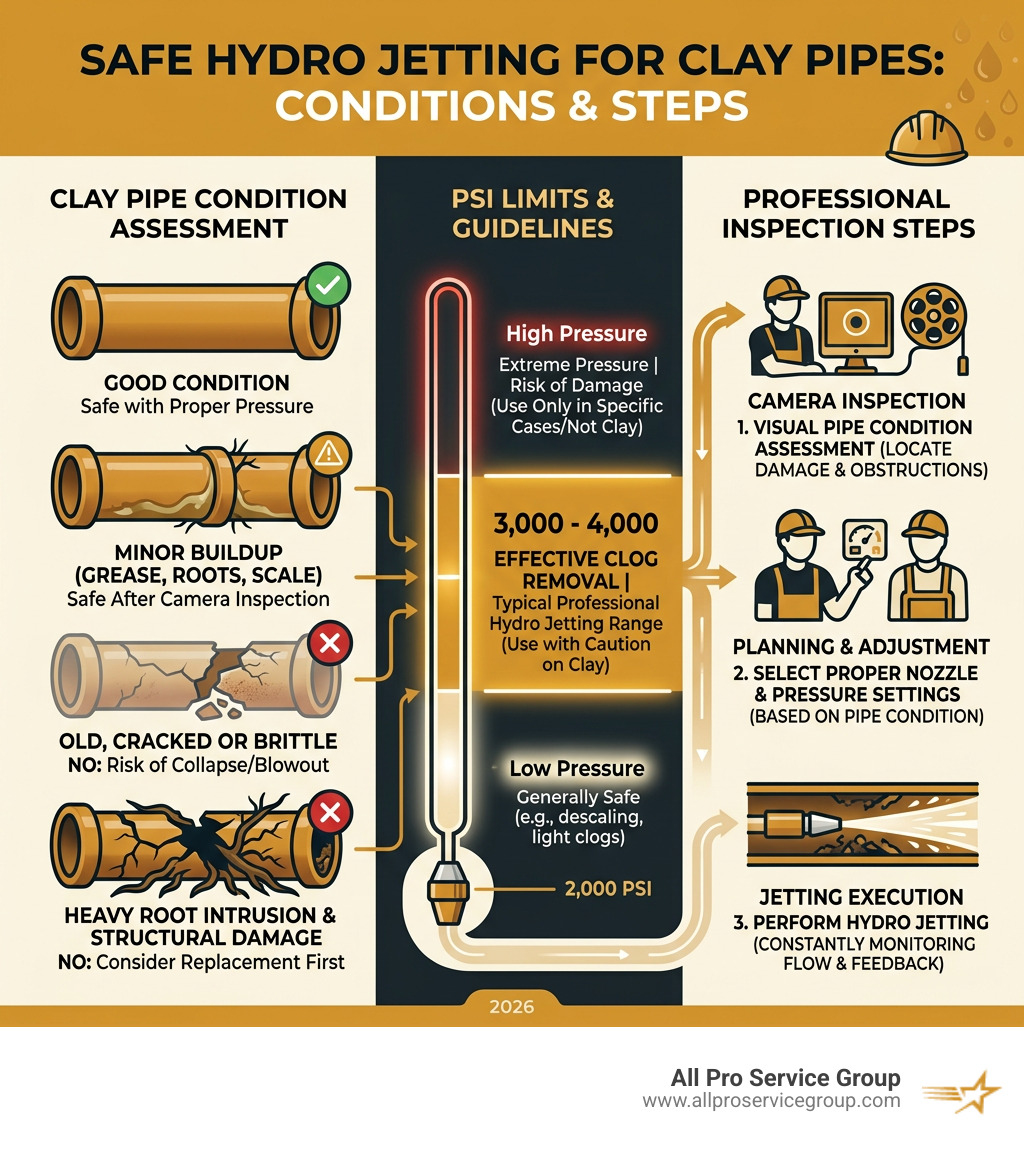
Can you hydro jet clay pipe? Yes — but only if the pipe is in good structural condition, and only when done by a professional using the right pressure settings.
Here's a quick breakdown:
| Condition | Safe to Hydro Jet? |
|---|---|
| Clay pipe with no cracks or joint damage | Yes, with proper pressure control |
| Clay pipe with minor buildup (grease, roots, scale) | Yes, after camera inspection |
| Old clay pipe with visible cracks or brittle sections | No — risk of collapse or blowout |
| Clay pipe with heavy root intrusion and structural damage | No — consider replacement first |
Clay pipes — also called vitrified clay pipe (VCP) — were the standard in American homes and municipal sewer systems for much of the 20th century. Many homes in the Greater Salt Lake area still have them underground today. When a drain backs up in one of these older systems, it's natural to wonder whether high-pressure water jetting is safe, or whether it could make things worse.
The answer isn't a simple yes or no. It depends on the age , condition , and structural integrity of the pipe — and getting that wrong can turn a clogged drain into a collapsed sewer line.
I'm Gary from All Pro Service Group, and I've worked on hundreds of older plumbing systems across the Salt Lake Valley — including plenty of homes where the question of whether can you hydro jet clay pipe was exactly the right one to ask before touching anything. In the sections below, I'll walk you through everything you need to know to make a safe, informed decision.
What is Hydro Jetting and How Does It Work?
Hydro jetting is essentially "power-washing" for the inside of your sewer lines. While a standard garden hose might tickle a clog, a professional hydro jetter uses a heavy-duty machine to blast water at pressures typically ranging from 3,000 to 4,000 PSI (pounds per square inch).
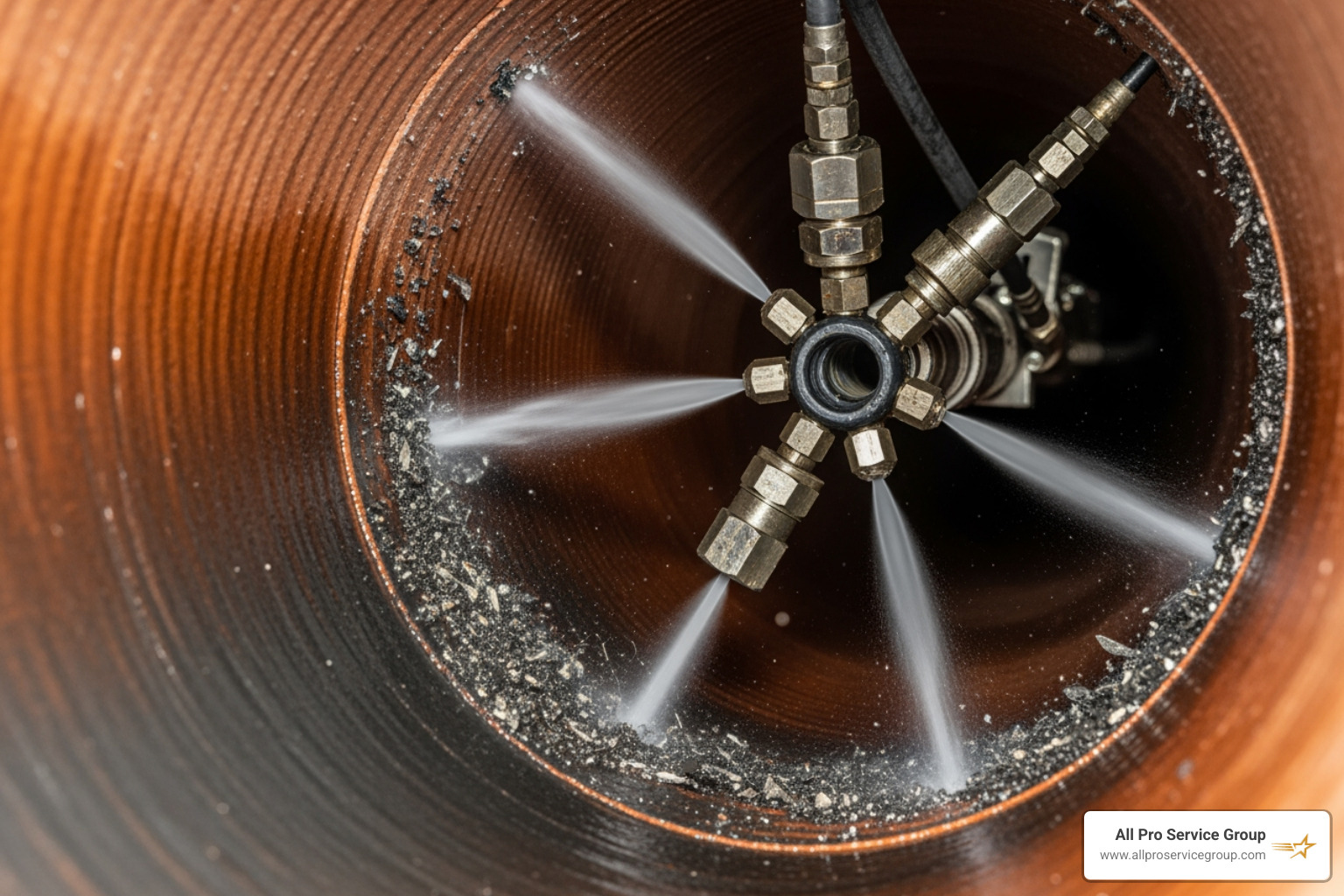
The magic happens at the nozzle. These specialized heads feature multi-directional jets: some blast forward to break up the blockage, while others angle backward to propel the hose through the pipe and scour the walls clean. This 360-degree cleaning action is incredibly effective at removing the "Big Three" of sewer obstructions:
- FOG (Fats, Oils, and Grease): The EPA reports that grease is responsible for roughly 47% of all reported sewer blockages. Hydro jetting emulsifies this sludge, washing it away rather than just poking a hole through it.
- Mineral Scale: In the Greater Salt Lake area, hard water can lead to calcium buildup on pipe walls. High-pressure water "shaves" this scale off, restoring the pipe's original diameter.
- Tree Roots: This is the most common issue for clay pipes. Over 90% of municipal sewer systems deal with root intrusion. Hydro jetting can cut through smaller roots like a warm knife through butter.
By using professional drain cleaning, you aren't just clearing a clog; you're restoring the pipe to nearly 95% of its original flow capacity.
Can You Hydro Jet Clay Pipe Safely?
The short answer is yes, but the long answer involves understanding what vitrified clay pipe (VCP) actually is. VCP is a ceramic material created by firing clay at temperatures exceeding 2,000°F. This process makes the pipe incredibly hard, inert, and resistant to chemicals and abrasion.
Because it is so hard, VCP is actually one of the most durable materials when it comes to high-pressure cleaning. In fact, scientific research on jetting pressures shows that new clay pipe can often withstand pressures up to 5,000 PSI with flow rates exceeding 125 gallons per minute (GPM) without suffering any damage.
However, the "vitrified" part of the name means the pipe is glass-like. While it is strong, it is also brittle. If the pipe has shifted due to soil movement or has been weakened by decades of root growth, that same high pressure could cause a structural failure.
Comparing Material Durability
Different pipe materials have different "breaking points." Here is how clay stacks up against modern alternatives:
| Pipe Material | Safe Stationary Pressure (120s) | Safe Rotating Pressure | Max Recommended PSI |
|---|---|---|---|
| Vitrified Clay (VCP) | 2,500 PSI | 4,000 - 6,000 PSI | 7,000 PSI (150° jet) |
| PVC (Plastic) | 1,500 PSI | 4,000 PSI | 10,000 PSI (Rotating) |
| HDPE | 2,000 PSI | 4,500 PSI | 7,000 PSI |
Assessing Structural Integrity: Can You Hydro Jet Clay Pipe Without a Camera?
We never recommend hydro jetting a clay pipe without a sewer camera inspection first. Because clay pipes are installed in sections (usually 2 to 3 feet long), they have many joints. Over time, these joints can "offset" or separate.
A camera allows us to see:
- Cracks and Fractures: If the pipe is already cracked, 4,000 PSI of water will enter that crack and likely shatter the section.
- Joint Condition: We need to ensure the high-pressure water won't blast out the old mortar or rubber gaskets connecting the segments.
- Root Entry Points: If roots have already destroyed the structural integrity of a joint, jetting might "blow out" the surrounding soil, leading to a sinkhole.
Safe Pressure Limits and Jet Angles for Clay
To safely answer the question can you hydro jet clay pipe, a technician must calibrate their equipment. Research indicates that a stationary jet (one that stays in one spot) at 3,000 PSI can begin damaging clay pipe in as little as 60 seconds.
To prevent this, we use rotating nozzles. By keeping the water in constant motion, we prevent the "drilling" effect of a stationary stream. Furthermore, the angle of the jet matters. A 90-degree jet (hitting the wall directly) is much more aggressive than a 150-degree jet (hitting at a shallow angle). For older clay lines, we often use shallower angles and higher flow rates to flush out debris safely.
Hydro Jetting vs. Snaking for Clay Pipes
In the past, the go-to tool was the plumber’s snake (mechanical rodding). While snaking is great for punching a hole through a solid clog to get the water moving, it has limitations—especially in clay.
- The "Hole" Problem: A snake or cable only clears a path as wide as the blade. It often leaves grease and small roots behind.
- The Damage Risk: Believe it or not, a heavy metal cable thrashing around inside a brittle clay pipe can sometimes cause more "impact" damage than water.
- The Permanent Solution: Hydro jetting cleans the pipe wall-to-wall. While snaking might get you through the week, hydro jetting can prevent another backup for years.
If you are dealing with recurring clogs, you likely need a more thorough plumbing repair or a deep cleaning. Given that root intrusion affects 90% of municipal systems, the "wall-to-wall" clean of a hydro jet is often the only way to truly clear the line.
Risks, Precautions, and When to Avoid Jetting
While hydro jetting is a miracle for most pipes, there are scenarios where it’s a recipe for disaster.
One major red flag is Orangeburg pipe. If your home was built between 1945 and 1970, you might have these pipes made of wood pulp and tar. Orangeburg pipes cannot handle any pressure and will disintegrate under a hydro jet. If we find Orangeburg during our inspection, we will immediately pivot to trenchless sewer repair or replacement.
When to Avoid the Jet: Can You Hydro Jet Clay Pipe if it's Brittle?
You should avoid hydro jetting if:
- The pipe is older than 50-60 years and shows signs of "scaling" or extreme brittleness.
- The camera shows a "collapsed" section. Jetting a collapsed pipe will only wash away the dirt holding the remaining structure together.
- There are massive root "balls" that have already displaced the pipe. In these cases, the pipe is no longer a pipe; it's a series of ceramic shards held together by roots.
In these cases, we offer a full range of plumbing services to replace or reline the damaged section.
Essential Precautions for Professional Jetting
When we perform hydro jetting in the Salt Lake City area, we follow strict safety protocols:
- Centralizers: We use "skids" or centralizers to keep the nozzle in the middle of the pipe. This prevents the nozzle from dragging along the bottom (called "catfishing"), which can cause uneven wear.
- Downstream Traps: We often install a debris trap or vacuum at the downstream manhole. This ensures that the roots and grease we blast loose don't just clog up the city's main line or cause a backup elsewhere.
- Upstream Cleaning: We always jet from the lowest point moving "upstream." This allows the dislodged debris to flow away with gravity rather than being pushed deeper into the house.
Frequently Asked Questions about Hydro Jetting Clay Pipes
How often should clay pipes be hydro jetted for maintenance?
For most homes in Utah with older clay lines, a proactive cleaning every 18 to 24 months is ideal. If you have large trees near your sewer line, a yearly "root pruning" with a hydro jet can prevent emergency backups and extend the life of your pipes significantly.
Will hydro jetting damage my old clay sewer joints?
If the joints are healthy, no. However, if the mortar has crumbled away over the last 70 years, high pressure can sometimes push water into the surrounding soil. This is why the camera inspection is so critical—we adjust the PSI to a level that cleans the pipe without "blowing out" the joints.
Can hydro jetting remove heavy tree roots from clay lines?
Yes! Hydro jetting is one of the most effective ways to remove roots. For particularly stubborn roots, we use hydro-mechanical tools—nozzles with spinning blades powered by water pressure. We may also recommend a chemical root inhibitor after jetting to slow down their return.
Conclusion
So, can you hydro jet clay pipe? The answer is a resounding "yes," provided you have the right team behind the nozzle. At All Pro Service Group, we’ve been the "Gephardt Approved" choice for the Greater Salt Lake Area since 2008. We understand the unique challenges of Utah’s soil and the aging clay infrastructure in cities like Ogden, Provo, and Salt Lake City.
Don't let a stubborn clog turn into a flooded basement. Whether you need an emergency clear-out or a proactive maintenance check, our trained experts are available 24/7 to help.
Schedule professional drain cleaning today with All Pro Service Group and keep your sewer lines flowing clear!